Deep Work for Software Developers: The Cognitive Math, Newport's Framework, and What Actually Works
Programmers take 10–15 minutes to resume editing code after an interruption — and the widely cited "23-minute" recovery figure has no peer-reviewed source. What the actual evidence says about deep work for software developers, and how Newport's four philosophies map to a working calendar.
The five-minute Slack ping does not actually cost five minutes. After an interruption, programmers take an average of 10–15 minutes to start editing code again (Parnin's data, summarized in Programmer, Interrupted, Game Developer 2013, based on Parnin & Rugaber's Software Quality Journal 19(1), 2011). On top of that, Sophie Leroy's attention-residue effect kicks in — when a prior task is left unfinished and you are forced to switch, part of your attention stays bound to the prior task and degrades performance on whatever comes next (Leroy 2009, Organizational Behavior and Human Decision Processes). By the third or fourth ping in an afternoon, a developer's day is structurally a sequence of partial cognitive recoveries — not a sequence of completed thoughts.
That math is the case for protecting deep work. It is also the case for being honest about which "deep work" advice survives contact with software engineering reality. Cal Newport's framework is the most cited; large parts of it apply directly. Other parts — the monastic philosophy, the scheduling neatness, the implicit promise of universal applicability — fit awkwardly to a job that includes PR review, on-call rotation, and Slack-default communication.
What Deep Work for Software Developers Actually Means in Code
Cal Newport defines deep work in Deep Work: Rules for Focused Success in a Distracted World (Grand Central, 2016, p. 3) as follows:
"Professional activities performed in a state of distraction-free concentration that push your cognitive capabilities to their limit. These efforts create new value, improve your skill, and are hard to replicate."
Newport is a computer-science professor at Georgetown. Deep Work is not a software-engineering book — most of his examples are academic researchers and writers, with Donald Knuth as the standard CS-adjacent figure cited for his focus practice. But the category Newport defines — cognitively demanding work that pushes your capabilities to their limit — covers the activities that drive most software value: system design, debugging mysterious behavior, novel-algorithm work, complex refactors, distributed-system reasoning. The category fits; the book just was not written specifically about it.
Not all developer work is deep work, and pretending otherwise leads to bad scheduling. An honest split:
Deep: first implementation of a feature, debugging an unknown failure mode, architectural decisions, complex refactors, novel-algorithm design, learning an unfamiliar codebase or framework.
Not deep (shallow): small PR reviews, Slack replies, standup, dependency bumps, typo fixes, copy-paste from a known pattern, status updates, calendar admin.
This split is not a value judgment. Shallow work is not bad work; it is different work. PR review is real, paid, professional output. The mistake is putting deep and shallow in the same time slot — which usually breaks both.
The Hidden Cost: Programmer Resumption Time
The most directly applicable interruption-cost data for software developers is Parnin and Rugaber's "Resumption Strategies for Interrupted Programming Tasks" (Software Quality Journal 19(1):5–34, 2011; originally an ICPC 2009 paper). The methodology — 85 programmers (73 Eclipse users, 12 Visual Studio), roughly 10,000 recorded programming sessions — is the closest thing to a representative sample of real-world programmer behavior in the literature.
Two abstract findings, verbatim. "Only 10% of the programming sessions have coding activity start in less than a minute" after resumption. "Only 7% of the programming sessions involve no navigation to other locations prior to editing." Translation: in 90 percent of sessions, the first minute back is spent rebuilding context, not writing code. In 93 percent, the developer has to navigate around the codebase to remember where they were.
Parnin's own follow-up summary in Game Developer's Programmer, Interrupted (2013) collapses the data into the often-quoted derived statistic: a programmer takes 10 to 15 minutes to start editing code after resuming an interrupted task. That number compounds when interruptions cluster. Two interruptions per hour means 20–30 minutes of pure resumption overhead per hour worked — leaving 30–40 minutes of actual editing time before the next break.
On top of resumption, Sophie Leroy's attention-residue research (Organizational Behavior and Human Decision Processes 109(2):168–181, 2009) describes a separate cost. When attention shifts from Task A to Task B before A is mentally complete, a residue of attention stays with A and degrades performance on B. Leroy's actual finding on time pressure is the opposite of the version that often gets repeated online: time pressure on Task A helps people disengage and improves Task B performance. Residue is largest when Task A is left genuinely unfinished — exactly what an interruption produces. That is the mechanism: a half-written PR plus a Slack ping equals a developer who is no longer fully in either task.
Combine the two effects and the actual cost of the casual "got a sec?" is closer to five minutes plus 10–15 minutes of resumption plus a slow-fading residue across the next task. Repeat three or four times in an afternoon and the structural shape of a developer's day is the sequence of partial recoveries described in the hook.
One myth worth retiring. The widely cited claim that it takes 23 minutes and 15 seconds to recover from an interruption — usually attributed to Gloria Mark at UC Irvine — has no verifiable peer-reviewed source. The 2023 fact-check at oberien.de reviewed Mark's published papers and found the number nowhere in the literature. It appears in interview transcripts and secondary write-ups; it is not in Mark, Gudith, and Klocke's 2008 CHI paper or in Mark's other major studies. The Parnin number — 10 to 15 minutes — is grounded in actual recorded programmer behavior. Use that one.
Why Interruptions Feel Cheaper Than They Are
Mark, Gudith, and Klocke's 2008 CHI paper, The Cost of Interrupted Work: More Speed and Stress, reports a counterintuitive primary finding: people who were interrupted completed their tasks faster than people who were not. The catch is in the abstract verbatim: "people compensate for interruptions by working faster, but this comes at a price: experiencing more stress, higher frustration, time pressure and effort."
That maps onto every developer's experience of a busy week. "Got the PR shipped despite all the Slack." True. "Brain feels destroyed." Also true. "Wonder why this team has burnout." The accumulated form of the previous two. Mark's finding explains why interruption-heavy environments do not always look unproductive in the short run — speed compensation hides the cost — but produce the chronic exhaustion and turnover patterns that show up in longer windows.
Microsoft's 2025 Work Trend Index, "Breaking down the infinite workday" measures the scale (31,000 knowledge workers across 31 markets, surveyed February–March 2025):
- "Employees are interrupted every 2 minutes during core work hours — 275 times a day — by meetings, emails, or chats."
- "Nearly half of employees (48%) — and more than half of leaders (52%) — say their work feels chaotic and fragmented."
- "Half (50%) of all meetings take place between 9–11 am and 1–3 pm — precisely when, as research shows, many people have a natural productivity spike in their day, due to their circadian rhythms."
Interrupted every two minutes during core hours is not a working condition; it is a baseline that prevents deep work from happening as a default. Deep work in this environment is not a habit you slip into when free time appears — it is a scheduling artifact you build deliberately, before the calendar fills.
Newport's Four Philosophies, Mapped to Developer Reality
In Part 2 of Deep Work, Newport presents four scheduling philosophies for integrating deep work into a professional life. Verbatim, with the standard short forms:
1. Monastic. "Maximize deep efforts by eliminating or radically minimizing shallow obligations." One high-level focus, almost nothing else.
2. Bimodal. "Divide your time, dedicating some clearly defined stretches to deep pursuits and leaving the rest open to everything else." Chunks at the level of weeks or months.
3. Rhythmic. Transform deep work into a simple regular habit — same window, every day. The point is to remove decisions about when to go deep.
4. Journalistic. "Fit in 30 minutes or an hour or two of deep work" wherever the schedule permits. The mode for irregular days.
Newport does not claim one philosophy is best — different schedules and roles fit different modes. The mapping below is not Newport's claim; it is an interpretation for the specific working-developer context:
Monastic — rarely fits. Possible for solo indie hackers or full-time open-source maintainers with no team obligations. Unrealistic for most working developers, who have PR review, code review, on-call rotation, and Slack-default expectations baked into the role.
Bimodal — occasionally fits. Conference weeks, quarterly planning offsites, hackathons, and the rare "head-down sprint" when a manager actively shields the team. Hard to sustain as the steady-state mode.
Rhythmic — the realistic default. A 90-minute deep block at the same time every day eliminates the daily decision about whether to focus. Calendar block, "Focus" label, notifications off. The Pomodoro technique sits inside this philosophy as a micro-rhythm — a 90-minute block decomposes naturally into four Pomodoro cycles.
Journalistic — the fallback. When schedule predictability collapses (on-call week, infant at home, cross-functional firefight), the fallback is to grab any 30-minute window that opens and use it. Less powerful than rhythmic, but real. Better than zero.
The recommended stack for most working developers: rhythmic as the default mode, journalistic as the fallback when a week breaks. Bimodal as the occasional structural change for genuinely deep stretches. Monastic mostly as a thought experiment.
A Working Developer's Deep Work Setup
Concrete is more useful than abstract. The setup below applies to most working-developer contexts — solo and team — and assumes the rhythmic-plus-journalistic stack from the previous section.
1. Time block (rhythmic). Microsoft's 2025 data puts 50% of meetings between 9–11 am and 1–3 pm, and frames those windows as "natural productivity spike... due to circadian rhythms." That creates a real trade-off:
Option A — meetings-avoidance priority. Place the 90-minute block in a low-meeting-density slot (for example 7:30–9, 11–12:30, or 3–4:30, depending on the company's actual pattern). Lowest collision probability with team scheduling.
Option B — cognitive-peak priority. Reserve a 90-minute window inside 9–11 or 1–3 and decline meeting requests there by default. Largest scheduling friction, but the strongest cognitive output.
The principle is to invert the team's meeting pattern to find the deep-work slot, then lock it on the calendar at the same time every day so the decision cost drops to zero. Calendar block, "Focus" label, notifications off, phone in another room.
2. Pomodoro to fill the 90 minutes. If 90 minutes of unbroken focus is too long to sustain in one push, split the block into four Pomodoro cycles (25 minutes work, 5 minutes break × 4 = 100 minutes — close enough). Twenty-five minutes is long enough to fully load working memory and short enough to keep the nervous-system reset cheap. The cognitive mechanism is in our post on the science behind the Pomodoro technique.
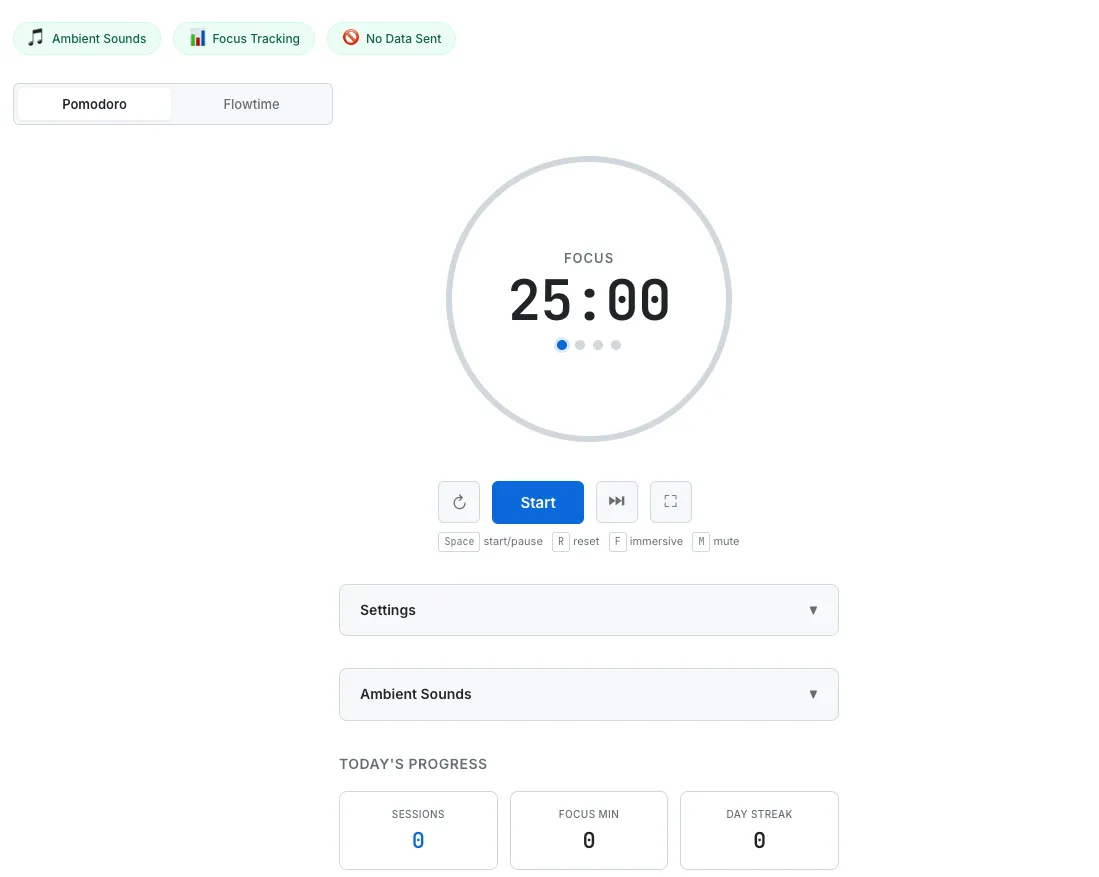
SudoTool's Pomodoro Timer — four 25-minute cycles compose a 90-minute deep work block compatible with the rhythmic philosophy.
3. Async-first communication. During the deep block, Slack, Teams, and email are muted by default. The team norm to set: "urgent enough to break focus equals a phone call." The deeper case for async-default communication as the precondition for deep work is in our guide to async vs sync communication for remote teams.
4. Treat meetings as expensive. A meeting's true cost is not the duration on the calendar — it is the destruction of two deep blocks (one before, one after) plus six engineers' worth of resumption time and residue. A six-person one-hour meeting consumes six hours of direct salary plus roughly 60–90 minutes of resumption overhead distributed across the participants. Run the precise number for your team with the meeting cost calculator; the framing case is in our true cost of meetings post.
5. Environment. Phone in another room or on Do Not Disturb. Browser windows narrowed to the work tabs only — no social, news, or messaging. IDE in focus mode (VS Code workbench.action.toggleZenMode; JetBrains Distraction Free Mode). Operating-system focus assist (macOS Focus, Windows Focus assist) tied to the calendar block so it activates automatically.
6. Self-tracking (optional). The SPACE framework from Forsgren, Storey, et al. (ACM Queue 19(1), 2021) defines five dimensions of developer productivity, of which the fifth — Efficiency and Flow — explicitly proposes individual-level metrics like uninterrupted focus time and time in flow state. A single week of recording the actual length of each deep block and the count of interruptions tends to expose the specific weak point in a personal schedule — usually a recurring meeting at the wrong time, a habit of checking Slack between Pomodoros, or a starting time that lines up with the morning standup.
When Deep Work Doesn't Work
Honest scope. Deep work is not a universal solution to every developer-productivity question, and the scheduling philosophies fail under predictable conditions.
Junior developer. Pairing, code review, and synchronous time with a mentor are the learning vehicle. Forcing pure deep work too early loses the learning curve itself. One 30–60-minute journalistic block per day is usually enough at this stage; the rest of the calendar should remain interactive.
On-call rotation. Pages and incident alerts will break any rhythmic block by definition. During an on-call week, drop rhythmic and operate in journalistic mode — grab the 30-minute windows that open between alerts, accept that nothing longer is reliable.
Production incidents and bug emergencies. A deep block is a plan, not a promise. When a real fire is burning, drop the block, work the incident, and reset rhythm afterward. The schedule serves the work, not the other way around.
Team-level dysfunction. If the team's culture is interruption-heavy by design, an individual cannot fix it from the bottom. The lever with the largest payoff is a team-level change — for example, every weekday 9–11 am marked meeting-free for the whole team, or async-default Slack response expectations. Bring it to a manager as a system change rather than fight the culture quietly.
Deep work is not a productivity hack. It is a deliberate trade-off between the cognitive shape of writing software and the scheduling shape of an interruption-default workplace — accepting fewer meetings, clearer "no"s, and protected calendar windows in return for reliable contact with the codebase mental model. Whether that trade-off makes sense depends on the role, the team, and the phase of work. The point is to choose deliberately, not by default.
This guide is general productivity guidance, not personalized career or HR advice. The empirical research cited (Parnin & Rugaber 2011, Leroy 2009, Mark, Gudith, & Klocke 2008, Forsgren et al. 2021, Microsoft Work Trend Index 2025) reflects specific samples and time periods. Software-developer roles, team structures, and on-call patterns vary widely; applying any of this to a specific team requires judgment. The Parnin "10–15 minutes" figure is a derived statistic from his follow-up summary; the 85-programmer / 10,000-session base data is from the published Software Quality Journal paper.
- Newport, Cal (2016) — Deep Work: Rules for Focused Success in a Distracted World. Grand Central Publishing. Author page.
- Parnin, C. & Rugaber, S. (2011) — Resumption strategies for interrupted programming tasks, Software Quality Journal 19(1):5–34, DOI 10.1007/s11219-010-9104-9 (originally ICPC 2009).
- Parnin, C. (2013) — Programmer, Interrupted, Game Developer (follow-up summary of the 2009/2011 data).
- Leroy, S. (2009) — Why is it so hard to do my work? The challenge of attention residue when switching between work tasks, Organizational Behavior and Human Decision Processes 109(2):168–181.
- Mark, G., Gudith, D., & Klocke, U. (2008) — The cost of interrupted work: more speed and stress, Proceedings of the SIGCHI Conference on Human Factors in Computing Systems (CHI '08), ACM, pp. 107–110.
- Forsgren, N., Storey, M.-A., Maddila, C., Zimmermann, T., Houck, B., & Butler, J. (2021) — The SPACE of Developer Productivity: There's more to it than you think, ACM Queue 19(1):20–48 (republished in Communications of the ACM).
- Microsoft Worklab (2025) — Breaking down the infinite workday, Work Trend Index 2025 Special Report (31,000 knowledge workers, 31 markets, Feb–March 2025).
- Oberien (2023) — Interruptions cost 23 minutes 15 seconds, right? (independent fact-check of the widely cited Mark figure).