The Science Behind the Pomodoro Technique: Why Timed Focus Actually Works
59% of workers can't focus for 30 minutes straight. The Pomodoro Technique is the simplest science-backed fix — here's why it works.
Microsoft's 2025 Work Trend Index — surveying 31,000 knowledge workers across 31 markets — measured the modern interruption baseline: employees are interrupted every 2 minutes during core work hours. Mark, Gudith, and Klocke's 2008 CHI paper The Cost of Interrupted Work documented the quiet price of that pattern: "people compensate for interruptions by working faster, but this comes at a price: experiencing more stress, higher frustration, time pressure and effort." (The widely cited "23 minutes 15 seconds" recovery figure attributed to Mark has no peer-reviewed source — see our multitasking myth post for the fact-check.) It's exactly the kind of environment the Pomodoro Technique was designed to push back against.
The result? Even in an 8-hour workday, the average knowledge worker spends fewer than 3 hours in genuine deep focus. The rest disappears into email, Slack notifications, meetings, and the mental recovery time between them. Rubinstein, Meyer & Evans (2001) in the Journal of Experimental Psychology: Human Perception and Performance established the underlying mechanism — every task switch carries a measurable time cost that scales with rule complexity. (The widely repeated "40% of productive time" figure attributed via APA to this paper actually comes from Meyer's interviews, not the published research; the cost mechanism is real, the round number is not from the paper itself.)
In the late 1980s, an Italian university student found a surprisingly simple solution. He grabbed a tomato-shaped kitchen timer and asked himself one question: "Can I focus for just 25 minutes?" His name was Francesco Cirillo, and that method became the Pomodoro Technique — a time management approach now used by over 2 million people worldwide.
This article isn't another how-to guide. It's about why the Pomodoro Technique works — backed by neuroscience research, cognitive psychology experiments, and real-world productivity data. By the end, you'll understand the science behind timed focus and how to use it to your advantage.
What Is the Pomodoro Technique?
The Pomodoro Technique is a time management method created by Francesco Cirillo in the late 1980s while he was a university student struggling to focus. "Pomodoro" is Italian for tomato — named after the tomato-shaped kitchen timer he used.
The method is simple:
- Pick one task to work on
- Set a timer for 25 minutes
- Work on that task — and only that task — until the timer rings
- Take a 5-minute break
- After 4 sessions, take a longer break of 15–30 minutes
Each 25-minute block is called one "Pomodoro." Cirillo refined the method over five years and began teaching it publicly in 1998. His free PDF guide was downloaded over 2 million times before he took it offline in 2013.
It sounds almost too simple to be effective. But that simplicity is the point. "Work on this project for 2 hours" feels overwhelming. "Focus for just 25 minutes" feels manageable. This psychological reframing is one of the most effective strategies for overcoming procrastination — you're not committing to finishing the task, just to starting it.
The Science of Timed Focus: Why the Pomodoro Technique Works
The Pomodoro Technique isn't effective just because "breaks feel nice." It aligns with how the human brain actually sustains attention — and what happens when it doesn't get rest.
Your focus naturally declines over time. Cognitive psychologists call this vigilance decrement — the well-documented phenomenon where performance on sustained attention tasks drops the longer you work. A 2023 study published in Frontiers in Cognition tested 262 people aged 7 to 85 and confirmed that attention performance degrades over time within a task. Research shows that as little as 10 minutes of cognitively demanding work can begin to induce mental fatigue.
But brief breaks prevent that decline. In 2011, Atsunori Ariga and Alejandro Lleras at the University of Illinois published a landmark study in Cognition. They had participants perform a repetitive computer task for 50 minutes. The group that received two brief mental switches during the task maintained their focus throughout. The control group — no breaks — showed the typical steady decline. The researchers explained this through "goal reactivation": briefly shifting your attention allows your brain to re-engage with the original goal as if it were fresh, preventing habituation.
Even elite performers have limits. K. Anders Ericsson's famous 1993 study in Psychological Review — the research behind the "10,000 hours" concept — found that world-class violinists practiced in sessions of about 60–90 minutes with breaks between them, and their total daily deliberate practice averaged about 3.5 to 4 hours. Beginners could sustain only about 15–20 minutes of full concentration. Beyond 4 hours per day, there was essentially no additional benefit. The takeaway: sustained, intense focus is inherently limited — even for the best in the world. Recovery between sessions matters as much as the practice itself.
Your brain has two thinking modes. Barbara Oakley, engineering professor and co-creator of Coursera's "Learning How to Learn" (one of the most popular online courses ever), popularized the concept of focused mode and diffuse mode. Focused mode is the concentrated, sequential, analytical thinking driven by the prefrontal cortex — what you use when working through a problem step by step. Diffuse mode is the relaxed, big-picture processing that happens when your mind wanders — connecting ideas across different brain regions. Effective learning requires alternating between both modes. The Pomodoro's 25-minute focus + 5-minute rest structure naturally facilitates this alternation.
What Happens in Your Brain During Breaks
Breaks aren't downtime. They're when your brain does some of its most important work.
Your brain replays what you just learned — at 20x speed. A 2021 study led by Leonardo G. Cohen at the National Institutes of Health, published in Cell Reports, had 33 volunteers learn to type a five-digit number sequence. Using magnetoencephalography (MEG), the researchers found that during short rest periods between practice blocks, the brain replayed the practiced sequence at approximately 20 times the speed of actual performance. And the frequency of this replay directly predicted how much the participants' skills improved. As Dr. Cohen put it: "Our results support the idea that wakeful rest plays just as important a role as practice in learning a new skill."
Your Default Mode Network activates. When you're not focused on an external task — when you're staring out the window, going for a walk, or daydreaming — your brain's Default Mode Network (DMN) lights up. This network is associated with big-picture thinking and creative insight. A 2024 study published in Brain (Oxford Academic) used direct cortical stimulation to establish a causal link between the DMN and creativity: disrupting DMN function reduced participants' ability to generate original, divergent responses. Pomodoro's 5-minute breaks create space for this network to operate — which is why your best ideas often come when you step away from the problem.
Spaced intervals build stronger long-term memory. A 2025 study in Cell Reports found that spaced learning increases the similarity of neural representations in the ventromedial prefrontal cortex (vmPFC), and these increases predict the behavioral benefits of spacing. In plain terms: studying in spaced intervals — like Pomodoro's 25-minute blocks with breaks between them — helps your brain consolidate information more effectively than cramming the same material in one continuous session.
The Real Cost of Not Taking Breaks
The numbers make the cost of continuous work painfully clear.
Interruptions and context switching. Mark, Gudith, and Klocke's 2008 CHI paper revealed a paradox: interrupted workers completed tasks faster, but the abstract verbatim records the price — "experiencing more stress, higher frustration, time pressure and effort." Speed goes up, well-being goes down. (The widely cited 23-minute recovery figure does not actually appear in this paper; see our multitasking myth post for the source-trace.)
Multitasking is a myth for 97.5% of people. A 2010 study by Watson and Strayer at the University of Utah, published in Psychonomic Bulletin & Review, tested 200 participants and found that only 2.5% — so-called "supertaskers" — could multitask without performance decrements. The full evidence base for the multitasking myth is in our multitasking myth post.
Deep focus hours are scarce. Multiple independent studies converge on a sobering number: the average knowledge worker spends fewer than 3 hours per day in genuine deep focus. Hubstaff's 2026 Global Work Index (140,000 workers, 17,000 organizations) found workers spend about 39% of tracked time in deep focus. RescueTime's analysis of tens of thousands of knowledge workers reached the same conclusion. The rest of the workday goes to shallow tasks, communication overhead, and recovery.
The most productive people work in sprints. DeskTime, a time-tracking company, has studied the work patterns of their most productive users across multiple years. In 2014, the top 10% of users worked in cycles of 52 minutes on, 17 minutes off. After the pandemic, the ratio shifted to 112 minutes on, 26 minutes off (2021). Their most recent data (January–December 2024, published 2025, analyzing 6,000 users from a pool of 75,000) found the pattern has settled at 75 minutes on, 33 minutes off. The specific numbers change, but the principle doesn't: the most productive people treat focus time as intense sprints followed by genuine rest. Whether it's Pomodoro's 25/5 or DeskTime's 75/33, the underlying pattern is the same.
Does the Pomodoro Technique Actually Work? What Research Says
Anecdotes aren't enough. Here's what the peer-reviewed evidence shows.
A 2025 scoping review in BMC Medical Education searched six databases (PubMed, Web of Science, Scopus, ERIC, MEDLINE, Google Scholar), reviewed 6,499 records, and analyzed 32 studies (3 randomized controlled trials, 5 quasi-experimental, 24 observational). The findings across the three RCTs:
- Approximately 20% lower fatigue compared to self-paced breaks
- A 0.5-point improvement in distractibility
- A 0.4-point increase in motivation
- Five quasi-experimental studies reported 15–25% increases in self-rated focus
- Overall, 88% of all studies showed positive outcomes
Among the studies reviewed, comparative data from student groups showed Pomodoro users reporting focus scores of 8.5 out of 10 versus 6.2 in control groups, and academic performance of 82% versus 70%.
But let's be honest about the limitations. A 2025 study in MDPI Behavioral Sciences directly compared Pomodoro, Flowtime, and self-regulated breaks among 94 university students in a 2-hour study session. The result: Pomodoro breaks led to a faster increase in fatigue, and both Pomodoro and Flowtime led to a faster decrease in motivation compared to self-regulated breaks. However — and this is important — these rate differences did not result in overall differences in fatigue, motivation, productivity, task completion, or flow between conditions.
What does this mean? The Pomodoro Technique isn't magic, and it may not be optimal for everyone. But the evidence consistently shows it's an effective starting point for structured focus — especially for people who currently have no system at all.
When Pomodoro Doesn't Work — And What to Try Instead
The Pomodoro Technique isn't a universal solution. Some tasks and some people benefit from different approaches.
It can interrupt flow state. Reaching a flow state — that feeling of being fully immersed in a task — typically requires 15–30 minutes of uninterrupted concentration. Pomodoro's 25-minute timer can ring right when you've finally gotten deep into the work. The Flowtime Technique, credited to Zoe Read-Bivens, addresses this directly. You work without a timer and take proportional breaks based on how long you focused: 25 minutes of work earns a 5-minute break, 50 minutes earns 10, 90 minutes earns 15. You get structure without arbitrary interruptions.
Complex coding or debugging. Loading a codebase and its mental model into your head can take 10–20 minutes alone. In a 25-minute Pomodoro, that leaves only 5–15 minutes of actual productive work. Many developers prefer a 50/10 protocol — 50 minutes on, 10 minutes off — which gives enough time to both load context and do meaningful work.
Cal Newport's Deep Work. Newport advocates for 90-minute continuous focus blocks with zero external stimulation — more intense than Pomodoro, but better suited for complex analytical or creative work. His four rules — Work Deeply, Embrace Boredom, Quit Social Media, Drain the Shallows — provide a framework-level approach. Think of Pomodoro as the entry-level practice that builds toward deep work capacity.
DeskTime's evolving ratios. As noted above, DeskTime's data shows the most productive workers using cycles of 52/17, 112/26, or 75/33 depending on the era. The point isn't one specific ratio — it's that structured work-rest cycles consistently outperform continuous effort.
Adapting for ADHD. The Pomodoro Technique can be effective for people with ADHD because it provides external structure against time blindness (difficulty sensing how much time has passed) and breaks overwhelming tasks into small, manageable chunks. PsychCentral recommends starting with shorter intervals of 10–15 minutes and adjusting from there. However, frequent timer resets can be disruptive for some — if that's the case, Flowtime's flexible structure may be a better fit.
| Method | Work | Break | Best For |
|---|---|---|---|
| Pomodoro | 25 min | 5 min | Getting started, routine tasks, studying, beating procrastination |
| Flowtime | Flexible | Proportional | Creative work, deep immersion, tasks requiring flow state |
| 50/10 | 50 min | 10 min | Coding, debugging, complex problem-solving |
| DeskTime 75/33 | 75 min | 33 min | Sustained knowledge work, writing, research |
| Deep Work (90 min) | 90 min | 20–30 min | Advanced analytical or creative work, experienced practitioners |
Whichever method you choose, the core principle is the same: intentional focus + intentional rest. Pomodoro is the most accessible starting point for building that habit.
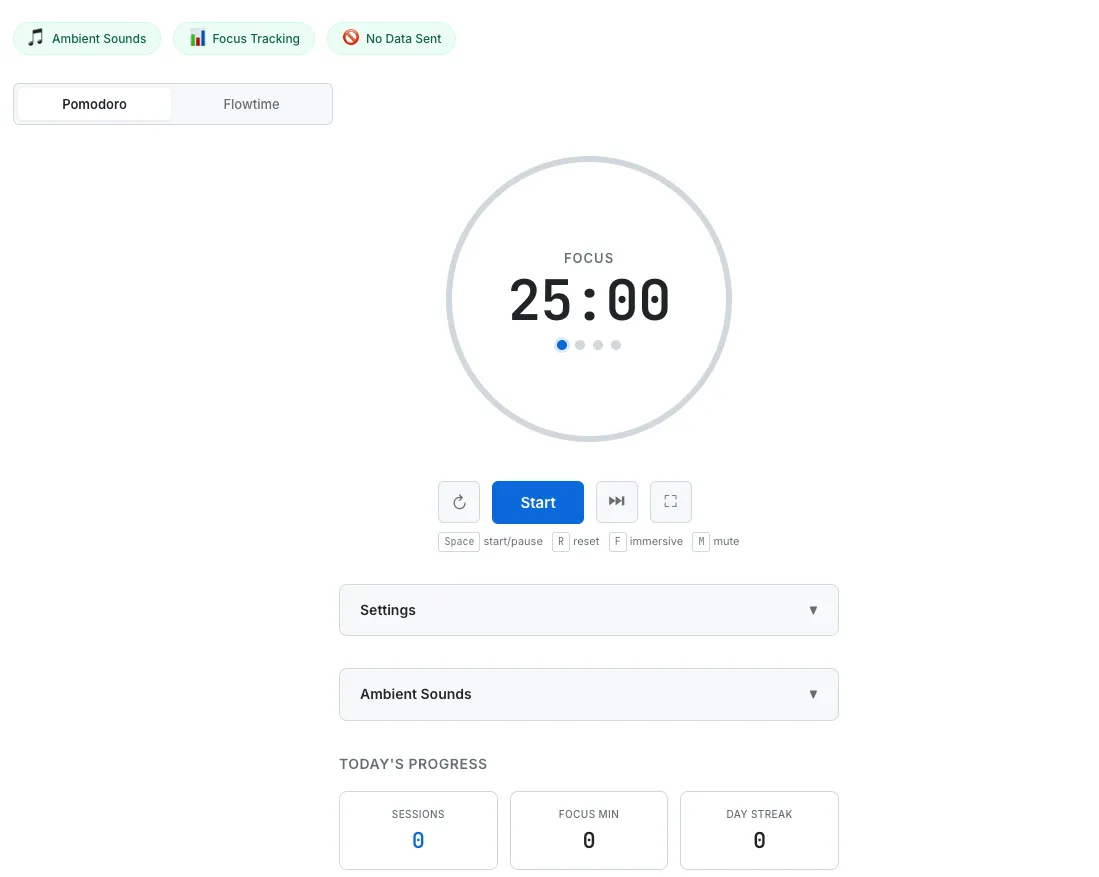
SudoTool's Pomodoro Timer with immersive backgrounds, ambient sounds, Flowtime mode, and GitHub-style session tracking.
How to Get Started with the Pomodoro Technique
Enough theory. Here's how to actually start.
Step 1: Pick a timer. Any timer works — your phone, a kitchen timer, or a dedicated Pomodoro app. The SudoTool Pomodoro Timer runs directly in your browser with immersive backgrounds, ambient sounds, Flowtime mode, and session tracking — no signup required.
Step 2: Choose one task. Not "everything I need to do today." One specific task for the next 25 minutes. It doesn't have to be completable in 25 minutes — what matters is that you work on nothing else during that time.
Step 3: Start your first 25 minutes. Hit the timer, silence notifications, and work only on your chosen task. When the timer rings, stop — even if you're in the middle of something. This is the hardest part at first, but it's what makes the system work.
Step 4: Take a real break. Checking email is not a break. Scrolling Slack is not a break. Stand up, drink water, stretch, or look out the window. These 5 minutes activate your brain's Default Mode Network and restore focus for the next session.
Step 5: Scale gradually. Aim for 4 Pomodoros (2 hours of deep focus) in your first week. As it becomes habitual, work up to 6–8 Pomodoros (3–4 hours). Remember Ericsson's research: even world-class performers max out at about 3.5–4 hours of deliberate practice per day. Eight Pomodoros is a highly productive day.
For students: Combine Pomodoro with active recall. Instead of passively reading for 25 minutes, spend each session testing yourself — explain concepts in your own words, solve practice problems, or use flashcards. The combination of timed focus and active retrieval is one of the most effective study strategies backed by research.
For developers: The standard 25-minute Pomodoro works well for code reviews, documentation, and refactoring — tasks with clear boundaries. For debugging or architectural design, switch to Flowtime mode so deep immersion isn't interrupted.
For remote workers: Block "Pomodoro time" on your calendar. Secure a 2-hour meeting-free window in the morning and run it as 4 Pomodoros. Reserve afternoons for meetings and communication. This single structural change can dramatically increase your deep work hours.
Frequently Asked Questions
Why 25 minutes? Can I change the interval?
25 minutes is the sweet spot Cirillo found through experimentation — long enough for meaningful work, short enough to feel manageable. But it's not a fixed rule. Research suggests optimal focus intervals range from 20 to 90 minutes depending on the person and task. Start with 25, then experiment. Many developers use 50-minute intervals; others prefer 90-minute deep work blocks.
How many Pomodoros should I do per day?
Ericsson's research found that deliberate practice maxes out at about 3.5–4 hours per day — that's 8–10 Pomodoros. For most people, 6–8 Pomodoros (3–4 hours of deep focus) is a highly productive day. Don't force yourself to hit 12. Quality matters more than quantity.
What if I get interrupted during a Pomodoro?
Cirillo's official rule: a Pomodoro is indivisible. If you're interrupted, you void that Pomodoro and start over later. In practice, saying "I'm in the middle of something — I'll check in 15 minutes" is usually enough. Setting this boundary is one of the technique's most powerful effects.
Does the Pomodoro Technique work for ADHD?
It can, because it provides external time structure — helpful for the time blindness common in ADHD. Start with shorter intervals (10–15 minutes) and adjust upward. If the frequent resets feel disruptive, Flowtime's flexible approach may work better. Experiment to find what fits.
Is Pomodoro effective for studying?
Research says yes. The BMC Medical Education scoping review (2025) found consistent improvements in focus and reduced fatigue across student populations. For maximum effect, pair it with active recall — use each 25-minute block to test yourself rather than passively re-read material.
Pomodoro or Flowtime — which is better?
It depends on the task. Pomodoro is better for tasks you're avoiding, tasks with clear boundaries, and when you need structure to get started. Flowtime is better for creative work, deep immersion, and when you're already motivated. Many people use both, switching based on the situation.
What should I do during breaks?
Step away from screens. Drink water, stretch, take a short walk, or look out the window. Checking social media or email doesn't count — it demands new information processing from your brain. A real break activates your Default Mode Network, boosting creativity and memory consolidation.
Start Your First Pomodoro
The Pomodoro Technique isn't a complex productivity system. All you need is a timer. Focus for 25 minutes. Rest for 5. During those 25 minutes, your brain operates at peak efficiency in focused mode. During those 5 minutes, it replays what you learned at 20x speed and forges new connections through the Default Mode Network.
It won't be perfect for every person or every task. But for most people, in most situations, it's the easiest way to start managing your focus. You don't need an app, an account, or a plan. You need 25 minutes and a timer.
Curious about the technical decisions behind this timer? Read how and why we built it — from CSS-only animated backgrounds to procedurally generated brown noise using the Web Audio API.