The True Cost of Meetings: Why Every Minute Has a Price Tag
Your one-hour meeting with eight people doesn't cost one hour. It costs eight hours of salary, plus overhead, plus the productive work that didn't happen. Here's how to calculate what meetings really cost your organization.
Every meeting has a price tag. Not the kind you see on a calendar invite, but a real dollar amount that hits your company's bottom line every time people gather in a conference room or hop on a video call. A Harvard Business Review survey of 182 senior managers found that 71% consider meetings unproductive and inefficient. Yet the average knowledge worker still spends 31 hours per month sitting in them. The result? U.S. companies lose an estimated $399 billion annually to unproductive meetings. That's not a typo. And it doesn't even account for the hidden costs most people never think about.
In this guide, you'll learn exactly how to calculate the true cost of any meeting using a simple meeting cost calculator formula, understand the hidden expenses that inflate the real number, and discover practical strategies to cut your organization's meeting waste in half.
How Much Do Meetings Actually Cost?
The basic meeting cost calculator formula is deceptively simple:
Meeting Cost = Number of Attendees × Average Hourly Rate × Duration (in hours)
Let's run a concrete example. Say you have a typical project status meeting: 8 people in the room, each earning an average of $75 per hour, for one hour. That's:
8 × $75 × 1 = $600
Six hundred dollars for a single meeting. Now scale that up. If this meeting happens every week, that's $600 × 52 = $31,200 per year for one recurring calendar event. If you have ten similar recurring meetings across your team, you're looking at $312,000 annually spent in conference rooms.
But that $75/hour figure is just the salary component. The real cost is significantly higher, as we'll see in the next section. The broader economic impact is staggering. Research from Doodle's 2019 State of Meetings report estimated that poorly organized meetings cost U.S. businesses $399 billion per year, while other industry analyses put the figure even higher at $532 billion when factoring in preparation time and follow-up work.
| Meeting Size | Hourly Rate | Duration | Cost per Meeting | Annual Cost (Weekly) |
|---|---|---|---|---|
| 4 people | $50/hr | 30 min | $100 | $5,200 |
| 6 people | $65/hr | 1 hour | $390 | $20,280 |
| 8 people | $75/hr | 1 hour | $600 | $31,200 |
| 12 people | $85/hr | 1.5 hours | $1,530 | $79,560 |
| 20 people | $100/hr | 1 hour | $2,000 | $104,000 |
The numbers speak for themselves. That "quick sync" with 20 people costs more per year than a junior employee's entire salary.
The Hidden Costs Nobody Counts
The formula above only captures direct salary cost. The true cost of a meeting is far higher because of four hidden factors that most organizations never account for.
1. Fully Loaded Employee Costs
An employee's hourly rate on their paycheck is only part of what they cost the company. On top of base salary, employers pay for health insurance, retirement contributions, payroll taxes (Social Security, Medicare, unemployment insurance), office space, equipment, software licenses, and other overhead. As a rule of thumb, these costs add approximately 30% on top of the base salary. Some industries run higher — in tech, the multiplier can reach 1.4x or even 1.5x when you include expensive stock-based compensation.
So that $75/hour employee actually costs the company roughly $97.50/hour when fully loaded. Your $600 meeting? It's really $780. That weekly meeting now costs $40,560/year instead of $31,200.
2. Context-Switching Cost
This is the hidden cost that's hardest to measure and easiest to underestimate. Mark, Gudith, and Klocke's 2008 CHI paper, The Cost of Interrupted Work, reports a counterintuitive primary finding — abstract verbatim: "people compensate for interruptions by working faster, but this comes at a price: experiencing more stress, higher frustration, time pressure and effort." The widely cited "23-minute" recovery figure attributed to Mark has no verifiable peer-reviewed source — see our multitasking myth post for the fact-check. A meeting is not just the 60 minutes on the calendar — it is the 60 minutes plus the speed-stress trade-off that ripples across the rest of the participants' day.
For deep work — writing code, designing systems, drafting strategy — recovery is real. Programmers, for example, take 10–15 minutes to start editing code again after an interruption (Parnin's data, summarized in Programmer, Interrupted, 2013). A one-hour meeting in the middle of an afternoon can effectively destroy a three-hour block of productive time: 30 minutes of pre-meeting distraction ("I have a meeting soon, let me not start anything deep"), 60 minutes in the meeting, and 10–15 minutes of resumption time getting back into flow — plus the attention residue Sophie Leroy 2009 identified.
3. Preparation Time
Meetings don't start when the calendar event begins. Someone has to create the agenda (if there even is one). Presenters build slide decks. Participants review pre-read documents. A well-prepared meeting might require 30 minutes of prep time per attendee — which for an 8-person meeting adds another 4 person-hours. That's $300 in salary cost before anyone opens their mouth.
4. Opportunity Cost
This is the biggest hidden cost of all, and it's the one that never shows up on any spreadsheet. Every hour someone spends in a meeting is an hour they're not spending on revenue-generating work, creative problem-solving, customer interactions, or strategic thinking. For a senior engineer earning $150/hour, a recurring weekly meeting doesn't just cost their salary — it costs whatever product feature, bug fix, or system improvement they would have built during that time.
The Meeting Epidemic in Numbers
The scale of the meeting problem is enormous, and it's gotten significantly worse since the shift to remote and hybrid work. Here are the numbers that paint the full picture.
The average knowledge worker now spends 31 hours per month in meetings — that's nearly four full workdays. Before the pandemic, the average meeting lasted about 45 minutes. Post-pandemic, that number has ballooned to 72 minutes as video calls removed the natural friction of booking conference rooms and walking between offices.
Perhaps the most damning statistic: 63% of meetings have no agenda. People are gathering without a clear purpose, talking until the time runs out, and then scheduling follow-up meetings to discuss what they should have covered in the first one. It's no wonder that 50% of all meeting time is considered wasted by the participants themselves.
Some companies have started pushing back. In January 2023, Shopify made headlines by deleting all recurring meetings with more than two people from every employee's calendar — a move the company called a "calendar purge." The result was extraordinary: Shopify projected a reduction of 322,000 hours of meeting time for the year. CEO Tobi Lütke called meetings "bugs" in the operating system of a company and said the purge was about treating employee time as the precious resource it is.
Shopify also introduced new rules: meetings with more than two people could only be held on Thursdays, no meeting could exceed 30 minutes, and large meetings of more than 50 people were limited to a single six-hour window each week. The company reported increased productivity and employee satisfaction after the change.
Harvard Business Review research backs this up. Their survey of 182 senior managers found that 71% said meetings are unproductive and inefficient, 65% said meetings keep them from completing their own work, and 64% said meetings come at the expense of deep thinking time.
How to Calculate Your Meeting's Real Cost
Now that you understand what goes into the real cost, here's how to calculate it step by step for any meeting on your calendar.
Step 1: Count the attendees. Look at the invite list. Don't count just the required attendees — count everyone who's actually going to show up, including optional attendees who always join anyway. If 12 people are invited and typically 10 attend, use 10.
Step 2: Determine the average hourly rate. If you know actual salaries, divide each person's annual salary by 2,080 (the number of working hours in a standard year: 52 weeks × 40 hours). If you don't know actual salaries, use industry averages. For most U.S. knowledge workers in 2026, $50–$100/hour is a reasonable range. For a mixed-seniority meeting, $65–$75/hour is a solid middle estimate.
Step 3: Apply the fully loaded multiplier. Multiply the hourly rate by 1.3 to account for benefits, taxes, office space, and equipment overhead. If you're in a high-cost industry (tech, finance, consulting), use 1.4 or even 1.5. This gives you the true cost to the organization per hour, per person.
Step 4: Multiply by the duration. Convert the meeting length to hours. A 45-minute meeting is 0.75 hours. A 90-minute meeting is 1.5 hours.
Step 5: Calculate. Attendees × Fully Loaded Rate × Duration = Total Meeting Cost.
Here's an example: 8 people, $75/hour average salary, 1.3x overhead multiplier, 1-hour meeting.
8 × ($75 × 1.3) × 1 = 8 × $97.50 × 1 = $780
That same weekly meeting now costs $40,560 per year in fully loaded costs. And that still doesn't include context-switching or opportunity cost.
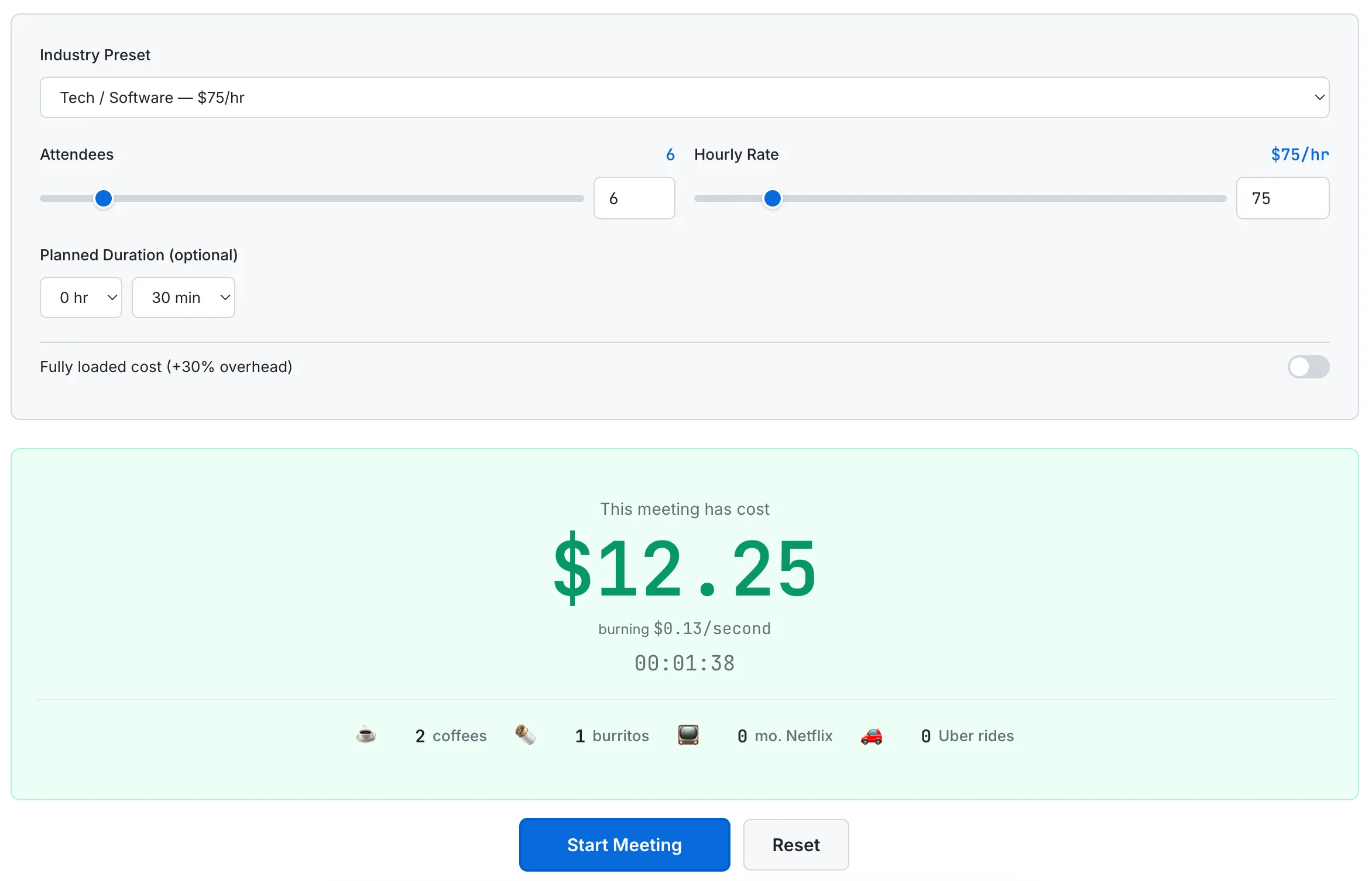
The Meeting Cost Calculator shows the running cost in real time with a live comparison ticker — 2 coffees burned and counting.
Don't want to do this math by hand every time? Our Meeting Cost Calculator does it automatically. Enter the number of attendees and the average hourly rate, hit start, and watch the cost tick up in real time. It's a simple but powerful way to make the invisible cost of meetings visible.
Five Ways to Reduce Meeting Costs
You don't have to pull a Shopify and delete every meeting on the calendar (though there's something to be said for the approach). Here are five practical strategies that any team can implement starting this week.
1. Audit Your Calendar and Kill Zombie Meetings
Open your calendar right now and look at every recurring meeting. For each one, ask: "If this meeting didn't exist, would anyone recreate it?" If the answer is no, cancel it. These are zombie meetings — they persist through organizational inertia long after their original purpose has expired. A project kickoff meeting that turned into a "weekly check-in" six months after the project launched. A cross-team sync where nobody has anything to sync on. A daily standup where people read out what they already posted in Slack. If a meeting has no agenda, it has no purpose. Delete it.
2. Apply the Two-Pizza Rule
Amazon popularized this concept: if you need more than two pizzas to feed the group, there are too many people in the meeting. Every person added to a meeting increases the cost linearly but decreases the value of each individual's contribution. In a meeting of 4, each person speaks roughly 25% of the time. In a meeting of 12, each person speaks roughly 8% of the time — and the rest is waiting, multitasking, or zoning out. Keep meetings to 5–7 people maximum. Everyone else can get the notes afterward.
3. Default to 25 or 50 Minutes
Calendar tools default to 30- or 60-minute blocks. There's nothing magical about these numbers — they're artifacts of how software rounds time. Set your defaults to 25 minutes (instead of 30) or 50 minutes (instead of 60). This gives attendees a 5- or 10-minute buffer between meetings for bio breaks, context-switching, and mental reset. Google actually built this feature directly into Google Calendar — you can set "Speedy meetings" in your settings. The constraint also forces tighter agendas. When you know you have 25 minutes, you cut the small talk and get to the point.
4. Replace Status Updates with Async Communication
The single easiest meeting to eliminate is the status update. No one needs to sit in a room and listen to eight people read their task lists aloud. Move status updates to asynchronous tools: a Slack channel, a shared document, a Loom video, or even a simple email. Reserve synchronous meeting time for things that actually require real-time interaction: decisions, debates, brainstorming, and relationship building. A good test: if the meeting is primarily one-directional (one person talks, everyone listens), it should be an email or a recorded video.
5. Require an Agenda — No Exceptions
Implement a simple rule: no agenda, no meeting. Every meeting invite must include a written agenda with specific topics, time allocations, and desired outcomes. If the organizer can't articulate what the meeting is supposed to accomplish, the meeting shouldn't happen. Some teams go a step further and auto-decline any meeting invite that arrives without an agenda. It sounds aggressive, but it works. It forces organizers to think before they schedule, and it respects attendees' time by ensuring every meeting has a clear purpose.
When Meetings Are Worth the Cost
This article isn't anti-meeting. It's anti-unnecessary-meeting. Some meetings are worth every penny, and trying to eliminate them would be counterproductive. The key is knowing the difference.
Decision-making with stakeholder alignment. When you need multiple decision-makers to weigh in, hear each other's concerns, negotiate trade-offs, and commit to a path forward, a synchronous meeting is irreplaceable. Trying to make complex decisions over a 47-email thread is far more expensive in calendar time, emotional energy, and delayed outcomes than a well-run 45-minute decision meeting.
Creative brainstorming that requires real-time riffing. The magic of brainstorming comes from building on each other's ideas in the moment — "Yes, and..." thinking. This kind of rapid-fire creative collaboration doesn't work asynchronously. If you need to generate new ideas, a meeting is the right format. Just keep it small (4–6 people) and timeboxed.
Relationship building. One-on-ones between managers and direct reports, team bonding sessions, and "get to know you" conversations for new hires are investments in trust and psychological safety. These don't show up on any productivity metric, but they're foundational to team performance. Don't cut them.
Complex problem solving. Some problems require rapid back-and-forth, whiteboarding, shared screen debugging, or the kind of nuanced discussion that collapses in text. When the problem is ambiguous and the solution requires multiple perspectives interacting in real time, a meeting is the most efficient format.
The pattern is clear: meetings are worth it when they require real-time human interaction — decisions, creativity, relationships, and complex reasoning. Meetings are wasteful when they could be replaced by a document, a message, or a recording.
Frequently Asked Questions
What hourly rate should I use in the meeting cost calculator?
If you know the actual salaries of attendees, divide each annual salary by 2,080 (52 weeks × 40 hours) to get the hourly rate. If you don't know exact salaries, use industry averages. For U.S. knowledge workers, $50–$100/hour covers most roles. A reasonable default for mixed-seniority teams is $65–$75/hour. For executive meetings, $150–$250/hour is more realistic. You can also search salary data on sites like Glassdoor, Levels.fyi, or the Bureau of Labor Statistics for role-specific averages.
Should I include overhead in the calculation?
Yes, if you want the true cost to the organization. An employee's salary is only about 70–77% of what they actually cost the company. The rest goes to benefits (health insurance, retirement contributions), payroll taxes, office space, equipment, and software. Multiply the base hourly rate by 1.3 for a conservative estimate of fully loaded cost. In high-cost industries like tech or finance, a 1.4x or 1.5x multiplier may be more accurate.
How do I convince my manager to cancel unnecessary meetings?
Lead with data, not complaints. Use the meeting cost formula to calculate the annual cost of the meetings you want to cut. Present alternatives: "This weekly status meeting costs $31,200/year. I can deliver the same information via a Monday morning Slack update in 5 minutes." Frame it as a productivity gain, not as criticism of the meeting organizer. You can also run a one-month experiment: cancel the meeting for 30 days and see if anyone misses it. If nothing breaks, the meeting wasn't needed.
How many meetings per day is too many?
Research suggests that more than 3 meetings per day significantly degrades deep work output. Microsoft's WorkLab research found that after about 2 hours of consecutive meetings, stress levels rise sharply and engagement drops. Aim for no more than 2–3 meetings per day, and batch them together to preserve uninterrupted blocks of at least 2 hours for focused work.
Want to see the dollar cost of your next meeting in real time? Try the Meeting Cost Calculator — it takes two inputs and gives you a running total that makes the invisible cost impossible to ignore.
Curious about how this tool was built? Read the full story: Building a Meeting Cost Calculator: Making Every Minute Count.