The Multitasking Myth: What Brain Science Shows About Switching Tasks
The multitasking myth has a simple structure — you feel like you're doing two things at once, but the brain is actually switching very fast, with measurable costs. Only about 2.5% of people can truly multitask without performance loss (Watson & Strayer 2010, Psychonomic Bulletin & Review). What the science actually shows, what's been overstated, and what to do instead.
You have probably felt like a competent multitasker — answering email while listening to a meeting while checking Slack. Statistically, that self-belief is almost always wrong. Watson and Strayer's 2010 study in Psychonomic Bulletin & Review tested 200 participants in a high-fidelity driving simulator combined with a demanding auditory working-memory task. "2.5% of the sample showed absolutely no performance decrements with respect to performing single and dual tasks." Five out of 200. The other 195 measurably degraded.
On top of that, almost three decades of cognitive psychology — anchored by Rubinstein, Meyer & Evans 2001 in the Journal of Experimental Psychology: Human Perception and Performance — have established that the brain does not run cognitively demanding tasks in parallel. It switches between them very fast, and every switch costs time and accuracy.
The Multitasking Myth Starts with How Your Brain Actually Works
The premise behind the multitasking myth is that the brain runs two cognitively demanding tasks at the same time. The actual mechanism is faster than perception but still serial: the brain rapidly switches between tasks, and each switch is its own small operation.
The standard reference for this is Rubinstein, Meyer, and Evans 2001 in the Journal of Experimental Psychology: Human Perception and Performance, 27(4):763–797. Across four experiments where participants alternated between tasks (geometric classification rules and arithmetic operations), the abstract reports a clean finding: "Task alternation yielded switching-time costs that increased with rule complexity but decreased with task cuing." The authors propose a two-stage model of executive control — a goal-shifting stage where intent moves to the new task, and a rule-activation stage where the new task's rules are loaded into working memory. Both stages take time. Both happen on every switch.
Two decades later, Stanford's Madore and Wagner 2019 review in Cerebrum ("Multicosts of Multitasking") describes the same mechanism at the neural level. Brain imaging shows that "frontoparietal regions — including those of the frontoparietal control and dorsal attention networks — were more responsive during switch than stay trials." Switching is extra work for the brain. As the authors put it: "When we switch from one task to another, it requires more neural processing because we have to bring back to mind the new task's representation and then use it to allocate attention to information that is relevant to perform the new task."
In plain terms: the feeling of doing two things at once is the experience of switching back and forth fast enough that you do not notice the gaps. The gaps are real, and they have a cost.
The Hidden Cost of Every Switch
A single switch looks small, but switches accumulate. Rubinstein 2001 reported per-switch costs in the hundreds of milliseconds for simple tasks, with the cost growing as rule complexity grew. Across a workday with dozens of switches, the lost time compounds into minutes — and the time loss is only the most visible piece of the cost.
Two further cost layers sit on top of raw switching time.
Speed compensation, paid in stress. Mark, Gudith, and Klocke's 2008 CHI paper, The Cost of Interrupted Work: More Speed and Stress (UCI host PDF: ics.uci.edu/~gmark/chi08-mark.pdf), reports a counterintuitive primary finding: people who were interrupted finished their tasks faster than people who were not interrupted. The cost shows up elsewhere. Abstract verbatim: "people compensate for interruptions by working faster, but this comes at a price: experiencing more stress, higher frustration, time pressure and effort." Speed compensation is real; the bill arrives as the chronic exhaustion of an interruption-heavy week.
Attention residue. Sophie Leroy's 2009 paper in Organizational Behavior and Human Decision Processes 109(2):168–181 introduces the concept of attention residue: when a switch happens before Task A is mentally complete, part of attention remains bound to A and degrades performance on B. Residue is largest when Task A is genuinely unfinished — exactly what an interruption produces, regardless of what dual-task feels like in the moment.
Add the three together — switching time, speed-stress trade, attention residue — and the subjective sensation of "doing more by multitasking" maps to the objective reality of doing less, with more stress, and lower-quality output on each piece.
Why You Feel Like a Great Multitasker (When You're Not)
Self-confidence about multitasking ability is weakly correlated with measured multitasking ability. The evidence base for this claim has gotten more nuanced over the decade since the famous Stanford finding, so it is worth handling honestly.
The original study is Ophir, Nass, and Wagner 2009 in PNAS 106(37):15583–15587. Using a trait media-multitasking index, the authors classified participants as heavy or light media multitaskers and compared them on cognitive control tasks. The headline finding from the abstract: "Results showed that heavy media multitaskers are more susceptible to interference from irrelevant environmental stimuli and from irrelevant representations in memory. This led to the surprising result that heavy media multitaskers performed worse on a test of task-switching ability." Heavy multitaskers — the people who would describe themselves as great at it — did worse, not better.
The honest caveat: this finding has not consistently replicated. Parry and le Roux's 2021 meta-analysis in Cyberpsychology: Journal of Psychosocial Research on Cyberspace 15(2), Article 7 pulled together 118 assessments published in the decade after Ophir 2009. The verdict, abstract verbatim: "Overall, the review suggests that, ten years on, we are no closer to understanding 'cognitive control in media multitaskers.'" The specific task-switching deficit Ophir reported produced a meta-analytic effect of z = 0.031, p = 0.387 — not statistically significant. Other cognitive functions in the same meta-analysis (sustained attention, working memory, inhibitory control) produced small but significant effects (z = 0.16 to 0.19, p < 0.001), so the broader cognitive-control picture is not entirely empty — but the headline task-switching claim from 2009 did not survive replication.
What survives is the weaker, broader observation that self-reported multitasking ability is a poor predictor of measured multitasking ability. Confidence about being good at it is not a reliable signal — and that single fact is enough to motivate not relying on the self-assessment when designing your day.
The 1-in-40 Exception: Real Supertaskers
Genuinely simultaneous multitasking ability does exist — it is just rare.
Watson and Strayer 2010 in Psychonomic Bulletin & Review 17(4):479–485 ran 200 participants through a high-fidelity driving simulator combined with an auditory operation-span (OSPAN) working-memory task, comparing single-task and dual-task conditions. The full abstract finding, verbatim: "Whereas the vast majority of participants showed significant performance decrements in dual-task conditions (compared with single-task conditions for either driving or OSPAN tasks), 2.5% of the sample showed absolutely no performance decrements with respect to performing single and dual tasks."
Five participants out of 200. One in 40. Monte Carlo simulations confirmed the frequency of supertaskers in the sample exceeded chance. These five were not average individuals scoring well — they scored in the top quartile on every dependent measure even in single-task condition.
The other 97.5% paid the dual-task cost. Per the University of Utah News press release accompanying the study (March 29, 2010), non-supertaskers in the same driving-plus-cell-phone condition showed: brake reaction time up about 20%, following distance up 30%, memory performance down 11%, math problem performance down 3%. Quiet, measurable degradation across every metric.
The probability that any given person is a supertasker is roughly 2.5%. Without an objective test in a controlled environment, no self-belief carries that information — and Section 3 above already showed that self-belief about multitasking is a poor signal in general. The realistic prior is that you are not one of the five.
When "Multitasking" Actually Works
Not every dual-task pairing carries the same cost. Honest nuance: some combinations work, and ignoring this turns the multitasking myth into its own kind of overcorrection.
Passive plus active = often fine. Walking while having a conversation. Washing dishes while listening to a podcast. Exercising while listening to music. In each pairing, one task is heavily automated (walking, dishwashing, walking on a treadmill) and consumes almost no working-memory or attention resource. The brain is not actually running two cognitively demanding tasks in parallel — one of the tasks is automatic enough that it leaves the cognitive resource untouched.
Active plus active = costly. Email plus a meeting. Coding plus Slack. Writing plus a phone call. Both tasks require active language processing, working memory, decision-making, attention. The two demands compete for the same finite resource, and the switching cost, attention residue, and speed-stress trade-off all kick in.
The practical heuristic: if both tasks require active production (speaking, writing, deciding), separate them. If one is passive consumption (listening, watching, walking) and the other is active, the pairing is usually fine. This distinction sits inside the broader cognitive-psychology line on automaticity versus controlled processing — Daniel Kahneman's Thinking, Fast and Slow dual-process framing is the most accessible summary — and it should not be applied as a hard rule. Degree of automation is the real variable, and the same activity can be more or less automatic for different people.
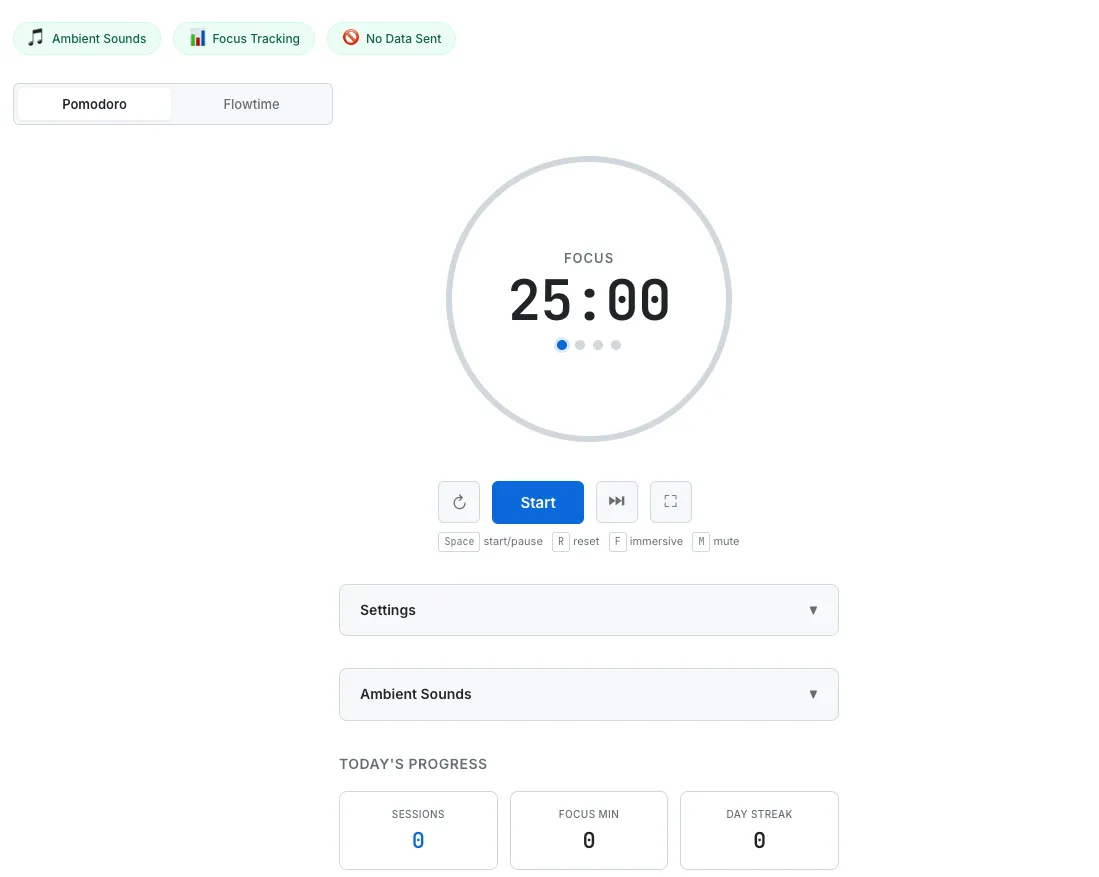
SudoTool's Pomodoro Timer — 25 minutes of single-task focus, the practical answer to the multitasking myth.
How to Actually Focus Single-Task
Knowing that the multitasking myth is wrong does not by itself produce different behavior. Five practical patterns work in combination.
1. Time-block a single-task window on the calendar. Set a recurring 90-minute block at the same time every day, label it "Focus," and decline meeting requests against it by default. Cal Newport's Deep Work framework calls this the rhythmic philosophy of focus scheduling — the same window every day removes the daily decision about whether to focus. The full case for this in a working-developer context is in our deep work for software developers post.
2. Use Pomodoro for 25-minute single-task bursts. If 90 unbroken minutes is too long to sustain, decompose the block into four Pomodoro cycles — 25 minutes of one task, 5 minutes of break, four times. Twenty-five minutes is long enough to fully load working memory and short enough to keep the nervous system reset cheap. The cognitive mechanism is in our post on the science behind the Pomodoro technique.
3. Set a notification budget. Microsoft's 2025 Work Trend Index, "Breaking down the infinite workday" (31,000 knowledge workers across 31 markets, surveyed February–March 2025) measured the modern interruption baseline: "Employees are interrupted every 2 minutes during core work hours." The heaviest 20% of users — those who receive the most pings — register more than 275 interruptions a day. In an environment where the default is a notification every two minutes, single-task focus does not happen by accident. Mute everything during the focus block, batch checks (for example, once an hour rather than continuously), and disable push notifications outside the work window.
4. Treat meetings as expensive. The most common workplace invocation of multitasking is the simultaneous meeting plus email plus chat. Each meeting carries direct salary cost plus the destruction of the participants' deep blocks before and after. Run the actual number for your team with the meeting cost calculator; the framing case is in our true cost of meetings post.
5. Apply the active-plus-active check. Before defaulting to a dual-task, pause for five seconds and ask: are both of these tasks active production (speaking, writing, deciding)? If yes, separate them. If one is passive consumption (listening to a recorded talk, monitoring a build, walking), the pairing is usually fine. This single heuristic prevents most of the costly multitasking attempts in a normal day.
None of these patterns are exotic. The reason the multitasking myth survives is not that the alternative is hard to describe — it is that single-tasking has to be deliberately defended against an environment that pushes the other way every two minutes. The defense is a calendar block, a notification mute, and a single decision rule applied honestly. The science covered above is the case for paying that small cost, every day, in exchange for the cognitive output that switching destroys.
This guide is general cognitive-science reading, not personalized medical, educational, or workplace advice. The empirical research cited (Rubinstein, Meyer & Evans 2001; Ophir, Nass & Wagner 2009; Parry & le Roux 2021; Watson & Strayer 2010; Madore & Wagner 2019; Mark, Gudith & Klocke 2008; Leroy 2009; Microsoft Work Trend Index 2025) reflects specific samples and contexts. ADHD, learning differences, brain injury, and certain clinical conditions can produce different mechanisms than the standard task-switching cost picture; an evaluation by a licensed professional is the appropriate next step for those contexts. The "2.5% supertaskers" figure is from one driving-simulator study and should not be taken as a precise population estimate.
- Rubinstein, J.S., Meyer, D.E., & Evans, J.E. (2001). Executive control of cognitive processes in task switching. Journal of Experimental Psychology: Human Perception and Performance 27(4):763–797. APA PDF: apa.org/pubs/journals/releases/xhp274763.pdf.
- Ophir, E., Nass, C., & Wagner, A.D. (2009). Cognitive control in media multitaskers. Proceedings of the National Academy of Sciences USA 106(37):15583–15587. PMC open access: PMC2747164.
- Parry, D.A., & le Roux, D.B. (2021). "Cognitive control in media multitaskers" ten years on: A meta-analysis. Cyberpsychology: Journal of Psychosocial Research on Cyberspace 15(2), Article 7. cyberpsychology.eu/article/view/13303.
- Watson, J.M., & Strayer, D.L. (2010). Supertaskers: Profiles in Extraordinary Multitasking Ability. Psychonomic Bulletin & Review 17(4):479–485. PubMed: pubmed.ncbi.nlm.nih.gov/20702865. Companion press release: University of Utah News, March 29, 2010.
- Madore, K.P., & Wagner, A.D. (2019). Multicosts of Multitasking. Cerebrum: the Dana Forum on Brain Science. PMC open access: PMC7075496.
- Mark, G., Gudith, D., & Klocke, U. (2008). The cost of interrupted work: more speed and stress. CHI '08: Proceedings of the SIGCHI Conference on Human Factors in Computing Systems, ACM, pp. 107–110. UCI host PDF: ics.uci.edu/~gmark/chi08-mark.pdf.
- Leroy, S. (2009). Why is it so hard to do my work? The challenge of attention residue when switching between work tasks. Organizational Behavior and Human Decision Processes 109(2):168–181. sciencedirect.com.
- Microsoft Work Lab (2025). Breaking down the infinite workday. Microsoft Work Trend Index. microsoft.com/en-us/worklab/work-trend-index/breaking-down-infinite-workday.