Async vs Sync Communication for Remote Teams: The Honest Tradeoffs
Async vs sync communication for remote teams — the 6-hour rule, when sync is genuinely necessary, and how async done badly beats sync's worst day.
You have probably been told async vs sync communication for remote teams is the easy choice — install Slack, cut meetings, tell people they don't have to reply right away. Microsoft's June 2025 Breaking Down the Infinite Workday report measured what actually happened: the average Microsoft 365 worker receives 153 Teams messages plus 117 emails per weekday, gets interrupted every 2 minutes, and 29% are still active in their inbox by 10 pm. "Async" got piled on top of sync, not used to replace it.
The peer-reviewed evidence is heavier. Chauvin, Choudhury, and Pan Fang's 2024 paper in Organization Science analyzed three months of telemetry from 12,038 Fortune 100 employees, using daylight-saving-time transitions as a natural experiment. Per Rice News: each additional hour of temporal distance cuts synchronous communication by about 11%, and 43% of remaining sync now happens when at least one person is outside their local business hours. Once teammates are more than six hours apart, sync becomes a system that systematically takes someone's evening. That's what makes async math, not morality.
What Async vs Sync Communication for Remote Teams Actually Means
Don't treat async and sync as two separate categories. Treat them as the two ends of a single spectrum. At one end, communication that requires simultaneous attention — in-person meetings, video calls, phone. At the other, communication that requires none — handbook pages, RFC documents, searchable decision logs. In between live the everyday tools: Slack DM is sync-leaning async, email is async with defined latency, Loom is high-bandwidth async.
The clearest definition comes from Doist's Twist guide: asynchronous communication "is when you send a message without expecting an immediate response." Their corollary: "synchronous communication should be the exception, not the rule." Async ≠ slow and sync ≠ fast — the variable is whether simultaneous attention is required. Slack is a tool; whether your culture requires immediate replies determines where it sits on the spectrum.
GitLab's handbook anchors the same logic from the sync side, citing engineer Coda Hale: "Synchronous meetings should be reserved for low-latency collaboration on complex issues; likewise, collaboration should be reserved for synchronous meetings." Doist describes their own stack as roughly 70% async, 25% sync, 5% in-person — one company's process choice, not an empirical optimum, but the inversion of the default is the load-bearing framing.
The 6-Hour Rule: When Async Becomes Math, Not Choice
The Chauvin paper is the empirical core. 12,038 employees, three months of telemetry, identification via DST transitions where one jurisdiction shifted and the other didn't — a quasi-random shock that lets the authors estimate causal effects rather than correlations.
The HBS Working Knowledge writeup states the core finding: "the amount of synchronous communication, such as phone calls and video chats, declined by 11 percent when the time delay between workers increased by an hour." That one-hour loss represented a 19% reduction in sync opportunities — so the 11% drop is smaller than expected, meaning employees closed the gap by time-shifting into someone's off-hours.
The off-hours split is the more striking number. Per HBS: "on average, 57 percent of synchronous communication took place within employees' business hours, while 43 percent occurred when at least one employee was working outside of local business hours." The same paper documents a gender asymmetry in off-hours work share, with workers in countries that have stricter legal work-hour limits time-shifting less. Sync-default culture quietly redistributes its cost onto whoever can absorb it.
Where does the six-hour threshold come from? Fortune (December 2023) quotes Atlassian CTO Rajeev Rajan: distributed teams need "at least four to six hours of overlap and can reasonably work together across that." Atlassian's hiring rule, not an empirical threshold — but combined with Chauvin's data, the picture is consistent. Under six hours, sync-first is workable. Past six hours, sync without nightly sacrifice is impossible. City-pair math is in our companion post on how to manage time zones in remote teams.
What "Async Done Badly" Looks Like (and Why It Beats Sync's Worst Day)
You have probably seen a company announce "we're async-first now" and leave Slack untouched. The label changes; the implicit reply expectations don't. Managers still grade people on responsiveness, channels buzz with ten-minute reply cultures, and now everyone has both a calendar full of meetings and a Slack tab they can't close. That's the failure mode — sync's response pressure plus async's fragmented context, both at once.
Doist describes the same diagnosis. Per their remote work writeup: "Keeping up with Slack conversations started consuming more and more time. People felt they had to be online constantly to not miss out on something important." Their migration guide names three failure modes. First, half-conversation drift: "It leads to everyone having half-conversations all day long, with people frequently rotating through one slow-drip discussion after another." Second, tool change without culture change: "if your company depends on unstructured, ad-hoc communication, telling people to check email less is not going to work." Third, visibility-based judgment — grading by responsiveness "incentivizes context switching and performative workaholism."
Microsoft's 2025 Worklab telemetry shows the failure mode at scale: ~270 daily messages per worker, an interruption every two minutes, 57% of meetings ad-hoc without a calendar invite. Sync at least ends — a meeting is over, you return to deep work. An always-on Slack culture has no end. The individual-focus side is covered in how to stay focused while working from home.
When Sync Is Genuinely Necessary
Async universalism is the opposite kind of dishonesty. Yang, Holtz, Jaffe, Suri and colleagues published the closest thing to a counter-experiment in Nature Human Behaviour 6:43–54 (2022), studying 61,182 US Microsoft employees during the firm-wide remote shift in early 2020. The shift caused a decrease in synchronous communication, an increase in asynchronous communication, and a move to "less rich" media such as email and IM. Collaboration networks became "more static and siloed, with fewer bridges between disparate parts." Pushing sync close to zero degrades the weak-tie information flow that carries new perspectives across teams.
Six contexts where sync earns its cost: (1) Kickoffs and introductions — new project, new teammate, first contact with a vendor. Forming a relationship needs faces, voices, and simultaneity. (2) Conflict resolution — text escalates conflict; tone of voice and real-time empathy carry the de-escalation. (3) Real-time creative ideation — whiteboarding and "yes, and" momentum. (4) Crisis response — production outage, security incident. Latency itself is the failure mode. (5) Performance feedback or sensitive HR — privacy plus nuance plus the ability to clarify in real time. (6) Onboarding day-1 — throwing a handbook URL at a new hire is async dogma at its worst.
Atlassian's Intentional Togetherness research reports that "team gatherings had the largest impact on team connection, with boosts averaging 27%" with effects lasting roughly four months. Atlassian's own internal research, not external peer-reviewed evidence, but it captures the case for in-person sync at the right moment. GitLab's handbook lands in the same place: "Async is very powerful for GitLab, but not an absolute — especially if at the expense of our values."
How Async-First Companies Actually Work
What follows is process documentation, not empirical proof. Each company self-reports what they do; none are controlled studies. Cite them as "this is how X company runs," not "this proves async wins."
GitLab's public handbook is the single source of truth: "At GitLab, we have people spread across 60+ countries." And: "Business happens around the clock, in all time zones, in perpetuity. Attempting to shoehorn communications into a single time zone's predefined set of hours is dysfunctional." The flagship concept is the non-linear workday — work splits into chunks with non-work time interleaved.
Automattic runs internal communication on P2, an internal blog system: "at its core, P2 is organized, searchable knowledge," and "we ditched email and moved to an internal blogging system." Same logic as GitLab's handbook, different surface — every decision lives where someone can reconstruct it later.
Doist moved entirely from Slack to their in-house Twist tool and self-reports 95%+ async. Twist's framing is "Work async, not ASAP" — channels and threading designed against deep-work fragmentation.
Atlassian's Loom challenge — two weeks in March 2024, replace live meetings with Loom recordings. Result: "43% of Atlassians had a meeting replaced with a Loom" and "this freed up 5,000 hours for focused work — which is 2.5 years of working time saved from meetings." Self-experiment, not a controlled study, but a useful order-of-magnitude.
Buffer's 2023 State of Remote Work: "Over half of survey takers (62 percent) said people in their immediate teams were distributed across multiple time zones." Their process answer is "Impromptu Hours" — twin weekly sessions, one timed for Europe/Asia/Australia, one for the Americas/Europe, both recorded. Burden rotates instead of one zone always taking the late shift.
Sync Hygiene: Rules That Make the Cost Worth Paying
Async-first doesn't mean killing sync. It means making sync earn its cost. GitLab's all-remote meetings handbook spells out the rules.
Pre-read and agenda are mandatory. "Meeting agendas should be shared 72 hours (minimum 24 hours) in advance of the meeting." And: "'No agenda, no attenda.' Every work-related meeting should have a single live doc agenda affixed to the calendar invite at the time that the invite is added to calendars."
Async pre-discussion before sync. Don't read material for the first time during the meeting. Push it into the pre-read; reserve live time for reaction and decision. That maps to Wang, Qiu, Cranshaw, and Zhang's 2024 PACMHCI/CSCW paper on "meeting bridges," which identifies five ways meetings connect to async work: archive, task reminders, onboarding, group sensemaking, and launching point for follow-on collaboration.
Record for the absent zones. GitLab's rule: "Upload recording. When the meeting is recorded, add the recording link and password in the agenda within 12 hours after the meeting to allow for async consumption for people in different time zones." Buffer's Impromptu Hours follow the same pattern.
Don't present. Per GitLab: "Avoid presenting in most meetings. Valuable synchronous time should not be used to present in most cases." Send a Loom; reserve sync for back-and-forth.
Decisions captured in writing. Whatever was decided gets written into the handbook, P2, or thread. Atlassian's State of Teams 2025, surveying 12,000 knowledge workers, reports that "leaders and teams waste 25% of their time just searching for answers." That overhead is the tax for not capturing decisions in searchable form.
Rotate the burden, make attendance optional. Buffer's twin sessions and GitLab's 8 AM / 3 PM Pacific alternation distribute the late-evening cost. GitLab also rules that meeting attendance should be optional wherever an async record covers the same ground — make attendance valuable, don't compel it.
A Decision Rubric: Which Mode for Which Need
The rubric is four axes. Each votes sync or async. The mode with the most votes is your default for that need.
- Urgency. Crisis or immediate decision → sync. Decision can wait a week → async.
- Bandwidth. Emotional nuance, trust-forming → sync. Information transfer or status update → async.
- Familiarity. First contact, new hire, external party → sync. Established team interior → async.
- Privacy. Personal data, HR, financial → sync (1:1). Public update or broadcast → async.
Worked examples. Production-down crisis with a new contractor: urgent + high-bandwidth + low-familiarity → sync, hard. Established team weekly status: medium-bandwidth + high-familiarity → async, push update to handbook. Performance review: high-bandwidth + privacy-sensitive → sync 1:1, with an async written follow-up. Technical RFC review: low-urgency + high-familiarity → async by default; escalate to sync only when comments deadlock. Conflict escalating in text: high-emotional-urgency → switch to video as soon as you notice the escalation.
The point isn't finding the universally better mode. It's matching the specific need to the mode whose costs fit it. Doist's short list condenses the same axes: "Generally, meetings are best for sensitive subjects, issues that will require lots of follow-up questions, kickoffs that bring a team together around a new project timeline, and 1-to-1s between a manager and a report."
Quantify Your Sync Cost Before You Migrate Anything
The biggest trap with the rubric above is applying it on vibes. "This meeting feels like it could be async" is not the same as "this meeting costs us $1,200 a week, so it goes first." Without measurement, async migration drifts — no priority list, nothing actually moves.
Steven Rogelberg's 2022 voluntary online survey, commissioned by Otter.ai with 632 workers across 20+ industries, reported respondents spent 18 hours per week in meetings, considered nearly 6 hours unproductive, and "didn't need to be in 30%" of the gatherings — costs that CBS News reported at "$100 million annually" for a 5,000-person company. Self-reported and vendor-commissioned, not a randomized study, but a useful order of magnitude. The full breakdown is in our true cost of meetings post.
For the long-run baseline, Perlow, Hadley, and Eun's 2017 HBR piece "Stop the Meeting Madness" reports that "executives spend an average of nearly 23 hours a week in them, up from less than 10 hours in the 1960s." Sync isn't a natural default — it's a cultural inflation that doubled over fifty years.
At the team level: a 30-minute meeting with 8 mid-level employees at $60/hour fully loaded costs roughly $240 per session. Run it weekly across 5 recurring meetings and that's $1,200/week, or $60,000/year — about one full-time salary. If you don't see those numbers, you don't know which meetings to migrate first.
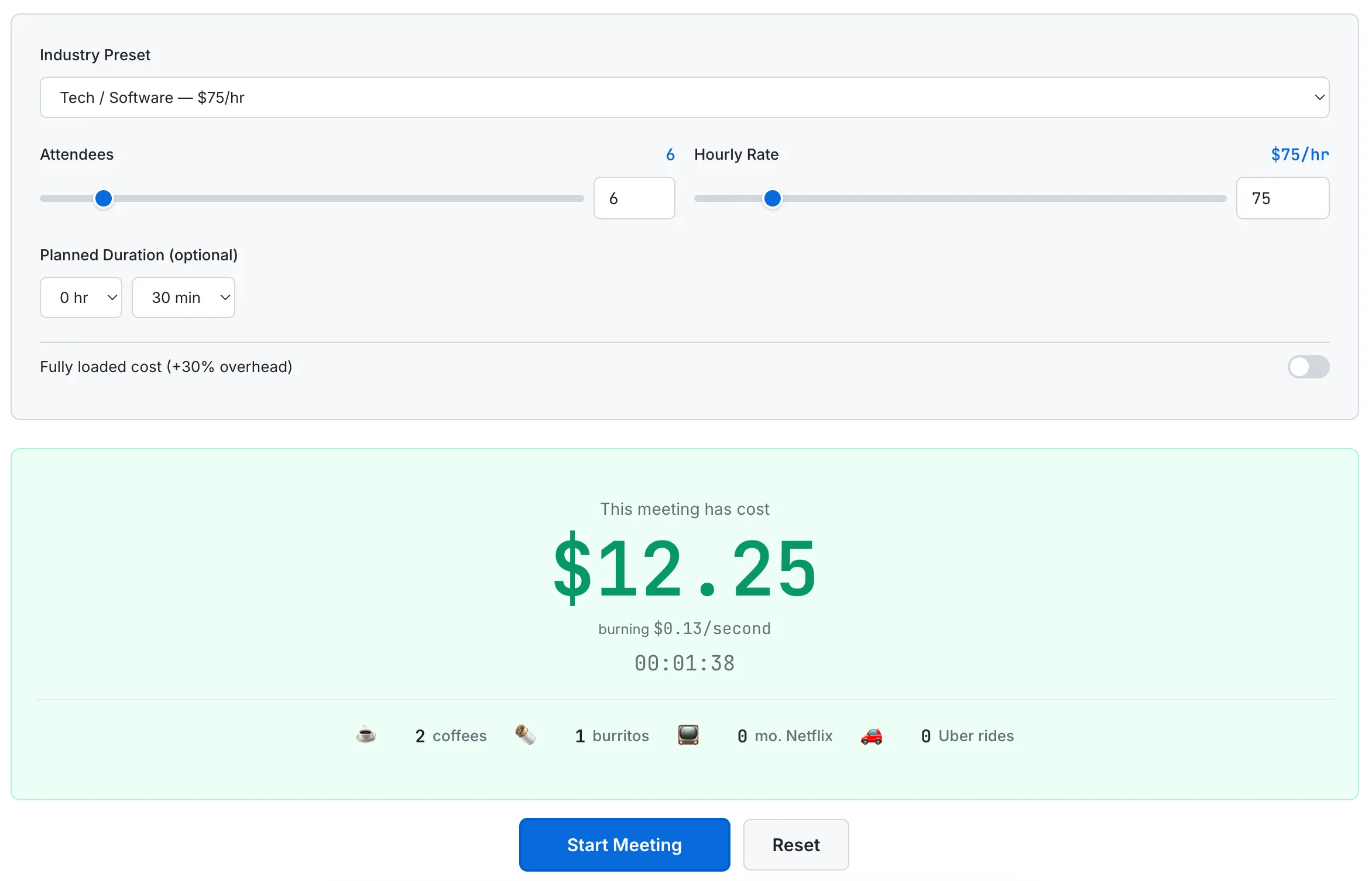
SudoTool Meeting Cost Calculator — runs the cost ticker in real time so the invisible price of sync becomes visible. Free, no signup.
That measurement is the first concrete step. Once you know the dollar cost of every recurring meeting, run the four-axis rubric on the most expensive ones first. Async candidates move to GitLab/Doist/Buffer-style patterns. Sync that survives gets the hygiene rules. Measure, prioritize, apply — the difference between vibes-based async and evidence-based migration.
This guide is general productivity guidance, not personalized HR or legal advice. Empirical research cited (Chauvin et al. 2024, Yang et al. 2022, Wang et al. 2024, Microsoft Worklab 2025) reflects specific samples and time periods. Process examples (GitLab, Doist, Automattic, Buffer, Atlassian) are single-company self-reports, not controlled comparisons. Company culture, team distribution, and labor laws vary widely — applying any of this to your team requires judgment.
- Chauvin, Choudhury & Pan Fang (2024) — Working Around the Clock: Temporal Distance, Intrafirm Communication, and Time Shifting of the Employee Workday, Organization Science 35(5), 1660–1681.
- Yang, Holtz, Jaffe, Suri et al. (2022) — The effects of remote work on collaboration among information workers, Nature Human Behaviour 6:43–54, DOI 10.1038/s41562-021-01196-4.
- Wang, Qiu, Cranshaw & Zhang (2024) — Meeting Bridges: Designing Information Artifacts that Bridge from Synchronous Meetings to Asynchronous Collaboration, PACMHCI / CSCW 2024.
- HBS Working Knowledge — Global Talent, Local Obstacles: Why Time Zones Matter in Remote Work (2024).
- Microsoft Worklab — Breaking Down the Infinite Workday (June 2025 Special Report).
- GitLab Handbook — How to embrace asynchronous communication, Non-linear workday, All-Remote Meetings.
- Doist — What is asynchronous communication?, How to move your team toward async-first communication, How Doist Works Remote.
- distributed.blog — Distributed FAQ: P2 (Automattic).
- Buffer — 2023 State of Remote Work, Team Building Across Six Time Zones.
- Atlassian — Loom Challenge: Atlassian Meeting Research, Intentional Togetherness Research, State of Teams 2025.
- Fortune — Atlassian: Remote Work, But Only in the Right Time Zones (December 21, 2023).
- CBS News — Unnecessary meetings cost big companies $100 million annually (Rogelberg/Otter.ai 2022 survey coverage).
- Perlow, Hadley & Eun (2017) — Stop the Meeting Madness, Harvard Business Review July–August 2017.