How to Run Effective Remote Standups: The 2020 Scrum Guide, the Empirical Evidence, and a 5-Question Audit
How to run effective remote standups in 2026 — most teams are still running a format Scrum officially removed five years ago, and the peer-reviewed research says the cost is conditional on a culture most teams don't have.
The daily standup format you were taught — yesterday, today, blockers — was officially removed from Scrum five years ago. The 2020 Scrum Guide's revisions log states it in one line: "removed Daily Scrum questions." The replacement: "The Developers can select whatever structure and techniques they want" (scrumguides.org). Yet a new SaaS productivity post arrives every week evangelizing the three questions as the essence of agile, while five engineers sit through a 30-minute standup that costs roughly $50,000 a year reporting yesterday/today/blockers to a manager.
Stray, Sjøberg, and Dybå's 2016 grounded-theory study in the Journal of Systems and Software documented this mismatch across 12 software teams: status reporting to the manager was the largest driver of negative attitudes. Rietze and Zacher's 2025 follow-up reaches the same conclusion — daily stand-ups improve team performance only when psychological safety mediates the effect. Two peer-reviewed papers, nine years apart, same picture: standups help conditionally.
How to Run Effective Remote Standups Starts with the History You Were Not Taught
The "agile daily ritual" most teams know is the fusion of two separate practices. The Agile Alliance's Daily Meeting glossary entry documents the timeline: "1997: Ken Schwaber describes the 'daily scrum'"; "1998: the 'daily stand-up' is listed as one of the core practices in Extreme Programming"; "2000: the 'three questions' of Scrum's daily meeting format are largely adopted by Extreme Programming teams." Daily Scrum (Schwaber) and Daily Stand-up (XP, Kent Beck) had separate origins and merged around 2000. The standing posture is XP heritage — attributed to Extreme Programming, "which recommended participants stand up to encourage keeping the meeting short."
The decisive change is the 2020 Scrum Guide. It defines Daily Scrum as "a 15-minute event for the Developers of the Scrum Team," with the purpose "to inspect progress toward the Sprint Goal." Then the load-bearing line: "The Developers can select whatever structure and techniques they want." The event is for Developers; the purpose is Sprint Goal progress, not manager-fronted status; the structure is explicitly unprescribed. The yesterday/today/blockers template still on company wikis is a 1998–2000 artifact the 2020 Scrum Guide explicitly removed.
What the Empirical Evidence Actually Shows
Be honest first: peer-reviewed research on standups is thin. RCT evidence is essentially absent. Two empirical anchors plus one quantitative follow-up — that is the entire base.
The anchor is Stray, Sjøberg, and Dybå (2016): a grounded-theory study of 12 software teams in Malaysia, Norway, Poland, and the UK — 60 interviews, 79 observations. Abstract verbatim: "The factors that contributed the most to a positive attitude... were information sharing with the team and the opportunity to discuss and solve problems. The factors that contributed the most to a negative attitude were status reporting to the manager and that the frequency of the meeting was perceived to be too high and the duration too long." That description matches the typical SaaS-prescribed standup. One developer put it plainly: "I don't like those meetings. It is kind of reporting. You have to report every single day." The same paper reports an aggregate brevity effect — standing teams averaged 12 minutes; sitting teams 19.
A peer-reviewed follow-up appeared in IEEE Software in 2020 — Stray, Moe, and Sjøberg, "Daily Stand-Up Meetings: Start Breaking the Rules," 37(3), 70–77 (arXiv preprint 1808.07650 from 2018; peer-reviewed publication 2020). It studied 15 teams across five countries and recommended teams adapt frequency, duration, and format to context rather than enforce a fixed prescription.
The most recent addition is Rietze and Zacher 2025: a two-wave online survey of 318 employees plus an experiment (n=108). Abstract: daily stand-up meetings "are directly and positively related to psychological safety, and indirectly and positively related to work satisfaction and team performance perceptions via psychological safety." Productivity benefits flow through psychological safety. In a status-reporting culture, the mediator does not engage and the effect does not appear.
Across nine years and three studies the message converges: standups help conditionally — status-reporting framing absent, format adapted to the team, psychological safety present. Conditional effect, not unconditional uplift.
The Hidden Cost: Standup Math Most Teams Never Run
Calculate the cheapest case. Five engineers × 15 min × 5 days × 50 weeks ≈ 312 person-hours/year. A $120,000 base salary ÷ 2,000 working hours = $60/hour; × 1.3 fully-loaded multiplier (benefits, payroll tax, overhead) ≈ $78/hour. 312 × $78 ≈ $24,300/year.
The cheapest case is rare. Stray 2016 documented sitting standups averaging 19 minutes; plenty of teams run 30. A 30-minute version of the 5-engineer team is roughly $48,000/year; an 8-engineer 30-minute team near $78,000 — a $24K-to-$50K annual cost range depending on whether your standup stays in its timebox.
Direct cost is the floor. Programmers take 10–15 minutes to resume editing code after an interruption — Parnin's data, 10,000 sessions across 85 programmers, summarized in Programmer, Interrupted (Game Developer 2013, based on Parnin & Rugaber's Software Quality Journal 19(1), 2011). The widely cited "23-minute" figure attributed to Gloria Mark has no peer-reviewed source — see our deep work for software developers post for the fact-check. Five engineers losing the midpoint 12 minutes each day adds ~5 person-hours per week of indirect cost. Focus-side analysis is in how to stay focused while working from home. With indirect cost, a 5-engineer 15-minute daily lands roughly $44K; the 30-minute version near $68K — still a meaningful annual line item even at the corrected figure.
For a precise figure on your team's specific headcount and rates, the meeting cost calculator runs the numbers in real time. Doist's "When to Take Real-time Meetings Async": "An hour-long weekly team standup for our 12-person team would cost 12 hours of work per week (that's 624 hours for the year)." Microsoft's Breaking Down the Infinite Workday 2025 telemetry: workers already receive 153 Teams messages and 117 emails per weekday. Sync time is not scarce. Cost case reinforced in our true cost of meetings companion.
Five Questions Before Scheduling Daily Sync Standup
Make the cadence decision audit-based, not vibe-based.
1. Are real, daily-novel blockers actually surfacing? Pull a month of standup transcripts. Count blockers that surfaced only in standup. In most teams the answer is zero to two per month — a daily generating one blocker-unblock event a fortnight is checking, not unblocking.
2. Does the team span more than four time zones? Chauvin, Choudhury, and Pan Fang's 2024 Organization Science study (12,038 Fortune 100 employees) found 43% of synchronous communication already occurs when at least one participant is outside their local business hours. Past four hours of spread, daily sync systematically taxes someone's evening. City-pair math is in our guide to managing time zones in remote teams.
3. Is work coupling tight? Are two or more engineers working the same code path on the same day? Microservice teams with clean boundaries rarely need daily coordination; monolith teams with frequent merge conflicts do.
4. Are you in an active phase — incident, launch, or kickoff? Daily sync is defensible during active phases; steady-state rarely justifies it.
5. Is psychological safety actually present? Rietze and Zacher 2025's mediation finding applied. In low-trust teams the meeting is theater — people answer for the manager; real blockers surface only in 1:1s.
Mostly no? Kill the daily; replace with async written daily plus a weekly sync. Mostly yes? Apply the hygiene rules below. Mixed? Hybrid. Re-run the audit once a quarter — cadence should change with phase, not stay frozen.
Format Spectrum: Pick by Need, Not Default
Four formats, each with a context where it wins.
Sync daily, 15-minute hard cap. Audit mostly yes — tight-coupled work, under four hours of spread, active phase or still-forming team. Atlassian's Team Playbook: "Stand up! Yes, even if you're on a video conference call." Their three prompts replace yesterday/today/blockers — "Since the last Stand-up, I have…", "Before the next Stand-up, I will…", "What's slowing me down is…"
Async written daily. Distributed work, more than four time zones, mature team, rare daily blockers. Slack bots (Geekbot, Friday, Standuply, Polly) push prompts; native Slack workflows or Microsoft Teams polls cover the same job at zero cost. Format the response as a decision log, not a status report.
Weekly sync, 30 to 45 minutes. Mature team, slow-moving work, async-default culture. Doist anchors this in "The Flipped Meeting Model": "At Doist, each team has a weekly snippets thread where we post our top level priorities for the month, what we did last week, and what we're focusing on this week."
Hybrid: async written daily plus one or two weekly sync sessions. The most common honest fit for mixed audit answers. Async covers checking-in and blocker surfacing; the weekly sync reserves time for topics that genuinely need real-time discussion. Only works with an explicit escalation rule.
The deeper layer — when async-default versus sync-default is the right mode — is in the sister post on async vs sync communication for remote teams.
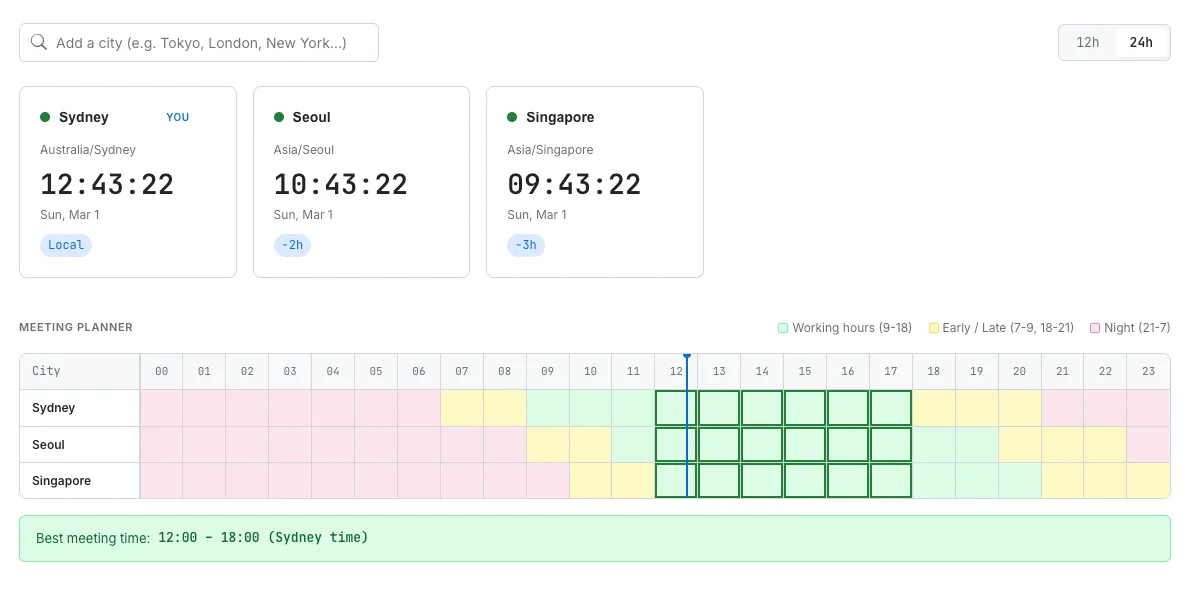
SudoTool's World Clock — once your team spreads past four time zones, daily sync standup systematically takes someone's off-hours.
Async Standup Execution: How GitLab and Doist Actually Run It
GitLab employs people across more than 60 countries. Its handbook documents many teams running async standups via Slack plugins like Geekbot. The pattern is team-by-team variation. According to GitLab handbook entries indexed in 2026, the Create team posts in a dedicated Slack channel on an adjustable cadence (per their public issue tracker, the schedule is treated as adjustable per team feedback). That variety is the 2020 Scrum Guide's "Developers can select whatever structure" in organizational form.
Doist reports a 95%-async culture; their standup is the weekly snippets thread. Atlassian's own Team Playbook directly recommends async for distributed teams: "Working in different time zones? Do an asynchronous Stand-up with your team on your preferred communication platform where everyone can write down and submit their updates."
Five operational rules. Time-bound posting windows in each person's local time. Format as decision log, not status report. Threading — each update is a thread; replies live in it. No read-receipt expectation; manager grading on responsiveness collapses async into sync pressure. An explicit weekly sync escalation rule. Tools enforce rules but do not create culture. As of 2026, async standup tooling is commodity — Geekbot ~$2.50 per user/month, Friday $4–6, Standuply $2–3.50, Polly $12, plus zero-cost native Slack workflows.
Sync Standup Execution: When You Do It, Make 15 Minutes Worth Paying For
Eight hygiene rules — each backed by a verifiable primary citation.
1. Fifteen-minute hard cap. Locked by both the 2020 Scrum Guide and the Atlassian Team Playbook. Hard timer; when it rings, the next topic goes to the parking lot.
2. Replace yesterday/today/blockers with progress-and-blocker framing. Use Atlassian's three prompts ("Since the last Stand-up, I have…" / "Before the next Stand-up, I will…" / "What's slowing me down is…") to keep the meeting on Sprint Goal progress rather than reporting.
3. Stand up — or use a hard timer. Atlassian: "Stand up! Yes, even if you're on a video conference call." Stray 2016's aggregate — standing teams averaged 12 minutes; sitting teams 19 — is XP's original rationale in measured form.
4. Record for absent zones. The GitLab all-remote meetings handbook: "Upload recording... within 12 hours after the meeting to allow for async consumption for people in different time zones."
5. Capture decisions in writing afterward. Whatever is decided goes into the handbook, project doc, or Slack channel. Wang, Qiu, Cranshaw, and Zhang's 2024 PACMHCI/CSCW paper on "meeting bridges" identifies five post-meeting use cases (archive, task reminders, onboarding, group sensemaking, launching point).
6. Same time and same place every day. 2020 Scrum Guide verbatim: "To reduce complexity, it is held at the same time and place every working day of the Sprint."
7. Parking lot for off-topic. Agile Alliance verbatim: "any topic that starts a discussion is cut short, added to a 'parking lot' list, and discussed in greater depth after the meeting."
8. Do not schedule outside business hours. Atlassian's Loom blog stand-up guide: "Try to avoid scheduling meetings before or after hours for team members." Chauvin 2024's 43% off-hours figure is the floor; hygiene pushes it toward zero.
When Sync Standup Is Genuinely the Right Call
Async universalism is a different kind of dishonesty. Yang, Holtz, Jaffe, Suri et al. 2022 in Nature Human Behaviour studied 61,182 US Microsoft employees during the early-2020 firm-wide remote shift and found collaboration networks became "more static and siloed, with fewer bridges between disparate parts." Pure async has its own failure mode.
Five contexts where sync daily is genuinely defensible — each temporary.
1. New team forming, weeks one and two. Atlassian's Intentional Togetherness research: "team gatherings had the largest impact on team connection, with boosts averaging 27%."
2. Cross-functional dependency in flight. Daily handoff between Operations, Engineering, Product. Doist's async-first migration guide: "Generally, meetings are best for sensitive subjects, issues that will require lots of follow-up questions, kickoffs that bring a team together around a new project timeline, and 1-to-1s between a manager and a report."
3. Incident response or war room. Decision velocity is in minutes — async cannot operate at that latency.
4. Onboarding day-1. A mentor sits with the new hire in sync; from day two, the handbook takes over.
5. Tightly-coupled product launch, one or two weeks before ship. Cadence drops back to weekly when the launch ends.
GitLab's handbook locks the framing: "Highly capable asynchronous work still allows for, and includes at appropriate moments, some synchronous discussion. Async is very powerful for GitLab, but not an absolute." Async-first means reserving sync for moments that earn it, not abolishing it.
A Working Recipe
Condense the evidence into four steps.
Step 1 — Audit. Apply the five questions. Write the answers down.
Step 2 — Pick a format. Mostly yes → sync daily, 15-minute hard cap. Mostly no → async written daily plus weekly sync. Mixed → hybrid. Note the reasoning in one line — you will need it next quarter.
Step 3 — Execute. Sync daily uses the eight hygiene rules. Async daily uses the five operational rules. Hybrid requires an explicit "what gets escalated from async to sync" definition; without it, hybrid drifts toward the worst of both.
Step 4 — Re-audit quarterly. Active phase ended? Daily drops to weekly. New cross-functional collaboration started? Weekly moves up.
Default is zero; cadence is added only when audit justifies it. That is the closest faithful application of the 2020 Scrum Guide's "Developers can select whatever structure" — evidence-driven, audit-based, periodically re-evaluated. Twelve hours a week in standup is either deserved cost or inherited theater. The five-question audit tells you which.
This guide is general productivity guidance, not personalized HR or Scrum-coaching advice. Empirical research cited (Stray et al. 2016, Stray, Moe, and Sjøberg 2020, Rietze and Zacher 2025, Chauvin et al. 2024, Yang et al. 2022) reflects specific samples and time periods. Process examples (GitLab, Doist, Atlassian) are single-company self-reports, not controlled comparisons. Team size, distribution, and culture vary widely — applying any of this to your team requires judgment.
- Schwaber, K. & Sutherland, J. (2020) — The 2020 Scrum Guide™ (scrumguides.org).
- Scrum Guide Revisions Log — Changes between 2017 and 2020 Scrum Guides (scrumguides.org).
- Agile Alliance — Daily Meeting / Daily Standup glossary entry.
- Stray, V., Sjøberg, D. I. K., & Dybå, T. (2016) — The daily stand-up meeting: A grounded theory study, Journal of Systems and Software, 114, 101–124.
- Stray, V., Moe, N. B., & Sjøberg, D. I. K. (2020) — Daily Stand-Up Meetings: Start Breaking the Rules, IEEE Software, 37(3), 70–77 (arXiv preprint 1808.07650, 2018).
- Rietze, S. & Zacher, H. (2025) — Relations between daily stand-up meetings, work satisfaction, and team performance perceptions: the role of psychological safety, European Journal of Work and Organizational Psychology, 34(5), 565–582.
- Chauvin, J., Choudhury, P., & Pan Fang, T. (2024) — Working Around the Clock: Temporal Distance, Intrafirm Communication, and Time Shifting of the Employee Workday, Organization Science, 35(5), 1660–1681.
- Yang, L., Holtz, D., Jaffe, S., Suri, S., et al. (2022) — The effects of remote work on collaboration among information workers, Nature Human Behaviour 6:43–54, DOI 10.1038/s41562-021-01196-4.
- Wang, R., Qiu, L., Cranshaw, J., & Zhang, A. X. (2024) — Meeting Bridges: Designing Information Artifacts that Bridge from Synchronous Meetings to Asynchronous Collaboration, PACMHCI / CSCW 2024.
- Microsoft Worklab — Breaking Down the Infinite Workday (June 2025 Special Report).
- GitLab Handbook — Communication, Asynchronous, All-Remote Meetings.
- Doist — The Flipped Meeting Model, When to Take Real-time Meetings Async, How to Move Your Team Toward Async-First Communication.
- Atlassian — Team Playbook: Stand-ups, Stand-Up Meetings 101 (Loom blog), Intentional Togetherness Research.
- Geekbot — Asynchronous Standup in Slack (case studies); Standuply.