How to Stay Focused While Working from Home: The Cognitive Science
Microsoft says the average knowledge worker is interrupted every two minutes. Here's how to stay focused while working from home — what the cognitive science actually says, and the highest-ROI defenses.
In the thirty seconds since you started reading this, a notification has probably already gone off somewhere on your devices. Microsoft's June 2025 Work Trend Index Special Report, drawn from Microsoft 365 telemetry, reports that "employees…are interrupted every 2 minutes by a meeting, email, or notification," for "275 times a day." Averages, not outliers. The question of how to stay focused while working from home isn't a willpower question; it's an environment-design question, and the environment is built to interrupt you every 120 seconds.
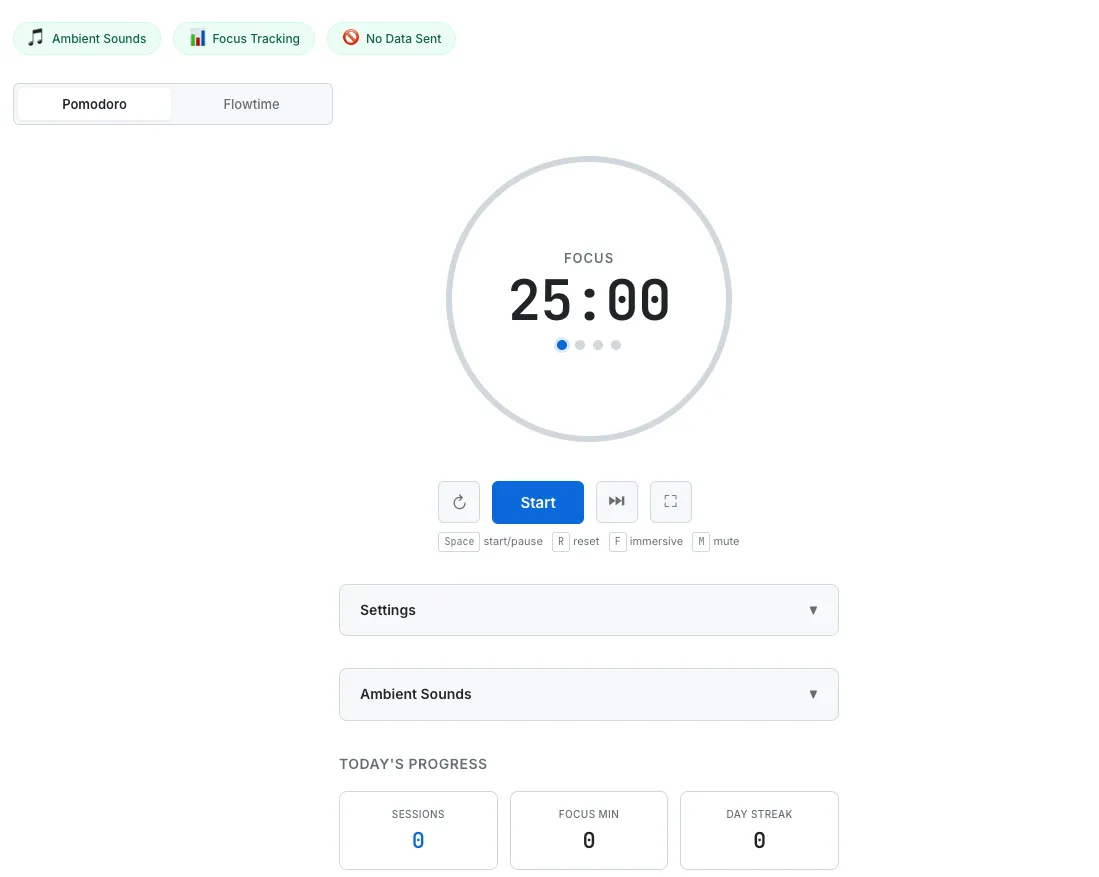
This guide covers the WFH paradox (Bloom's data shows it can match or beat office work, but only conditionally), the cognitive science of interruption, five WFH-specific failure modes with the defense for each, honest evidence on Pomodoro, environment design, and a defense map ranked by effort-to-value. To start a 25-minute focus block right now, our Pomodoro Timer runs in your browser with no signup.
The WFH Paradox — Why Staying Focused While Working from Home Is Conditional, Not Automatic
The most-cited WFH RCT is Nicholas Bloom's 2015 QJE paper with Ctrip's call center: "Home working led to a 13% performance increase…9% was from working more minutes per shift…and 4% from more calls per minute." Strong number, but the work was a defined-output job. Bloom's 2024 Nature paper with Han and Liang tested knowledge workers — a 1,612-person, six-month RCT comparing two-day hybrid against five-day office: "a hybrid schedule with two days a week working from home does not damage performance," with "improved job satisfaction and reduced quit rates by one-third." Managers' pre-experiment forecast of −2.6% reversed to +1.0% afterward. Full remote looks different: Yang et al. 2022 in Nature Human Behaviour reported that the firm-wide remote shift at Microsoft cut cross-group collaboration by about 25% and siloed networks. The "13% boost" is conditional on task type, days per week, and how the work is structured — and the rest of this guide is about the structure.
Why Focus Is Harder Than You Think — The Cognitive Science
Sophie Leroy (University of Washington Bothell) named "attention residue" in her 2009 OBHDP paper: when you switch tasks, "part of our attention often stays with the prior task," leaving fewer cognitive resources for the next one — worst when Task A is unfinished. Leroy's 2018 follow-up with Theresa Glomb showed that a one-minute "where I am, what's next" note before stopping cuts the residue: "people who have done the ready-to-resume plan make better decisions, and recall more information." That 30-second note is the cognitive mechanism behind a well-run Pomodoro break.
UC Irvine's Gloria Mark has tracked screen-attention for two decades. Per her UC interview, average attention at modern displays dropped from "75 seconds" in 2012 to "47 seconds" in recent years. Recovery-time figures Mark mentions in interviews ("about 25 and a half minutes" in the same UC source; the often-quoted "23 minutes 15 seconds" elsewhere) do not appear in her peer-reviewed papers — see our multitasking myth post for the fact-check. The peer-reviewed contribution from Mark's group is Mark, Gudith & Klocke 2008 CHI: interrupted workers compensate by speed but pay in stress, frustration, and effort. The mechanism behind these costs is established in Rubinstein, Meyer & Evans 2001 task-switching research. Cal Newport's Deep Work framing — "focusing without distraction on a cognitively demanding task" — sits on top of that literature.
WFH Failure Mode 1 — No Commute, No Transition
Commuting was an industrial-revolution accident that became a useful liminal space — a buffer between home and work. Psychological detachment is documented as protective for sleep, mood, stress, and next-day performance. WFH erases the buffer, and most people don't replace it. In a September 2020 Microsoft 365 blog summarizing internal research not peer-reviewed, Microsoft piloted a chatbot with start-of-day and end-of-day prompts: "6 in 10 people (61%) felt they were more productive," and "productivity increased between 12 and 15%." Suggestive, not definitive — the broader literature, going back to Sonnentag and Fritz's 2007 Recovery Experience Questionnaire, supports the same mechanism.
Defense — design a transition ritual. A small ritual whose only job is to mark the cognitive transition the commute used to mark for free. A 5–10-minute walk before starting work, no phone. The same walk to close the day, with the laptop closed and out of sight. A clear marker for "now I'm working" — change clothes, sit at a designated chair, start a timer. Consistency matters more than content.
WFH Failure Mode 2 — Async Fatigue and the Infinite Workday
The Microsoft 2025 numbers capture the texture of a remote workday: "117 emails daily," "153 Teams messages per weekday," "48% (and 52% of leaders) say their work feels chaotic and fragmented," "meetings after 8 pm are up 16% year over year," and "Nearly a third of meetings now span multiple time zones—up 35% since 2021." The "infinite workday" — nine-to-five eroded by async messaging dripping through twenty-four hours.
Mark, Iqbal, and Czerwinski's 2016 ACM CHI paper (40 workers, 12 workdays) reported that "the longer daily time spent on email, the lower was perceived productivity," and that self-initiated checkers report higher productivity than notification-driven ones. Critically: "Batching email is associated with higher rated productivity…but despite widespread claims, we found no evidence that batching email leads to lower stress." Batching helps perceived productivity; it does not by itself reduce stress. An older Mark study at UC Irvine cut email entirely for 13 subjects: email users sat in "a steady 'high alert' state, with more constant heart rates," while subjects without email had "more natural, variable heart rates" — what physiology calls increased heart rate variability and lower autonomic stress load.
Defense. Push notifications off at the OS level (exceptions only for phone, SMS, urgent calendar). Email batched into one to three calendar windows; a self-promise is undermined by attention residue, but a calendar block is robust. Slack and Teams "do not disturb" outside working hours. Use send-later for off-hours email so you don't push your hours onto colleagues.
WFH Failure Mode 3 — Household Interruptions
Peer-reviewed COVID-era research quantified the household side. Galanti et al. 2022 in Ergonomics documented mental-health effects from environmental interruptions. Hartner-Tiefenthaler et al. 2022 (283 Austrian remote workers): "mothers' representations about WFH emphasize perceived incompatibility between the work and non-work sphere whereas fathers' representations highlight work-family facilitation" — a gendered representation gap. Gibbs, Mengel, and Siemroth's BFI Working Paper 2021-56 on more than 10,000 IT professionals during 2020 found productivity declined by 8–19% across the full sample, with at-home parents taking a larger sub-finding hit. According to a secondary review of the BFI paper, the gender-by-parental-status interaction has subtleties that have been over-stated in popular reporting — the "WFH is especially harsh on mothers" framing goes beyond what the paper concluded.
The Bright Horizons Modern Family Index 2024 (2,000 U.S. working parents) reports 76% say work focus is tied to the reliability of their children's schedules and 87% experience disruptions when children are home in summer. For most working parents, focus from home isn't an individual hygiene problem — it's an infrastructure one (benefits, public childcare, household labor). No focus listicle solves it.
What individual hygiene can do. Workspace separation — a designated zone, not the bed or couch. Visual signaling — headphones, a closed door, a "do not disturb" sign. Time-box deep vs. shallow work. Honest expectations — eight hours of deep focus with young children at home is close to impossible; the smallest workable unit is a single 25-minute Pomodoro.
WFH Failure Mode 4 — Chronotype and Calendar Mismatch
Working from home offers freedom to align the workday with biology, and most people don't take it. Roenneberg, Pilz, Zerbini, and Winnebeck's 2019 review in Biology summarizes the consensus: "we suggest abandoning the notion that chronotype reflects a stable personal trait in favor of it being a state…sleep improves (is longer) when schedules are organized according to chronotype." The standard instrument is the Munich Chronotype Questionnaire (MCTQ), created in 2002 by Till Roenneberg and Martha Merrow at LMU Munich. Forcing a late chronotype onto a 9 AM meeting schedule is the analog of waking them at biological 5 AM every day; over time this produces social jet lag, with documented links to sleep debt, mood disorders, and metabolic risk.
Defense. Identify your chronotype with the MCTQ. Schedule the deep-work block in your prime time — a late chronotype doing analytical work at 9 AM is fighting biology. Audit the calendar against the Microsoft 2025 finding that meetings are drifting both later (16% more after 8 PM) and broader (a third now cross time zones, up 35% since 2021); reserve your peak alertness window before someone else's invitation does. Use Outlook or Google Calendar's named "Focus Time" to decline overlapping requests automatically.
WFH Failure Mode 5 — Blurred Boundaries and Always-On
Sonnentag and Fritz's 2007 paper formalized "psychological detachment" as a measurable construct via the Recovery Experience Questionnaire. Blake et al.'s 2025 longitudinal cohort verbatim: "Psychological detachment from work…is known to be beneficial for wellbeing and life satisfaction," with associations to "mood, energy, compensatory effort, sleep quality, fewer health complaints, wellbeing, and lower stress levels." When the commute disappeared, the external boundary went with it — detachment now has to be produced internally, and the literature points to a clear closing ritual (an act, not a clock time) as the trigger.
Defense. Hard boundary on work apps via iOS Focus or Android Digital Wellbeing. Spatial cue — close the laptop and put it out of sight. Verbal or written closure — a 30-second "what I finished, what I'll start tomorrow" note (same Ready-to-Resume mechanism). Recovery activities — exercise, time with people you care about, hobbies; Sonnentag's four-factor model groups these as "mastery experiences" and "relaxation."
Pomodoro and Time-Blocking — Honest Evidence
The strict RCT evidence for the Pomodoro Technique is thin; the underlying mechanisms are well-supported. Wikipedia: "developed by Francesco Cirillo in the late 1980s," using "a kitchen timer to break work into intervals, typically 25 minutes in length, separated by short breaks." Ogut, 2025 in BMC Medical Education, a single-author scoping review by Eren Ogut, screened 32 studies (three RCTs, five quasi-experimental, 24 observational): "88% of all studies showed positive outcomes," with "approximately 20% lower fatigue, a 0.5-point improvement in distractibility, and a 0.4-point increase in motivation." Three RCTs at a combined n = 87 is small, and most of the 32 studies are self-report. Twenty-five minutes isn't magic — 12/3, 24/6, and 50/10 variants behave similarly.
The mechanisms are stronger than the RCTs. Ultradian rhythm (BRAC): Kleitman's 1950s proposal that the 90-minute REM/NREM cycle has a daytime echo. Wikipedia: "an ultradian rhythm of approximately 90 minutes (80–120 minutes)…of excitement and rest." A 1995 Conroy and O'Reilly review noted that BRAC is detectable in physiology but the mapping onto cognitive output is weaker than the popular framing suggests. Task-switching cost: Pomodoro's defensible value is precommitting for 25 minutes — against Mark's 47-second baseline, a substantial step up. Ready-to-Resume: the break is a natural moment for the 30-second note. Decision fatigue, with caveat: the dopaminergic mechanism is reviewed in Cools 2016, but the headline ego-depletion effect didn't replicate: Hagger et al. 2016 (k = 23, N = 2,141) found "d = 0.04, 95% CI [-0.07, 0.15]" — a null result. Treat "Pomodoro saves you decisions" as plausible mechanism, not RCT-grade evidence.
Pomodoro suits writing, coding, study, and deep analytical work. It doesn't suit meetings, brainstorming, or light admin. 25/5 is a starting point; 50/10 if 25 feels short, 15/3 if household interruptions cap your real focus blocks. The Pomodoro Timer runs a 25/5 cycle in your browser.
Environment Design — Light, Noise, Workspace
Mehta, Zhu, and Cheema 2012 in the Journal of Consumer Research reported verbatim that "a moderate (70 dB) versus low (50 dB) level of ambient noise enhances performance on creative tasks," while "A high level of noise (85 dB), on the other hand, hurts creativity." A quiet office (50 dB) and a busy cafe (70 dB) trade places for creative cognition. The finding is specific to creative work — analytical or detail work probably still benefits from quiet.
Light's effect on alertness is one of the better-replicated findings in chronobiology. Mu et al. 2022 in Neural Regeneration Research (17(9):1929–1936), a 29-study meta-analysis (n = 1,210), reports a positive effect on subjective alertness (SMD = –0.28) and objective alertness (SMD = –0.34), with cold light beating warm (SMD = –0.37). Cajochen et al. 2000: "Half of the maximum alerting response to bright light of 9100 lux was obtained with room light of approximately 100 lux." Sit near a window during daytime, use cool-white temperature (5,000–6,500 K) and pair a desk lamp with overhead light, and switch to warm light in the evening (the sleep side is in Why Am I Tired After 8 Hours of Sleep?).
Reserve the bed for sleep only. Stimulus control therapy, originally developed by Bootzin in 1972 and now a core component of CBT-I, treats the bed as a conditioned cue for sleep. Bootzin's original 1972 rules included "do not read or watch television in the bedroom"; the broader bed-for-sleep-only rule (excluding work) is the now-standard expanded form within current CBT-I guidance. Working from bed undermines sleep conditioning and degrades work itself: slouched posture, laptop heat, distracting comfort. A small dedicated desk is a meaningful spatial cue.
A 25-minute Pomodoro is the smallest robust unit for putting attention residue, task-switching cost, and the Ready-to-Resume effect into one defensible block.
Movement, Breaks, and Sleep
Albulescu et al.'s 2022 PLoS ONE meta-analysis (22 studies, n = 2,335) reports verbatim "statistically significant but small effects of micro-breaks in boosting vigor (d = .36, p < .001)…reducing fatigue (d = .35, p < .001)…a non-significant effect on increasing overall performance (d = .16, p = .116)." Micro-breaks help well-being meaningfully and performance modestly; claims like "a 10-minute break boosts productivity 30%" outrun the evidence. Microsoft Human Factors Lab's EEG study (14 subjects, internal Microsoft research, not peer-reviewed) reports "in two straight hours of back-to-back meetings, the average activity of beta waves—those associated with stress—increased over time." Plausible mechanism, small sample. The most modifiable WFH change: build breathing room between meetings — Outlook and Google Calendar both offer "end meetings five minutes early."
Focus advice without sleep is malpractice. Pankowska et al. 2023 (CDC PCD) reports that approximately one-third of U.S. adults self-report short sleep (under seven hours). A companion Ramos, Wheaton, Johnson commentary: "Inadequate sleep disrupts critical neural processes and impairs cognitive functioning." WFH-specific risks: an erased commute becomes "I can stay up later because I can sleep in," feeding social jet lag; a bedroom that doubles as an office breaks sleep conditioning. When focus disappears, suspect sleep before caffeine. Sister coverage: How to Fall Asleep Faster and How to Reset Your Sleep Schedule.
The Multitasking Debunk — You're Probably Not a Supertasker
Watson and Strayer's 2010 paper (200 participants, driving simulator + OSPAN dual-task) found most subjects show clear performance decrements; about 2.5% — the "supertaskers" — perform equivalently in dual and single conditions, with Monte Carlo simulation confirming the proportion exceeds chance. If you feel you're an excellent multitasker, the odds (roughly 97.5%) say you're not. Multitasking as empirical statistic, not moral prescription.
Practical Defense Map — Threats to Defenses by ROI
Tier 1 (automatic, set once): notifications off across nearly every app at the OS level; a "Focus Time" calendar block on your peak alertness window; "end meetings five minutes early" enabled in Outlook or Google Calendar; Slack and Teams "do not disturb" outside working hours.
Tier 2 (small effort, big value): a single 25-minute Pomodoro on the day's most-avoided task; email batching with one to three calendar windows; a 5–10-minute walk to start and end the workday; workspace separation — no work from bed or couch.
Tier 3 (active hygiene): take the MCTQ and schedule deep work in your prime window; a closing ritual that combines putting the laptop away with a 30-second "what I finished, what I'll start tomorrow" note; light and noise calibration (window seat, cool-white desk lamp, 70 dB ambient for creative work or quiet for analytical); audit sleep before reaching for caffeine.
Tier 4 (household and system-level): honest acknowledgement that childcare is infrastructure, not focus advice; negotiate async-default norms — async first, sync with a clear agenda; push for "no-meeting blocks" at the team level. The true cost of meetings goes deeper.
The Honest Bottom Line
Focus while working from home is an environmental problem, not a willpower problem. The environment recovers most of what it loses if you turn off notifications, run a single 25-minute commitment, and end the day with a clear closing act. Productivity-porn lists promise that ten hacks let you crush nine hours of deep work; the data don't support that. What the data do support is modest and reliable: shave a single 25-minute interruption-recovery cost off your day, replace one 47-second attention span with a 25-minute commit, batch email instead of letting it interrupt continuously — and you have measurable gains in the direction of Bloom's 13%, Ogut's 20% lower fatigue, and Albulescu's d = 0.35 vigor effect.
None of this needs to happen at once. If today's only experiment is a single 25-minute Pomodoro — notifications off, one task, five-minute break with a 30-second "where I left off, what's next" note — that single block addresses attention residue, task-switching cost, and the Ready-to-Resume mechanism in one action. The Pomodoro Timer below is exactly that.
Frequently Asked Questions
How do I stay focused while working from home?
Treat it as environment design, not willpower. The five highest-ROI defenses: turn notifications off at the OS level, run a single 25-minute Pomodoro on the day's most-avoided task, build a 5–10-minute transition ritual to start and end the workday, schedule deep work in your chronotype's prime window, and close the day with a 30-second note on what you finished and what comes next.
How often are remote workers interrupted?
Microsoft's June 2025 Work Trend Index, drawn from Microsoft 365 telemetry, reports that employees are interrupted every 2 minutes by a meeting, email, or notification — 275 times a day — alongside 117 daily emails and 153 Teams messages per weekday. UC Irvine's Gloria Mark finds average attention at modern displays is about 47 seconds before switching.
Is working from home bad for productivity?
Not automatically — it's conditional. Bloom's 2015 randomized trial found a 13% performance increase for call-center work, and his 2024 Nature study of 1,612 knowledge workers found two-day-a-week hybrid did not damage performance while cutting quit rates by one-third. Full remote is where collaboration costs show: Yang et al. 2022 found Microsoft's firm-wide remote shift cut cross-group collaboration by about 25%.
Does the Pomodoro Technique actually work?
The mechanisms are better supported than the technique itself. A 2025 scoping review of 32 studies found 88% reported positive outcomes — including approximately 20% lower fatigue — but only three were randomized trials with a combined 87 participants. The defensible value is precommitting to 25 minutes of one task, a large step up from the 47-second average screen attention span. The 25-minute length isn't magic — 12/3, 24/6, and 50/10 variants behave similarly.
What is attention residue and how do you prevent it?
Attention residue is Sophie Leroy's 2009 finding that part of your attention stays with a prior task after you switch, leaving fewer cognitive resources for the next one — worst when the first task is unfinished. Her 2018 follow-up showed the fix: a one-minute ready-to-resume note (where I am, what's next) written before stopping helps people make better decisions and recall more information afterward.
This article is general productivity education, not medical or clinical advice. The cognitive-science findings cited here are population-level results; individual response varies with chronotype, household composition, role, and underlying health. If persistent fatigue, sleep difficulty, anxiety, or depression are part of the picture, please consult a licensed healthcare professional rather than relying on a focus guide. Working-from-home arrangements differ widely; treat the defenses below as a menu to experiment with, not a prescription.