How to Manage Time Zones in Remote Teams: The Honest Math
How to manage time zones in remote teams — real city-pair overlap math, why DST breaks calendars, and the async-first patterns that actually work.
Your colleague in Sydney sends a Slack message at 19:00 their time. You know that's 04:00 in New York, and the team meeting is booked for 09:00 New York — which is 24:00 Sydney. Somebody is losing sleep every day. Most articles on how to manage time zones in remote teams hand-wave at this with "be flexible." Almost none show the actual math — which city pairs sustain a daily sync, which quietly burn somebody's evenings, and which are mathematically impossible without breaking somebody's week. Microsoft's June 2025 Worklab Special Report, Breaking Down the Infinite Workday, measured it from product telemetry: "nearly a third of meetings now span multiple time zones — up 35% since 2021," and "meetings after 8 pm are up 16% year over year." Time zones aren't a problem you grow out of; they're a structural cost of distributed work, and it's growing.
Australia/Sydney. A per-teammate timezone strip plus overlap calculator covers 90% of the problem; you don't need a SaaS subscription.
The Math: How Much Sync Time You Actually Have to Manage Time Zones in Remote Teams
Define "business hours" as 09:00–17:00 local. Sync only counts when both sides are inside their BH simultaneously — no sacrificing evenings or early mornings.
NY-Berlin: a generous two-hour window
NY is UTC−5/−4; Berlin is UTC+1/+2. Standard difference: 6 hours. Overlap: NY 09:00 = Berlin 15:00, NY 11:00 = Berlin 17:00 — a clean two-hour slot, daily standup feasible. The catch: those two hours are also the only time either side can do high-bandwidth collaborative work, so they fill with meetings instead of focus time.
SF-Tokyo: zero normal-hours overlap
SF is UTC−8/−7; Tokyo is UTC+9 year-round (no DST). Difference: 16–17 hours. SF 09:00 is Tokyo 02:00 the next day; SF 17:00 is Tokyo 10:00 the next morning. Overlap inside business hours: zero. A daily standup forces somebody onto a permanent night shift. Async-first isn't a preference here — it's the only sustainable answer.
NY-Sydney: a 15-hour baseline that step-changes four times a year
The worst pair to schedule a recurring meeting on, because the difference oscillates four times a year as the U.S. and Australia transition into and out of DST on different dates:
- Both standard: EST (UTC−5) + AEST (UTC+10) = 15 hours, Sydney ahead.
- NY DST, Sydney standard (~3 weeks, mid-March to early April): EDT + AEST = 14 hours.
- Both DST (~4 weeks, early October to early November): EDT + AEDT = 15 hours.
- NY standard, Sydney DST (~4 months, the longest segment): EST + AEDT = 16 hours.
The gap oscillates 14h / 15h / 15h / 16h across four step changes per year. NewYork.com.au for 2026: "in 2026 the clocks in New York will move forward on the night of Sunday, 8 March. States observing daylight savings time in Australia will turn their clock back one hour on the night of Sunday, 5 April." A meeting fixed at the same wall-clock time drifts by an hour for several weeks each year unless you re-anchor it. Business-hours overlap is at most a one-hour margin. Weekly meeting yes; daily standup, no.
London-Sydney: effectively zero
London is UTC+0/+1; Sydney UTC+10/+11. Difference: 9 to 11 hours. At 9 hours, London 09:00 is Sydney 18:00 — Sydney has already left. At 11 hours (southern summer plus British winter), the overlap is zero with no margin. Harder than NY-Sydney. Anyone insisting on a daily sync here is running a burnout pipeline.
| Pair | Standard difference | DST drift | BH overlap (09–17) |
|---|---|---|---|
| NY-Berlin | 6h | ±1h for ~3 weeks | 2h (NY 09–11 / Berlin 15–17) |
| SF-Tokyo | 16–17h (Tokyo no DST) | ±1h with US DST | 0h |
| NY-Sydney | 14–16h (4 step changes/yr) | 14 / 15 / 15 / 16 | 0–1h margin |
| London-Sydney | 9–11h | ±1h with both DST | 0h |
Past six hours of spread, sync-first gets hard. Past nine, daily sync is effectively impossible. Pretending otherwise just decides whose sleep schedule you're going to sacrifice.
Why DST Is Poison for Cross-Country Teams
The U.S. and Australia transition on different dates
U.S. DST follows a clean rule, per Wikipedia: "in the US, daylight saving time starts on the second Sunday in March and ends on the first Sunday in November, with the time changes taking place at 2:00 a.m. local time." (Arizona, Hawaii, and the U.S. territories are internal exceptions.) Australia's rule is the mirror image, six months out of phase — all five DST-observing jurisdictions (NSW, VIC, ACT, TAS, South Australia) start DST on the first Sunday of October and end it on the first Sunday of April. The 2026 transition is October 4 across all five. Queensland, Western Australia, and the Northern Territory don't observe DST.
The six-month offset is exactly why the NY-Sydney difference step-changes four times a year. A meeting fixed at "10:00 AM New York every Tuesday" drifts to "11:00 AM New York" relative to Sydney for several weeks each spring and fall. Microsoft has documented an Outlook bug for exactly this: on the first and last days of DST in either zone, "the time difference between the primary and secondary time zones in the time bar doesn't reflect the DST change," and "calendar events that are scheduled on the day when DST starts or ends... are shown as scheduled for the wrong time." The multi-zone view quietly misleads exactly the people most likely to rely on it.
The U.S. Sunshine Protection Act would lock the country onto permanent DST. Reintroduced January 2025 — Senate S.29 (Sen. Rick Scott), House H.R.139 (Rep. Vern Buchanan). As of May 2026, both remain in committee; neither has passed.
Half-hour and quarter-hour zones break naive math
The world doesn't run on 24 integer time zones. India is UTC+5:30 (Asia/Kolkata) for 1.4 billion people on one clock. Newfoundland, Iran, Afghanistan, Myanmar, central Australia, and the Marquesas Islands all sit on 30-minute offsets. Two zones use 45-minute offsets: Nepal (UTC+5:45) and the Chatham Islands of New Zealand at UTC+12:45 — per Wikipedia: "the Chatham Standard Time Zone is a time zone twelve hours and forty-five minutes ahead of Coordinated Universal Time (UTC) resulting in UTC+12:45." Do timezone arithmetic by hand and you'll send an invite that's 30 minutes off for half of South Asia. Use IANA identifiers and let the database do the math. Our Time Zones Explained walks through why these offsets exist.
IANA tzdata is ground truth
None of the above works without a canonical database. The IANA Time Zone Database contains data that "represent the history of local time for many representative locations around the globe" and "is updated periodically to reflect changes made by political bodies to time zone boundaries, UTC offsets, and daylight-saving rules." iOS, Android, Linux, macOS, Windows, Java, Python pytz, and JavaScript Intl.DateTimeFormat all use it. Identifiers follow the Area/Location form — per Wikipedia: "the timezones have unique names in the form 'Area/Location', e.g., 'America/New_York'." Lebanon delayed DST in March 2023 with one week's notice; every device on Earth needed a tzdata patch within days. Delayed device updates make your calendar start lying.
Async-First Is the Only Honest Answer for More Than Six Hours of Spread
The city-pair math forces this conclusion. Past six hours of spread, async-first isn't a "best practice" — it's the only configuration that doesn't require somebody to systematically work outside their business hours.
The strongest evidence is Chauvin, Choudhury, and Pan Fang (2024), "Working Around the Clock," in Organization Science 35(5), 1660–1681 (DOI 10.1287/orsc.2023.17558). First author Jasmina Chauvin (Georgetown McDonough), with Prithwiraj Choudhury (HBS) and Tommy Pan Fang (Rice). The study analyzes three months of Outlook and Skype telemetry from 12,000+ employees of a Fortune 100 multinational, using DST transitions in one jurisdiction but not another as a natural experiment to isolate the causal effect of a one-hour change in temporal distance.
From Rice News: "a one-hour increase in temporal distance — that is, when daylight saving time occurred in one jurisdiction but not another — reduced synchronous communication by 11%." The HBS Working Knowledge summary: that one-hour loss represented a 19% reduction in sync opportunities, and "on average, 57 percent of synchronous communication took place within employees' business hours, while 43 percent occurred when at least one employee was working outside of local business hours."
The simple read: one extra hour of spread cuts sync 11% and pushes 43% of remaining sync into somebody's evenings. Six hours cuts roughly half the collaboration capacity; nine-plus hours leaves nothing that doesn't break someone's evening. A related baseline — Yang, Holtz, Jaffe, Suri et al. (2021) in Nature Human Behaviour, 61,000+ Microsoft employees in early 2020: "the shift to remote work caused the formal business groups and informal communities within Microsoft to become less interconnected and more siloed." Not timezone-specific, but it's why handbook-first culture matters more for spread teams — without documentation, silos compound.
What async-first actually means in practice
Async-first does not mean "Slack always on" — that's sync's response pressure plus 24/7 deep-work fragmentation, the worst of both worlds. Real async: decisions and policy live in writing first (agenda and RFC written before the meeting); context updates happen in recorded video, not live calls; Slack is awareness with 24-hour response as default; status replaced with daily written or recorded updates anyone catches up on within twelve hours.
Documentation Beats Meetings: The GitLab and Automattic Patterns
The operational core of a distributed team is documentation. Meetings are volatile; a handbook is permanent. GitLab and Automattic are the canonical worked examples.
GitLab publishes a 2,700-page public handbook as single source of truth — "at GitLab, we have people spread across 60+ countries." The non-linear workday page formalizes the philosophy: "the company must work handbook-first, such that all meaningful takeaways from conversations are documented in their proper place, around the clock." The all-remote meetings handbook is blunt: every meeting needs "a single live doc agenda affixed to the calendar invite" — the doctrine summarized as "no agenda, no attenda" — and "you should aim to record all meetings." Attendance becomes optional, because the agenda doc and recording carry the information forward.
Automattic — the company behind WordPress.com — runs internal communication on P2, an internal blog system. From the distributed.blog FAQ: "P2 is the evolution of the blog for the purpose of working within and across teams," "conversations on P2s take place in line, update in real time, and provide space for threaded replies," and "at its core, P2 is organized, searchable knowledge" that "has ultimately evolved into a rich source of institutional wisdom and collective company memory." Every decision lives in a permanent searchable record — no email silos, no Slack volatility.
Atlassian is the third example. Fortune (December 21, 2023) quotes CTO Rajeev Rajan: distributed teams need to "have at least four to six hours of overlap and can reasonably work together across that." Past that, the team can't function as a single collaborative unit. Atlassian's Loom challenge measured the documentation-over-meetings trade — over two weeks, "93% of Atlassians watched a Loom and 43% of Atlassians had a meeting replaced with a Loom," which "freed up 5,000 hours for focused work — which is 2.5 years of working time saved from meetings." Their broader distributed-work research: "today, 92% of Atlassians say flexibility to work from anywhere allows them to do their best work."
Three companies, one conclusion: handbook plus recorded async video plus searchable internal blog is the operational backbone. None of this is a SaaS subscription — it's a culture choice with documentation as the artifact.
Practical Defenses Ranked by Realism
Rotate the burden — meeting times that move
A recurring meeting fixed at NY 09:00 puts the Sydney teammate on a permanent 23:00 commitment every week — same person, every week, sacrificing their evening forever. That's burnout-by-policy. The fix is rotation. GitLab's handbook spells out the pattern: "a team's recurring weekly meetings, alternate between a time which is ideal for EMEA and Eastern AMER (8:00AM Pacific) and a time ideal for APAC and Western AMER (3:00PM Pacific)." 8 AM Pacific one week, 3 PM Pacific the next. No region carries the entire burden permanently. Buffer's team-building post documents the same logic for social time — Buffer hosts "two 'Impromptu Hours' each week, one timed for Europe/Asia/Australia teammates and one for North and South America/Europe folks. We record and share the recordings for those who couldn't attend." Buffer's State of Remote Work (2023, the most recent edition) reports 62% of remote workers have immediate teammates across multiple time zones — alternation isn't a minority concern.
Cap synchronous meetings; default to async
Concrete rules: weekly all-hands record and alternate the slot; one-on-ones schedule inside the natural overlap window; project decisions live in a written RFC plus async comment thread, with meetings only to unblock deadlocked discussion; daily standups become a written or Loom-style video update that anyone catches up on within twelve hours.
Pick one time-format convention and use it everywhere
The classic mistake is "3pm meeting tomorrow" with no zone — the Sydney teammate enters it at their local 15:00 and misses the call. In writing, always specify the zone — "3pm Sydney (AEDT) = 4am New York (EST)" — or use ISO 8601 with UTC: "2026-05-15T05:00Z." In calendar invites, enable the secondary timezone display. For machine-readable contexts, use IANA names (Australia/Sydney, America/New_York, Asia/Kolkata) — "AEST" is ambiguous because Australia uses AEST, ACST, and AWST. This habit alone eliminates roughly 80% of DST-week meeting drift.
Loom and short-form video for context
Short-form recorded video replaces a category of meetings entirely. The recorder doesn't perform live, viewers watch at 1.5x or 2x (a 30-minute discussion becomes 5 minutes), the file is permanent and searchable, and questions stay async. Record when your day allows, watch when theirs does.
When Sync Is Actually Necessary
Async universalism is the opposite kind of dishonesty. Sync wins for real-time creative work where ideas don't yet exist in writeable form (brainstorms, whiteboarding, parts of pair programming); conflict resolution and interpersonal repair, where tone of voice carries the information; kickoffs and onboarding, where misalignment is expensive and relationships don't yet exist; critical decisions where waiting 18 hours for an async reply is itself the failure mode (incident response, outage debug); and social cohesion, where the Yang et al. "more siloed" effect compounds without occasional unstructured time. A meeting cost calculator helps teams budget the synchronous time that earns its keep.
Atlassian's Intentional Togetherness research measured the social-cohesion case: "team gatherings had the largest impact on team connection, with boosts averaging 27%," and on cadence — "the optimal frequency for getting together in person is every four months, or roughly three times per year." Quarterly in-person retreat plus async-default daily work is a defensible hybrid for teams that can afford the travel. GitLab takes the same shape smaller — the handbook encourages new hires to schedule introductory coffee chats with colleagues, though without a required number. Sync when sync is the right tool; async by default. "Daily live meetings" versus "we never meet" is false on both ends.
What You Actually Need (and What You Don't)
Most "team timezone" SaaS products do two things underneath: a per-teammate timezone strip (colleagues' current local times at a glance) and a meeting overlap calculator (business-hours overlap for two cities). That's 90% of what teams actually need. The other 10% — AI scheduling, Slack integrations, dashboards — is over-engineering for most teams.
The genuine minimum: a per-teammate timezone overview, a pair-overlap calculator, automatic IANA-based DST handling so you never add or subtract an hour by hand, and optionally an alert for upcoming DST transitions. If you're doing the math in your head every morning — "is Australia 16 hours ahead now or 17?" — you've spent more time on that calculation in a year than any SaaS subscription costs. But you don't need the SaaS either; you just need the strip.
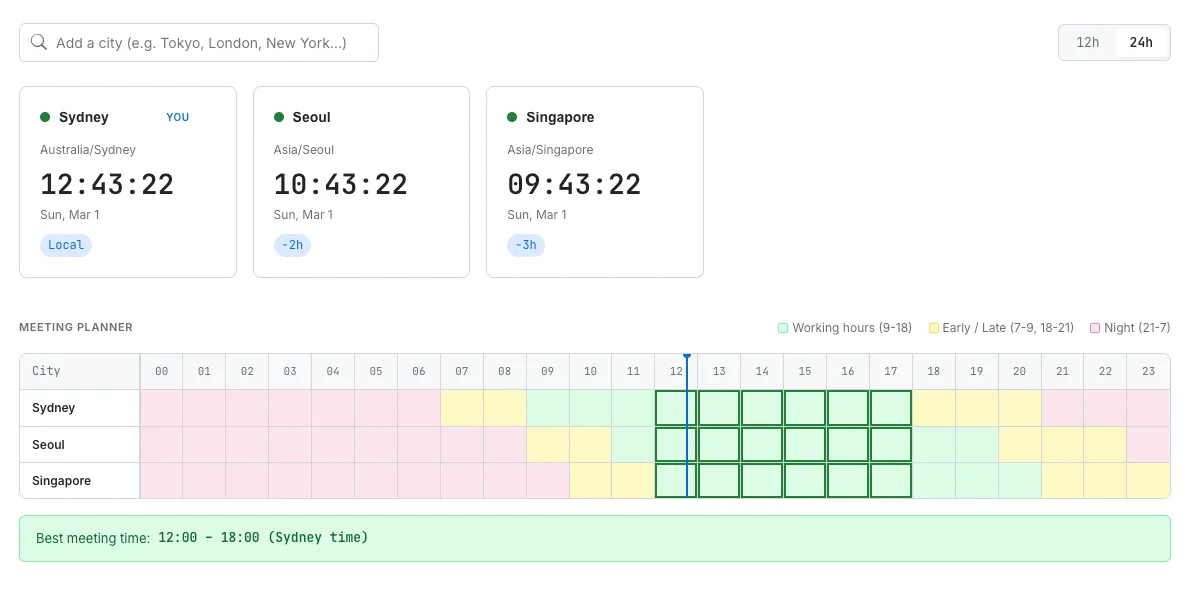
SudoTool World Clock — per-teammate timezone strip plus an overlap planner. Free, local, no signup.
SudoTool's World Clock is exactly that — a per-teammate timezone strip, an overlap window for any pair of cities, and IANA-based DST handling so you never have to think about whether the Sunshine Protection Act passed yet. Free, no signup, your data never leaves the browser. Ten seconds a morning to see who's awake, find a window that doesn't ruin somebody's evening, and get on with the day.
This guide is general productivity guidance, not personalized HR or legal advice. Company culture, time-zone policies, and labor laws vary widely by jurisdiction. The empirical research cited (Chauvin et al. 2024, Yang et al. 2021, the 2025 Microsoft Worklab report) reflects specific samples and time periods — generalizing to your team requires judgment. Tool feature availability changes over time; verify current behavior of any tools mentioned (Outlook, Loom, GitLab handbook, Buffer reports) before relying on them for sensitive coordination.
- Chauvin, Choudhury & Pan Fang (2024) — Working Around the Clock: Temporal Distance, Intrafirm Communication, and Time Shifting of the Employee Workday, Organization Science 35(5), 1660–1681.
- Yang, Holtz, Jaffe, Suri et al. (2021) — The effects of remote work on collaboration among information workers, Nature Human Behaviour, DOI 10.1038/s41562-021-01196-4.
- HBS Working Knowledge — Global Talent, Local Obstacles: Why Time Zones Matter in Remote Work (2024).
- Rice News — The Hidden Cost of Working Across Time Zones (2024).
- Microsoft Worklab — Breaking Down the Infinite Workday (June 2025 Special Report).
- Atlassian — Distributed Work Research.
- Atlassian — Atlassian Meeting Research (Loom Challenge).
- Atlassian — Intentional Togetherness Research.
- Fortune — Atlassian: Remote Work, But Only in the Right Time Zones (December 21, 2023).
- Buffer — 2023 State of Remote Work (most recent edition published).
- Buffer — Team Building Across Six Time Zones.
- GitLab Handbook — How to embrace asynchronous communication.
- GitLab Handbook — Non-linear workday.
- GitLab Handbook — All-Remote Meetings.
- distributed.blog — Distributed FAQ: P2 (Automattic).
- IANA — Time Zone Database.
- Wikipedia — tz database.
- Wikipedia — Daylight saving time in the United States.
- Wikipedia — Daylight saving time in Australia.
- Wikipedia — Chatham Standard Time Zone.
- RBA — Daylight Saving.
- Microsoft Learn — Multiple time zones show an incorrect time difference when DST starts and ends — Outlook.
- NewYork.com.au — Time Difference Between Australia and New York.
- U.S. Congress — Sunshine Protection Act of 2025 (S.29 / H.R.139, 119th Congress, in committee as of May 2026).