Understanding Time Zones: How They Work and Why They Matter
From the 1884 Meridian Conference to UTC, Daylight Saving Time, and the 38+ offsets that actually exist — everything you need to know about how the world keeps time.
Your smartphone displays the correct local time the moment you step off a plane. Your video conferencing app automatically calculates that 3:00 PM in Seoul is 1:00 AM in New York. All of this is possible because the world agreed on a single system for keeping time — time zones. But that system is far more complex than most people realize.
You've probably been taught that the world has 24 time zones. In reality, the number of UTC offsets in active use is more than 38. India uses UTC+5:30, Nepal uses UTC+5:45, and the Line Islands of Kiribati use UTC+14 — the first place on Earth where each new day begins. China spans five geographic time zones but uses only one. France, thanks to its overseas territories, covers 12 time zones — the most of any country in the world.
This guide explains what time zones are, why they were created, how they actually work, and how they affect everyday life and technology. Whether you're a remote worker, a traveler, or a developer, you'll walk away with a clear and accurate understanding of how the world keeps time.
What Is a Time Zone?
A time zone is a geographic region where the same standard time is observed. The Earth rotates 360 degrees in 24 hours, so in theory it can be divided into 24 zones of 15 degrees of longitude each, with a one-hour difference between each zone. That's the basic principle behind time zones.
The reference point for all time zones is UTC (Coordinated Universal Time). UTC is anchored to the Prime Meridian (0° longitude) passing through the Royal Observatory in Greenwich, England, and is calculated as a weighted average of hundreds of cesium atomic clocks worldwide. The cesium-133 atom oscillates exactly 9,192,631,770 times per second, and this is the official definition of one second (adopted by BIPM at the 13th General Conference on Weights and Measures in 1967).
Each time zone is expressed as an offset from UTC. Seoul is UTC+9 (9 hours ahead of UTC), and New York is UTC-5 (5 hours behind UTC). Because UTC itself is not affected by Daylight Saving Time, it serves as the absolute reference point shared by the entire world.
UTC vs GMT — What's the Difference?
GMT (Greenwich Mean Time) is an astronomical time standard based on Earth's rotation — specifically, the position of the sun. It was adopted as the international standard in 1884, but has a fundamental limitation: Earth's rotation speed is not constant. UTC replaced GMT in 1972 as the global standard because it's based on atomic clocks, making it far more precise. In everyday life the difference between GMT and UTC is less than one second, but technically they are entirely different systems.
How Time Zones Were Created
Before time zones existed, every city and town set its own local time based on when the sun reached its highest point. Seoul and Busan had different times. London and Bristol had different times. In the 1880s, there were more than 300 different local times across the United States alone (Smithsonian National Museum of American History).
Railroads Changed Everything
This chaos became a serious problem because of railroads. Every station kept its own clock, so a single train timetable listed departure and arrival times in dozens of different local times. Passengers were confused, and worse, the lack of a unified time system led to collisions on single-track lines.
In 1876, Canadian railway engineer Sir Sandford Fleming missed a train in Ireland after confusing a.m. and p.m. on a misprinted timetable (Smithsonian Magazine). That frustrating experience set him on a mission to propose a global system of 24 standard time zones, each spanning 15 degrees of longitude.
The Day of Two Noons
On November 18, 1883, U.S. and Canadian railroads adopted Standard Railway Time. In some cities, clocks had to be turned back after noon had already passed — giving those cities two noons in a single day. The event became known as the "Day of Two Noons" (Library of Congress). However, this was a voluntary agreement among railroad companies — the U.S. Congress didn't officially enact time zones into law until 1918.
The 1884 International Meridian Conference
In October 1884, at the request of U.S. President Chester Arthur, the International Meridian Conference was held in Washington, D.C. 41 delegates from 25 nations attended. On October 22, a historic resolution was passed: the meridian passing through the Airy Transit Circle at the Royal Observatory, Greenwich, was adopted as the Prime Meridian. The vote was 22 in favor, 1 against (Santo Domingo), and 2 abstentions (France and Brazil). Greenwich was chosen because more than two-thirds of the world's ships (65% by ship count, 72% by tonnage) already used it as the reference for zero longitude (Project Gutenberg — original conference proceedings).
Time Zones Around the World — More Complex Than You Think
The textbook claim that "the Earth is divided into 24 time zones" is correct in theory, but reality is far messier. Time zone boundaries don't follow neat lines of longitude — they zigzag along national borders, shaped by economics, history, and political decisions.
Half-Hour and Quarter-Hour Offsets
There are more than 38 distinct UTC offsets in active use worldwide, and many of them are not whole hours.
| Time Zone | Offset | Reason |
|---|---|---|
| India (IST) | UTC+5:30 | Compromise between the country's eastern and western extremes |
| Nepal | UTC+5:45 | Chosen to differentiate from India |
| Iran | UTC+3:30 | Historical and geographic reasons |
| Myanmar | UTC+6:30 | Maintained since British colonial era |
| Central Australia | UTC+9:30 | Compromise between eastern (+10) and western (+8) states |
| Chatham Islands (NZ) | UTC+12:45 | One of only three 45-minute offsets in the world |
When Politics Decides the Time
Time zone selection is often a political decision rather than a purely geographic one.
China — geographically spans from roughly UTC+5 to UTC+9 across five time zones, but has used a single time zone (Beijing Time, UTC+8) since the founding of the People's Republic of China in 1949, as a symbol of national unity. As a result, in the westernmost Xinjiang region, the sun doesn't rise until about 10:00 AM Beijing Time during winter. Locals informally observe "Xinjiang Time" (UTC+6).
Spain — sits at roughly the same longitude as the United Kingdom (UTC+0), but has used Central European Time (UTC+1) since 1940, when Franco aligned Spain's clocks with Nazi Germany. Western Spain is nearly two hours ahead of true solar time — one reason behind Spain's famously late dinner hours (9–10 PM).
India — spans approximately 30 degrees of longitude but uses a single time zone (UTC+5:30). The difference in sunrise between Kolkata in the east and Jamnagar in the west can exceed one hour on the same day.
Countries with the Most Time Zones
| Rank | Country | Time Zones | Notes |
|---|---|---|---|
| 1 | France | 12 | Includes overseas territories (French Guiana, Reunion, New Caledonia, etc.) |
| 2 | Russia | 11 | 10 contiguous + Kaliningrad exclave |
| 3 | United States | 11 | Includes territories (Guam, American Samoa, etc.) |
The International Date Line and UTC+14
The International Date Line is an imaginary line that runs roughly along the 180th meridian through the Pacific Ocean. Crossing it westbound advances the date by one day; crossing eastbound moves it back by one day. It is not defined by international law — it's a convention, and countries have shifted it multiple times to suit their needs (NOAA).
The most dramatic example is Kiribati. On December 31, 1994, Kiribati — whose territory was split by the date line — shifted its eastern islands to UTC+14 so the entire country would share the same calendar date. December 31, 1994 was skipped entirely, jumping straight to January 1, 1995. As a result, Kiritimati (Christmas Island) in Kiribati became the first place on Earth to welcome the new year.
Samoa crossed the date line in 2011 to align its business days with major trading partners Australia and New Zealand. In the process, Friday, December 30, 2011 simply did not exist — Thursday, December 29 was followed directly by Saturday, December 31.
Because of all this, the world's time zone range stretches from UTC-12 (Howland Island, a U.S. territory) to UTC+14 (Line Islands, Kiribati) — a total span of 26 hours.
Daylight Saving Time (DST) — Why We Change the Clocks
Daylight Saving Time (DST) is the practice of moving clocks forward by one hour during summer to extend evening daylight. In the United States, it begins on the second Sunday of March (spring forward) and ends on the first Sunday of November (fall back).
A Brief History of DST
The idea first appeared in a satirical essay titled "An Economical Project" written by Benjamin Franklin in Paris in 1784. But Franklin proposed changing sleep habits, not clocks — and he meant it as a joke (The Franklin Institute).
The first country to actually implement DST was Germany in 1916, during World War I, as an energy-saving measure. Britain and France soon followed. The United States first adopted DST in 1918, observed it during the summers of 1918 and 1919, then repealed it in 1919. It was reinstated during World War II and finally standardized by the Uniform Time Act of 1966 (later amended by the Energy Policy Act of 2005, which adjusted the start and end dates).
Who Uses DST — and Who Doesn't?
As of 2026, approximately 70 countries observe DST — less than 40% of all countries worldwide (timeanddate.com). The majority are in Europe.
Notable countries that do not use DST include Japan, South Korea, China, India, Russia (eliminated clock changes in 2011, switched to permanent standard time in 2014), Brazil (abolished in 2019), and Turkey (abolished in 2016). Within the U.S., Hawaii and Arizona (except the Navajo Nation) do not observe DST.
The Abolition Debate
The trend worldwide is moving away from DST. The European Commission proposed abolishing seasonal clock changes in September 2018, and the European Parliament approved the proposal in March 2019 — but the EU Council never reached consensus. As of 2025, the Commission is considering withdrawing the proposal, and DST remains in effect across EU member states. In the United States, the Senate passed the Sunshine Protection Act by unanimous consent in 2022, but the House never voted on it. The bill was reintroduced in 2025 but has not passed (Congress.gov).
The reason DST makes time zones even more complicated is straightforward: two countries sharing the same UTC offset can end up at different times for half the year, depending on whether one observes DST and the other doesn't. For example, South Korea (UTC+9, no DST) and Japan (UTC+9, no DST) are always in sync. But the United Kingdom (UTC+0) and Iceland (UTC+0) differ by one hour during summer — because the UK observes DST and Iceland does not.
How Time Zones Affect Everyday Life
Time zones are not an abstract concept — they directly affect work, travel, and health every day.
Remote Work and Global Collaboration
According to Buffer's State of Remote Work survey, roughly 20% of remote workers cite time zone differences as a major barrier to effective collaboration (21% in 2022, 19% in 2023). Research by Prithwiraj Choudhury's team at Harvard Business School found that even a one-hour time zone difference reduces synchronous communication by approximately 11% and real-time collaboration opportunities by roughly 19%.
To address this, many global companies adopt the "4-Hour Overlap" model — adjusting work schedules so all team members share at least four hours of simultaneous working time. Real-time meetings and decision-making are concentrated during the overlap window, while the remaining hours are handled through asynchronous communication.
Aviation and Transportation
Departure and arrival times on airline tickets are always displayed in the local time of the respective airport. Behind the scenes, however, all flight plans, air traffic control, and pilot-to-pilot communications use UTC exclusively — because time confusion in aviation can be fatal. Modern aircraft automatically adjust their clocks based on GPS data.
DST transition days are especially problematic for airlines. Not every country observes DST, and those that do don't always switch on the same date, requiring dozens of schedule adjustments each year.
Jet Lag and Social Jet Lag
Rapidly crossing multiple time zones by air desynchronizes your internal body clock (circadian rhythm) from local time, causing jet lag. A general rule of thumb is that it takes roughly one day of adjustment for each time zone crossed.
Interestingly, a similar phenomenon can occur without ever boarding a plane. When your sleep schedule differs between weekdays and weekends, your body experiences the equivalent of traveling across time zones every week. This is called social jet lag. About two-thirds (67%) of the working and studying population experience social jet lag, and roughly 70% have at least a one-hour gap between weekday and weekend sleep times (Wittmann et al., Current Biology, 2006). Two or more hours of social jet lag has been significantly associated with obesity, depression, and cardiovascular disease.
Sports Broadcasting
Time zones have a major impact on sports broadcasting. A Premier League match in London may air past midnight in Southeast Asia and in the early morning in North America. U.S. networks sometimes broadcast the same live event on both an East Coast and a West Coast feed — aired twice, three hours apart — to maximize primetime viewership in each region.
Why Programmers Dread Time Zones
Time zones are widely regarded as one of the hardest problems in software engineering. There's even a famous list called "Falsehoods Programmers Believe About Time" that illustrates just how counterintuitive time zone rules can be.
Common False Assumptions Programmers Make
- "Time zone differences are always a whole number of hours." — False. India is UTC+5:30, Nepal is UTC+5:45. Historically, Amsterdam used UTC+0:19:32.13.
- "A day is always 24 hours." — False. On DST transition days, a day can be 23 or 25 hours.
- "UTC offsets range from -12 to +12." — False. They span from UTC-12 to UTC+14 — a 26-hour range.
- "DST always adjusts by one hour." — False. Lord Howe Island in Australia adjusts by only 30 minutes.
- "Time always moves forward." — False. During the fall-back transition, the same local time occurs twice.
The IANA Time Zone Database
Nearly every computer, smartphone, and server in the world references the IANA Time Zone Database (tz database) — also known as tzdata or zoneinfo — when handling time zones. It contains approximately 600 time zone identifiers (~430 canonical zones, ~170 linked aliases), using the Continent/City naming format — for example, America/New_York, Asia/Seoul, Europe/London (IANA).
The crucial point is that this database is constantly being updated. Whenever a government changes its time zone rules, the database must reflect the change. Between 1997 and 2020, it received 3 to 21 updates per year. Sometimes the change notice arrives only days before the new rules take effect.
Real-World Time Zone Bugs
2007 U.S. DST Change. The Energy Policy Act of 2005 shifted DST start and end dates for the first time in over 20 years. Every operating system, programming language, and embedded system needed patches — an effort compared in scale to Y2K preparations.
2011 Samoa Date Skip. When Samoa crossed the International Date Line, December 30 simply disappeared. Calendar software and booking systems had to handle a date that didn't exist.
2022 Chile DST Change. When Chile changed its DST schedule, Microsoft Teams and Outlook on Windows displayed times one hour off — a bug that affected every user in the country.
The UTC Storage Principle
Because of this complexity, the golden rule of software development is: "Always store timestamps in UTC in the database, and convert to local time only when displaying to the user." Following this principle ensures correct behavior through DST transitions, time zone rule changes, and users moving between time zones.
How to Deal with Time Zones Effectively
Now that you understand the complexity of time zones, here are practical tips to manage them.
1. Agree on a reference time zone. When your team or project communicates in "Seoul time" or "UTC," confusion drops dramatically.
2. Always specify the time zone. Instead of "let's meet at 3," say "3:00 PM KST (Seoul time)." Always include the time zone abbreviation.
3. Check the other person's local time. Your 3:00 PM might be someone else's 1:00 AM. Checking their local time before scheduling a meeting is both courteous and efficient.
4. Watch out for DST transitions. The time difference you're used to may change when DST starts or ends. Double-check whether your counterpart's country observes DST and when the transition dates are.
5. Use a world clock tool. A tool that shows current times and working-hour overlaps across multiple cities makes time zone management far easier.
SudoTool's World Clock & Meeting Planner was built to solve exactly this problem. Add any of 80+ major cities and see each city's live time, UTC offset, and working-hour status indicated by color. Once you add two or more cities, the Meeting Planner appears automatically, showing you the optimal meeting time when all cities share working hours. It uses the browser's built-in IANA time zone database, so half-hour and quarter-hour offsets are handled accurately. No data is sent to any server.
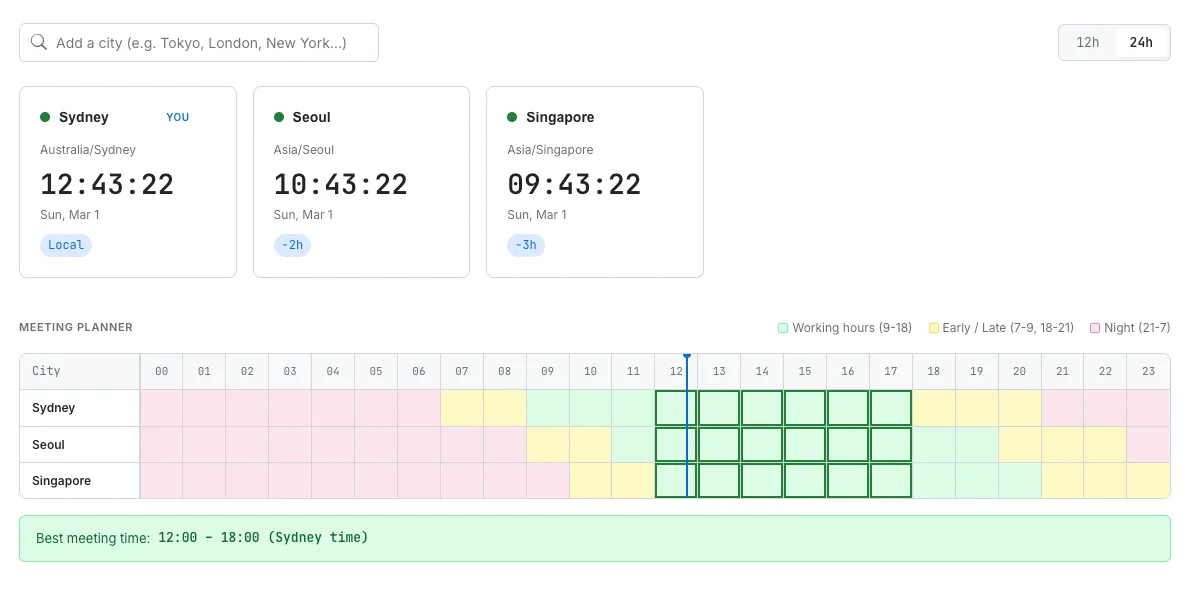
SudoTool World Clock — check live times across multiple cities and find the best meeting time at a glance.
Frequently Asked Questions
How many time zones are there in the world?
In theory, 24 — but when you include half-hour and quarter-hour offsets plus political decisions, there are more than 38 distinct UTC offsets in active use. The IANA Time Zone Database contains approximately 600 time zone identifiers.
What is the difference between UTC and GMT?
GMT is an astronomical time standard based on Earth's rotation (the position of the sun), while UTC is a modern standard based on atomic clocks. In everyday life the difference is less than one second, but they are technically entirely different systems. UTC has been the international standard since 1972.
Why don't all countries use whole-hour offsets?
Time zone selection is influenced by political, economic, and historical factors — not just geography. India (UTC+5:30) chose a half-hour offset as a compromise across its vast territory, and Nepal (UTC+5:45) adopted a quarter-hour offset to differentiate itself from India.
What is Daylight Saving Time (DST)?
DST is the practice of moving clocks forward by one hour during summer to extend evening daylight. About 70 countries observe it, while countries like South Korea and Japan do not. There is an ongoing global debate about abolishing DST, but as of 2026 it remains in effect in most observing countries.
Why does China have only one time zone?
Since the founding of the People's Republic of China in 1949, the country has used a single time zone — Beijing Time (UTC+8) — as a symbol of national unity. Geographically, China spans five time zones, so in the far-western Xinjiang region the sun doesn't rise until about 10:00 AM Beijing Time in winter.
What happens when you cross the International Date Line?
Crossing westbound advances the date by one day; crossing eastbound moves it back by one day. The line roughly follows the 180th meridian through the Pacific but is not defined by international law — it's a convention, and it zigzags around national borders.
Why are time zones so difficult for programmers?
DST transitions, non-integer offsets, politically driven rule changes, and historical changes all compound into extraordinary complexity. The fact that the IANA Time Zone Database receives 3 to 21 updates per year illustrates just how frequently time zone rules change around the world.
What's the best way to schedule a meeting across multiple time zones?
Find the window where all participants' working hours overlap. A world clock tool lets you visually compare each city's working hours and quickly identify the best meeting time. The general recommendation is to ensure at least a 4-hour overlap window.
Time Zones — Now You Understand Them
Time zones are not just about simple time differences. They are the product of an agreement made by 25 nations in Washington 141 years ago, layered with each country's political decisions, Daylight Saving Time, and decades of historical changes. Three key takeaways:
UTC is the foundation of everything — always use UTC as your reference point when dealing with time. There are 38+ time zones, not 24 — remember the half-hour and quarter-hour offsets, and the political exceptions. Always specify the time zone — say "3:00 PM KST," not just "3:00."
If you want to check multiple time zones at a glance and find the optimal meeting time, try SudoTool's World Clock & Meeting Planner.
Curious about how this tool was built? Read how we built a browser-based world clock — the design decisions, technical trade-offs, and lessons learned along the way.