Deep Work vs Flow State: What's Actually Different (and Where They Overlap)
Productivity content often uses "deep work" and "flow state" as synonyms — bundled into "the zone" or described as the same phenomenon under two names. They are not. One is a trainable behavior; the other is a state of consciousness. Here's the honest comparison, based on Newport's and Csikszentmihalyi's own framings.
"Deep work" and "flow state" describe overlapping but distinct layers. Cal Newport's Deep Work (Grand Central, 2016) is a book about a practice — a habit of scheduling distraction-free concentration on cognitively demanding work. Mihaly Csikszentmihalyi's Flow: The Psychology of Optimal Experience (Harper & Row, 1990) is a book about a state — a particular experience that emerges when certain psychological conditions are met. One is something you do; the other is something you experience.
The distinction matters in practice. If a deep work session ends without flow, that's not a failure — flow is a possible byproduct, not a deliverable. And flow occurs in activities that aren't "deep work" at all: rock climbing, sports, surgery. The two concepts overlap heavily, but the overlap is not the whole picture.
Deep Work vs Flow State: Two Different Layers
The clearest way to see the difference is to look at what each author wrote that the other did not. Newport's Deep Work is a productivity book — concerned with how to schedule, how to remove distractions, how to make focus a habit. Csikszentmihalyi's Flow is a positive psychology book — concerned with what makes experience subjectively meaningful, what conditions produce optimal engagement, what the structure of "the experience itself" looks like. The first is a layer of behavior: what you do with your calendar, your notifications, your task selection. The second is a layer of experience: what you feel while doing it.
The two layers are not unrelated. Deep work's behavioral conditions overlap heavily with flow's psychological conditions, so deep work tends to make flow more likely. But "more likely" is not "guaranteed," and the conditions for one don't perfectly map to the conditions for the other.
Deep Work Is a Trainable Skill
Newport's definition of deep work, from page 3 of the book, is one paragraph that has been quoted thousands of times:
"Professional activities performed in a state of distraction-free concentration that push your cognitive capabilities to their limit. These efforts create new value, improve your skill, and are hard to replicate."
The framing is operational. Newport treats deep work as a skill, a habit, a practice — his own vocabulary throughout the book. On page 157: "the ability to focus draws upon willpower, effort, and energy, and because of this, it requires practice." Two pages later: "treat undistracted concentration as a habit like flossing." The Deep Work Hypothesis, his framing of the book's thesis, also uses skill: "the few who cultivate this skill, and then make it the core of their working life, will thrive."
This vocabulary matters. Deep work is something you do, not something you feel. It is measurable in hours of protected calendar time. It is trainable through repeated practice. Newport's whole book is about the how-to — the schedules, the environments, the negotiation with colleagues, the management of email. Flow, when it comes up, is treated as a possible feeling that may accompany deep work, not as the goal itself. The goal is the cognitive output that distraction-free work produces.
Our deep work for software developers post covers Newport's framework in detail — including his four scheduling philosophies (monastic, bimodal, rhythmic, journalistic) and the practical setup that makes the habit sustainable.
Flow Is a State of Consciousness
Csikszentmihalyi's flow is a different object entirely. Flow: The Psychology of Optimal Experience (Harper & Row, 1990) describes a subjective state — the felt experience of being absorbed in an activity to the point where action and awareness merge and time perception distorts. Csikszentmihalyi spent decades studying this state empirically, mostly using the Experience Sampling Method (developed by Csikszentmihalyi and colleagues in the late 1970s — Csikszentmihalyi, Larson & Prescott 1977; validity established by Csikszentmihalyi & Larson 1987), in which participants carry a pager and report their activity and subjective state at random prompts.
His framework is most often summarized as the 9 dimensions of flow. The primary source — Nakamura & Csikszentmihalyi 2002, "The Concept of Flow," Chapter 7 in Handbook of Positive Psychology (Snyder & Lopez, eds., Oxford University Press, 2002, pp. 89–105) — presents the framework as 3 antecedent conditions plus 6 experiential characteristics. Later sport psychology literature (Jackson & Csikszentmihalyi, Flow in Sports, 1999) consolidated these into the now-canonical 9 dimensions list:
Three antecedent conditions:
- Challenge-skill balance — perceived challenges that "stretch (neither overmatching nor underutilizing) existing skills"
- Clear proximal goals — moment-to-moment clarity about what to do next
- Immediate feedback — the activity itself signals whether progress is being made
Six experiential characteristics that follow when the conditions are met:
- Merging of action and awareness — actions feel automatic, separate from a "monitoring self"
- Concentration on the task at hand — intense focused attention on the present moment
- Sense of control — the feeling that you can handle whatever the activity throws at you
- Loss of reflective self-consciousness — the inner critic goes quiet
- Time distortion — typically, time passes faster than expected
- Autotelic experience — the activity becomes intrinsically rewarding; the end goal is "just an excuse for the process"
Flow, in this framework, is not something you schedule. It is a state that emerges when the three preconditions are met. You can set the preconditions; you cannot directly produce the state.
Why They Get Confused
The two concepts get treated as interchangeable because their surface features overlap substantially. Both require single-task focus. Both require a distraction-free environment. Both involve sustained cognitive engagement with a demanding task. Both are vulnerable to interruption in the same ways.
That vulnerability is documented in the cognitive science literature. Rubinstein, Meyer & Evans 2001 (Journal of Experimental Psychology: Human Perception and Performance 27(4):763–797) measured switching-time costs across four experiments and showed that costs scale with task complexity. Leroy 2009 (Organizational Behavior and Human Decision Processes 109(2):168–181) identified attention residue — the lingering cognitive activity from an unfinished prior task that degrades performance on the next one. Mark, Gudith & Klocke 2008 (CHI '08, ACM, pp. 107–110) found that interrupted workers complete tasks faster but pay in measurable stress, frustration, time pressure, and effort. Microsoft's 2025 Work Trend Index (31,000 knowledge workers across 31 markets, surveyed February 6 – March 24, 2025) measured the modern interruption baseline: "interrupted every two minutes during core work hours—275 times a day—by meetings, emails, or chats."
Every one of those interruption mechanisms is destructive to both deep work and flow. So when productivity content describes "the zone" or "deep work flow" or "the flow state of focus work," it's pointing at a real overlap — the conditions that protect deep work also protect flow. But behavior and experience are still logically separate layers. Protecting the conditions doesn't guarantee that the experience appears.
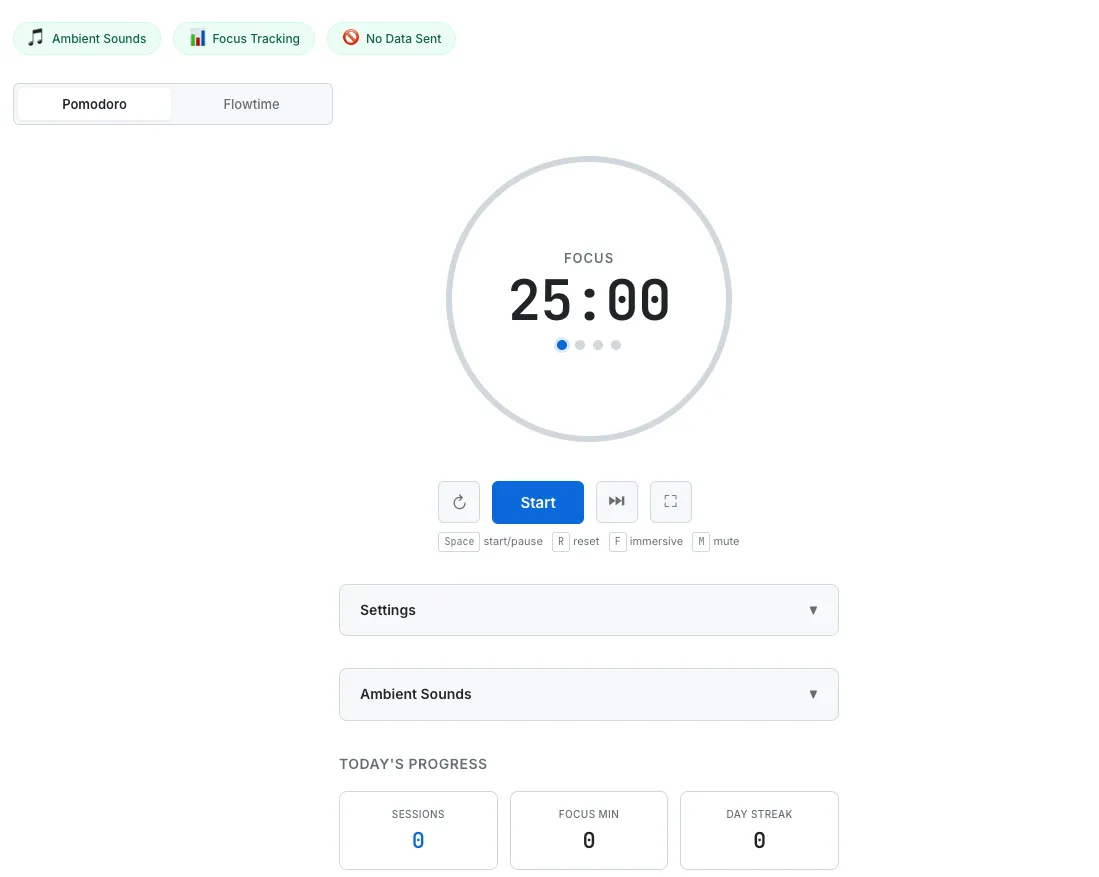
SudoTool's Pomodoro Timer — single-task 25-minute cycles that support deep work behavior and flow's antecedent conditions.
Where They Diverge
The cleanest way to see the difference is to look at situations where one occurs without the other.
| Situation | Deep work? | Flow? | Why |
|---|---|---|---|
| Debugging a difficult mystery bug, stuck | ✓ | ✗ | Distraction-free concentration on cognitively demanding work — but challenge >> skill puts you in the frustration band; not autotelic. |
| Complex spreadsheet analysis, not enjoyable | ✓ | ✗ | Cognitively demanding but the challenge-skill balance is uncomfortable; immediate feedback is weak; not autotelic. |
| Solving a coding puzzle you find enjoyable | ✓ | ✓ | The ideal case — both at once. |
| Rock climbing a challenging route | ✗ | ✓ | Flow conditions all met (challenge-skill balance, immediate feedback, autotelic); not Newport's "cognitively demanding professional work." |
| Jazz improvisation | ✗ | ✓ | Action-awareness merging and autotelic experience; not "deep work" in Newport's professional sense. |
| Surgeon performing routine surgery | △ | ✓ | Csikszentmihalyi documented surgeons in flow extensively (1975); Newport's "new value, hard to replicate" criterion fits some surgical work but not routine procedures. |
| Zoning out during a meeting | ✗ | ✗ | Neither. |
Observation 1 — Deep work does not guarantee flow. Difficult debugging and complex analysis both meet Newport's definition (distraction-free concentration pushing cognitive limits) but produce frustration, not flow. The challenge-skill balance is off — challenge exceeds skill — and the activity is not intrinsically rewarding at that moment. Flow requires the autotelic element; deep work does not.
Observation 2 — Flow occurs outside of deep work. Csikszentmihalyi's original four flow activities, from his 1975 book Beyond Boredom and Anxiety, were chess players, rock climbers, dancers, and surgeons. None of these are "deep work" in Newport's professional-value sense, but all produce well-documented flow. Jazz improvisation, which has become a canonical flow example in later research, similarly sits outside Newport's frame. Newport's deep work is tied to cognitively demanding professional output; Csikszentmihalyi's flow is more general.
Observation 3 — The overlap is the goal. The ideal case is cognitively demanding professional work that you also find intrinsically engaging. That's the intersection where the writer absorbed in a draft, the scientist absorbed in analysis, the programmer absorbed in an architecture problem all live. Most productivity advice is implicitly pointing at this intersection. But aiming for the intersection is different from believing the two concepts are identical.
How to Design for Both
Deep work is a habit you can train directly. Flow is a state you can set conditions for. A practical stack that handles both:
1. Calendar block the time (deep work behavior). Same window every day, 60–90 minutes, labeled and protected. This is the rhythmic philosophy from Newport's framework — the daily decision to make focus a default rather than an exception. The full case for time-blocking, and the distinction between time blocking and calendar blocking, is in our calendar blocking vs time blocking post.
2. Use Pomodoro to start each block (single-task focus). Twenty-five minutes of one task, five-minute break, repeat. The structure makes starting low-friction and protects against the multitasking impulse — the topic of our multitasking myth post and the cognitive mechanism covered in the science behind the Pomodoro Technique.
3. Match the task to your skill level (flow's first precondition). The task in your block should be at the upper edge of what you can currently do — challenging enough to require attention, not so far above you that it produces frustration. A block of tasks far below your skill level produces boredom, not flow; a block of tasks far above produces frustration, not flow. The Goldilocks zone is where flow becomes possible.
4. Make the goal and feedback visible (flow's other two preconditions). Define what "done" looks like for the block. Then make progress visible — a checklist crossed off, words written, code compiling, a passage drafted. If your feedback loop is slow (you'll only know in a week whether this was right), flow's precondition is broken.
5. Mute everything (protection for both). Microsoft's 2025 data — interrupted every two minutes during core hours, 275 times a day — is the environment you have to defend against. Slack, email, phone notifications, browser tabs all closed during the block. Meeting cost compounds in this environment; for the precise number on your team, the meeting cost calculator runs the math, and the broader framing is in our true cost of meetings post.
The core principle: deep work is a behavior you can start; flow is a state you can host. A 90-minute calendar block is a decision. Entering flow during that block is not. What you can do is consistently set the conditions where flow becomes likely. When it arrives, the work feels different. When it doesn't, the work still produces output — that's the deep work part. Flow is the bonus, not the deliverable.
This is a general cognitive-science and productivity guide, not personalized medical, educational, or workplace advice. Flow research relies heavily on self-report (Experience Sampling Method), with individual variation that limits how directly any single framework can be applied. ADHD, learning differences, and certain clinical conditions can produce different attention patterns than the standard task-switching cost picture; an evaluation by a licensed professional is the appropriate next step for those contexts.
- Newport, Cal (2016). Deep Work: Rules for Focused Success in a Distracted World. Grand Central Publishing. (Verbatim definition p. 3; "habit/practice/skill" framing throughout, especially p. 157.)
- Newport, Cal (2013). Deep Habits: The Importance of Planning Every Minute of Your Work Day. calnewport.com.
- Csikszentmihalyi, Mihaly (1990). Flow: The Psychology of Optimal Experience. Harper & Row.
- Csikszentmihalyi, Mihaly (1975). Beyond Boredom and Anxiety. Jossey-Bass. (Original four flow activities: chess, rock climbing, dance, surgery.)
- Nakamura, J., & Csikszentmihalyi, M. (2002). The Concept of Flow. In C.R. Snyder & S.J. Lopez (Eds.), Handbook of Positive Psychology (Chapter 7, pp. 89–105). Oxford University Press.
- Csikszentmihalyi, M., Larson, R., & Prescott, S. (1977). The ecology of adolescent activity and experience. Journal of Youth and Adolescence 6:281–294. (First published application of the Experience Sampling Method.)
- Csikszentmihalyi, M., & Larson, R. (1987). Validity and reliability of the Experience-Sampling Method. Journal of Nervous and Mental Disease 175(9):526–531.
- Jackson, S.A., & Csikszentmihalyi, M. (1999). Flow in Sports: The Keys to Optimal Experiences and Performances. Human Kinetics. (Source of the now-standard 9-dimensions framing.)
- Rubinstein, J.S., Meyer, D.E., & Evans, J.E. (2001). Executive control of cognitive processes in task switching. Journal of Experimental Psychology: Human Perception and Performance 27(4):763–797. APA PDF: apa.org/pubs/journals/releases/xhp274763.pdf.
- Leroy, S. (2009). Why is it so hard to do my work? The challenge of attention residue when switching between work tasks. Organizational Behavior and Human Decision Processes 109(2):168–181.
- Mark, G., Gudith, D., & Klocke, U. (2008). The cost of interrupted work: more speed and stress. CHI '08, ACM, pp. 107–110. UCI host PDF: ics.uci.edu/~gmark/chi08-mark.pdf.
- Microsoft Work Lab (2025). Breaking down the infinite workday. Work Trend Index 2025 Special Report.