Subway vs Hexagon vs Mosaic Tile
Three tile names come up again and again — subway, hexagon, and mosaic. Here is what actually separates them, the one thing most guides get backwards, and how to pick the right one for your space and budget.
Browse a tile aisle or a Pinterest board and the same three names keep surfacing: subway, hexagon, and mosaic. They get lumped together as "tile styles," but when it is time to actually choose, it is hard to say what really separates them — or which one belongs on your kitchen wall versus your shower floor. And there is a hidden cost wrinkle: keep the room the same and just change the tile shape, and the price of the tile, the labor, and even the grout all move.
Before comparing them, it helps to clear up one thing that trips almost everyone up: subway and hexagon describe a tile's shape, while mosaic describes its size and format. They are not three versions of the same choice. This guide sorts that out, walks through what each one is and where it shines, shows how the shape changes your waste, grout, and cost, and ends with which tile fits which spot.
Subway vs Hexagon vs Mosaic Tile at a Glance
Here is the whole comparison on one screen. The sections below explain each row:
| Subway | Hexagon | Mosaic | |
|---|---|---|---|
| What it is | Rectangle (brick shape) | Six-sided shape | Small pieces on a mesh sheet |
| Typical size | 3×6 in (2×4–4×8) | 2–24 in | Under ~9 sq in per piece |
| Look | Classic, clean | Geometric, modern or retro | Bold, textured |
| Grout lines | Moderate | Many | Most |
| Install | Easiest (DIY-friendly) | Hardest (angled cuts) | Mesh helps, but fiddly |
| Cost | Lowest | In between | Highest |
| Best for | Backsplash, shower walls | Bathroom floors, accents | Shower floors, backsplash, accents |
First, a Clarification — Shape vs Format
The reason this comparison feels slippery is that the three are not the same kind of thing. Subway and hexagon are shapes — they describe the outline of a single tile, rectangular or six-sided. Mosaic is a size and format: per the industry educators at Why Tile, any tile smaller than roughly 9 square inches (think 3×3 inches or less) counts as a mosaic, and to make those tiny pieces manageable they come pre-mounted on mesh sheets.
That is why a mosaic can also be hexagonal. Mosaics are sold in squares, hexagons, penny rounds, diamonds, and more — so a "hexagon mosaic" is a real, common product. Read the comparison this way: subway versus hexagon is a question of shape, and mosaic is the small-piece, sheet-mounted format those shapes can come in. With that sorted, the three actually compare cleanly.
Subway Tile — The Classic Workhorse
Subway tile is the rectangle everyone pictures. According to CLÉ Tile, the classic and most common size is 3×6 inches, with 2×4 and 4×8 close behind. The familiar "twice as long as it is wide" definition is a guideline, not a law — CLÉ points out that not every subway tile is a 2:1 rectangle, and some are even square. The name traces back to the glossy white tile used in early New York City subway stations, as tile maker Fireclay Tile notes — which is where a century of kitchens got the look.
It earns its popularity by being the low-drama option. The simple rectangle is the most DIY-friendly to set, the smooth surface and straight joints are the easiest to wipe down, and it is typically the cheapest of the three. You can keep it traditional with a half-offset brick layout, modernize it with a stacked grid or a larger 4×8 tile, or dress it up in a herringbone. A standard 1/8-inch grout line is the usual sweet spot — wide enough to be forgiving for a first-timer. Subway's natural home is the kitchen backsplash and the shower wall.
Hexagon Tile — Geometric and Modern
Hexagon tile trades the straight grid for a six-sided geometry that turns a plain surface into a pattern. Its size range is wide — Why Tile lists everything from about 2 inches up to 24 inches — and size sets the mood: small 2- to 3-inch hexes read vintage and retro, while large-format hexes feel distinctly contemporary. One measuring quirk to know before you order: manufacturers size hexagons either side-to-side or point-to-point, so confirm which with your supplier or the spec sheet so you are comparing like for like.
The catch is installation. As tile installer DIY Tile Guy explains, hexagons are harder to set than plain square or rectangular tile because the odd shape means every perimeter cut is different and has to be squared up individually — slower, fussier work that rewards patience. The extra angles also mean more grout lines, which means more little edges to keep clean. It is doable as a DIY job, but budget more time, and consider a pro for a large or complex floor. Hexagon shines on bathroom floors, accent walls, and feature backsplashes where the geometry is the point.
Mosaic Tile — Small Pieces, Big Texture
Mosaic is the small-piece format: dozens of little tiles held together on a mesh sheet so you can set them a square foot at a time instead of one chip at a time. Sheets commonly cover about one square foot each, but that varies, so check the coverage printed on the product. The pieces come in every shape — square, hexagon, penny round, diamond — which is exactly why mosaic is a format rather than a single look.
Its defining feature is all those grout joints. Why Tile notes that the many joints add texture and slip resistance, and the team at Master Edge Homes makes the same point for showers — more grout means more friction underfoot. That makes mosaic a strong pick for shower pans and bathroom floors where a large, slick tile would be risky when wet. The trade-offs: it is usually the most expensive of the three, especially in glass or natural stone, and all those joints mean the most grout to buy and the most surface to keep clean.
How the Choice Changes Waste, Grout, and Cost
Shape is not just a look — it moves the numbers, too. The smaller and more angular the tile, the more it costs to cover the same wall, in three quiet ways.
Waste. Small, angled tiles produce more offcuts at the edges, so you buy a higher percentage as a cushion. In our own tile waste factor guide, mosaic and other complex layouts sit at the top of the range (around 20%), a simple subway brick layout near the bottom (about 10–12%), with hexagon's many angled cuts landing on the higher side. Grout. Smaller tiles pack more linear feet of joint into each square foot, so they drink more grout — mosaic the most, subway the least; our guide on how much grout you need breaks that down. Cost. Generally, subway is the cheapest and mosaic the most expensive (glass and stone push it highest), with hexagon in between — though the exact figures swing with material and how tricky the install is.
The upside is that none of this has to be guesswork. Once you have picked a shape and measured the area, the calculator applies the right waste factor and grout math for that format and rounds up to whole tiles or sheets.
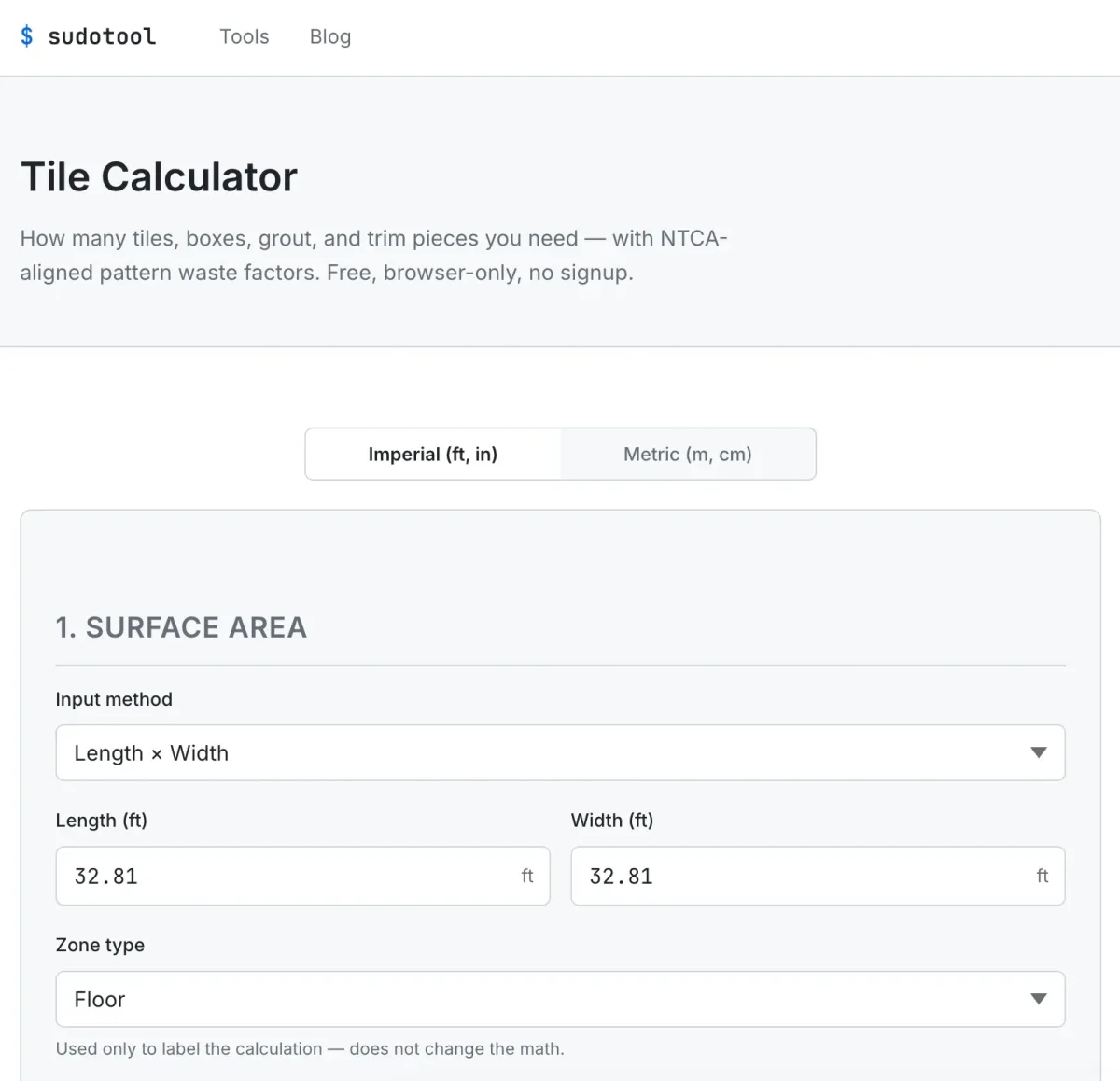
Pick your tile size and pattern — the calculator returns tiles, sheets, boxes, and grout with the waste factor already applied.
Which Tile for Which Spot
Translate the three into actual rooms and the decision gets simple:
| Spot | Best pick | Why |
|---|---|---|
| Kitchen backsplash | Subway (cheap, DIY, classic) or mosaic (accent) | No foot traffic — look and budget lead |
| Shower / bathroom floor | Mosaic or small hexagon | More grout joints add slip resistance |
| Accent / feature wall | Hexagon or mosaic | Geometric, bold, eye-catching |
| Budget or DIY job | Subway | Cheapest and easiest to set |
| Modern look | Large hexagon or 4×8 subway | Contemporary feel |
| Retro look | Small 2–3 in hexagon | Vintage character |
Two follow-ups once you have a shape in mind. If it is a backsplash, the next step is measuring it — our guide on how to measure for backsplash tile covers the wall-band math and what to subtract. And the material — ceramic, porcelain, glass, or stone — is a separate decision from the shape; our guide on porcelain vs ceramic vs natural stone sorts that one out.
Frequently Asked Questions
Is subway tile out of style? No — it has been in continuous use for over a century, which is about as trend-proof as tile gets. You can keep it current with a larger format, a herringbone layout, or a contrasting grout color.
Are hexagon tiles hard to install? Harder than subway or square tile, because the six-sided shape makes every edge cut different and slower to fit. It is a doable DIY with patience, but a big or intricate floor is worth handing to a pro.
Which tile is best for a shower or bathroom floor? Small mosaic or small hexagon. The many grout joints give more friction underfoot, which matters most where the floor gets wet — a large, smooth tile is slicker.
Do mosaic sheets need more grout? Yes. The small pieces pack far more joint length into each square foot, so mosaic uses the most grout of the three — the same density that gives it its slip resistance.
Which is cheapest? Subway is generally the most budget-friendly, and mosaic the priciest (especially glass or natural stone), with hexagon in between. Material and installation difficulty move the final number.
Is mosaic a shape? Not really — mosaic refers to the small-piece, mesh-mounted format, and it comes in many shapes including hexagon, square, and penny round.
The Bottom Line
The choice between subway, hexagon, and mosaic comes down to look, install effort, grout, cost, and grip. Subway is the easy, affordable, goes-anywhere rectangle; hexagon is the geometric statement that asks for more patience to install; mosaic is the textured, slip-resistant format that costs the most. And the thing to keep straight: mosaic is not a shape but a small-piece sheet, one that comes in hexagons and squares of its own. Start with the spot — backsplash or budget leans subway, a feature wall leans hexagon, a wet floor leans mosaic — then, once the shape is set, drop your measurements into the tile calculator and let it size the tiles, sheets, and grout.
This is a general home-improvement guide based on tile-maker and trade references. Exact sizes, prices, and slip ratings vary by product, manufacturer, and material — hexagons in particular may be measured side-to-side or point-to-point, so always check the product label before ordering. For a shower or other wet floor, confirm the tile's slip rating (such as its DCOF value) in the product specs rather than relying on shape alone, and consult a professional installer for large, complex, or structural work.
- CLÉ Tile — Subway Tile Sizes. Reference for the classic 3×6 size, the 2×4 and 4×8 options, the "not always 2:1" point, and grout-line guidance.
- Fireclay Tile — The Essential Guide to the White Subway Tile Backsplash. Reference for subway tile's origin in the early New York City subway system.
- Why Tile — Tile Sizes. Reference for the under-9-square-inch mosaic definition, mesh-sheet mounting, mosaic slip resistance, and the 2–24-inch hexagon range with side-to-side vs point-to-point measuring.
- DIY Tile Guy — How to Install Hexagon Tile. Reference for why hexagon is harder to install than square or rectangular tile (every perimeter cut is different).
- Master Edge Homes — Tile Pattern Style Breakdown. Reference for mosaic's friction and slip resistance in showers.
- SudoTool — Tile Waste Factor and How Much Grout Do You Need. Companion guides for how tile shape changes waste and grout.