Best Tile for a Small Bathroom
Tile for a tight bathroom is really three decisions — material, size, and safety — and the shower floor follows the opposite rule from the rest of the room. Here is what to put where.
The best tile for a small bathroom is not a single product — it is three decisions made well: the material that shrugs off water, the size and color that make a tight room feel open, and the finish that keeps a wet floor safe underfoot. And there is one twist: almost every rule below says go bigger and smoother, except on the shower floor, which flips that completely.
This guide goes zone by zone — floor, shower floor, and walls — covering material, the size that makes a room look bigger (and its limits), the slip rating that actually matters, and the color and grout tricks that open up a tight space.
Material First: the Best Tile for a Small Bathroom Floor
Start with what the tile is made of, because a bathroom floor gets wet and a small room shows wear fast. The default answer is porcelain. Porcelain is a type of ceramic, but it is fired denser: the Tile Council of North America's certification agency only calls a tile porcelain if it absorbs 0.5% or less water when tested to ASTM C373. Less absorption means less water working into the tile, which is exactly what you want around a tub or shower.
Daltile puts the practical version plainly: "Porcelain is a type of ceramic that produces a denser tile, which makes it more water-resistant and can have greater breaking strength," and "Porcelain floor tile is the best choice for areas that may see more moisture such as the bathroom." Ceramic still has a place — it is cheaper and easier to cut, which makes it a sensible pick for walls and shower walls that are not constantly underfoot. For the difference in detail, see our breakdown of porcelain vs ceramic vs natural stone.
One more number worth a glance: the PEI rating (0 to 5) grades surface wear. Most residential floors want PEI 3 or higher. In a small bathroom that mostly means "don't put a delicate wall tile on the floor" — a distinction the wall-versus-floor guide covers.
Why Large Tiles Make a Small Bathroom Look Bigger
Here is the counterintuitive part. Many people assume a small room needs small tiles. The design consensus is the opposite: larger tiles make a small bathroom look bigger, because they cut the number of grout lines and therefore the number of visual breaks your eye has to cross.
Daltile's small-bathroom guide is direct about it: "Large-format tile is one of the easiest ways to create the illusion of a bigger bathroom. Their oversized dimensions reduce grout lines, which helps eliminate visual clutter and makes the space feel more open and cohesive." Tile Outlets of America frames the same idea as a rule of thumb — "the larger the tile, the fewer grout joints you'll have and the greater sense of spaciousness you'll feel."
Treat that as a design principle, not a law of physics — it works by reducing visual busyness, not by adding floor area. And it has a real limit. In a genuinely tiny room, an oversized tile means more cutting at the edges, which adds waste and can leave a less uniform border; very large tiles also need a flat, level substrate to avoid lippage (one corner sitting proud of its neighbor). The practical sweet spot for most small bathrooms is a mid-large format such as 12 by 24 inches rather than the biggest slab on the shelf. Running a rectangular tile lengthwise along the longest wall stretches the eye further in the same way. If you want pattern instead of a plain grid, a herringbone layout is a popular small-bathroom choice for visual interest — just budget extra tile, since its angled perimeter cuts waste more than a straight grid.
The Shower Floor Is the Exception: Go Small
Everything above says go big. The shower floor is the one place to do the opposite and reach for small mosaic, roughly 2 inches or smaller. There are two reasons, and they both come from the grout lines you were trying to minimize everywhere else.
First, grip. More tiles mean more grout joints, and those joints break up a slick surface. Daltile notes that "Tile smaller than 4 inches (mosaic floor tile) means more grout joints, which create better grip on your shower floor and increases slip resistance." Second, slope: a shower floor is pitched toward the drain, and small mosaic sheets flex to follow that curve where a large rigid tile cannot. Square or hexagon mosaic both work here — see subway vs hexagon vs mosaic for how the shapes differ.
A dose of honesty: there is no enforceable residential rule here. The Ceramic Tile and Stone Consultants note that "There is no industry standard that says what type of ceramic tile can be used on a residential shower floor" — these are guidelines, not code. And texture is a trade-off: "The more textured the tile the more slip resistant — the more slip resistant the more dirty the floor gets and the more maintenance required." A small textured mosaic grips well but needs regular cleaning to keep doing so.
Slip Resistance: the One Number to Check (DCOF 0.42)
If you remember a single spec, make it DCOF — dynamic coefficient of friction, the standard North American measure of how much a wet floor resists a moving foot. The threshold is set by ANSI A137.1, and Daltile states it cleanly: "ANSI A137.1 requires tile flooring products to have a DCOF of 0.42 or greater if recommended for use in a level interior space intended to be walked upon when wet." For a bathroom floor, 0.42 is the floor of acceptable, not the target.
Finish drives most of this. "Matte tile flooring generally offers the safest option for the floor, especially in areas that may become wet. Glossy or polished finishes tend to be less slip-resistant," per Daltile — so keep polished tile off the floor and save the shine for walls. Tougher conditions ask for more: exterior and pool surfaces want 0.60 or higher, and ramps higher still, which is part of why a sloped, always-wet shower floor justifies the extra traction of mosaic.
The honest caveat belongs here too: "No floor tile is 'slip proof.'" A rating describes a lab test, not your particular floor on a particular morning. Traction also depends on keeping the surface clean — soap film and residue can make any tile slippery regardless of its number.
Color, Grout, and Layout That Open Up the Room
Material and size do the heavy lifting; color and grout do the finishing. The single most repeated tip is light, neutral color. As Daltile's designers put it, "Light-colored tile is your best friend in a small bathroom, they reflect both natural and artificial light, instantly making the room feel brighter and more open." Soft white, beige, and pale gray all qualify.
Then make the grout disappear. "In a small bathroom, matching your grout color to your tile will streamline the look and make the space feel more serene," Daltile advises — a close-matched grout minimizes visual breaks so floor and wall read as one continuous plane. This is the same fewer-lines logic as large-format tile, applied to color.
Two more levers. Reflectivity: a glossy wall tile bounces light around, so it is fine to use gloss on the walls even though the floor stays matte for grip — the two goals live in different zones. And height: "Placing tile in a vertical orientation naturally draws the eye upward, making your walls appear taller and your ceiling feel higher," which is a cheap way to add a sense of volume to a cramped room.
Best Tile for a Small Bathroom, Zone by Zone
Put it together and the choices fall into a simple map. Match the tile to the job in each zone rather than buying one tile for the whole room.
| Zone | Best pick | Why |
|---|---|---|
| Floor (outside shower) | Large-format porcelain, matte, light color, DCOF ≥ 0.42 | Fewer grout lines look bigger; dense and water-resistant; matte grips when wet |
| Shower floor | Small porcelain mosaic (≈ 2 in or smaller) | Extra grout lines add grip and follow the slope to the drain |
| Walls / shower walls | Large ceramic or porcelain, light color, gloss OK | Reflects light, costs less, and is not underfoot |
| Grout | Matched to the tile color (light) | Lines nearly vanish, so surfaces read as one continuous plane |
Once you have settled on a tile and size for each zone, the last step is figuring out how much to buy — tiles, boxes, and grout, with the right waste factor for your layout. That math is easy to get wrong by a box, so let the calculator handle it.
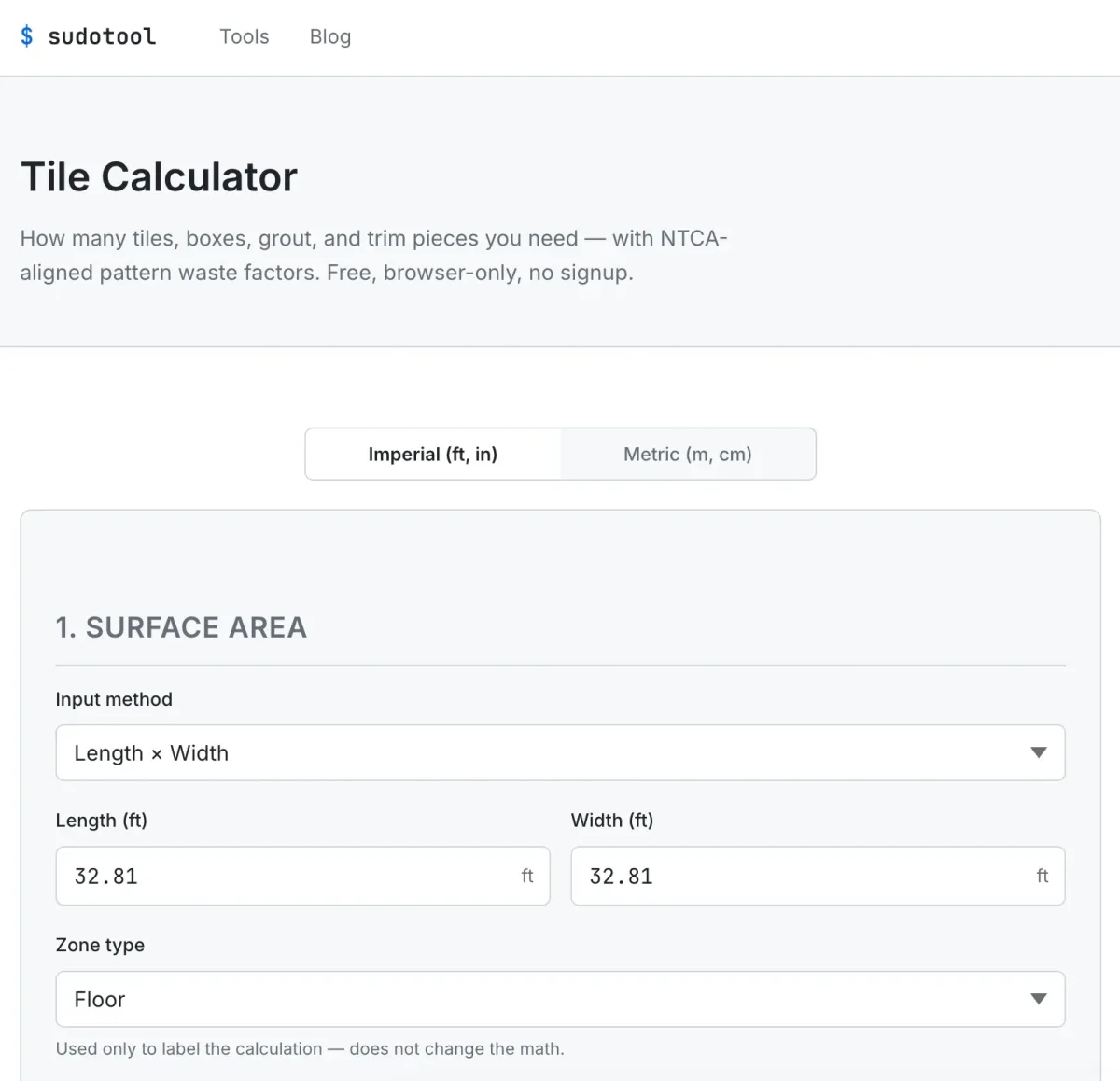
After you choose a tile rated for each zone, the calculator returns tiles, boxes, and grout with your layout's waste factor already applied.
Frequently Asked Questions
What is the best tile for a small bathroom floor?
Porcelain in a matte or textured finish rated at least 0.42 DCOF. Porcelain is dense and water-resistant, and a matte finish grips better than polished tile when the floor is wet.
Do large tiles really make a small bathroom look bigger?
As a design principle, yes — larger tiles mean fewer grout lines and fewer visual breaks, so the room reads as more continuous and open. The trade-off is more edge cuts in a tiny room, so a mid-large size such as 12 by 24 inches is often the practical balance.
What size tile is best for a small shower floor?
Small mosaic, around 2 inches or smaller. The extra grout lines add grip, and the small sheets flex to follow the slope toward the drain. The shower floor is the exception to the go-bigger rule.
What tile color makes a small bathroom feel larger?
Light, neutral colors such as white, beige, or soft gray reflect light, and matching the grout to the tile minimizes visual breaks so the surfaces feel like one continuous plane.
Is porcelain or ceramic better for a small bathroom?
Use porcelain on the floor because it is denser and more water-resistant. Ceramic is fine and usually cheaper on the walls and shower walls, which are not constantly underfoot.
Slip-resistance figures like DCOF are general guidance, not a safety guarantee. No tile is truly slip-proof, ratings reflect lab tests rather than your specific floor, and real traction also depends on cleaning, footwear, and standing water. For a shower or a home with mobility needs, treat tile choice as one layer alongside grab bars, mats, and good drainage, and consult a qualified installer for your situation.