Wall Tile vs Floor Tile
"Wall tile" and "floor tile" are not just shelf labels — they are performance grades. Here is what actually separates them, the two ratings that decide it, and whether you can use one in place of the other.
You fall for a wall tile and want it on the floor too. Or the opposite — a gorgeous floor tile you would love to run up a bathroom wall. It feels like it should be a free choice, but "wall tile" and "floor tile" describe different performance grades, not just different displays in the showroom. Put the wrong one in the wrong place and a tile can crack underfoot, turn dangerously slick when wet, or weigh more than the wall can safely hold.
The single most useful thing to know up front: generally, any floor-rated tile is fine on a wall, but a wall tile is not automatically safe on a floor. This guide explains why — what makes a tile a "floor tile," the two ratings that settle the question, and exactly when you can and cannot swap one for the other.
Wall Tile vs Floor Tile at a Glance
Here is the whole comparison on one screen. The sections below explain each row:
| Floor Tile | Wall Tile | |
|---|---|---|
| Thickness | Thicker (~3/8 in or more) | Thinner (~1/4 in) |
| Hardness | Harder, denser | Softer, lighter |
| PEI (wear) | 3 or higher | Often 0–2 |
| Slip (DCOF) | 0.42 or higher when wet | Can be low (glossy) |
| Use on the other surface? | Yes, on walls (heavier) | Usually not on floors |
| Typical use | Floors | Walls, backsplash |
The One Rule to Remember
If you take away nothing else, take this: a floor-rated tile is generally safe on a wall, but a wall tile is not automatically safe on a floor. The tile experts at Tilezz put it the same way — all floor tile can serve as wall tile, but not all wall tile can serve as floor tile.
The logic is one-directional. A floor tile already meets every demand a wall makes, and then some: it is tougher, denser, and slip-rated. A wall tile is built only for the wall, so it may fall short of a floor's demands for wear and grip. That is why the real answer to "can this tile go on my floor?" almost always lives in its ratings — not its price, its looks, or the aisle it came from.
What Makes a Floor Tile a Floor Tile
A floor tile has to survive being walked on, having furniture dragged across it, and getting scrubbed clean over and over. So it is built differently. As Tilezz notes, most floor tile is thicker and harder than wall tile precisely because it has to withstand people and the weight of furniture and appliances. In practice that means it is usually around 3/8 inch thick or more — and often a full 1/2 to 3/4 inch — denser, and tougher.
Those qualities show up as two label ratings: a wear rating (PEI) high enough for foot traffic, and a slip rating (DCOF) that holds up when the floor is wet. Floor tile also tends to be denser and less porous — porcelain is the classic example — which is part of why it resists water and wear so well; our guide on porcelain vs ceramic vs natural stone digs into that density and water-absorption side. In short, a floor tile is one built to be stepped on, loaded up, and stay safe when wet.
What Makes a Wall Tile a Wall Tile
A wall tile never gets walked on, so it is optimized for different things. It is thinner — frequently around 1/4 inch — which makes it lighter and easier to hang. It is often glossy and smooth, which looks crisp and wipes clean easily, but that same slickness is exactly what makes it risky underfoot when wet. And it can carry a low wear rating, because it does not need to resist abrasion from foot traffic.
Classic subway tile is the archetypal wall and backsplash tile; our guide on subway vs hexagon vs mosaic covers those shapes. A kitchen backsplash is wall-tile territory too, with its own measuring quirks — see how to measure for backsplash tile. The short version: a wall tile is light, attractive, and easy to clean, on the assumption that nothing will ever stand on it.
The Two Ratings That Decide It — PEI and DCOF
Floor versus wall is not a matter of taste; it comes down to two numbers on the box. Read them and the guesswork disappears.
PEI — surface wear. The PEI rating grades how much abrasion a glazed tile's surface can take, on a scale from 0 to 5. Per the breakdown at Tilezz: PEI 0 and 1 are wall-only; PEI 2 is mostly for walls but works on light-traffic floors like bedrooms and bathrooms; PEI 3 covers the majority of residential floors; and PEI 4 and up handle heavy residential and commercial use. So for a floor you actually walk on, look for PEI 3 or higher (PEI 2 is acceptable for light-traffic rooms), while a wall can happily use a 0, 1, or 2. The same scale gets more attention in our porcelain vs ceramic guide.
DCOF — wet slip resistance. The dynamic coefficient of friction measures how much grip a tile keeps when it is wet. The US standard, ANSI A137.1, calls for a DCOF of at least 0.42 for tile used on a level interior floor that may be walked on while wet, as manufacturer Daltile documents, with the measurement taken under the ANSI A326.3 test method. Wetter, higher-risk areas ask for more — Daltile recommends around 0.60 for showers and pool decks. One honest caveat the standards themselves stress: no tile is truly slip-proof. DCOF is a benchmark for comparing products under controlled tests, not a guarantee that a floor is safe in either direction — real-world grip also depends on footwear, spills, drainage, and cleaning.
Put simply: PEI is about wear, DCOF is about slipping. A floor needs both; a wet floor especially needs the DCOF.
Can You Use Wall Tile on the Floor?
Usually not — but the reason matters, because it points to the exception. A typical wall tile is thin, relatively soft, and glossy, so on a floor it can chip or wear under traffic and turn slippery when wet. It was never rated for any of that.
The key is that the deciding factor is the rating, not the label. Some tiles are certified for both walls and floors. If a tile you love happens to carry a floor-suitable PEI (3 or higher) and an adequate DCOF for where it is going, it can go on the floor regardless of being marketed as a "wall tile." So before putting any tile underfoot, check those two numbers on the box or spec sheet. If they are not there, or they fall short, keep that tile on the wall.
Can You Use Floor Tile on the Wall?
Here the answer is usually yes — a floor tile already exceeds what a wall needs. The one real variable is weight. Floor tile is heavier, and that weight, plus the adhesive, has to be supported by the wall.
In practice that means the wall needs a solid, stable substrate. Cement backer board is the standard choice, especially in wet areas, because it bonds with tile adhesive better than plywood or drywall and stands up to moisture — as This Old House describes. Beyond that, follow the manufacturer's weight guidance for your wall construction, and for very large or very heavy tiles, check with a professional installer before committing. Done right, floor tile on a wall gives you an especially durable, substantial finish.
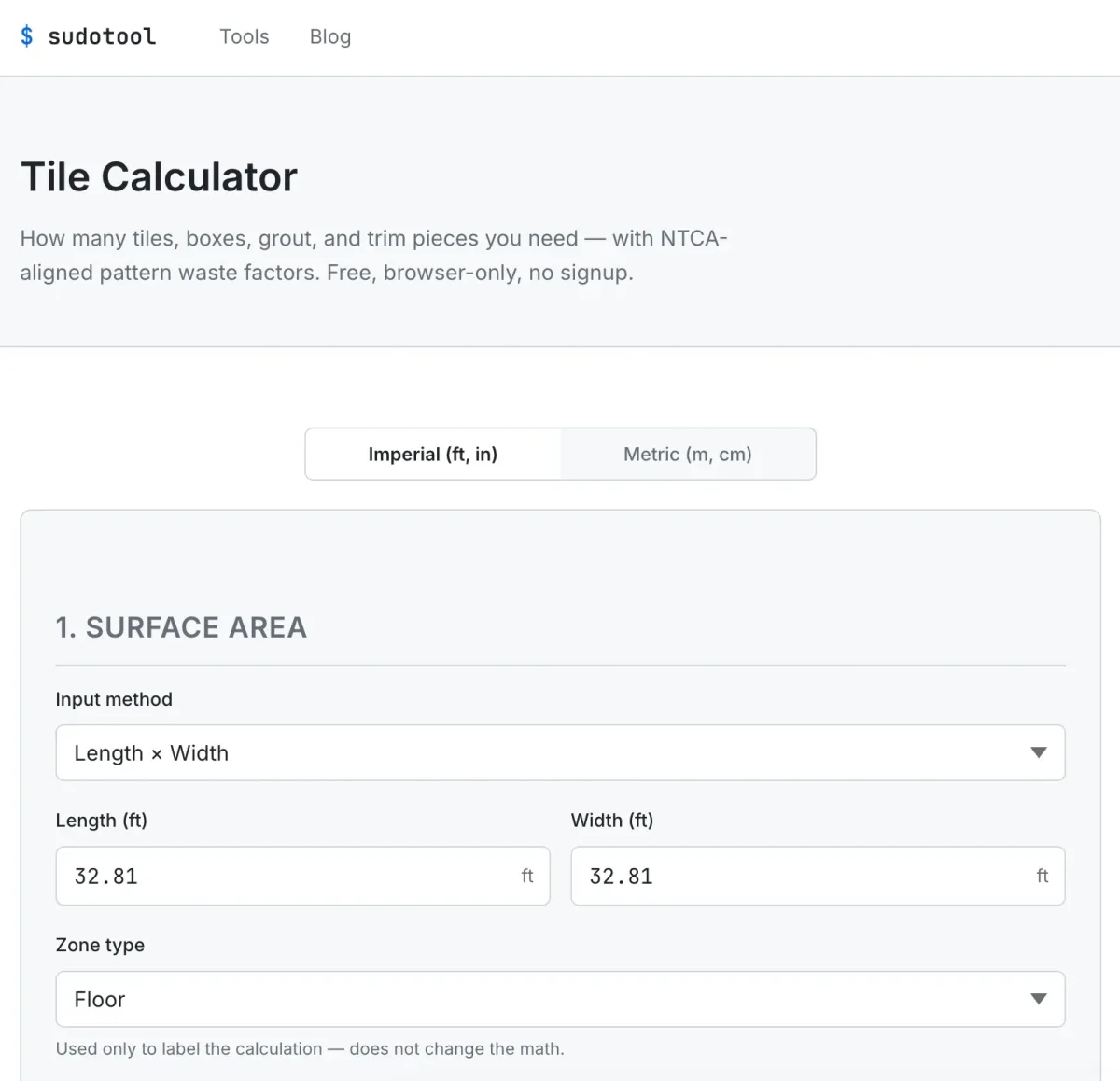
Once you have a tile rated for the surface, set the calculator to floor, wall, or backsplash and it returns tiles, boxes, and grout with the waste factor applied.
Frequently Asked Questions
Can I use wall tile on a bathroom floor?
Only if it is rated for floors. A bathroom floor gets wet, so slip resistance matters most — look for a floor-suitable PEI (2 or higher for a low-traffic bathroom) and a DCOF of at least 0.42 (around 0.60 inside a shower). A glossy wall tile with no floor rating is a poor and slippery choice.
Can I put floor tile on a shower wall?
Usually yes — a floor tile easily meets a wall's demands, and it makes a durable finish. Just make sure the wall can carry the extra weight on a proper substrate like cement backer board; for very large or heavy tiles, check with a pro.
How do I tell wall tile from floor tile?
Read the ratings, not the looks. The box or spec sheet lists the intended use ("wall," "floor," or "wall & floor") along with the PEI and DCOF. Thickness is a clue too — floor tile is generally the thicker of the two.
What PEI rating do I need for a kitchen floor?
At least PEI 3, and PEI 4 to 5 is the safer bet for a busy kitchen, which sees heavy foot traffic and the occasional dropped pan.
What DCOF do I need for a wet floor?
The ANSI guideline is 0.42 or higher for a level interior floor that gets wet, and around 0.60 for showers and pool decks. Remember that no tile is fully slip-proof, so treat the number as a minimum, not a guarantee.
Is floor tile more expensive than wall tile?
Not necessarily — prices for the two are often similar. That said, the thick, dense porcelain typically used on floors can cost more than a thin wall ceramic, so it depends on the specific material and grade.
The Bottom Line
The difference between wall tile and floor tile is performance: floor tile is thicker, harder, and rated to resist wear and slipping, while wall tile is lighter and prettier on the assumption that no one stands on it. Keep the one rule in mind — a floor tile is fine on a wall, but a wall tile belongs on a floor only if its ratings say so. And the decision lives in two numbers, PEI for wear and DCOF for grip, not in the showroom label. Once you have a tile that is rated for the surface, drop your measurements into the tile calculator to size the tiles and grout — and let our guides on material and shape settle the rest of the choice.
This is a general home-improvement guide based on tile-maker and standards references. A tile's real suitability depends on its rated PEI and DCOF, its thickness and material, and your wall's construction — always check the product label and manufacturer guidance before buying. The DCOF figures (0.42, and around 0.60 for showers) are ANSI-based minimums, and no tile is fully slip-proof, so for wet floors, accessibility needs, or anyone at higher risk of falls, choose a higher-grip tile and consult a professional. When putting heavy floor tile on a wall, follow the manufacturer's weight limits and substrate requirements, and use a professional installer for large or structural work.
- Tilezz — Floor vs. Wall Tile: What's the Difference? Reference for the floor-can-go-on-walls rule, why floor tile is thicker and harder, and the PEI scale by level.
- Daltile — DCOF Slip Resistance Testing. Reference for the ANSI A137.1 DCOF 0.42 minimum (level wet floors), the ANSI A326.3 test method, the ~0.60 figure for showers, and the no-tile-is-slip-proof caveat.
- CLÉ Tile — Tile Thickness Guide. Reference for typical wall (~1/4 inch) versus floor (3/8 inch or greater) tile thickness.
- This Old House — When and How to Use Cement Backerboard. Reference for using a stable substrate to support tile and the weight consideration when tiling.
- SudoTool — Porcelain vs Ceramic vs Natural Stone and Subway vs Hexagon vs Mosaic. Companion guides on tile material (PEI and water absorption) and shape.