How to Measure for Backsplash Tile
A backsplash looks like the easy part of a kitchen — until the tile order comes up short around an outlet, or you overbuy and end up with mismatched boxes. This guide shows how to measure for backsplash tile the right way: the formula, the standard heights, and what to subtract.
Measuring for backsplash tile trips people up more than measuring a floor, and for a surprising reason: a backsplash is not a floor at all. It is a narrow band of wall running along the top of your countertops, and its area depends as much on how tall you tile as on how long the counters are. Get the height wrong — or forget that the strip behind the range usually climbs higher than the rest — and the square footage is off before you even pick a tile.
The arithmetic itself is easy: width times height, divided by 144. The judgment is in the details — which sections to measure separately, what to subtract, and how to turn square feet into the mosaic sheets or subway boxes a store actually sells. This guide walks through all of it: the formula, the standard backsplash heights, the wall-by-wall method, what counts as worth subtracting, and a full worked example. Once you have the square footage, you can let the SudoTool tile calculator handle the tile count, waste factor, and grout.
What You're Measuring for Backsplash Tile
A floor is measured as length times width — two horizontal dimensions. A backsplash is measured as length times height: the horizontal run of countertop and the vertical distance up the wall that you intend to tile. The formula to convert to square feet is the same one used for any tile surface:
Backsplash area = width (inches) × height (inches) ÷ 144
You divide by 144 because there are 144 square inches in one square foot (12 × 12). So a single stretch of counter that is 48 inches wide and 18 inches tall works out to 48 × 18 = 864 square inches, or 864 ÷ 144 = 6 square feet. That is the entire calculation for one clean rectangle — the rest of this guide is about the parts of a real kitchen that are not one clean rectangle.
If the whole measure-divide-add-waste-buy-by-the-box sequence is new to you, our companion guide on how to calculate tile for a room walks through the same four steps for a floor, with a full worked example. A backsplash uses that identical logic — it just adds a few quirks of its own, starting with height.
How Tall Is a Backsplash? Standard Heights
Height is the variable people get wrong most often, because unlike a floor there is no single "right" answer — it depends on the look you want and what sits above the counter. Four heights cover almost every kitchen:
| Backsplash type | Typical height | Notes |
|---|---|---|
| Short / "ledge" | ~4 in | A short strip of the countertop material, minimal tile cutting |
| Full (counter to cabinets) | ~15–18 in | The most common tiled backsplash; fills the standard cabinet gap |
| Behind the range | ~30 in or more | Taller because of the clearance above a cooktop |
| Full-height | To the ceiling | Tile runs all the way up, often above open shelving |
The number that anchors most projects is the gap between the countertop and the bottom of the upper cabinets. The industry-standard distance is about 18 inches, with a normal adjustment range of roughly 15 to 20 inches depending on the cabinetry, as home-design references like House Digest note. A full backsplash that fills that gap is therefore usually 15 to 18 inches tall — which is why tile retailers commonly cite that band as the standard backsplash height. A short "ledge" backsplash, by contrast, is just a 4-inch lip of the counter material, common in older or more traditional kitchens.
The exception is the wall behind the range. Building codes generally require extra clearance above a cooktop to the combustible cabinets or hood above it — commonly around 30 inches, and in many installations 30 to 36. That means the tile behind the stove usually rises higher than the 18-inch band on either side, so you measure it as its own, taller rectangle. Some ranges and hoods call for still more room, so check your appliance manual and local code rather than assuming. If your upper cabinets are not installed yet and you are estimating early, use 18 inches for the main run and measure the range wall up to wherever the hood or cabinet will sit.
Measure Wall by Wall — Break It Into Sections
Very few kitchens give you one continuous rectangle of backsplash. An L-shaped or U-shaped counter wraps across two or three walls; a window over the sink interrupts the run; the range wall climbs higher than its neighbors. The reliable way to handle all of that is to stop thinking about it as one shape and break it into rectangles.
Walk the kitchen and identify each separate stretch of wall that will be tiled. Label each one — a capital letter per section works well — and measure its width and height in inches, rounding each measurement up to the nearest inch. Convert each section to square feet with the divide-by-144 formula, then add the sections together for your total. Treat the taller strip behind the range as its own section so its extra height is captured rather than averaged away. A quick sketch of the kitchen on paper, with each section, window, and the range marked, makes it far harder to forget a wall — which is the most common way a backsplash estimate goes wrong.
What to Subtract — and What Not To
Here is where two opposite mistakes show up. People subtract the things they shouldn't and forget to subtract the things they should.
Subtract large openings. A window over the sink, a doorway, a passthrough — anything sizable that you will not be tiling over comes out of the area. If a 36-inch-wide window sits inside your 18-inch band, that is 36 × 18 = 648 square inches, or 4.5 square feet, that you genuinely do not need tile for. Take it out.
Do not subtract small obstructions. Electrical outlets and switches feel like they should reduce the tile count, but the standard advice from tile estimators is to leave them in. As the team behind one mosaic backsplash guide at My Building Shop puts it, an outlet is so small it does not meaningfully change how much tile you need — and you still have to cut tile to fit around it, which wastes a little material rather than saving it. Trying to subtract outlets is a classic way to end up a few pieces short. Do mark their locations on your sketch, though; you are not subtracting them from the math, you are just planning the cuts.
One more zero to remember: any spot where an upper cabinet meets the countertop with no gap has no backsplash at all, so leave it out of the total entirely.
Counting Tile — Sheets, Boxes, and the Waste Factor
Square feet is the answer to "how big," but stores sell tile in units, so there is one more conversion. Backsplashes come in two common forms, and they count differently.
Mosaic tile — the small chips that dominate kitchen backsplashes — is sold on mesh-mounted sheets, not as loose pieces. You count by the coverage printed on each sheet, commonly around one square foot for a 12-inch sheet, though it varies by material, so always check the coverage-per-sheet figure on the product. Divide your total area by the sheet coverage and round up. Subway and other field tile works the same way as floor tile: divide your area by the square footage one box covers, and round up to whole boxes.
Then add a waste factor, because the bare area assumes every tile lands whole. It never does — you cut at the edges, around the window, and around every outlet, and a few pieces crack. For a straight subway or grid layout, 10 to 15 percent extra is the usual cushion; Fireclay Tile suggests ordering at least 15 percent more. Mosaic and busier patterns run higher — 15 to 20 percent — because the small pieces and angled cuts produce more offcuts, a point Apollo Tile makes for herringbone and intricate layouts. The reasoning behind each pattern's number is the same as for floors, which our guide on the tile waste factor breaks down in detail.
Finally, round up to whole sheets or boxes and buy everything in a single order from the same dye lot — tile is fired in batches, and two boxes of the "same" tile bought weeks apart can read as visibly different shades. Keep a few spare pieces for future repairs. This batch-and-dye-lot logic is identical to floor tile, so our tile-for-a-room guide covers it in more depth if you want the full reasoning.
A Worked Example — an L-Shaped Kitchen
Put it together on a realistic kitchen: an L-shaped counter with a standard 18-inch backsplash, a cooktop with a hood, and a window over the sink.
- Main wall: 10 ft (120 in) × 18 in = 2,160 ÷ 144 = 15 sq ft
- Return wall: 4 ft (48 in) × 18 in = 864 ÷ 144 = 6 sq ft
- Taller strip behind the cooktop (up to a 30-inch hood): the extra 12 in of height × 30 in wide = 360 ÷ 144 = +2.5 sq ft
- Subtract the window over the sink: 36 in × 18 in = 648 ÷ 144 = −4.5 sq ft
- Subtotal: 15 + 6 + 2.5 − 4.5 = 19 sq ft
- Add 15% waste: 19 × 1.15 = 21.85, round up to 22 sq ft
- In ~1 sq ft mosaic sheets: about 22 sheets — or, in 10-sq-ft subway boxes, 22 ÷ 10 = 2.2, round up to 3 boxes
Notice what happened: the outlets stayed in the count (their cuts come out of the 15% waste), the window came out, and the range strip was added as its own taller piece. Most kitchen backsplashes land somewhere in the rough range of 10 to 40 square feet depending on layout, so a result in the low 20s for an L-shaped kitchen is right where you would expect.
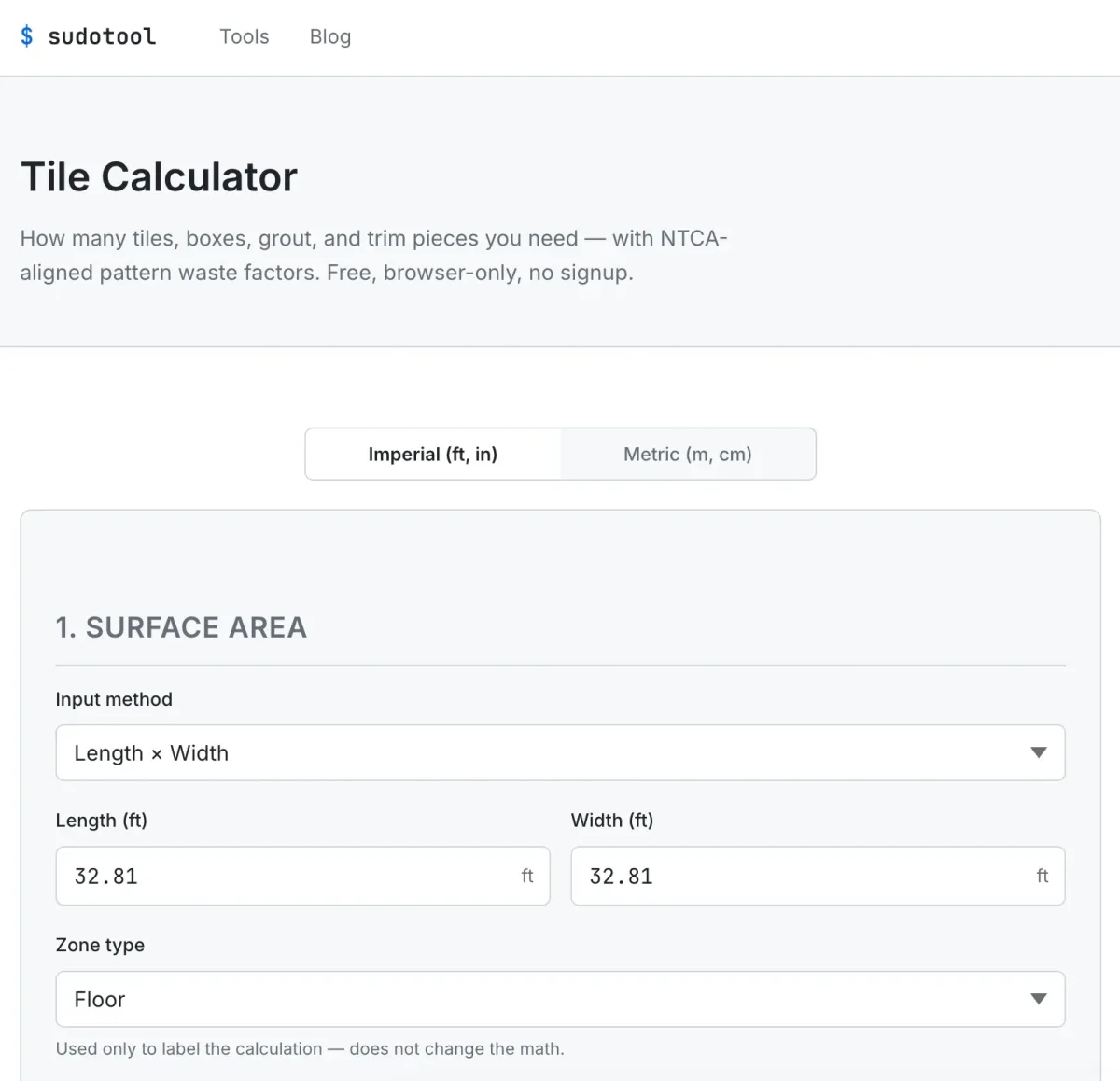
Enter your total backsplash square footage and tile size — the calculator applies the waste factor, rounds up to whole tiles and boxes, and adds optional grout and trim.
Common Backsplash Measuring Mistakes
Most short or over-ordered backsplashes come from the same handful of slips:
- Guessing the height. Not knowing the ~18-inch standard, or averaging it across the whole wall, throws the area off. Measure your actual gap.
- Forgetting the range wall. The taller strip behind the cooktop is extra area — add it as its own section instead of tiling it in your head at 18 inches.
- Subtracting outlets. Taking out small obstructions leaves you short, because you still cut around them. Let the waste factor cover it.
- Counting mosaic chips individually. Mosaic is sold by the sheet — work in coverage per sheet, not piece count.
- Rounding sheets or boxes down. 2.2 boxes means 3 boxes. A fractional box does not exist at the store.
- Ignoring the dye lot. Reordering later risks a mismatched batch. Buy it all at once, from one lot.
- Forgetting edge trim. Exposed edges — the end of a run, an outside corner — may need separate trim or finished-edge pieces.
Frequently Asked Questions
How much tile do I need for a backsplash?
Add up each wall section's width × height ÷ 144, then add 10–15% for waste (15–20% for mosaic or complex patterns). Backsplash size varies widely by layout, but many kitchens fall roughly in the 10–40 square foot range, with a typical mid-size kitchen often around 25–35.
What is the standard backsplash height?
The countertop-to-cabinet gap is about 18 inches (typically adjustable between 15 and 20), so a full backsplash usually fills 15–18 inches. A short ledge backsplash is about 4 inches, and the strip behind a range runs taller — often 30 inches or more for clearance.
Do I subtract outlets when measuring a backsplash?
No. Outlets and switches are small enough that they don't meaningfully reduce the tile you need, and you still cut tile around them — the waste factor covers that loss. Subtract only large openings like windows and doors.
How many mosaic sheets do I need?
Divide your total square footage by the coverage printed on each sheet (commonly about 1 square foot per 12-inch sheet), round up, then add your waste factor. Count by sheet, not by individual chip.
How do I measure behind the stove?
Measure that strip separately, from the cooktop up to the hood or cabinet above — usually 30 inches or more — and add it to your total. It is taller than the standard band on the rest of the wall.
The Bottom Line
Measuring for backsplash tile comes down to three habits: break the wall into rectangles and add width × height ÷ 144 for each, get the height right (about 18 inches for the main run, taller behind the range), and subtract the windows while leaving the outlets in. Convert to whole sheets or boxes, add a 10–20% waste cushion, and buy one dye lot. The same measure-then-convert thinking carries across the rest of a tile project — our guides on calculating tile for a room and how much grout you need apply it to floors and grout. When the sections start adding up, drop your square footage into the tile calculator and let it handle the tiles, boxes, and grout.
This is a general home-improvement guide based on retailer and manufacturer measuring guidance plus widely used trade rules of thumb. Heights and waste percentages are working estimates, not guarantees — your actual cabinets, walls, tile size, and pattern will vary, so always measure your own walls and check the coverage printed on the product before ordering. Clearance above a range or cooktop is governed by your appliance's instructions and local building code; follow those rather than a general figure, and consult a professional installer for complex layouts or anything involving electrical or code questions.
- Apollo Tile — How to Measure and Plan a Kitchen Backsplash. Reference for the width × height ÷ 144 formula, the section-by-section method, the 4-inch and 15–18-inch heights, and waste factors (10–15% standard, 15–20% for complex patterns).
- Fireclay Tile — Tile School: How to Measure for Your Tile Backsplash. Reference for the square-footage formula and the recommendation to order at least 15% extra.
- Mercury Mosaics — How to Measure Your Kitchen Backsplash. Reference for labeling and measuring each wall section separately and for overage on handmade and specialty-shape tile.
- House Digest — How High Should Upper Cabinets Be? Reference for the ~18-inch (15–20 range) countertop-to-cabinet standard and the taller 30–36-inch clearance over a stove.
- My Building Shop — How to Calculate Mosaic Tile Quantity for a Backsplash. Reference for not subtracting small outlets and for counting mosaic tile by coverage per mesh sheet.
- SudoTool — How to Calculate Tile for a Room. Companion guide to the underlying measure-divide-waste-box method and dye-lot logic.