Porcelain vs Ceramic vs Natural Stone Tile
Three materials, three price tags, and two boxes on the shelf that look almost identical. Here is what actually separates porcelain, ceramic, and natural stone tile — and how to pick the right one for each room.
Stand in the tile aisle and the choice between porcelain, ceramic, and natural stone can feel arbitrary. Two boxes sit side by side looking nearly the same, except one says ceramic and the other porcelain and costs more. Across the aisle, real quarried stone carries a price tag two or three times higher. Pick wrong and you end up with a thirsty tile on a wet bathroom floor, or a high-maintenance marble behind the stove that etches the first time someone splashes lemon juice.
The good news is that the differences boil down to four things: how much water the tile absorbs, how hard it is, how much upkeep it needs, and what it costs. This guide explains what really separates the three materials, how to read the durability labels (PEI and water absorption), what natural stone asks of you in return for its looks, and which material fits which room. Once you have chosen, working out how much to buy is the easy part.
Porcelain vs Ceramic vs Natural Stone at a Glance
Before the detail, here is the whole decision on one screen. Every section below is really just one row of this table explained:
| Ceramic | Porcelain | Natural Stone | |
|---|---|---|---|
| What it is | Fired clay, softer | Fired clay, denser | Quarried real stone |
| Water absorption | Higher (above 0.5%) | Very low (0.5% or less) | Porous — needs sealing |
| Durability | Moderate, chips easier | Very high | Varies; softer stones scratch |
| Upkeep | Low | Very low | High (periodic sealing) |
| Cost | Lowest | Middle | Highest |
| Best for | Walls, backsplash, light floors | Floors, wet areas, outdoors, high traffic | Statement and formal spaces |
Porcelain vs Ceramic — What's the Real Difference?
The most common confusion is also the easiest to clear up: porcelain is a type of ceramic. As tile maker MSI explains, both porcelain and ceramic tile fall under the broad category of ceramics because both are made from natural clay hardened by heat. The difference is in the recipe — porcelain uses a more refined clay fired at higher temperatures, which makes it denser and less porous than ordinary ceramic.
That density shows up as one number that the industry uses to draw the line. According to the Tile Council of North America, a tile only counts as porcelain if it has a water absorption of 0.5% or less, measured by the ASTM C373 test method. Because manufacturers were applying the porcelain label loosely, the TCNA and the Ceramic Tile Distributors Association created the Porcelain Tile Certification Agency (PTCA), which independently tests tiles and lets the ones that meet the 0.5% threshold carry a certification mark. Anything that absorbs more than 0.5% is, technically, non-porcelain ceramic.
That single number ripples into everything else. The dense, near-impervious body that earns porcelain its rating also makes it harder to cut — it usually needs specialized cutting tools, often a wet saw, where ceramic can be scored and snapped far more easily. It makes porcelain more expensive, and it makes it more resistant to chips and cracks. There is even a visible difference when damage does happen: a chipped glazed ceramic tile can reveal a different-colored body underneath, while a through-body (full-body) porcelain tile tends to keep its color all the way through, so chips are less obvious — a distinction tile importer Carmel Imports describes well.
If you want the full classification, the industry sorts tile into four bands by water absorption, per the National Tile Authority:
| Class | Water absorption | Roughly |
|---|---|---|
| Impervious (porcelain) | 0.5% or less | Wet areas, outdoors, floors |
| Vitreous | Over 0.5% up to 3% | Most indoor floors and walls |
| Semi-vitreous | Over 3% up to 7% | Drier indoor walls and light use |
| Non-vitreous | Over 7% | Indoor walls only, dry areas |
How Tough Is It? PEI and Water Absorption Ratings
Two labels take the guesswork out of durability: the water-absorption figure you just met, and the PEI rating. Read both off the box and you rarely choose wrong.
The PEI rating — named for the Porcelain Enamel Institute — grades a glazed tile's surface wear resistance on a scale from 0 to 5, as Apollo Tile lays out. It tells you how much foot traffic the surface can take before it shows wear:
| PEI | Suitable for |
|---|---|
| 0 | Walls only — backsplashes, shower walls; not underfoot |
| 1 | Very light duty, walls; not underfoot |
| 2 | Normal foot traffic — walls and lighter-use floors |
| 3 | Regular residential floors — kitchens, entryways, living rooms |
| 4 | All residential plus medium-traffic commercial |
| 5 | Heavy commercial — airports, malls, hospitals |
The practical takeaway: for a floor you walk on every day, look for PEI 3 or higher — PEI 2 can handle normal foot traffic, but 3 and up give you more margin for regular use, and a busy kitchen or entryway is happiest at PEI 4 or 5. Walls and backsplashes can use a low PEI rating, since nothing walks on them. One caveat worth remembering: PEI measures surface wear only, so it is not the same thing as the porcelain-versus-ceramic question — a well-made glazed ceramic can out-rate some porcelain. Check the actual label rather than assuming.
Natural Stone — Beauty With a Maintenance Cost
Natural stone — marble, granite, travertine, slate, limestone — offers something manufactured tile cannot fake: every piece is genuinely unique, with veining and variation no printer can reproduce. That beauty comes with two strings attached.
It is porous, so it needs sealing. Because stone soaks up water, oil, and spills, it has to be sealed to create an invisible barrier. How often depends entirely on use. According to CLÉ Tile, a low-traffic indoor wall with no moisture exposure might go as long as five years between sealings, while a high-traffic mudroom, bathroom, or kitchen floor may need resealing every six months to a year — many homeowners land on roughly every year or two as a rough rule of thumb. There is an easy way to check: drop a little water on the stone, and if it beads up, the seal is good; if it soaks in, it is time to reseal. Skip sealing and stone becomes prone to staining and water spots.
Some stones are also chemically delicate. Here is the nuance most guides gloss over: sealing helps with stains and water, but it does not fully stop etching. Marble and other calcium-based stones react with acids — lemon juice, vinegar, wine, tomato sauce — and etch, leaving dull marks that are a chemical reaction, not a stain a sealer can block. That makes marble a risky pick directly behind a stove or on a kitchen counter. Porosity also varies by stone: granite is among the least porous, marble sits in the middle, and limestone and especially travertine are the most porous and thirsty for sealer.
Stone is also the most expensive of the three, in both material and the labor to install it. If you love the look but not the upkeep, there is a shortcut worth knowing: modern porcelain can mimic marble, travertine, and slate convincingly while asking for none of the sealing — a common way to get the stone aesthetic with porcelain's low maintenance.
Which Tile for Which Room
Translate all of that into actual rooms and the decision gets simple:
| Situation | Best pick | Why |
|---|---|---|
| Kitchen / entryway floor (high traffic) | Porcelain (PEI 4–5), or granite/slate | Wear and impact resistance |
| Bathroom floor / shower | Porcelain | Lowest water absorption |
| Backsplash / walls | Ceramic (cheap, easy to cut) | No foot traffic, durability matters less |
| Outdoors (patio, balcony) | Porcelain | Low absorption resists freeze damage |
| Tight budget | Ceramic | Lowest material cost |
| Formal / resale statement | Natural stone or premium porcelain | One-of-a-kind look |
| DIY install | Ceramic | Easiest to cut |
| Lowest maintenance | Porcelain | No sealing needed |
That outdoor row is worth a note: porcelain's sub-0.5% absorption is exactly why it survives freezing climates — there is almost no water inside the tile to freeze, expand, and crack it, which is the failure mode that destroys thirstier tile outdoors. And if you are tiling a kitchen backsplash, choosing the material is step one; our guide on how to measure for backsplash tile covers measuring it once you have decided.
Cost and Installation
On price, the ranking is consistent from cheapest to most expensive: ceramic, then porcelain, then natural stone, in both material and installation, as flooring retailer Flooring 101 notes. Exact prices swing too much by quality, region, and season to pin down, so treat the order — not any specific dollar figure — as the reliable part.
Installation effort tracks the same line. Ceramic is relatively easy to cut and work with, which is why it is the friendliest material for a DIY job. Porcelain's hardness makes it harder to cut, calling for specialized tools and often professional help. Natural stone is the heaviest and most demanding, and its cost usually justifies a professional installer. There is a budgeting wrinkle here: the more expensive the tile, the more each mistake costs, so dense porcelain and large-format pieces deserve a generous waste allowance — our guide to the tile waste factor explains how much extra to add for cuts and breakage.
Once the material is decided, turning your room into a tile count is the straightforward part — area divided by tile size, plus that waste factor. Our walkthrough on how to calculate tile for a room covers the math, or you can let the calculator do it.
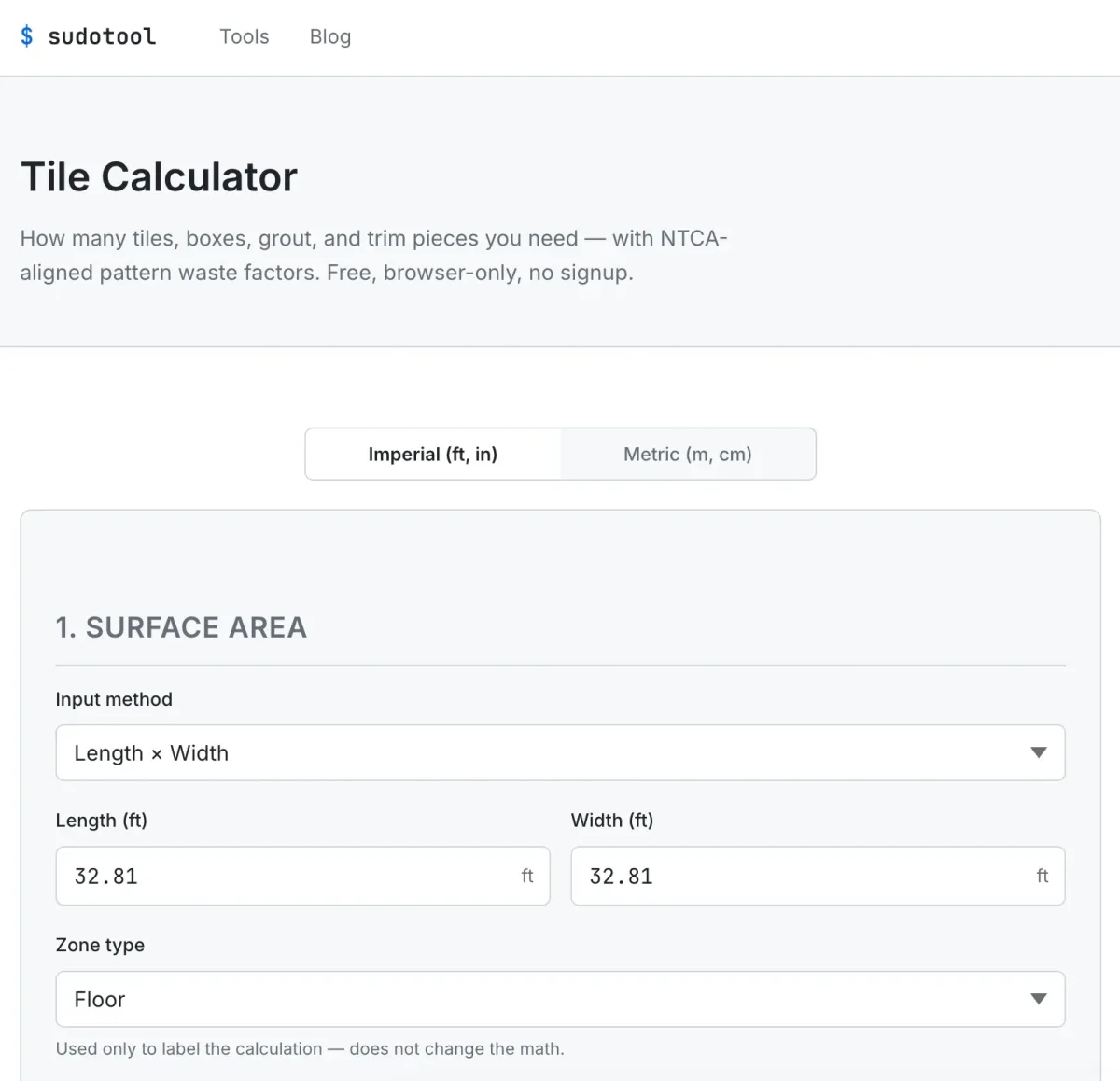
Picked a material? Enter the area, tile size, and pattern and the calculator returns tiles, boxes, and grout with the waste factor applied.
How to Choose — A Quick Decision Guide
When the options blur, four questions settle it:
- How much water? Showers, bathroom floors, and outdoors want porcelain's low absorption. A dry wall can take anything.
- How much foot traffic? A high-traffic floor wants porcelain (PEI 4–5) or a hard stone like granite. Walls and decorative areas are fine with ceramic.
- What's the budget? Tight means ceramic. Room to spend, with looks as the priority, opens up stone or premium porcelain.
- How much maintenance will you actually do? If resealing every year or two sounds unlikely, skip natural stone and choose porcelain or ceramic.
All three are still "tile," but those four dials — water, traffic, budget, and upkeep — are what move the answer from one material to another.
Frequently Asked Questions
Is porcelain better than ceramic?
Not better, just harder and more water-resistant — which makes porcelain the smarter choice for floors, wet rooms, and outdoors, while ceramic wins on price, ease of cutting, and walls. It depends on where it is going.
What's the actual difference between porcelain and ceramic?
Porcelain is a denser type of ceramic defined by a water absorption of 0.5% or less (per ASTM C373). Ordinary ceramic absorbs more than that, which is why it is softer, cheaper, and easier to cut.
Do I need to seal porcelain or ceramic tile?
Usually not — both, especially when glazed, are dense enough that they do not need sealing. Natural stone is the one that is porous and needs periodic sealing. (Some unglazed or specialty tiles are exceptions, so check the product guidance.)
Which tile is best for a bathroom floor?
Porcelain, because its very low water absorption stands up best to moisture. Ceramic can work too, but porcelain is the safer bet on a wet floor. If you want stone, plan on sealing it.
Can I use ceramic tile on the floor?
Yes — just check the PEI rating and pick 3 or higher for a regular residential floor. For a high-traffic floor, step up to PEI 4–5 or choose porcelain.
Is natural stone worth it?
For looks and resale appeal, often yes — if you are willing to handle the higher cost, the periodic sealing, and the delicacy of softer stones like marble. If not, a stone-look porcelain gets you most of the appearance with far less upkeep.
The Bottom Line
The difference between porcelain, ceramic, and natural stone really is a trade-off between water resistance, durability, maintenance, and cost. Porcelain absorbs 0.5% or less and is the toughest, but costs more and resists the saw; ceramic is softer yet cheaper and easier to work with; stone is the most beautiful but asks for sealing and a bigger budget. Start with the room — the more water and foot traffic it sees, the more porcelain makes sense; walls and tight budgets lean ceramic; statement spaces justify stone. Once the material is settled, the rest is arithmetic: drop your measurements into the tile calculator and it will turn them into boxes, grout, and a waste cushion — and if it is a backsplash, our guide on measuring a backsplash takes it from there.
This is a general home-improvement guide based on manufacturer and trade references. The right tile depends on the specific product, its ratings (PEI and water absorption), the stone variety, your budget, and site conditions, so always check the actual product label and specifications before buying. Water-absorption thresholds and PEI ratings follow ASTM and industry standards but individual products vary; natural-stone sealing frequency depends on the stone, finish, and traffic, so follow the manufacturer's care instructions. For large-format installations, structural questions, or high-end stone, consult a professional tile installer.
- Tile Council of North America — Porcelain Tile Certification. Industry reference for the 0.5%-or-less water-absorption definition of porcelain (ASTM C373) and the PTCA certification program.
- National Tile Authority — Tile Water Absorption Ratings. Reference for the impervious / vitreous / semi-vitreous / non-vitreous absorption classes.
- MSI — Porcelain vs. Ceramic Tile: What's the Difference? Reference for porcelain and ceramic both belonging to the ceramic family, with porcelain the denser, more refined version.
- Apollo Tile — PEI Rating for Tiles Explained. Reference for the 0–5 PEI surface-wear scale and floor-suitability by level.
- CLÉ Tile — How to Seal Natural Stone Tile. Reference for stone porosity, sealing frequency, the water-drop test, and unsealed-stone risks.
- Carmel Imports — Difference Between Porcelain and Ceramic Tile. Reference for glazed-ceramic chips revealing a different body color versus through-body porcelain.
- Flooring 101 — Ceramic vs. Porcelain vs. Natural Stone. Reference for the cost ranking and cutting/installation difficulty.