Can You Tile Over Existing Tile? When It Works and When It Fails
Tile demolition is the line everyone wants to delete from the renovation plan — the hammering, the dust, the disposal fees. Whether you can skip it comes down to a ten-minute inspection of the old tile and an honest look at half an inch of new floor height. This guide covers what the industry standard actually says, the go/no-go checks, the height problem nobody budgets for, the two surface-prep routes, and the five situations where tearing out is the right call.
Somewhere in the middle of every bathroom or kitchen renovation, the same question comes up: can you tile over existing tile, or does the old layer have to come out? The internet answers with equal parts "absolutely" and "never," which is no help. The industry answer is more useful — yes, it's a documented, standard method, and it comes with a specific list of conditions that take about ten minutes to check.
This guide walks through (1) what the industry standard actually says, (2) the ten-minute go/no-go inspection, (3) the height gain that catches people off guard, (4) surface prep and material choices — the half of the job that decides whether the new layer stays bonded, (5) the five situations where removal is the better decision, and (6) a scenario cheat sheet.
Tile Over Existing Tile: What the Industry Standard Actually Says
Tiling over tile has a reputation as a DIY shortcut, but it appears in the most authoritative document the tile trade has — the TCNA Handbook, which North American installers and architects treat as the reference for accepted methods. The handbook's Renovation section covers installing over existing surfacing in detail TR711, and the procedures for bonding to existing tile specifically are described in details TR712 and TR713. The TCNA's own guidance opens with the sentence quoted above: this "is done regularly."
The same guidance carries two warnings that set up everything else in this article. First, the layer you can see isn't the whole story — TCNA notes that the entire substrate below the tile matters, not just the surface the new tile bonds to, and floors still need to meet the standard stiffness spec (L/360 deflection). A solid-looking old floor on a bouncy subfloor fails the same way it would have failed as a fresh installation. Second, materials are not interchangeable: "Not all thin-sets (nor polymer modified thinsets) are capable of bonding directly to tile." Glazed ceramic is close to glass — smooth and nonabsorbent — and ordinary mortar formulated for concrete or cement board has little to grip.
Homeowner-side guidance agrees on the conditions. Bob Vila's guide puts it plainly: "If your tiles are in relatively good condition—evenly placed, without cracks, and not appearing to retain any moisture—then you can probably leave them underneath your new layer of tile." Condition of the existing layer is the whole game — which is what the next section inspects.
The Ten-Minute Go/No-Go Inspection
Six checks, no special tools beyond a coin and a level. One failing check doesn't always kill the project — but each failure points to the section on tear-outs below.
| Check | How | Go | No-go |
|---|---|---|---|
| Bond (tap test) | Tap tiles with a coin or a screwdriver handle, listening room-wide | Solid, dense sound everywhere | Hollow sounds in multiple spots, loose or rocking tiles |
| Cracks | Inspect tile and grout lines | None, or one or two isolated chips | A crack running across several tiles — a substrate-movement symptom |
| Moisture | Look for mildew and deep grout discoloration | Clean, evenly colored grout | Mildew or dark staining — an absorption problem that worsens if covered |
| Flatness | Run a level or straightedge across the surface | Flat; minor grout ridges you can sand down | Warped, humped, or stepped areas |
| Height budget | Check doors, transitions, fixtures, appliances | Roughly 1/2" of clearance everywhere it matters | A door, dishwasher, or threshold that can't absorb it |
| Weight (floors) | Identify what's under the floor | Concrete slab | Heavy new tile on a wood-framed floor — get a structural opinion first |
The moisture row deserves the strongest emphasis, because it's the one people most want to ignore. In Bob Vila's words: "Mildew and deep discoloration in the grout often signal an absorption issue–meaning that trapped water has damaged the grout and could thus rot the new tile from below." Covering a moisture problem doesn't pause it — it hides it while it keeps working. The weight row comes from the same source: "it's best not to lay heavy new tile over existing tile floors unless the foundation beneath both is concrete." Two tile layers plus mortar is real load, and wood framing that was sized for one layer didn't sign up for two.
The Half Inch Nobody Budgets For
Skipping demolition keeps the dust out of the house, but it raises the floor — and the height gain is the most underestimated cost of the whole approach. Typical porcelain floor tile runs about 1/4 to 3/8 inch thick, and the thinset bed underneath adds roughly another 1/8 to 3/16 inch. Call it half an inch of new elevation once both layers are down.
Half an inch sounds trivial until you walk the room and count what touches the floor:
- Doors. Every door swinging over the new floor loses half an inch of clearance — most need undercutting or planing, and some need replacing.
- Transitions. Where the new floor meets hallway wood or carpet, you now have a step. That means transition strips at best, a trip hazard at worst.
- The toilet flange. Raise the floor and the flange is effectively recessed below it — plan on a flange extension ring so the wax seal still seats properly.
- Built-in dishwashers. The kitchen deal-breaker. Raise the floor in front of a dishwasher that sits under a countertop and you can trap the appliance in its bay — it can't be pulled out for service or replacement without cutting the counter or the new floor. This single issue is why many kitchens that pass every other check still end in tear-out.
- Baseboards and casings. Either they come off and get reinstalled higher, or the gap gets covered with quarter-round that changes the room's trim profile.
This is exactly the qualifier in the TCNA's sentence — "where there is not a floor height or wall thickness limitation." The method is sound; the geometry of your room decides whether you're allowed to use it.
Surface Prep and Materials: The Half of the Job That Decides the Bond
Old glazed tile is a terrible bonding surface in its natural state — smooth, dense, often coated with years of soap film or floor wax. Getting a new layer to stick is a four-step sequence.
Step 1 — Fix the surface. Re-adhere or replace any loose tiles found in the tap test, and sand down proud grout ridges so the surface is flat. A new layer follows the old layer's geometry exactly — bumps included.
Step 2 — Degrease. Scrub with a degreasing cleaner and rinse. Soap residue, sealers, and wax are bond breakers; mortar applied over them is bonding to the film, not the tile. Let everything dry completely.
Step 3 — Create a bondable surface, by one of two routes. The traditional route is mechanical abrasion — grinding the glaze to roughen it. It works, but it has a real safety string attached. The TCNA warns: "Mechanical or chemical abrasion to tile can release fine particles which could cause harm if inhaled or ingested" — older glazes are the concern, and the TCNA laboratory offers toxic-metals analysis for exactly this reason. If you abrade, that means dust extraction, a respirator, and containment. The modern alternative skips the dust entirely: a bond-promoting primer. MAPEI's ECO Prim Grip — a ready-to-use primer with bond-promoting silica aggregates, designed for existing ceramics and porcelain — is applied with a roller and leaves a rough keying surface for the mortar; its data sheet's selling point is "No shotblasting or abrasion required." For most DIY tile-over-tile jobs, the primer route is the realistic one.
Step 4 — Use a mortar that's rated for this. This is where the TCNA's "not all thin-sets" warning lands. Check the mortar's data sheet for existing ceramic or porcelain tile in its approved-substrates list — the premium polymer-modified mortars typically qualify; bargain ones typically don't. From there the installation proceeds like any other: trowel, set, and grout, with the grout choice driven by your new joint width as covered in our sanded vs unsanded grout guide.
One honest caveat on the primer route: it has its own limits. ECO Prim Grip's data sheet excludes wet substrates and installations subject to water immersion, such as pools and spas — a restriction that matters for the next section.
Five Situations Where Tear-Out Is the Right Call
1. Shower floors. The clearest no. A shower pan is a waterproofing-and-slope system, and covering it means building on an assembly you can't inspect or verify. If the old pan has any weakness, you've sealed it under a new layer; meanwhile the no-dust primer route is off the table in immersion-adjacent conditions. Shower walls can qualify as a conditional yes — sound bond, intact waterproofing behind, manufacturer-approved system — but for the floor of a shower, tear out and rebuild.
2. Any moisture or absorption signal. Mildew, dark grout staining, tiles that seem to hold dampness — covering it transfers the problem to your new floor's foundation. Bob Vila's verdict on discovering moisture or bad installation: "it's better to start from scratch than to tile over the existing floor."
3. There are already two layers. Tile-over-tile is a one-time trick. Stacking a third layer compounds the weight, the height, and the odds that one of the buried layers lets go.
4. Structural cracks. A crack that runs across multiple tiles is the substrate talking — movement, settlement, or a missing expansion joint. A new bonded layer tends to crack along the same line (installers call it telegraphing). Replace one or two damaged tiles and proceed; treat a continuous crack as a stop sign until the cause is found.
5. Height-critical rooms. Kitchens with built-in appliances, entries with code-regulated thresholds, rooms where the door schedule can't absorb the change. When the half inch doesn't fit, it doesn't fit.
Weigh those against what demolition actually costs: days of dusty, loud work, debris disposal, and the risk of damaging the substrate on the way out — but also the chance to inspect and fix what's underneath, and a floor that returns to its original height. Tear-out is not failure; it's the better tool for these five jobs.
Scenario Cheat Sheet
- Solid old ceramic floor on a concrete slab, doors have clearance → go, primer route.
- Kitchen with a built-in dishwasher → usually tear out — the height trap.
- Shower walls, tile solid and waterproofing intact → conditional go, follow the mortar manufacturer's full system.
- Shower floor → no. Rebuild the pan.
- Mildew-stained grout → no — find and fix the moisture first.
- Heavy stone going over a wood-framed floor → not without a structural opinion.
If the answer is go, the next question is quantity — measuring the room, picking a layout, and adding the right waste factor, which our guide on calculating tile for a room walks through step by step. Or skip the hand math entirely:
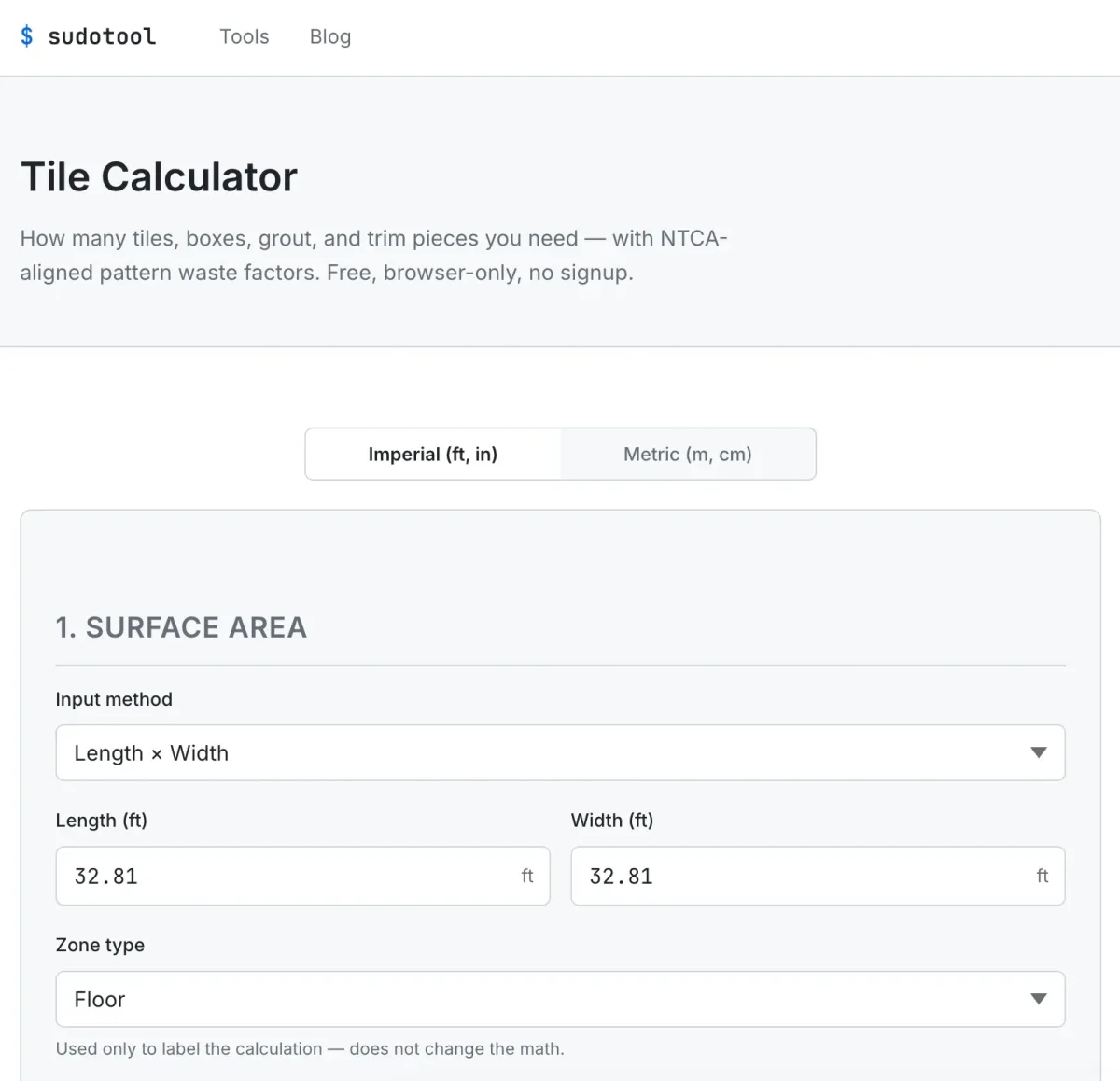
A tile-over-tile job needs the same quantity math as any other — area, pattern waste factor, and whole boxes for the new layer.
Frequently Asked Questions
Can you tile over tile in a shower?
On walls, conditionally — the existing tile must pass the bond checks, the waterproofing behind it must be intact, and the mortar manufacturer must approve the assembly. On shower floors, the practical answer is no: covering the pan means you can't verify the waterproofing and slope underneath, and bonding primers used for the no-abrasion route, like MAPEI ECO Prim Grip, are not rated for water-immersion installations. Tearing out a shower floor is the safer call.
Do you need special thinset to tile over tile?
Yes. The Tile Council of North America states that not all thinsets — including polymer-modified ones — are capable of bonding directly to tile. Use a polymer-modified mortar whose data sheet explicitly lists existing ceramic or porcelain as an approved substrate, and pair it with surface prep: either mechanical abrasion or a bond-promoting primer.
How much height does tiling over tile add?
Roughly half an inch. Typical porcelain floor tile runs about 1/4 to 3/8 inch thick, and the thinset bed adds another 1/8 to 3/16 inch. Before committing, check every door's clearance, the transitions to adjacent floors, the toilet flange (which may need an extension ring), and any built-in dishwasher — a raised kitchen floor can trap it under the countertop.
Do you have to sand or scuff old tile before tiling over it?
You need a bondable surface, and there are two routes. Mechanical abrasion works, but the TCNA warns that abrading tile can release fine particles that are harmful to inhale or ingest — older glazes are the reason its lab offers toxic-metals analysis. The no-dust alternative is a bond-promoting primer such as MAPEI ECO Prim Grip, which is designed for existing ceramics and requires no abrasion.
Can you tile over cracked tile?
Not over structural cracks. A crack that runs across several tiles is usually a symptom of substrate movement, and a new layer bonded on top tends to crack along the same line — the problem telegraphs through. One or two locally damaged tiles can be replaced or filled before tiling over; a continuous crack means finding the cause first.
This guide summarizes industry guidance (Tile Council of North America), manufacturer technical data sheets (MAPEI), and homeowner-focused publishers as published. Site conditions vary: structural load on wood-framed floors, shower waterproofing, and continuous cracking are situations where an on-site assessment by a qualified professional is the right next step, not a general guide. Product capabilities and limitations change by data-sheet revision — follow the current data sheet of the specific products you purchase.
- Tile Council of North America — FAQ: Existing Ceramic Tile (Tiling Over Tile). Industry reference for the "done regularly" guidance, the well-bonded requirement, TR712/TR713 handbook details, the thinset bonding warning, and the abrasion-particle safety caution.
- Tile Council of North America — FAQ: Tile Over Other Flooring. Industry reference for the TR711 renovation detail, the whole-substrate principle, and the L/360 deflection requirement.
- MAPEI — ECO Prim Grip (technical data sheet, 2024-10-09). Manufacturer reference for the bond-promoting primer route: use over existing ceramic and porcelain, no abrasion required, wet-substrate and water-immersion limitations.
- Bob Vila — Can You Tile Over Tile? Homeowner reference for the condition checks, the moisture/absorption warning, the concrete-foundation weight caution, and the start-from-scratch threshold.
- Hunker — What Is the Standard Porcelain Tile Thickness? Reference for typical porcelain tile thickness used in the height estimate.
- SudoTool — How to Calculate Tile for a Room. Sister guide on measuring, layout patterns, and waste factors for the new layer.
- SudoTool — Sanded vs Unsanded Grout. Sister guide on choosing grout for the new layer's joint width.