Sanded vs Unsanded Grout: Which One Do You Need?
Every grout color in the store comes in two bags — sanded and unsanded — and the wrong pick cracks wide joints, pinholes narrow ones, or scratches a polished tile face. The good news: the decision isn't taste or brand loyalty. It's a width rule printed in the manufacturers' own data sheets, with one exception for delicate surfaces. This guide covers the rule, the exception, where each grout belongs room by room, and the newer products that let you skip the choice entirely.
Stand in the grout aisle long enough and the question repeats itself: sanded vs unsanded grout — same color chip, two different bags, no explanation on the shelf. The difference between them is a single ingredient, sand. But that one ingredient changes how much the grout shrinks as it dries, how narrow a gap it can fill, how it behaves on a wall, and whether it can be dragged across a polished marble face without leaving marks.
This guide walks through (1) what actually differs between the two grouts, (2) the 1/8-inch rule and why manufacturers enforce it in both directions, (3) the delicate-surface exception, (4) which grout goes where — showers, floors, walls, pools, (5) the fine-aggregate and epoxy alternatives, and (6) a scenario cheat sheet with the five most common mistakes.
Sanded vs Unsanded Grout: The Difference Is One Ingredient
Both products are cement grouts. The mainstream versions from MAPEI and Custom Building Products are polymer-modified Portland-cement formulas that meet the same baseline industry standard (ANSI A118.6), mix with water, and cure into the hard lines between your tiles. The split is in the aggregate.
Sanded grout is cement, pigment, and fine silica sand. The sand does the same job gravel does in concrete — it gives the cured material dimensional stability, so the joint resists shrinking as the water leaves it. Custom Building Products describes its sanded line as producing hard, dense joints that resist shrinking, cracking, and wear. That stability is exactly what a wide joint needs, because the more grout volume sits in a joint, the more there is to shrink.
Unsanded grout drops the sand and leans on a finer cement blend with a higher share of polymer. The result is a smooth paste that packs tightly into narrow gaps and grips better on vertical surfaces — it stays put on a wall where a heavier sanded mix would slump before it sets. The trade-off is shrinkage: without aggregate, the paste contracts more as it dries, which is fine in a 1/16-inch line and a problem in a 1/4-inch one.
Price tilts toward sanded. Sand is a cheap filler; polymer is not. For a typical bathroom you're talking a few dollars per bag of difference, which is why cost should never drive this decision — the failure modes of the wrong pick cost far more than the right bag.
The 1/8-Inch Rule Comes From the Data Sheets
The width rule is often presented as folk wisdom, but it's literally a product specification. Here's what the manufacturers print:
| Product | Type | Rated joint range | Standard |
|---|---|---|---|
| MAPEI Keracolor S | Sanded | 1/8"–5/8" (3–16 mm) | ANSI A118.6 |
| MAPEI Keracolor U | Unsanded | 1/16"–1/8" (1.5–3 mm) | ANSI A118.6 |
| Custom Building Products Polyblend Plus Sanded | Sanded | 1/8"–1/2" (3.1–12.7 mm) | ANSI A118.7 |
| Custom Building Products Polyblend Plus Non-Sanded | Unsanded | Up to 1/8" (3 mm) | ANSI A118.6 |
| MAPEI Ultracolor Plus FA | Fine aggregate ("all-in-one") | 1/16"–3/4" (1.5–19 mm) | ANSI A118.6 + A118.7 |
The data sheets don't just state the range — they prohibit crossing it. The Keracolor S sheet says "Do not use to grout joints less than 1/8" (3 mm) wide"; the Keracolor U sheet mirrors it with "Do not use to grout joints greater than 1/8" (3 mm) wide." Each sheet then names the sibling product (or an epoxy grout) as the correct substitute. When the manufacturer tells you which competitor-in-its-own-catalog to buy instead, the boundary is not negotiable.
The mechanism runs in both directions. Push sanded grout into a 1/16-inch joint and the sand grains — large relative to the gap — bridge and jam instead of compacting, leaving voids and a weak, poorly filled line that crumbles under cleaning. Run unsanded grout through a 1/4-inch floor joint and the aggregate-free paste shrinks as it cures, pulling away from the tile edges and cracking down the center within months. Neither failure is about quality; both are about geometry.
So the first practical step is to know your joint width. If the tile is already set, measure the gap between tiles; if you're planning, the spacer size you choose is the answer. As a reference point, 1/8 inch is about the thickness of two stacked quarters.
The Exception: Glass, Polished Marble, and Soft Glazes
Width settles most cases. The tile surface overrides it.
Sand is an abrasive, and dragging an abrasive paste across a delicate face with a rubber float is exactly the motion you'd use to sand something. Manufacturers say this directly. Custom Building Products positions its non-sanded grout with one sentence: "It is an ANSI A118.6 polymer-modified, cement-based non-sanded grout designed for highly glazed or polished tile, marble and natural stone that would be scratched by sanded grouts." MAPEI's data sheets carry a matching caution — that some types of glass, glazed ceramic tile, marble, and granite can be permanently stained, scratched, or dulled by sanded or pigmented formulas — and recommend checking the tile manufacturer's literature and testing on a separate sample before committing.
Two honest nuances are worth pulling out of that fine print. First, "glass means unsanded, always" is an oversimplification — MAPEI actually lists glass among the tiles its sanded grout can handle, while warning that some types are vulnerable. The accurate rule is: on glass, polished stone, or soft glazes, default to unsanded, follow what the tile maker recommends, and test a spare tile or hidden corner first. Second, notice that the cautions name pigmented grout alongside sanded — deep color pigments can stain a porous polished surface even with no sand involved. Light stone generally wants light grout.
If your polished or glass tile is set with joints wider than 1/8 inch — uncommon, but it happens with some stone layouts — that's the situation fine-aggregate grout was built for, covered two sections down.
Which Grout Where: Showers, Floors, Walls, and Pools
A persistent myth says sanded grout is "for floors" and unsanded is "for walls." It's half-true at best — both MAPEI Keracolor sheets rate both products for floors and walls. What makes the myth feel true is that floors usually get wider joints (so they end up sanded) and wall tile usually gets narrow ones (so it ends up unsanded). The location doesn't decide; the joint width that location typically uses does. The same logic applies to wet areas — there is no "shower grout" type; there's the right width grout, cured properly. For how tile itself differs between those surfaces, see our wall tile vs floor tile guide.
| Location | Typical joint | Usual pick | Why |
|---|---|---|---|
| Floors (ceramic, porcelain) | 1/8"–1/4" | Sanded | Wide joints + foot-traffic durability |
| Wall tile, backsplash | 1/16"–1/8" | Unsanded | Narrow joints; stickier paste resists slumping on vertical surfaces |
| Shower walls | 1/16"–1/8" | Unsanded | Width decides — not the water |
| Shower floors (mosaic) | ~1/8" | Match the width / fine aggregate | Mosaic sheets have a lot of joint area; measure before buying |
| Pools, submerged areas | Varies | Match the width | Both Keracolor grouts are rated for submerged use after a full 21-day cure (72 hours for Ultracolor Plus FA) |
| Polished marble, glass tile | Usually narrow | Unsanded by default | Scratch risk — test a sample either way |
Wet areas add timing rules rather than type rules. Per MAPEI's data sheet, a freshly grouted residential shower should stay dry for 24 to 48 hours, a steam shower for 14 days, and floors should be kept free of heavy traffic for at least 72 hours. Pools and fountains wait for the full cure — 21 days for the standard cement grouts.
One more piece of honesty the internet usually gets wrong: sealing. Generic advice says cement grout must always be sealed. MAPEI's own sheet for the polymer-modified Keracolor U says sealing is not required — a penetrating sealer is an optional extra layer, not a condition of the warranty. Polymer modification already cut the porosity that old-school site-mixed grouts had. Follow the data sheet of the product you actually bought rather than a blanket rule. And remember what grout is for in the first place — it fills joints and handles movement at the surface; actual waterproofing in a shower is the membrane system behind the tile, not the grout line. If you're choosing tile for a small, wet room, our small-bathroom tile guide covers that layer of the decision.
The Third Option: Fine-Aggregate All-in-One (and Epoxy)
The sanded-or-unsanded dilemma is old enough that manufacturers built a product to dissolve it. MAPEI's Ultracolor Plus FA is literally subtitled a rapid-setting "all-in-one" grout replacement for sanded and unsanded grouts: a fine-aggregate formula whose grains are small enough for 1/16-inch joints but which still resists shrinkage up to 3/4-inch joints. It meets both cement-grout standards (ANSI A118.6 and the high-performance A118.7), takes foot traffic in 3 to 4 hours, is rated for submerged use after 72 hours instead of 21 days, and doesn't typically need a sealer.
The catch is price — fine-aggregate products cost meaningfully more per bag than basic sanded grout. They earn it on jobs that mix widths: a bathroom with 1/16-inch wall joints and 3/16-inch floor joints is otherwise a two-bag, two-batch project with two slightly different textures in the same room. One bag that legitimately covers both is simpler and usually looks better. Note that the fine aggregate is still an aggregate — MAPEI's caution about testing polished marble and some glass before grouting applies to this product too.
Epoxy grout is the other escape hatch, and a different animal entirely — a resin-and-hardener chemistry (its own standard, ANSI A118.3) rather than cement. It's the most stain-resistant and chemical-resistant option, never needs sealing, and is the default in commercial kitchens. It's also two to four times the price, sets fast, and is unforgiving to clean off the tile face, which is why most residential jobs stick with cement grouts and save epoxy for countertops and extreme-mess zones.
Scenario Cheat Sheet and the Five Common Mistakes
The whole decision, compressed:
- 12×24 porcelain floor, 3/16" joints → sanded
- Ceramic kitchen backsplash, 1/16" joints → unsanded
- Subway tile shower walls, 1/16"–1/8" → unsanded (the width, not the shower, decides)
- Polished marble anywhere → unsanded by default, light color, test a spare piece
- Glass mosaic → tile manufacturer's recommendation first; unsanded as the default
- One job mixing 1/16" walls and 1/4" floors → consider a fine-aggregate all-in-one
- Not sure of your joint width → measure the gap or check your spacer size; 1/8" ≈ 3 mm
And the failures that show up in real bathrooms:
1. Using leftover sanded grout in narrow wall joints. The most common version of the mistake, because sanded is what people have in the garage. The sand bridges in the thin gap and the joint ends up under-filled and fragile.
2. Using unsanded grout in wide floor joints. Looks fine on day one. The shrinkage cracks arrive over the following weeks, and regrouting a floor is far more work than buying the right bag was.
3. Skipping the sample test on polished stone. The manufacturers' cautions about scratching and staining all end in the same instruction: test on a separate piece first. Five minutes against a permanently dulled marble wall.
4. Grouting joints that are still full of adhesive. MAPEI's sheets require excess mortar cleared so that two-thirds of the tile depth is open for grout. A joint that's half mortar holds half the grout — and fails like it.
5. Guessing the quantity. Grout coverage swings widely with joint width, joint depth, and tile size — a mosaic wall eats several times more grout per square foot than a large-format floor. Our grout quantity guide walks through the math, or let the calculator below do it for the exact tile and joint size you picked.
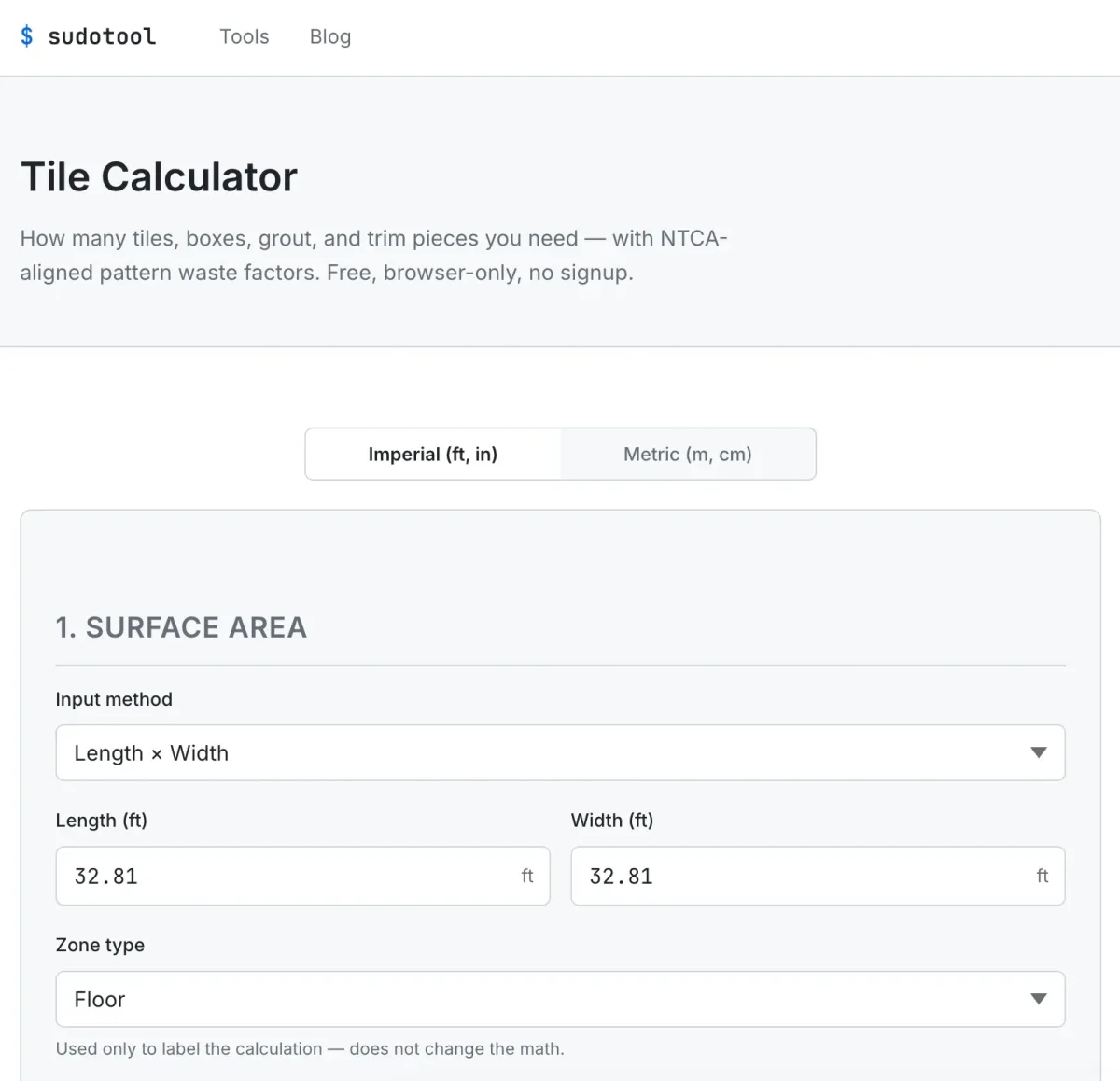
Joint width is the same number that drives your grout quantity — set it once in the calculator and get tiles, boxes, and grout in one pass.
Frequently Asked Questions
Can you use sanded grout in 1/16-inch joints?
No. Manufacturer data sheets prohibit it — MAPEI's Keracolor S, for example, is rated for 1/8-inch to 5/8-inch joints, and its data sheet says not to use it in anything narrower. Sand grains can't pack into a 1/16-inch gap properly, which leaves weak, poorly filled joints. Use an unsanded or fine-aggregate grout instead.
Will sanded grout scratch glass tile or polished marble?
The risk is documented by the manufacturers themselves. Custom Building Products designs its non-sanded line for highly glazed or polished tile, marble, and natural stone that would be scratched by sanded grouts, and MAPEI's data sheets warn that some glass, glazed ceramic, and marble can be permanently scratched or dulled by sanded or pigmented formulas. Default to unsanded on those surfaces, follow the tile manufacturer's guidance, and test on a spare tile first.
Should I use sanded or unsanded grout in a shower?
The joint width decides, not the shower. Both types are rated for wet areas — MAPEI rates both Keracolor grouts for submerged use after a 21-day cure. Most shower wall tile uses 1/16-inch to 1/8-inch joints, which calls for unsanded. Whichever you use, keep the shower dry for 24 to 48 hours after grouting, and 14 days for steam showers, per MAPEI's data sheet.
Is sanded grout stronger than unsanded grout?
Only in the joints it's designed for. In joints 1/8 inch and wider, the sand acts as aggregate that resists shrinkage and cracking, so sanded is more durable there. In joints narrower than 1/8 inch, sanded can't compact fully and unsanded fills more completely. Neither type is stronger everywhere — width determines which one performs.
Do I have to choose between sanded and unsanded at all?
Not anymore. Fine-aggregate grouts — MAPEI's Ultracolor Plus FA is the best-known example — are sold as all-in-one replacements for both, cover joints from 1/16 inch to 3/4 inch, and meet both the ANSI A118.6 and A118.7 standards. They cost more per bag, but one product covers a job that mixes narrow wall joints and wide floor joints. Epoxy grout is a separate category again — the most stain-resistant option, but pricier and harder to work with.
This guide summarizes manufacturer technical data sheets (MAPEI, Custom Building Products) and homeowner-focused publishers as published. Joint-width ratings, cure times, and sealing guidance vary by product and by data-sheet revision — always follow the current data sheet of the specific product you purchase. Grout choice does not fix structural problems: recurring cracks usually point to substrate movement or missing expansion joints, and waterproofing in wet areas is the job of the membrane system behind the tile, not the grout.
- MAPEI — Keracolor S Sanded Grout (technical data sheet, 2024-10-09). Manufacturer reference for the 1/8"–5/8" joint range, the prohibition on narrower joints, ANSI A118.6 compliance, submerged-use cure time, and the caution on sanded/pigmented formulas over marble and glazed ceramic.
- MAPEI — Keracolor U Unsanded Grout (technical data sheet, 2017-09-20). Manufacturer reference for the 1/16"–1/8" joint range, the prohibition on wider joints, shower and steam-shower cure restrictions, and the sealing-not-required guidance.
- MAPEI — Ultracolor Plus FA (technical data sheet, 2023-11-14). Manufacturer reference for the all-in-one positioning, 1/16"–3/4" joint range, ANSI A118.6/A118.7 compliance, 3-to-4-hour foot traffic, and 72-hour submerged cure.
- Custom Building Products — Polyblend Plus Sanded Grout. Manufacturer reference for the 1/8"–1/2" joint range, ANSI A118.7 compliance, and the shrink/crack/wear-resistance description.
- Custom Building Products — Polyblend Plus Non-Sanded Grout. Manufacturer reference for the up-to-1/8" joint range and the quoted sentence on surfaces that would be scratched by sanded grouts.
- Bob Vila — Sanded vs. Unsanded Grout. Homeowner reference for the width thresholds, vertical-surface workability, and cost comparison.
- SudoTool — How Much Grout Do You Need? Sister guide on grout quantity math by joint width, depth, and tile size.
- SudoTool — Wall Tile vs Floor Tile. Sister guide on why walls and floors take different tile — and different joints.