How Much Grout Do You Need? Tile and Joint Size
Grout is the material people forget to estimate — and the one that sends them back to the store mid-job. The amount you need is not driven by floor area; it's driven by tile size, joint width, and tile thickness. Here's how those three numbers work, and how to turn them into bags.
Most people plan a tile project carefully — they choose the tile, measure the room twice, and pick a pattern — and then treat grout as an afterthought. One bag should do it, right? Then halfway through they run dry, drive back to the store, and the replacement bag dries a shade off from the first. The question how much grout do you need turns out to be less obvious than it looks, because the answer barely depends on the thing most people reach for first: the floor area.
Two rooms can be the same size and need wildly different amounts of grout. A 100-square-foot floor in large tile might take a single bag; the same floor in small mosaic can take three or four. The square footage is identical — what changed is how much joint there is to fill. This guide explains the three variables that actually set the number, why small tiles are so hungry, and how to convert the result into bags without over- or under-buying.
How Much Grout Do You Need? It's Not the Floor Area
Grout fills the gaps between tiles, so how much grout you need is really a question about the gaps — not the tiles, and not the floor area. Three measurements set it:
- Tile size. Smaller tiles mean more tiles, more edges, and far more joint to fill in the same space. This is the biggest lever, and the one people miss.
- Joint width. The wider the gap between tiles, the more volume each joint holds. Going from a 1/8-inch joint to a 1/4-inch joint roughly doubles the grout you need.
- Tile thickness. The joint is as deep as the tile is thick, so a thick tile makes a deeper, more voluminous joint. Ceramic runs around 1/4 inch, porcelain around 3/8 inch, and stone 3/8 to 1/2 inch.
Area still matters — it's the final multiplier — but it scales a per-square-foot figure that the three variables above have already decided. That's what makes grout different from paint. Paint is almost purely an area game, a question of coverage per gallon (our guide on paint coverage per gallon walks through that one). Grout is a question of how much total gap your particular tile and joint create across that area.
Why Smaller Tiles Use More Grout
Here is the single most useful idea in this whole guide: grout consumption tracks the total length of your joints, not the floor area. Shrink the tile and you multiply the number of edges packed into the same room, and every edge is a joint that needs filling.
The tile retailer Original Mission Tile lays the contrast out for a 100-square-foot space. Large-format 24-by-24-inch tile produces roughly 100 linear feet of grout lines. Drop to 8-by-8-inch tile and that climbs to about 300 feet. Go all the way to a 2-by-2-inch mosaic and you are filling somewhere north of 1,200 linear feet of joint — in the very same room. The floor never changed size; the amount of gap inside it grew more than tenfold.
Manufacturer coverage charts show the same thing in bag terms. A 25-pound bag that stretches across roughly 40–60 square feet of 12-inch tile at a 1/4-inch joint might cover only about 10–20 square feet of small mosaic, because the mosaic crams in so much more joint per square foot. Exact coverage depends on the joint width and tile thickness, so the real figure lives on the product's coverage chart — but the direction never changes. If you are tiling with mosaic, small subway, or penny tile, plan on a lot more grout than the modest area suggests. "It's only a small backsplash" is exactly how people end up a bag short.
The Grout Formula, Without the Headache
You don't have to do this by hand, but seeing the formula makes the variables click. It just turns the idea above — more joint means more grout — into arithmetic.
For a single tile, the share of the surface taken up by joints is (joint width ÷ tile length) + (joint width ÷ tile width). The smaller the tile, the bigger that fraction. Multiply it by the tile thickness (the joint's depth) to get the cross-section of grout per square foot, multiply by the area for total volume, and convert that volume to weight with the grout's density. Written out, it's the form the calculator uses:
Grout per sq ft = (joint width ÷ tile length + joint width ÷ tile width) × tile thickness × density
This is the same shape as the industry-standard grout-volume formula used by manufacturers such as MAPEI and the figures published in the Tile Council of North America's handbook. The catch — the same one that applies to tile waste factors — is that the precise constants and coverage tables live in paid manufacturer documentation and reference manuals, not on a single free official page, so treat the exact numbers as well-calibrated industry figures rather than something you can verify line by line. A general construction reference like the Omnicalculator grout tool models the same geometry a slightly different way and uses a standard grout density of roughly 100 pounds per cubic foot. For weight, cement grout densities run approximately 0.19 lb per cubic inch for sanded, 0.17 for unsanded, and 0.22 for epoxy — close enough that the tile size and joint width dominate the result. Rather than memorize any of it, plug your numbers into the tile calculator and let it return pounds and bags.
Sanded vs Unsanded Grout — the 1/8-Inch Rule
Quantity is half the question; the other half is which grout, and the two types are not interchangeable. The deciding factor is joint width, and the line falls at 1/8 inch.
According to the Tile Council of North America, cementitious joints of 1/8 inch and wider should take sanded grout, while joints narrower than 1/8 inch should take unsanded grout. Joints wider than about 3/8 inch generally call for an even more heavily sanded product to fill the larger gap. The reasoning comes down to shrinkage. Cement grout pulls in slightly as it cures and the water leaves it, and unsanded grout shrinks noticeably more than sanded. The sand acts as a structural filler that resists that shrinkage, so a wide joint filled with unsanded grout is prone to cracking, while the same joint in sanded grout holds. Below 1/8 inch the sand simply doesn't fit, and on polished faces such as marble — and, by the same logic, glass or other delicate surfaces — sanded grout can scratch the tile, which is the other reason narrow joints go unsanded.
The practical upshot: pick your joint width first, because it decides both how much grout you buy and which kind. The calculator follows the same 1/8-inch rule and recommends sanded or unsanded automatically once you set the joint. If you're running a borderline 1/8-inch joint on a scratch-prone tile like marble or glass, confirm the choice with the tile or grout maker before committing.
How Wide Should Your Grout Joints Be?
Since joint width drives both the amount and the type, it's worth setting deliberately rather than by default. The right width depends on the tile, and the guidance from tile specialists like CLÉ Tile lines up well across the trade:
| Tile type | Typical joint width |
|---|---|
| Subway (modern look) | 1/16" |
| Subway (classic look) | 1/8" |
| Small format (≤ 6") | 1/16"–1/8" |
| Medium format (6–12") | ~1/8", up to 1/4" |
| Large format (> 12") | 1/8"–3/8"+ |
| Natural stone | ~1/8" |
| Brick / handmade | 3/8" / 1/4"+ |
The pattern behind the table is that larger tiles generally take a slightly wider joint to absorb small dimensional differences from tile to tile and allow for movement, while small tiles look cleanest with tight joints. Notice how the choice cascades: widen the joint and you use more grout and push past the 1/8-inch line into sanded territory; tighten it and you use less, in unsanded. The seemingly small decision between 1/16 and 1/8 inch quietly sets your quantity, your grout type, and your cost.
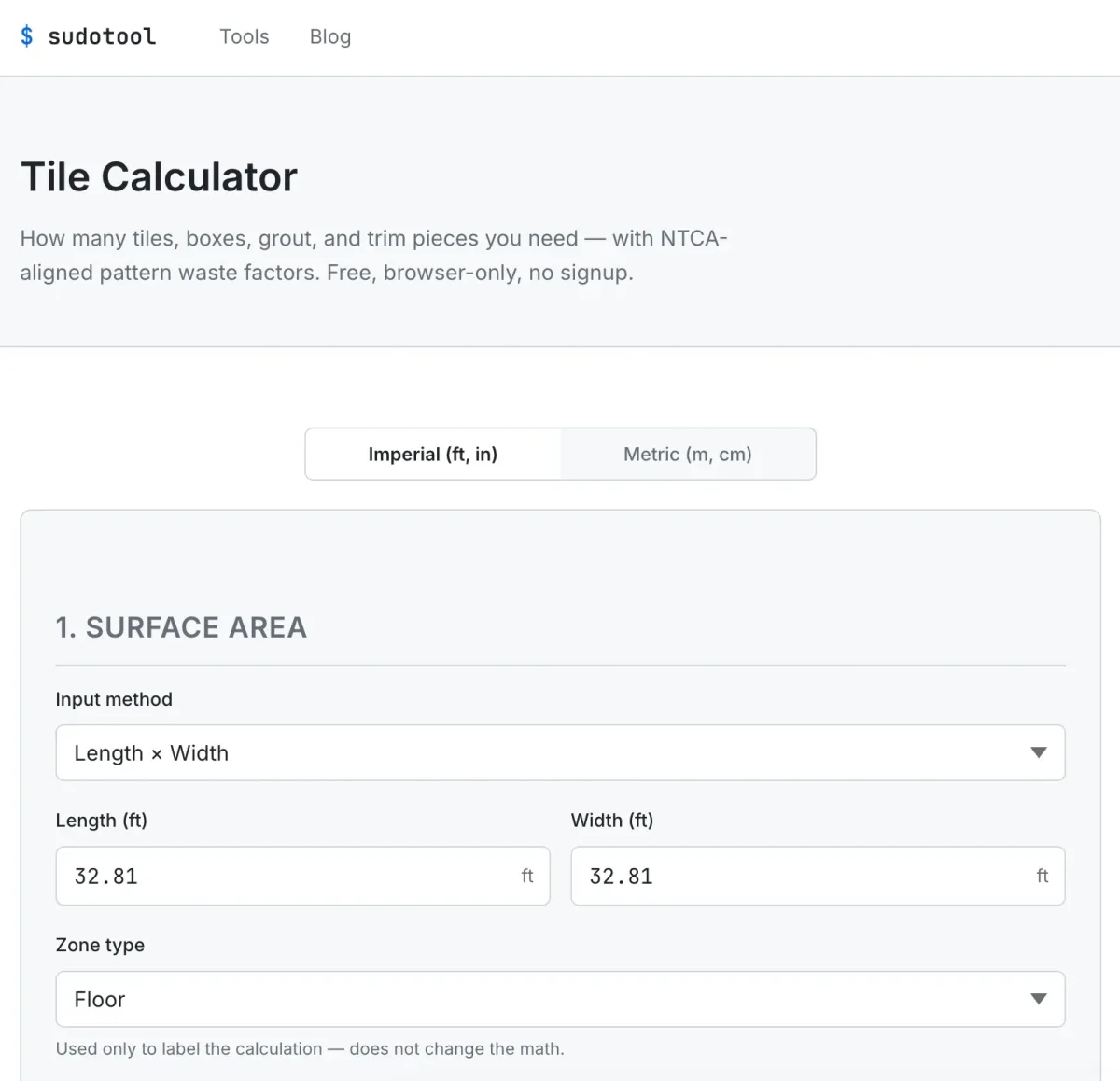
Turn on the grout option, set your joint width and tile thickness, and the calculator returns pounds and bags — and recommends sanded or unsanded for you.
From Pounds to Bags — What to Actually Buy
The formula gives you pounds; the store sells bags. Cement grout comes in roughly 7-, 10-, 25-, and 50-pound bags, with the 25-pound bag the most common for a typical room. Take your total weight, divide by the bag size, and round up to the next whole bag — never down. Being a third of a bag short still means a second trip.
On top of that, add a margin. Manufacturers such as MAPEI and LATICRETE typically suggest budgeting about 5–10% extra to be sure the job is covered, and a first-time install, a complex pattern, or an uneven surface argues for the higher end. The tile calculator builds in a 7% buffer for mixing and application waste before it rounds up to whole bags.
Two more things save jobs. First, color consistency: cement grout shades can drift slightly between batches, so mix enough at once for a continuous area rather than topping up with a freshly opened bag partway across a floor, where the seam can show. Second, don't under-buy to avoid waste — mixed cement grout can't be stored, but an unopened dry bag keeps, so a spare bag on the shelf is cheaper insurance than a mismatched second batch later. One note on product type: epoxy grout is a separate category — pricier, denser, and far more stain- and chemical-resistant, with its own coverage figures — so the numbers here are for standard cement grout.
Frequently Asked Questions
How much grout do I need per square foot? It depends on tile size, joint width, and thickness, so there's no single number. As a rough guide, a 12-inch tile at a 1/8-inch joint lands on the order of 0.1–0.2 pound per square foot, and a small mosaic can need several times that. For an exact figure, use a calculator or the product's coverage chart.
How many bags of grout do I need? Divide your total pounds by the bag size — usually 25 pounds — and round up. A 100-square-foot floor in large tile often fits in a single 25-pound bag, while the same area in mosaic can take several. Add 5–10% before you round.
Should I use sanded or unsanded grout? Joints 1/8 inch and wider take sanded grout; narrower joints take unsanded. Polished or scratch-prone tiles like marble and glass lean unsanded because sand can mar the surface.
Does tile thickness change how much grout I need? Yes. The joint is as deep as the tile is thick, so thicker porcelain or stone uses more grout than thinner ceramic at the same joint width.
Why did I run out of grout? Almost always one of three reasons: estimating from floor area while ignoring how small the tiles are, rounding bags down instead of up, or skipping the overage. Small tiles and mosaics are where it bites hardest.
The Bottom Line
Grout is about the total volume of the gaps, not the size of the floor — it climbs as tiles get smaller, joints get wider, and tiles get thicker. Set your joint width first, because it decides both the quantity and whether you're buying sanded or unsanded at the 1/8-inch line. Then convert pounds to whole bags, round up, add 5–10%, and buy enough in one go for consistent color. The same "pin down the variables, find the rate, scale by area, add a buffer" approach runs through the rest of a tile order too — counting tile for a room and setting a tile waste factor work the same way. When you'd rather skip the arithmetic, run your numbers through the tile calculator and let it size the grout, tiles, and trim at once.
This is a general home-improvement guide based on manufacturer guidance, tile-industry references, and widely used rules of thumb. Grout figures are working estimates, not guarantees — actual usage varies with tile size, joint width, tile thickness, mixing, installer skill, and jobsite conditions. The sanded/unsanded threshold follows Tile Council of North America guidance, while precise coverage numbers live in paid manufacturer documentation, so treat per-square-foot figures as approximate. Always check the product label and coverage chart before ordering, and confirm the grout choice with the maker for sensitive tiles such as marble or glass.
- Tile Council of North America (TCNA) — Grout FAQ. Standards body reference for the 1/8-inch sanded vs unsanded rule and the heavier-sanded guidance above 3/8 inch.
- Original Mission Tile — How Much Grout Do I Need. Retailer reference for how tile size multiplies linear feet of joint (100 vs 300 vs 1,200 ft per 100 sq ft) and why small tiles use more grout.
- CLÉ Tile — Tile Spacing Guide. Joint-width recommendations by tile type and the movement rationale for wider joints on larger tile.
- Omnicalculator — Grout Calculator. Cross-check on the grout-volume geometry and standard ~100 lb/ft³ density. Manufacturer grout calculators (MAPEI, LATICRETE) provide the overage and coverage figures referenced here.
- SudoTool — How to Calculate Tile for a Room and Tile Waste Factor. Sister guides applying the same measure-find-the-rate-add-a-buffer method.