Paint Coverage per Gallon: The Real Number Behind "400 sq ft"
The 350-400 sq ft per gallon on the paint can is the manufacturer's theoretical figure — accurate for a smooth, properly-primed surface, one coat, in ideal conditions, applied by a professional. Real walls almost never hit that. This guide breaks down the math behind the manufacturer's number, the gap between theoretical and practical coverage, and the surface and application factors that determine what you actually use on your wall.
"Paint coverage per gallon" is one of the most over-promised numbers in home improvement. Sherwin-Williams and Benjamin Moore both publish around 350-400 sq ft per gallon as the typical figure, and both are accurate — under specific assumptions that rarely match a real bedroom, kitchen, or stucco exterior. The figure is a baseline derived from a coatings-industry formula, not an empirical observation of how much paint a real DIY project uses. This guide walks through what the number actually means, where it comes from, and why the SudoTool paint coverage calculator uses lower per-surface coverage rates — calibrated to real two-coat jobs on textured walls — than the manufacturer's headline number.
The walkthrough has six parts: what "paint coverage per gallon" actually refers to (theoretical versus practical), where the manufacturer's 350-400 figure originates, the coatings-industry formula that produces it, how surface texture cuts coverage, how application method changes paint consumption, and how the calculator combines all of the above.
What "Paint Coverage per Gallon" Actually Means
The phrase "paint coverage per gallon" refers to two related but distinct numbers. The number on the paint can — Sherwin-Williams' 350-400 sq ft, Benjamin Moore's similar range — is theoretical coverage: the maximum square footage one gallon would cover under ideal conditions. The assumption stack is specific: a smooth, properly-primed, non-porous surface, applied at the manufacturer's recommended spread rate, in controlled environmental conditions, in one coat, by a professional with no overspray, drift, or rework loss. The number is a useful baseline for comparing products against each other, not for buying paint for a specific room.
The number you actually achieve is practical coverage: the same theoretical figure reduced by every real-world factor that wasn't true in the lab. Real walls have texture, real applicators lose paint to overspray or roller saturation, real-world environmental conditions vary, and the manufacturer-recommended two-coat job covers half the area per gallon that a one-coat theoretical job would.
Industrial coatings references frame this gap explicitly. New Guard Coatings, a UK protective-coatings specialist, puts the practical reality directly: "In real-world applications, you'll always experience some paint loss due to overspray, uneven surfaces, and absorption." Their loss factors quantify the gap by application method — 10-20% for brush or roller, 20-30% for airless spray, 30-50% for complex steelwork or irregular surfaces. International Paints' technical guide on theoretical versus practical coverage frames the issue similarly: "On site, practical coverage is a function of many factors, with losses due to surface condition, paint distribution, application procedure and wastage being the major factors."
For residential interior paint, the gap also includes a factor not always explicit in industrial guides: most jobs are two-coat, which halves the effective per-gallon coverage compared to the one-coat theoretical figure on the can. The SudoTool Paint Coverage Calculator's surface coverage rates — 350 sq ft per gallon for smooth drywall down to 175 for stucco or brick — already bake in the typical two-coat residential reality plus the texture losses. Those rates are industry-painter estimates calibrated to this calculator's dataset; they aren't the manufacturer's theoretical number applied directly.
The Manufacturer Baseline: Where 350-400 Comes From
The 350-400 sq ft per gallon figure is published by both major US paint manufacturers and follows a specific assumption set. Sherwin-Williams, in its paint-calculator FAQ, states "A gallon of paint typically covers about 350-400 square feet" — with an explicit caveat in the same document: "depending on wall texture and desired coverage, having a little more than a gallon on hand may be best." The manufacturer is on the record that the typical-conditions number does not survive contact with textured walls. The 350-400 is a headline, not an estimate for a specific project.
Benjamin Moore's calculator takes a slightly different framing. Its tool doesn't print a per-gallon number on the calculator page but states up front: "These calculations assume 2 coats of paint and do not include the ceiling." The assumption — two coats, walls only, with the calculator handling the math from there — is the same baseline most professional painters work from. Benjamin Moore's general interior product range falls in the same broad 350-400 sq ft per gallon zone for typical conditions, with the exact figure varying by product line's volume solids.
The same general baseline shows up across mainstream US interior paint lines. The variation between product lines comes from their volume solids percentage and the targeted dry film thickness: higher solids paints cover more sq ft per gallon at the same film thickness; thicker target film thicknesses cover less. The 350-400 figure represents a typical mid-range latex applied at one coat to a target half-thickness — the next section breaks down the underlying formula.
The Coverage Formula: 1,604 sq ft and Why It Matters
The manufacturer's 350-400 sq ft per gallon comes from a coatings-industry standard formula that is straightforward enough to verify in your head. From the Dampney coatings reference, a US industrial coatings manufacturer:
"The coverage obtained from one gallon of such a paint applied to a film thickness of 1 mil... would be 1604 square feet."
That 1,604 is the geometric maximum: one US gallon spread evenly at exactly 1 mil thick would cover 1,604 sq ft of perfectly smooth surface. It assumes 100% solids — every drop ends up in the dry film, none lost to solvent evaporation. Real paint isn't 100% solids; most residential latex is 30-45% by volume.
The general spread-rate formula derived from this baseline (also published verbatim by International Paints in decimal form: "volume solids (%) x 16.04 / measured dft (in mils) = Theoretical Coverage (sqft/US gallon)") is:
Spread Rate (sq ft per gallon) = (1,604 × Volume Solids %) ÷ Dry Film Thickness in mils
The decimal version (1,604 × 0.45) and the percent version (1,604 × 45% ÷ 100) are mathematically identical; the constant 1,604 is the same coverage at 100% solids at 1 mil DFT.
Plug in typical mid-range latex (40% volume solids) at one coat hitting 1.5 mils dry film thickness — the single-coat figure verified in our coats of paint guide:
(1,604 × 0.40) ÷ 1.5 = 427.7 sq ft per gallon
That 427.7 sits at the upper end of the manufacturer's published 350-400 range. The slight gap between the formula's 427.7 and the published 350-400 absorbs realistic application loss even under "ideal" conditions — the formula gives the geometric maximum, and the published range gives the typical achievable figure for a smooth surface.
The pivotal next step: the manufacturer's recommendation is two coats, not one. Two coats reach the full 3-4 mil dry film thickness that the paint's performance specification targets. Same paint, same wall, two coats: the effective per-gallon coverage for the full job halves to roughly 175-200 sq ft per gallon. The 350-400 sq ft on the can describes one coat at half-thickness. The figure for the actual professional-standard job — two coats at full thickness — is half that. Most homeowners and DIYers don't realize the per-gallon number on the can is implicitly a one-coat number; the math above is the reason for the gap.
Surface Texture: Why Coverage Drops 15-50% on Real Walls
Wall texture has more actual surface area than the flat dimensions suggest. A popcorn ceiling, for example, has roughly 1.5 times the real surface area of a smooth ceiling of the same length and width — every popcorn bump is additional surface that needs to be coated. The same applies to every other textured wall surface to varying degrees: orange peel, knockdown, stucco, brick, unprimed drywall. The "350 sq ft per gallon" headline figure that already assumes a smooth wall doesn't survive the surface-area increase.
The SudoTool Paint Coverage Calculator handles this with surface-specific coverage rates. These are industry painter estimates calibrated to the calculator's dataset rather than published by any single manufacturer:
| Surface | Per gallon | Per liter | Coverage drop vs. headline 400 |
|---|---|---|---|
| Smooth drywall | 350 sq ft | 8.6 m² | ≈ 13% lower |
| Orange peel | 300 sq ft | 7.4 m² | ≈ 25% lower |
| Knockdown | 275 sq ft | 6.7 m² | ≈ 31% lower |
| Popcorn (ceilings) | 225 sq ft | 5.5 m² | ≈ 44% lower |
| New unprimed drywall | 250 sq ft | 6.1 m² | ≈ 38% lower (porous) |
| Stucco or brick | 175 sq ft | 4.3 m² | ≈ 56% lower |
The baseline of 350 sq ft per gallon for smooth drywall is itself a small step down from the manufacturer's typical-conditions 400, building in a realistic adjustment even for the cleanest real surface. From there, each surface type cuts further based on the texture's actual surface-area multiplier and absorption characteristics. Stucco and brick lose the most because they combine high surface-area texture with porous absorption: paint sinks into the substrate as well as coating it.
The point isn't that the manufacturer's number is wrong — it's accurate for its assumptions. The point is that the manufacturer's assumptions are rarely your wall. A popcorn ceiling needs roughly 1.5 times the paint of a smooth one for the same flat dimensions; the per-gallon figure scales accordingly.
Application Method Changes Real Coverage
The paint that leaves the can isn't always the paint that ends up on the wall. Application method introduces a transfer-efficiency factor that significantly changes how much paint a given job consumes. Brush and roller transfer most of the paint they pick up directly to the wall — small losses come from drying on the roller nap or evaporation during cut-in work, but the bulk reaches the surface. Spray systems are different: a meaningful fraction is lost to overspray (drift, atomized droplets that miss the wall, fog).
The trade-press numbers vary by source and by sprayer type. Painter-trade references converge on the qualitative picture: brush and roller are near-100% transfer efficiency, conventional spray guns are lower (industry references typically place conventional spray transfer somewhere in the 30-60% range depending on equipment and conditions, with airless and HVLP higher when tuned correctly), and the per-job paint consumption increases proportionally. For homeowners deciding whether to spray or roll a project, the question is how much extra paint is involved.
Brad the Painter, a US painter-trade reference, quantifies the practical range from professional experience: "you use from 33% more up to 100% more (twice the paint) with an airless paint sprayer in perfect working order." The lower end of the range applies to tuned equipment under indoor conditions; the upper end shows up with exterior work, less optimal equipment, or environmental factors. The trade speed advantage is real — sprayers cover several times the square footage per hour of rollers — but the speed comes with paint consumption.
Wind matters outdoors. InsideOut Painting quantifies the effect: "Even a light five mph wind can increase paint consumption by nearly 25%." Microdroplets drift away from the target, and the painter ends up working into a partial fog of their own paint. The pace at which exterior conditions consume paint when spraying is one reason most professional exterior crews use back-rolling after spray to lock the paint film onto the substrate and reduce wasted material.
The SudoTool Paint Coverage Calculator assumes brush and roller application — the dominant method for residential interior projects. If your project uses a sprayer, the realistic add-on is one-third to twice the calculator's gallon estimate depending on conditions: a two-gallon calculator result becomes roughly three to four gallons for spray application.
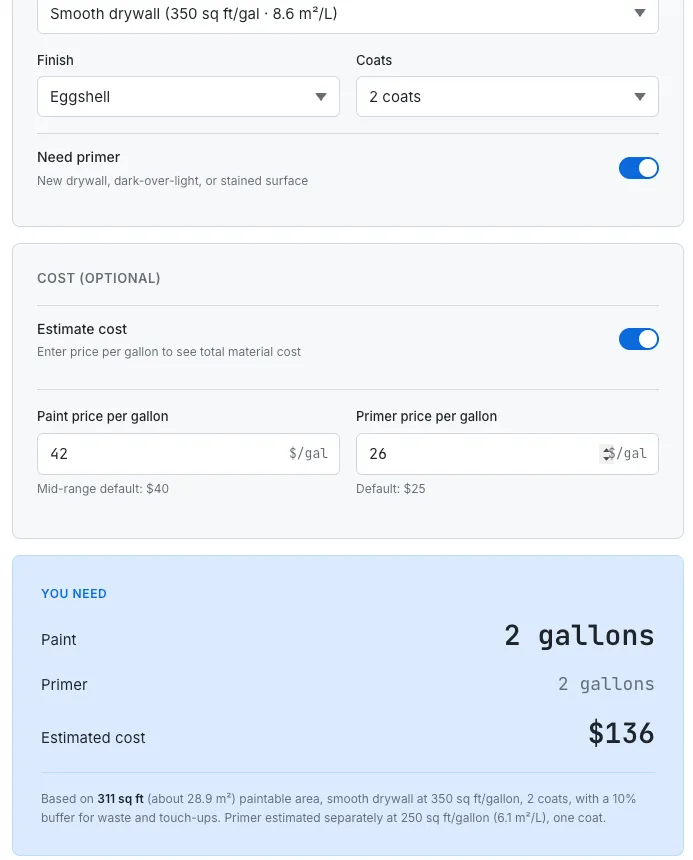
The calculator combines the theoretical baseline, the surface-specific practical adjustment, the coat multiplier, and the industry-standard buffer in sequence — the math behind each step is in the section below.
Putting It Together: The Calculator's Math
All the parts above come together as a single sequence of multiplications. The SudoTool Paint Coverage Calculator's math is transparent enough to verify by hand:
- Wall area = 2 × (length + width) × ceiling height
- Optional ceiling area = length × width (added if the ceiling toggle is on)
- Subtractions = (doors × 20 sq ft) + (windows × 15 sq ft) + other excluded area
- Paintable area = wall area + (optional ceiling) − subtractions
- Surface coverage rate = the practical figure from the table above (350 for smooth drywall, 300 for orange peel, 275 for knockdown, 225 for popcorn, 250 for new unprimed drywall, 175 for stucco or brick)
- Raw gallons = (paintable area × number of coats) ÷ surface coverage rate
- With buffer = raw gallons × 1.10 — applying the standard residential paint-waste factor of 10% (CalcForHomes places the standard residential paint buffer at 8% for simple layouts and 10% for complex or textured layouts; the calculator uses 10% as the default for the textured-wall case)
- Final = round up to whole gallons
Worked example. A 12 × 10 ft (3.7 × 3.0 m) bedroom with 8 ft (2.4 m) ceilings, smooth drywall, two coats, with one door and one window:
- Wall area = 2 × 22 × 8 = 352 sq ft (32.7 m²)
- Subtractions = 20 + 15 = 35 sq ft (3.3 m²)
- Paintable area = 352 − 35 = 317 sq ft (29.4 m²)
- Total at two coats = 317 × 2 = 634 sq ft
- Raw gallons = 634 ÷ 350 = 1.81 gallons
- With 10% buffer = 1.81 × 1.10 = 1.99 gallons
- Final = 2 gallons (rounded up)
The same bedroom with a popcorn ceiling included (smooth walls, popcorn ceiling — using the popcorn rate of 225 sq ft per gallon for the ceiling portion) and two coats would push paint use up substantially. The calculator handles the math; the underlying logic is the section-by-section reasoning above. Pair this with our coats of paint guide to decide how many coats your specific scenario needs, and our eggshell vs satin vs semi-gloss guide for the finish choice — note that the finish does not change the gallon math, only how forgiving each coat is during application. For metric conversion of any of the inputs or outputs, the unit converter handles square feet ↔ square meters and gallons ↔ liters.
One common variation is painting just a single accent wall rather than a whole room, where the decision is less "how many gallons" and more "a quart or a gallon." Our how much paint for an accent wall guide works through that smaller case.
The honest summary: paint coverage per gallon is a multiplication problem, not a single number. The 350-400 on the can is one factor; surface texture, coat count, application method, and waste buffer are the others. The calculator runs the multiplication; this article walks through each factor so the result makes sense when you see it.
Frequently Asked Questions
How many square feet does a gallon of paint cover?
Sherwin-Williams publishes 350-400 sq ft per gallon, but that is a theoretical one-coat figure for a smooth, properly-primed wall under ideal conditions. On a real two-coat job over textured drywall, expect closer to 350 sq ft per gallon for smooth drywall, dropping to 175 for stucco or brick.
Why is real paint coverage lower than the number on the can?
The can prints theoretical coverage — the maximum one gallon covers in one coat on a smooth surface under ideal conditions. Practical coverage is lower because real walls have texture, applicators lose paint to overspray and roller saturation, and the standard two-coat job halves the per-gallon coverage compared to one coat.
What is the formula for paint coverage per gallon?
The coatings-industry formula is (1,604 × Volume Solids %) ÷ Dry Film Thickness in mils. The constant 1,604 is the square feet one gallon would cover at exactly 1 mil thick and 100% solids. A typical 40%-solids latex at 1.5 mils dry film yields about 428 sq ft per gallon for one coat.
How much does surface texture reduce paint coverage?
Texture has more actual surface area than the flat dimensions suggest. Against a headline 400 sq ft, smooth drywall runs about 13% lower at 350, orange peel about 25% lower at 300, popcorn ceilings about 44% lower at 225, and stucco or brick about 56% lower at 175 because they also absorb paint into the substrate.
Does a paint sprayer use more paint than a roller?
Yes. Brush and roller transfer most of the paint to the wall, while spray systems lose a meaningful fraction to overspray. Brad the Painter quantifies airless sprayer consumption at 33% more up to 100% more (twice the paint) than brush or roller, so a two-gallon roller estimate becomes roughly three to four gallons for spray.
How much extra paint should I buy for waste?
CalcForHomes places the standard residential paint buffer at 8% for simple layouts and 10% for complex or textured layouts. The SudoTool Paint Coverage Calculator applies a 10% buffer by default to cover waste, roller absorption, cut-in overlap, and a touch-up reserve, then rounds up to whole gallons.
This is a general home-improvement guide based on industry consensus and major manufacturer documentation. Specific volume solids, recommended dry film thickness, and product-specific spread rates vary by product line — the authoritative source for any specific paint is the manufacturer's product data sheet or the can label. Sprayer paint consumption depends on equipment type, nozzle, technique, and environmental conditions; the 33-100% range above is a broad industry-painter consensus, not a specific equipment-tuned figure. For specialized projects involving lead paint encapsulation, active mold remediation, or exterior surfaces, consult a licensed contractor; those fall outside the scope of standard interior coverage guidance.
- Sherwin-Williams — Paint Calculator FAQ. Verbatim baseline ("typically covers about 350-400 square feet") plus the explicit wall-texture caveat.
- Benjamin Moore — Paint Calculator. Verbatim assumption statement ("These calculations assume 2 coats of paint and do not include the ceiling") that defines the manufacturer-side baseline.
- Dampney — Calculating Coating Requirements. Verbatim derivation of the 1,604 sq ft baseline (one gallon at 1 mil DFT, 100% solids).
- International Paints (hosted by Strands Industrial Coatings) — Theoretical and Practical Coverage. Verbatim general spread-rate formula in decimal form (volume solids × 16.04 ÷ DFT mils) and verbatim framing of practical coverage as a function of surface condition, paint distribution, application procedure, and wastage.
- New Guard Coatings — How to Work Out Paint Coverage for Protective Coatings. Verbatim framing of real-world paint loss and application-method loss factors (10-20% brush/roller, 20-30% airless spray, 30-50% complex surfaces).
- Brad the Painter — Do You Use More Paint with a Sprayer? Verbatim trade quantification (33-100% more paint with airless sprayer in perfect working order).
- InsideOut Painting — Painting a House With a Sprayer vs Brush and Roller. Verbatim wind-effect quantification (5 mph wind increases sprayer paint consumption by nearly 25%).
- CalcForHomes — Waste Factor Guide. Standard residential paint waste-factor reference (8% standard, 10% complex layout).
- SudoTool — How Many Coats of Paint Do You Really Need? Sister blog covering the dry-film-thickness math (1.5 mils single coat, 3-4 mils with two coats) underlying the coverage formula in this article.
- SudoTool — Eggshell vs Satin vs Semi-Gloss: How to Choose. Sister blog covering finish choice; finish does not change the gallon math.