Eggshell vs Satin vs Semi-Gloss: How to Choose the Right Paint Finish
Picking a paint finish looks like an aesthetic choice, but it is actually one physical trade-off in disguise: the ability to hide surface flaws and the ability to wipe paint clean move in opposite directions. Here is an honest comparison of eggshell, satin, and semi-gloss — backed by Sherwin-Williams' and Benjamin Moore's official guidance — and a per-room decision tree.
"Eggshell vs satin vs semi-gloss" is the comparison most home painters end up Googling at some point — usually after they have already picked a color and a brand, standing in the store aisle, wondering whether the small label difference will actually matter. It does, but not in the direction marketing language usually suggests. The three finishes sit close together on a continuous gloss scale, and the differences between them are real but driven by one underlying physical trade-off: how much the surface scatters light versus how much it reflects it. That single property cascades into hide, durability, washability, and how forgiving the surface is to imperfect application.
This guide walks through the trade-off in six parts: the at-a-glance comparison, what the sheen scale actually measures, the core trade-off between hiding flaws and being cleanable, each finish in detail with best and worst use cases, the per-room decision tree from the manufacturers themselves, and the common myth about sheen and coat count.
Eggshell vs Satin vs Semi-Gloss at a Glance
The table below maps each finish to its key properties — sheen level, approximate gloss-unit range, hide ability, cleanability, the rooms it suits, and the common pitfalls. The middle columns matter most: each finish is a particular point on the continuous trade-off between hiding flaws and being washable.
| Dimension | Eggshell | Satin | Semi-Gloss |
|---|---|---|---|
| Reflection (Sherwin-Williams category) | Low to medium reflection | Low to medium reflection (same Eg-shel category) | Medium to moderate reflection |
| Approximate 60° gloss range | Roughly 10-25 GU | Roughly 25-35 GU | Roughly 35-70 GU |
| Hides imperfections | Strong (scatters light) | Moderate | Weak (reflects light, flaws show) |
| Cleanability | Weak (gentle warm-water wipe only) | Moderate (light wiping OK, aggressive scrubbing damages) | Strong (damp sponge + mild detergent fine) |
| Best rooms | Bedrooms, living rooms, hallways, dining, home office | High-traffic living rooms, kids' rooms, kitchens (softer look), hallways | Kitchens, bathrooms, splash zones, trim, doors, busy hallways |
| Common pitfall | Permanent stains in moisture or grease areas | Aggressive cleaning dulls or thins the finish | Unforgiving — every drywall flaw shows under raking light |
Approximate gloss-unit (GU) ranges in the table vary by brand and product line. The only values Sherwin-Williams publishes verbatim are the two endpoints of the scale — high-gloss at 80 or more, matte or low-gloss at 10 or less. The middle ranges are aggregate references from the industry, useful for orientation but not authoritative for any specific product. Always check the manufacturer's data sheet for the exact value of the paint you are buying.
The Sheen Scale: What Each Finish Actually Reflects
Paint sheen is not just a feeling — it is a measurable physical quantity. The industry standard instrument is a glossmeter, which directs a beam of light at the painted surface at a defined angle (most commonly 60°) and measures how much light reflects back into a sensor. The result is reported in gloss units (GU) on a 0-to-100 scale calibrated against a highly polished black glass reference that returns 100 GU. Zero is a perfectly matte surface that reflects no light coherently; 100 is the calibration standard.
Sherwin-Williams' technical guide for architects and designers divides interior paint finishes into four categories, defined by how much light each reflects when dry:
- Flat (flat, matte): "No to very low reflection when dry."
- Eg-shel (low-gloss, eggshell, low sheen, satin, velvet): "Low to medium reflection when dry."
- Semi-gloss (semi-gloss, pearl, medium luster): "Medium to moderate reflection when dry."
- Gloss (gloss, high-gloss): "High reflection when dry."
One detail in that taxonomy surprises most readers: eggshell and satin sit in the same Sherwin-Williams category. They are not separate categories on the industry scale; they are two close points within the Eg-shel band, distinguished mostly by brand language and a small gradient of sheen. The eggshell-versus-satin debate is real but operates at finer resolution than the manufacturer's official structure suggests. Semi-gloss, by contrast, sits in its own clearly separated category one step up.
For specific numbers, Sherwin-Williams notes that "a high-gloss paint might have a 60-degree gloss value of 80 or more," while "a low-gloss or matte finish might have a 60-degree value of 10 or less." The middle ranges where eggshell, satin, and semi-gloss live are not pinned to specific values in the official guide; the industry-aggregate orientations are roughly 10-25 GU for eggshell, 25-35 GU for satin, and 35-70 GU for semi-gloss at 60°, but always verify against the data sheet for your specific paint.
The Core Trade-off: Hide vs Cleanability
The most useful single rule for picking a paint finish is this: the ability to hide surface imperfections and the ability to be cleaned move in opposite directions, and the same physics is responsible for both. The trade-off is mechanical, not marketing.
Toward the flat end. The paint surface is microscopically rough — there is less of the dense binder material that creates gloss. Light hitting that rough surface scatters in all directions rather than reflecting coherently. The coating appears to absorb light, and small cracks, slight unevenness, drywall patch lines, and tape joints disappear. The same property creates the downside: without a dense, smooth protective layer, stains, oils, and dust can penetrate the porous surface, and aggressive cleaning physically removes some of the paint.
Toward the gloss end. The paint surface is dense and smooth — high binder content. Light reflects coherently like a mirror, which highlights every microscopic difference in elevation: drywall seams, slight texture variations, brushstrokes left during application. The same density creates the upside: grease, fingerprints, and water marks sit on top of the surface rather than soaking in, so a damp sponge with mild detergent wipes them away cleanly without damaging the paint underneath.
That single trade-off cascades into the rest of the differences. Practically:
- Hide ranking (best to worst): Flat > Matte > Eggshell > Satin > Semi-gloss > High-gloss.
- Cleanability ranking (best to worst): High-gloss > Semi-gloss > Satin > Eggshell > Matte > Flat.
Manufacturers have been working to soften this trade-off at the flat end. Sherwin-Williams quotes Rick Watson, its Director of Product and Technical Information, on the modern scrubbable-flat lines: "For designers, specifying a flat finish no longer means compromising durability and cleanup ease." Premium scrubbable flat products such as Sherwin-Williams Emerald flat have closed some of the cleanability gap that traditionally came with matte finishes. The trade-off remains, but it is less absolute than it was a decade ago — at the cost of a higher per-gallon price.
Each Finish in Detail
Within the trade-off, each finish has a distinct best-fit zone. The descriptions below combine manufacturer guidance with painter-industry consensus on use cases.
Eggshell
Eggshell takes its name from the slightly pebbled surface of an actual eggshell — soft luster, faint texture, more sheen than flat but less than satin. It is the most-picked middle-of-the-road interior wall finish in the United States, and the default Sherwin-Williams and Benjamin Moore recommendation for bedrooms, living rooms, and quieter parts of the home. Benjamin Moore describes eggshell on its choose-finish guide as "an easy-to-clean, nearly shine-free finish, suited for most areas of a home, including family rooms and hallways."
Eggshell tolerates a gentle warm-water wipe for fresh scuffs but cannot survive repeated scrubbing. Abrasive cleaners or aggressive cloths physically lift paint off the wall over time. It is the right finish when the surface needs to look soft and calming, when drywall is not perfectly smooth, and when daily traffic is moderate. It is the wrong finish for kitchens (grease), bathrooms (moisture), or walls that small children will touch constantly.
Satin
Satin sits just above eggshell on the sheen scale — measurably shinier, with slightly denser surface chemistry. It is more washable than eggshell but the trade-off shows up in two places: small imperfections begin to be visible under raking light, and the warmer, softer look of true eggshell starts to shift toward a faint sheen. Benjamin Moore groups satin with its pearl tier: "a medium gloss that maintains high durability... beautiful and easy to clean."
Satin is the safer default than eggshell in any room where the walls will see more contact: living rooms in active households, kids' rooms, hallways used many times a day, kitchen walls (not cabinets), and any space where you expect to wipe the walls a few times a year. It is not the right finish for bathrooms by default — that is closer to semi-gloss or a specialty matte — and it is harder to apply cleanly than eggshell because the slight extra sheen reveals more brushwork.
Semi-Gloss
Semi-gloss is the wipe-down champion of the interior paint shelf. Painter-trade references converge on the same underlying explanation: higher resin content produces a harder, denser paint film that resists moisture, repels oils, and survives repeated cleaning. Manufacturer guidance points it straight at the toughest cleaning environments. Sherwin-Williams directs "Choose semi-gloss for easy cleaning" at kitchens and notes for bathrooms that "a satin or semi-gloss sheen is ideal, as it can withstand moisture." Benjamin Moore frames semi-gloss as "the luminous look... perfectly suited to highlight architectural details" on trim, millwork, and doors.
The downside is unforgiving visibility. Every drywall seam, every uneven brushstroke, every roller-edge mark catches raking light from windows or ceiling fixtures and stays visible. Semi-gloss demands smoother surface preparation than eggshell or satin and steadier application — if the wall is bumpy or the painter rushes, the result will not hide it. Sherwin-Williams pairs the kitchen guidance with the trim recommendation "High-gloss for a striking finish" on cabinets and trim, but semi-gloss is the more common choice for cabinets and doors where the same durability is needed without quite as much shine.
Flat and high-gloss (the endpoints, for context)
Outside the three-way comparison, the endpoints define what the spectrum tops out at. Flat or matte is the standard for ceilings and very low-traffic rooms — Benjamin Moore identifies its "Waterborne Ceiling Paint (N508)" as "the flattest paint Benjamin Moore offers." Painters point to two practical reasons for going flat on ceilings: ceilings are rarely perfectly level, and any sheen above flat catches raking light from windows and ceiling fixtures, exaggerating drywall seams and tape joints. High-gloss is the trim and cabinet specialty — Benjamin Moore describes it as a "mirror-like finish" that "is extremely durable and offers elegant shine. It is easy to clean, stain-resistant." Both endpoints maximize one side of the trade-off, and both demand surface preparation matched to their extremes: flat tolerates a less-than-perfect wall, while high-gloss exposes every flaw under any lighting.
By-Room Decision Tree
The two largest US paint manufacturers publish room-by-room recommendations that converge on most rooms and diverge interestingly on bathrooms. The table below consolidates their guidance:
| Room | Sherwin-Williams | Benjamin Moore |
|---|---|---|
| Kitchen walls | Semi-gloss for easy cleaning | Semi-gloss (cabinets: Advance® Interior Semi-Gloss 793) |
| Bathroom | Satin or semi-gloss for moisture resistance | Matte specialty product: Aura® Bath & Spa (532) |
| Bedroom | Eggshell or satin | Matte or eggshell |
| Living / dining room | Satin or eggshell | Matte, eggshell, or pearl |
| Hallway | Eggshell or satin (traffic-dependent) | Eggshell — "easy-to-clean, nearly shine-free" |
| Ceiling | Flat | Flat — Waterborne Ceiling Paint (N508) |
| Trim / cabinets | High-gloss | Semi-gloss or high-gloss |
| Doors | High-gloss recommended | Semi-gloss or high-gloss |
The interesting divergence is the bathroom. The traditional rule — semi-gloss everywhere a bathroom wall is — still holds for most cases. But Benjamin Moore's choose-finish guide names a specific matte alternative: "Bathrooms and areas that are exposed to more moisture can be painted in a matte finish using Aura® Bath & Spa (532), which was designed to achieve exceptional durability, color retention and mildew resistance in high-humidity environments." That product runs about $60-70 per gallon at the high end of the consumer range, and what it buys is a softer matte look without giving up the moisture and mildew resistance that bathrooms normally need semi-gloss to provide. It is an exception to the default rule, not a replacement for it: the standard semi-gloss bathroom recommendation is still the safer pick for most painters, and the matte specialty product is the option to know about when the softer look matters more than saving forty dollars.
A simplified decision tree for the rest of the house, derived from both manufacturers' guidance:
- Ceilings → flat (or a dedicated ceiling paint such as Waterborne Ceiling Paint N508).
- Trim, doors, cabinets, kitchen cabinets → semi-gloss or high-gloss.
- Kitchen walls and bathroom walls in splash zones → semi-gloss by default, or a specialty matte such as Aura Bath & Spa for bathrooms when a softer look matters.
- Living rooms, bedrooms, hallways, dining rooms, home offices, basements → eggshell by default, or satin in higher-traffic rooms.
- When in doubt anywhere except ceiling and trim → eggshell. It is the most-picked default for a reason — close enough to flat to hide most imperfections, washable enough to handle ordinary use.
What Sheen Does Not Change: The Coats Question
One myth that circulates in painting communities is worth flatly correcting: sheen does not change the number of coats your paint job needs. All major manufacturers — Sherwin-Williams, Benjamin Moore, Behr, PPG — recommend two coats minimum at the proper spread rate, regardless of whether you choose eggshell, satin, or semi-gloss. The dry film thickness math covered in our coats of paint guide (one coat delivers about 1.5 mils, two coats reach the engineered 3-4 mil target) does not change with the finish. The two-coat rule is mechanical, not aesthetic.
What sheen does change is how forgiving each of those two coats is. Higher sheen makes every microscopic imperfection in application visible under raking light: brush strokes, roller laps, slight unevenness in spread rate, the line where one section of wall ended and the next began. Higher sheen also makes surface preparation matter more — small drywall flaws that flat would hide become visible under semi-gloss. The same number of coats with the same volume of paint will produce a different perceived quality depending on the finish, because the finish either forgives or exposes whatever happened during application.
This is why the calculator and the finish decision are independent. Once you have picked a finish, the math the paint coverage calculator does — wall area minus doors and windows, multiplied by coats, divided by per-surface coverage rate, with a 10% buffer — produces the same gallon estimate whether you are buying eggshell, satin, or semi-gloss. The number of cans does not vary with the finish. The skill required to make those cans land cleanly does.
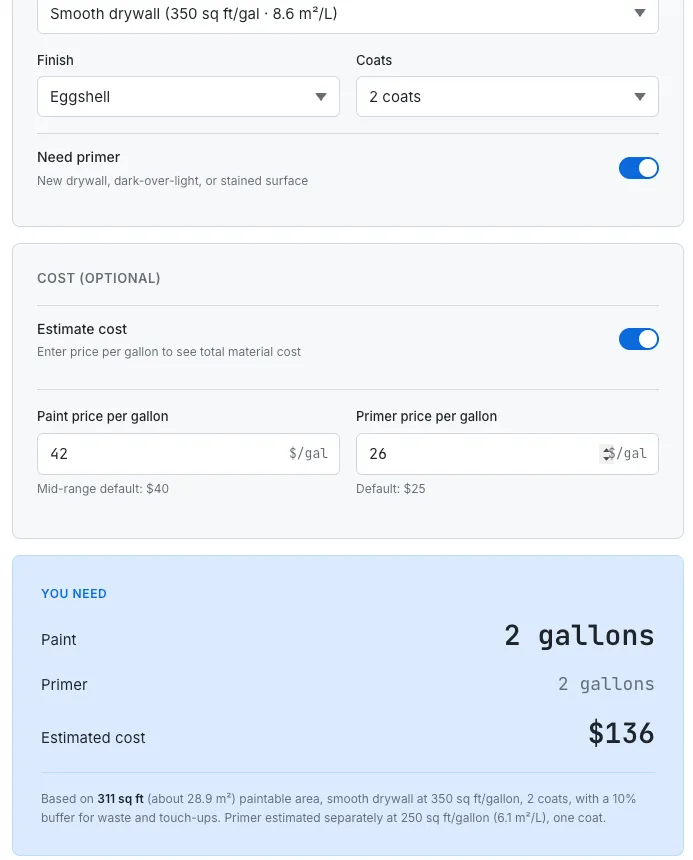
The Paint Coverage Calculator's finish input does not change the gallon math — it is there for completeness, not for adjusting the quantity.
Frequently Asked Questions
What is the difference between eggshell, satin, and semi-gloss?
All three sit on one physical trade-off between hiding flaws and being cleanable. Eggshell scatters light, so it hides drywall imperfections well but cannot survive repeated scrubbing. Semi-gloss reflects light, so it reveals every flaw under raking light but wipes clean of grease and moisture. Satin sits in the middle — more washable than eggshell, more forgiving than semi-gloss, and the common default for living rooms and bedrooms.
Are eggshell and satin the same finish?
Not quite, but they are close. On Sherwin-Williams' official scale, eggshell and satin fall in the same Eg-shel category — described as low to medium reflection when dry — so they are two nearby points within one band rather than separate categories. Satin is measurably shinier and a little more washable than eggshell, but the difference is finer than the marketing labels suggest.
What paint finish is best for a bathroom?
The traditional rule is satin or semi-gloss, because both withstand moisture — Sherwin-Williams recommends a satin or semi-gloss sheen for bathrooms. Benjamin Moore offers one exception: a specialty matte product, Aura Bath & Spa, designed to resist mildew and moisture in high-humidity rooms while keeping a softer flat look. For most painters, the standard semi-gloss bathroom recommendation is still the safer default.
What sheen should I use on kitchen walls?
Semi-gloss. Sherwin-Williams recommends semi-gloss for kitchens because its denser, higher-resin film repels grease and survives repeated wiping. The trade-off is that semi-gloss reveals more surface imperfections under raking light, so kitchen walls benefit from smoother prep. For cabinets and trim, semi-gloss or high-gloss is the usual choice.
Does paint sheen change how many coats you need?
No. All major manufacturers — Sherwin-Williams, Benjamin Moore, Behr, PPG — recommend two coats minimum at the proper spread rate regardless of finish. The dry-film-thickness math does not change with sheen. What sheen changes is how forgiving each coat is: higher sheen makes brush strokes, roller laps, and drywall flaws more visible, so it demands better surface prep and steadier application — not more cans of paint.
Which paint finish hides wall imperfections best?
Flatter finishes hide the most. The full hide ranking, best to worst, is flat, matte, eggshell, satin, semi-gloss, then high-gloss — because a rougher, lower-gloss surface scatters light and makes patch lines, seams, and slight unevenness disappear. Cleanability runs in the opposite order, which is the core trade-off: the finishes that hide flaws best are also the hardest to scrub.
This is a general home-improvement guide based on industry consensus and the official documentation of Sherwin-Williams and Benjamin Moore. Specific gloss-unit values, hide ratings, and washability characteristics vary by product line — the authoritative source for any specific paint is the manufacturer's product data sheet or the can label. For specialized projects involving lead paint encapsulation, active mold remediation, or exterior surfaces, consult a licensed contractor; those fall outside the scope of standard interior finish guidance.
- Sherwin-Williams — How to Differentiate Between Gloss and Sheen. Sherwin-Williams' technical guide for architects and designers; source for the four-category sheen taxonomy, the 60-degree gloss-unit endpoints, and the Rick Watson quote on scrubbable flat finishes.
- Sherwin-Williams — How to Choose Paint Finishes. Sherwin-Williams' consumer-facing room-by-room sheen recommendations; source for kitchen, bathroom, bedroom, living room, and trim guidance.
- Benjamin Moore — How to Choose a Paint Finish. Benjamin Moore's official choose-finish guide; source for the room-by-room recommendations, the eggshell description, the semi-gloss "luminous look" framing, the Aura Bath & Spa bathroom guidance, and the Waterborne Ceiling Paint (N508) ceiling recommendation.
- Benjamin Moore — Aura® Bath & Spa Interior Paint product page. Product reference for the matte-finish bathroom specialty paint.
- Glossmeter — Wikipedia. Industry instrument standard for gloss measurement; source for the 60°/85° measurement angles and the 0-100 gloss-unit scale calibrated against a polished black glass reference.
- Bob Vila — Satin vs Semi-Gloss Paint: What's the Difference? Consumer reference for the satin and semi-gloss comparison.
- Family Handyman — Eggshell vs Satin Paint. Consumer reference for the eggshell-satin distinction.
- Glidden — Flat, Gloss, or Satin Paint: How Do You Choose. Manufacturer-published consumer guide.
- JC Licht — Eggshell vs Satin Paint: Which Finish Is Best for Your Walls? Paint dealer reference for the low-sheen group framing.
- SudoTool — How Many Coats of Paint Do You Really Need? Sister blog covering the dry-film-thickness math and per-surface coverage rates referenced in the coats discussion above.