How to Finish Tile Edges: Bullnose, Metal Trim, and Mitered Edges
A perfectly tiled wall still looks unfinished if the cut edge shows the raw body underneath. Here are the four ways to finish a tile edge — and how to pick the right one for your tile.
It is the step that gets the least planning and shows the most. You measure, cut, and set the field beautifully — then you reach the spot where the tile ends in the open, and the cut edge stares back: the raw gray or tan body exposed, the corner sharp enough to catch a finger. How you finish that tile edge is what separates a job that looks built-in from one that looks unfinished. The frustrating part is that there is no longer a single default answer, because the trim that used to make this automatic — bullnose — is missing from many modern tiles.
This guide covers why a cut edge needs finishing at all, then walks through each option — bullnose, metal trim, mitered edges, and caulk or no-trim finishes — followed by a decision guide for matching the method to your tile, and a quick note on how much trim to buy.
Why tile edges need finishing
A factory tile edge is glazed and smooth. A cut edge is neither. The moment you run a tile through a wet saw, you expose the bare body of the tile, and that raw edge creates three separate problems at once.
The first is safety. As tile-tool maker RUBI bluntly puts it, a cut tile edge is effectively a glass-sharp blade — fine on a floor you walk on with shoes, genuinely hazardous on a backsplash corner or a shower niche at hand height. The second is looks: a cut edge shows the gray or tan underside of the tile, and that unfinished stripe breaks the illusion that you are looking at solid material rather than a thin glazed layer. The third is durability — an unprotected edge is the first place a tile chips, and on a wet wall it gives water a path into the body and the substrate behind it.
Not every edge needs a trim piece. Inside corners, where two tiled walls meet, are normally just caulked. The edges that need a real finish are the exposed ones: outside corners, the open end of a backsplash that stops partway along a wall, the edge of a niche or a curb, a countertop lip, and anywhere tile meets a different material. Those are the spots the four methods below are for.
Your options at a glance
Each method trades off look, durability, difficulty, and cost differently. Here is the quick comparison before the detail:
| Finish | Look | Best for | Skill / cost |
|---|---|---|---|
| Bullnose tile | Rounded, traditional | Tiles that offer a matching piece | Easy / about the price of field tile or more |
| Metal trim (Schluter) | Clean, modern line | Large-format and rectified porcelain; edge protection | Easy–moderate / ~$1 to $80 per stick |
| Mitered edge | Seamless, high-end | Outside corners and niches in low-traffic spots | Hard / pro labor |
| Caulk or grout | Minimal | Edges that already look finished (glass, mosaic) | Easy / cheap |
| Pencil / quarter-round | Slim, subtle | Subway tile and accent borders | Easy / DIY |
| Polished (DIY bullnose) | Seamless on stone or through-body | When no factory bullnose exists | Hard / tools or a fabricator |
Bullnose tile: the traditional cap
Bullnose is a trim tile with one (sometimes more) finished, rounded edge, made to cap the raw edge of the matching field tile. For decades it was the default: you bought your field tile, you bought the matching bullnose pieces for the edges, and the job finished itself. Where a matching bullnose exists — common with ceramic and many subway tiles — it is still a clean, durable, beginner-friendly choice.
The catch is availability. As installer resource DIYTileGuy notes, not all tile comes in bullnose, especially the more modern and contemporary looks — and large-format and rectified porcelain very often have no matching trim at all. Cost is the second catch: bullnose pieces frequently cost as much as the field tile, and sometimes more, because they are a specialty item produced in far smaller quantities.
There is a workaround when no factory bullnose exists, but only for the right tile. If your tile is through-body porcelain or natural stone — where the color runs all the way through the body rather than sitting in a thin top glaze — the cut edge can be ground into a rounded profile with diamond pads and polished. RUBI calls this the gold standard for natural stone and through-body porcelain. It is not a casual DIY job, though; the results are hard to get clean by hand, so most people send the pieces to a stone fabricator.
Metal edge trim (Schluter): the modern default
When bullnose isn't an option, a metal edge profile usually is — and it has quietly become the standard finish for modern tile. A profile is a rigid strip with two parts: a perforated leg that gets buried in the thinset under the tile, and a visible face that caps the cut edge with a crisp line. RUBI describes the result as a clean, straight line that hides the cut edge while protecting the tile in high-traffic spots.
The dominant name here is Schluter, and its two most common profiles are worth knowing by shape. According to Schluter, the JOLLY profile is a finishing and edge-protection profile for outside wall corners and other tile edges that, in the maker's words, prevents tile edges from chipping; it has a squared 90° face that gives a clean, flush, contemporary line and pairs especially well with large-format and rectified tile. The RONDEC profile does the same job but ends in a symmetrically rounded reveal, for people who want the softer look of bullnose without needing a matching tile. Both come in finishes ranging from anodized aluminum to chrome-plated brass to stainless steel, and both include an integrated joint spacer that sets a consistent grout gap between the tile and the profile.
The trade-offs are straightforward. Metal trim works with almost any tile, protects the edge, and offers a range of colors and metals — but the metal look is a matter of taste, and the profile must be installed during tiling, because its anchoring leg sits under the tile. You cannot add it later. On price, DIYTileGuy puts basic L-shaped aluminum at around a dollar per linear foot, with premium textured or stainless finishes running roughly $30 to $80 or more per 8-foot stick.
Mitered edges: the seamless premium look
A mitered edge is the high-end answer, and it uses no trim at all. Instead, the two tiles that meet at an outside corner are each cut at a 45° angle on the back, so their glazed faces fold together into a continuous, unbroken line. Done well, only the glazed surface shows and the corner looks like solid stone — which is why, as RUBI notes, it is the choice for modern, minimalist work.
The cost of that seamless look is fragility and difficulty. The feathered 45° tip is thin and brittle, so it chips easily if it takes a knock, and cutting it cleanly requires tilting the saw head and a steady, practiced hand — RUBI warns of the blade chattering or the tile breaking. DIYTileGuy is blunter, calling mitering a corners-only technique that isn't the most durable option and discouraging it on stairs. Treat it as a professional finish, reserve it for low-traffic outside corners, niches, and shower curbs, and keep it away from anything that gets kicked or bumped.
Caulk, grout, and no-trim finishes
The cheapest finish is no trim piece at all — but it only works in specific cases, and it is the option most often misused. Caulk or a matched grout can finish an edge cleanly when the edge already looks finished on its own. That covers tiles with a naturally clean edge: glass, many mosaics, and tumbled stone, plus some rectified porcelain. On those, a neat bead of color-matched caulk seals the edge and is genuinely all you need.
What caulk cannot do is rescue a raw cut edge. Smearing caulk over the exposed gray body of a freshly cut porcelain tile just gives you a lumpy line of caulk over a visible cut — which is why DIYTileGuy discourages caulk as an edge finish in general. The honest rule is to match the method to the edge: caulk belongs on already-finished edges, inside corners, and transitions between materials, not as a cover-up for a cut you should have trimmed.
Two more low-key options round out the list. A pencil trim (or quarter-round) is a slim, rounded ceramic or stone strip that gives a subtle finished border — RUBI notes it as a classic with subway tile. And as covered above, a polished edge on through-body porcelain or stone is the no-trim way to get a finished look when there is no factory bullnose, at the cost of fabrication.
How to choose the right edge finish
The decision comes down to three things: whether your tile even offers a matching bullnose, the look you are after, and how much skill (or budget for a pro) you have. This table maps common situations to the finish that usually fits:
| Your situation | Best finish |
|---|---|
| Your tile line offers a matching bullnose, and you want a traditional look | Bullnose tile |
| Large-format or rectified porcelain, modern look, want edge protection | Metal trim (Schluter JOLLY or RONDEC) |
| You want a seamless, high-end edge and have a pro (or the skill) for it | Mitered 45° edge |
| Glass, mosaic, or another tile whose edge already looks finished | Caulk or grout |
| Subway tile or an accent border, want something subtle | Pencil or quarter-round trim |
| Through-body porcelain or stone with no matching bullnose | Polished edge (usually a fabricator) |
Location matters as much as looks. For a high-traffic or floor-level outside corner, lean on the durable options — bullnose or metal trim — and keep mitered edges for spots that won't get knocked. In a wet area like a shower, the edge detail is tied to the waterproofing behind it, so when in doubt that is the place to bring in a professional rather than improvise.
How much edge trim to buy
Edge finishing is measured in linear feet, not square feet — you are buying a line, not an area. Add up the length of every exposed edge you plan to trim, then add a little extra for cuts and mistakes. Bullnose and pencil trim are sold by the piece, so convert your length into a piece count and round up; metal profiles come in sticks (commonly 8 feet), so round up to whole sticks. Buy it all in one order so finishes and dye lots match.
If you would rather not tally it by hand, the tile calculator estimates bullnose and trim length alongside the field tile for your room, so the edge pieces don't become the thing you forget. For the field-tile side of the order, our guides on how to calculate tile for a room and the tile waste factor cover turning a space into a square-foot count and the overage to add — and if you are running a pattern, herringbone tile has its own, higher waste factor.
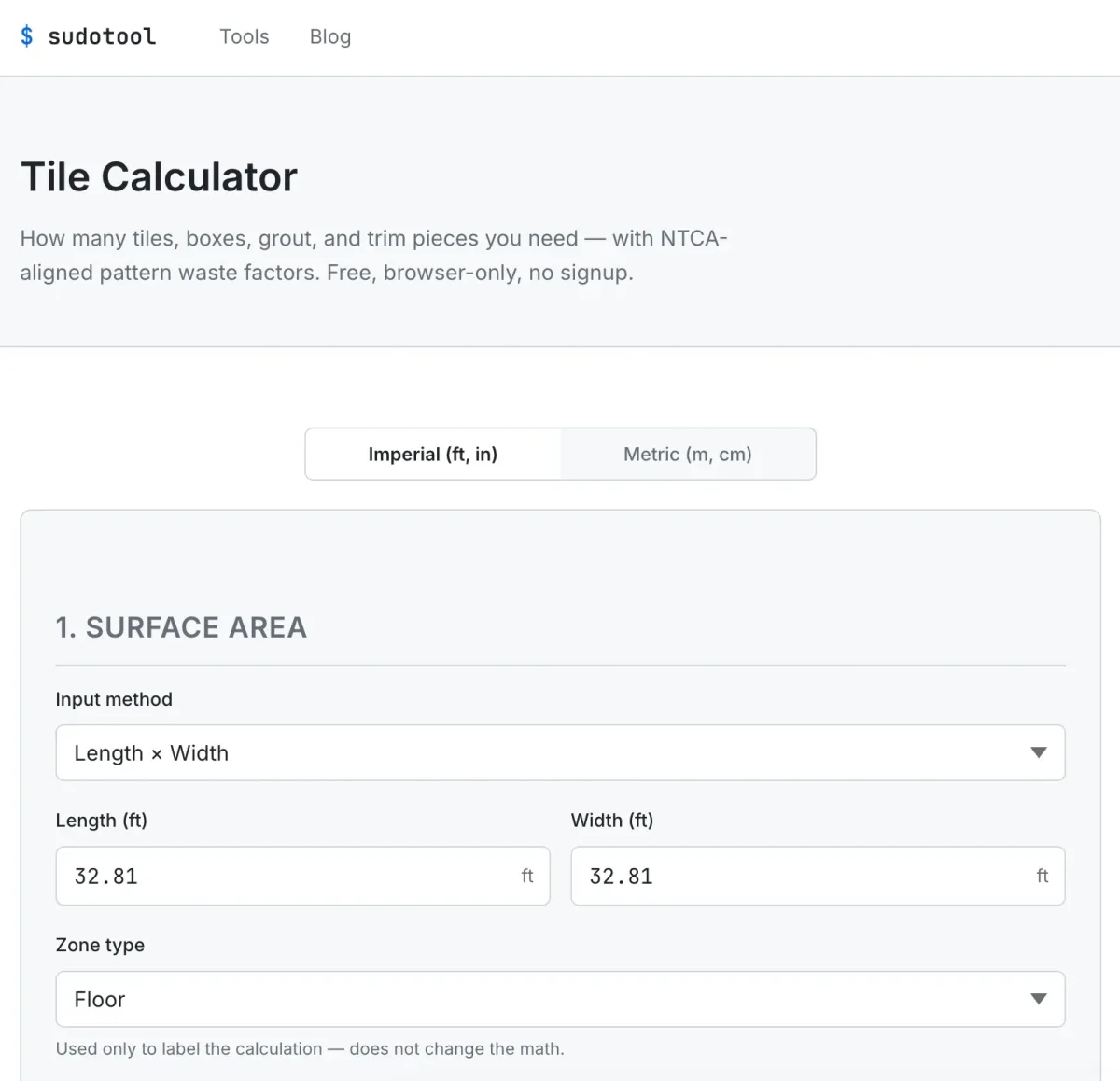
The tile calculator estimates bullnose and trim length alongside field tile, grout, and an optional cost, so the edge pieces aren't an afterthought.
Frequently Asked Questions
How do you finish exposed tile edges?
There are four main ways. Bullnose trim caps the edge with a matching rounded piece; a metal edge profile such as Schluter hides and protects the cut edge with a clean modern line; a mitered edge joins two tiles cut at 45 degrees for a seamless look; and caulk or grout works only on tiles whose edge already looks finished. The right one depends on your tile, the look you want, and your skill.
What is bullnose tile?
Bullnose is a trim tile with one finished, rounded edge used to cap the raw cut edge of standard field tile at an exposed edge or corner. It is the traditional finish, but many modern porcelain and large-format tile lines no longer offer a matching bullnose, and where it exists it often costs as much as the field tile or more.
What can I use instead of bullnose tile?
The common alternatives are a metal edge profile (such as Schluter JOLLY or RONDEC), a mitered 45-degree edge, a slim pencil or quarter-round trim, caulk on tiles whose edge already looks finished, or grinding and polishing the cut edge yourself on through-body porcelain or natural stone.
What is Schluter trim?
Schluter profiles are metal edge trims set under the tile during installation. The maker describes them as finishing and edge-protection profiles that prevent tile edges from chipping. JOLLY has a squared 90-degree edge and RONDEC has a rounded one, and both come in finishes like anodized aluminum, brass, and stainless steel.
Is a mitered tile edge better than bullnose?
It depends. A mitered edge looks seamless and modern because only the glazed face shows, but the thin 45-degree corner chips easily and needs precise cutting, so it is best left to experienced installers and kept off high-traffic edges. Bullnose and metal trim are more durable and far more forgiving to install.
Can you just caulk the edge of a tile?
Only when the edge already looks finished — for example glass, mosaic, or some rectified porcelain — or for inside corners and transitions. Caulk does not hide the raw gray or tan body of a freshly cut edge, so on most cut tile you need bullnose, a metal profile, or a mitered edge instead.
This is a general home-improvement guide based on manufacturer documentation, retailer guidance, and installer experience. Costs and trim availability vary widely by tile, brand, region, and finish, so always confirm what your specific tile line offers and check current prices. Mitered edges and DIY polished bullnose call for specialized tools and skill, and in wet areas such as showers the edge detail is tied to the waterproofing behind it — for those, or for any structural or floor-level concern, consult a professional tile installer.
- RUBI — How to Make Exposed Tile Edges Look Finished. Tool-maker reference for why cut edges need finishing (sharpness, exposed body, chipping), and for the metal-trim, polished-bullnose, mitered-edge, caulk, and pencil-trim methods.
- Schluter — Schluter-JOLLY profile. Manufacturer source for the JOLLY finishing and edge-protection profile (prevents tile edges from chipping), its 90° squared shape, materials, and integrated joint spacer; RONDEC is the rounded-reveal equivalent.
- DIYTileGuy — Tile Edge Trim Options. Installer reference for bullnose availability and cost, metal-profile pricing, the limits of mitered edges, and custom bullnose on through-body porcelain.
- The Home Depot — How to Finish Tile Edges and The Tile Shop — Top Ways to Finish Tile Edges. Retailer references for the bullnose definition and for caulk on tiles whose edge already looks finished (glass, mosaic, tumbled stone).