Herringbone Tile: How Much Extra Should You Buy?
Herringbone needs more tile than a straight grid — but not as much as its reputation suggests, and less than the pattern it's usually confused with. Here's the number, the reason behind it, and how chevron changes the math.
Pick a herringbone tile pattern for a floor or a backsplash and the first worry is almost always the same: doesn't that zigzag waste a mountain of tile? The interlocking diagonals look like they would leave off-cuts scattered across the room. The reality is more reassuring and more specific. Herringbone does cost you more tile than a plain grid, but not because the middle of the floor is wasteful — it is the edges that drive the number. Order roughly 15–20% over your measured area and you will usually finish the job from a single box run.
This guide covers the parts that actually change your order: how much extra to buy and when to push it higher, why herringbone needs more than a straight grid, how it differs from the chevron pattern it is constantly confused with (the difference moves the number a lot), what tile size and ratio to choose, how 45° and 90° layouts compare, and a worked example you can copy.
How much extra tile do you need for herringbone?
The working number for a herringbone tile layout is 15–20% overage on top of your measured area. The Toronto installer guide at Prime Tiling puts it plainly — plan for 15–20% above the measured square footage, and increase to 20–25% for complex rooms with many corners, alcoves, or fixtures. Home-improvement reference Bob Vila reaches the same place from the other direction: buy at least 10% more than you calculated for a standard install, and budget up to 20% for a unique pattern like herringbone or a diagonal offset.
So the pattern roughly doubles the cushion you would use on a plain grid, from a 10% floor to a 15–20% range. Where you land inside that range — and whether you push past it — depends on the room and on you:
| Layout | Extra to buy | Why |
|---|---|---|
| Straight grid (baseline) | ~10% | Perpendicular edge cuts only; off-cuts often reused |
| Herringbone | 15–20% (~18%) | Every perimeter piece is cut at 45°; triangular off-cut wasted |
| Herringbone — first attempt or complex room | 20–25% | Margin for measuring and cutting mistakes |
| Chevron (pre-cut tiles) | 16–24% | Angled ends leave thin, hard-to-reuse slivers at edges |
| Chevron (cut from plain planks) | 22–35% | Every plank is cut at 45° on both ends, plus edges |
A note on where these figures come from. They are well-established trade rules of thumb rather than numbers stamped on a free public standard. You will often see them attributed to the Tile Council of North America (TCNA) and the National Tile Contractors Association (NTCA), but those bodies publish their detailed guidance in paid reference manuals, so the exact per-pattern percentages are not something you can pull up and verify on a free official page. Treat them the way the trade does — as reliable working estimates, not guarantees.
Why herringbone needs more than a straight grid
The whole table above comes down to a single question: can the piece you cut off be reused? That one idea explains why a straight grid gets by on 10% and herringbone does not.
In a straight or running-bond layout, the cuts are clean and repetitive. When you trim a tile to finish a row against the wall, the leftover piece is frequently the right size to start the next row. Installers on the Fine Homebuilding forum describe exactly this — with a running bond you can use the off-cut from the end of one course as the first tile in the next, so very little actually goes in the bin. That reuse is what keeps the straight-grid number low.
Herringbone changes the geometry, but maybe not where you would expect. The middle of the floor — the field — is actually cut-free. As the flooring guide at Herron describes it, herringbone uses standard rectangular tiles or planks laid at 90° to each other, with the end of one piece butting against the side of the next, and those field tiles go down whole. The waste is concentrated entirely at the perimeter, where every tile that meets a wall, corner, or fixture has to be cut at a 45° angle. The triangular off-cut from that angled cut almost never matches the angle needed somewhere else along the edge — so it becomes scrap.
That is the key mental model: herringbone waste is not breakage and it is not the field. It is a ring of angled, unusable triangles around the edge of the room. A bigger room has proportionally less perimeter relative to its area, which is one reason a large open floor can sit at the lower end of the range while a small, choppy bathroom pushes toward the top.
Herringbone vs chevron: the difference that changes your order
Here is the distinction that trips up the most orders. Herringbone and chevron look related, and people use the names interchangeably, but they are built differently — and the difference shows up directly in how much tile you buy.
Herringbone uses plain rectangular tiles set at 90° to one another in a staggered, broken zigzag. The tiles themselves are never cut in the field; they are just rotated and interlocked. Only the edges are trimmed.
Chevron looks similar at a glance but is made completely differently. Its pieces have angled ends — typically cut at 45° — so they meet point-to-point and form a single continuous V, like a row of arrows. Herron's comparison spells out the consequence: if you cut chevron yourself from standard rectangular planks, every single piece needs two angled cuts before it even goes down, and each plank loses two triangular tips worth roughly 5–8% of its area in the process. You lose material twice — once trimming the angled ends to create each chevron piece, and again where those pieces meet the walls.
That is why chevron sits higher on the table. Pre-cut chevron tiles (sold already angled) run about 16–24%, and chevron cut from plain planks can reach 22–35%. The practical takeaway is simple but easy to miss: if your tile is actually a chevron, ordering it on a herringbone assumption will leave you short. Confirm which pattern you are buying first, then apply the matching cushion. Both patterns also take longer to install than a straight grid, so they cost more in labor as well — but the material number is the one that bites if you get it wrong at the store.
Tile size and ratio matter
Herringbone only works with rectangular tiles, and the proportions matter. The cleanest interlock comes from a tile whose length is a tidy multiple of its width — tile-tool maker RUBI phrases the rule as choosing tiles whose length is divisible by their width. Prime Tiling is more specific, calling a 1:2 or 1:3 width-to-length ratio ideal. In plain terms, a 2:1 tile such as 3x6 or 6x12 is the classic choice, while wood-look planks like 4x12 and 6x24 are the popular modern look.
Size affects waste in two opposing ways. Smaller mosaic herringbone usually arrives pre-mounted on mesh sheets, which dramatically reduces cutting and handling — the sheet does the alignment for you. Large planks, on the other hand, look striking but punish mistakes: a miscut or a crack on a 6x24 plank throws away far more material than the same error on a 3x6. The bigger and longer your tile, the more reason to order toward the upper end of the range, especially if your subfloor is not perfectly flat.
45-degree vs 90-degree herringbone
Herringbone is laid in one of two orientations relative to the room, and the choice is mostly about look — both stay inside the 15–20% range. Prime Tiling describes the two cleanly: in a 45-degree layout the V-pattern runs at a 45° angle to the walls, the most visually dynamic orientation, while a 90-degree layout runs the V parallel and perpendicular to the walls for a more structured, formal appearance.
The practical wrinkle is at the edges. A 45° layout sends the pattern into the walls at an angle, which tends to create more — and more irregular — perimeter cuts. A 90° layout lines the pattern up with the walls, which often produces cleaner, more predictable edge cuts and tends to behave better in a narrow room where a diagonal would leave awkward slivers. Neither orientation dramatically changes how much tile you buy, so pick the look you want first; just lean toward the higher end of your overage if you are running a 45° layout into a room with a lot of edges.
A worked example
Put numbers on it. Say you are tiling a 100-square-foot floor with 6x24 wood-look planks. Start from the measured area and apply each pattern's cushion before worrying about boxes:
| Layout | Tile to order | Cost at $6 / sq ft |
|---|---|---|
| Straight grid (10%) | 110 sq ft | $660 |
| Herringbone (18%) | 118 sq ft | $708 |
| Chevron from planks (30%) | 130 sq ft | $780 |
Same room, same tile, three patterns. Herringbone costs about $48 more than a straight grid here, and chevron about $120 more — purely from the pattern, before labor. The numbers are rounded for illustration; your real order depends on the box coverage printed on the carton. Whatever the pattern, run the math in the right order: take the measured area, multiply by one plus your waste percentage, divide by the box coverage, and round up to the next whole box. A half box does not exist at the store, and coming up short is exactly how you end up reordering.
How to order it right
The cushion only protects you if you buy it correctly. Three rules carry almost all the weight:
- Apply the percentage before rounding to boxes. Add your 15–20% to the measured area first, then convert to whole boxes — never round the area down to fit a box count.
- Buy it all in one order, from the same dye lot. Tile is fired in batches, and color drifts slightly between them. Two boxes of the "same" tile bought weeks apart can read as visibly different under raking light, so confirm the boxes share a lot number.
- Keep a few spares. Set aside several tiles after the job for the day one cracks years from now — a matching batch may not exist by then.
The mechanics of converting area into boxes, and the full waste-factor table for every other pattern, live in our companion guide on the tile waste factor. If you are still at the measuring stage, how to calculate tile for a room walks through turning an irregular space into a square-foot number, and how to measure for backsplash tile covers the wall version, where herringbone is especially popular.
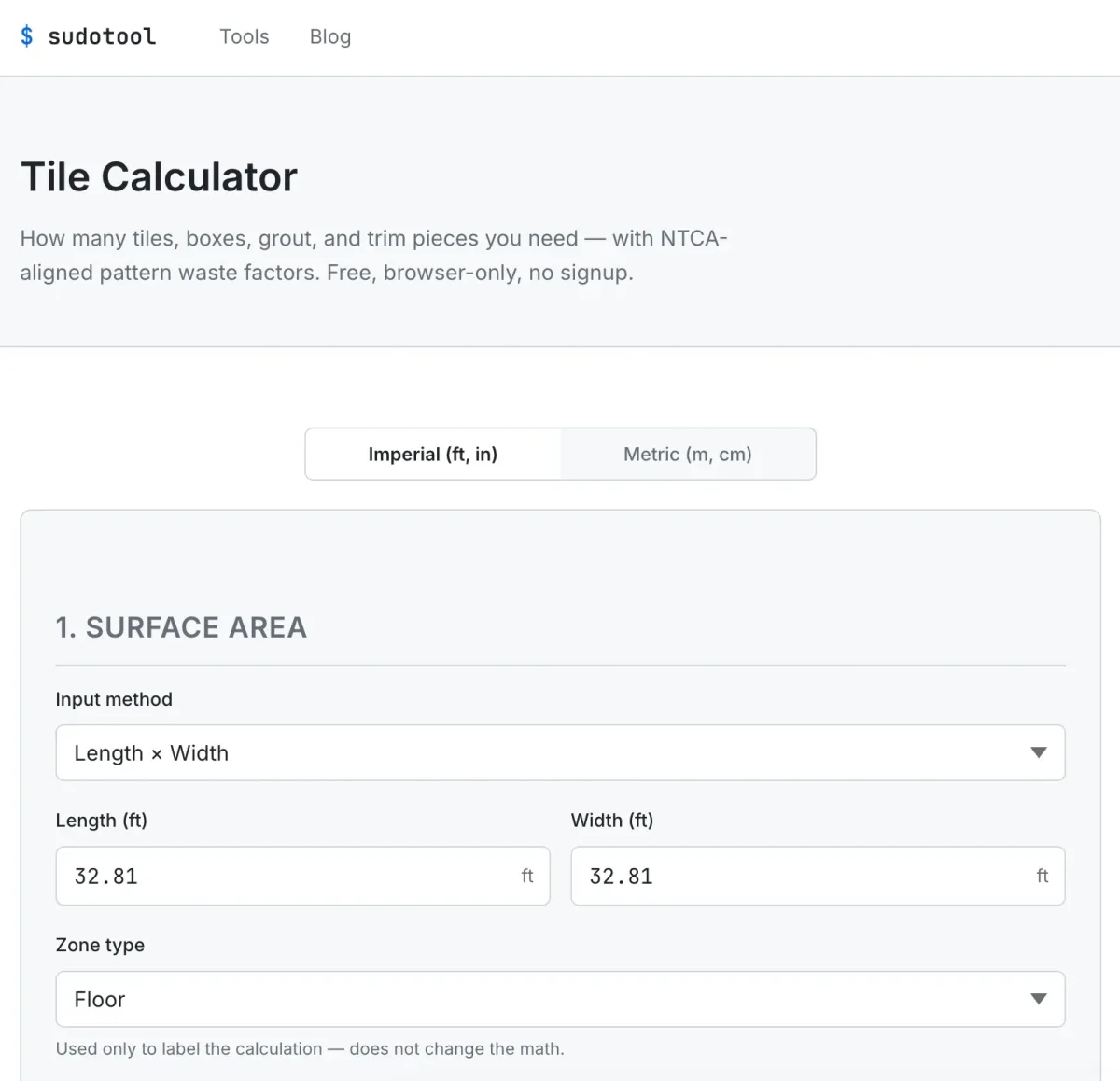
Choose the installation pattern and the calculator applies the matching waste factor automatically, then rounds up to whole tiles and boxes.
Frequently Asked Questions
How much extra tile do I need for a herringbone pattern?
About 15–20% over your measured area — roughly 18% as a midpoint, versus 10% for a straight grid. Go to 20–25% for your first herringbone job or a room with lots of angles, niches, and obstacles. The extra covers the angled perimeter cuts whose triangular off-cuts can't be reused.
Why does herringbone waste more tile than a straight layout?
Because of geometry, not breakage. In a straight grid the off-cut from one row often starts the next, so little is wasted. In herringbone the field tiles go down whole, but every tile meeting a wall is cut at 45 degrees, and that triangular off-cut rarely fits anywhere else — so it becomes scrap.
Does chevron use more tile than herringbone?
Usually yes. Herringbone lays rectangular tiles whole at 90 degrees and only cuts the perimeter, so 15–20% is typical. Chevron cuts every plank at 45 degrees on both ends to form its V — pre-cut chevron runs about 16–24%, and cutting it yourself from standard planks can reach 22–35%.
What size tile is best for herringbone?
A rectangle whose length is a clean multiple of its width works best, with 2:1 (such as 3x6 or 6x12) the classic choice and wood-look planks like 4x12 and 6x24 the popular modern look. Smaller mosaic herringbone comes pre-mounted on sheets, which reduces cutting.
Is 45-degree or 90-degree herringbone better?
Neither wastes dramatically more — both sit in the 15–20% range. A 45-degree (diagonal) layout looks more dynamic but adds angled cuts at the walls; a 90-degree layout runs parallel to the walls, looks more structured, and tends to produce cleaner edges in narrow rooms.
Do I apply the waste factor before or after rounding to full boxes?
Before. Multiply your measured area by one plus the waste percentage first, then divide by the box coverage and round up to the next whole box. Buy it all in one order from the same dye lot and keep a few spares for future repairs.
This is a general home-improvement guide based on retailer and installer guidance plus widely used trade rules of thumb. Waste-factor percentages are working estimates, not guarantees — actual waste varies with room shape, tile size and material, layout, and installer skill. The per-pattern figures are commonly attributed to TCNA and NTCA installation guidance, but the associations' detailed numbers are published in paid reference manuals rather than on a free official page, so treat them as well-established rules of thumb. For uneven subfloors, large-format installations, or structural concerns, consult a professional tile installer, and always check the product label and box coverage before ordering.
- Prime Tiling — Herringbone Tile Pattern Installation Guide. Installer reference for the 15–20% overage (20–25% for complex rooms), the 1:2 / 1:3 tile ratio, common sizes, and the 45° vs 90° orientation descriptions.
- Herron — Chevron vs Herringbone: Layout & Waste Compared. Source for the 90° whole-field vs 45° chevron cut mechanics, the per-pattern waste ranges (herringbone 15–22%, chevron 16–24% pre-cut and 22–35% from planks), and the two-angled-cuts-per-plank detail.
- Bob Vila — How Much Tile Do I Need for a Floor or Wall? Homeowner reference for the 10% baseline and budgeting up to 20% for a unique pattern like herringbone.
- RUBI — Herringbone Tile Layout: A Comprehensive Guide. Tool-maker reference for choosing tiles whose length is divisible by their width, and the existence of classic 45° and 90° layouts.
- Fine Homebuilding — Estimating Overage (forum discussion). Installer discussion of why running-bond off-cuts can be reused while angled layouts waste more.
- Tile Council of North America (TCNA) — tcnatile.com and National Tile Contractors Association (NTCA) — tile-assn.com. The US tile-installation standards bodies; detailed waste guidance lives in their paid reference manuals, so the per-pattern percentages here are trade rules of thumb rather than free-verifiable official figures.