Paint Sheen Guide by Room: Which Goes Where
Paint sheen is decided by the room, not by personal preference. A bedroom wall and a kitchen wall live in different physical environments — different humidity, different contact frequency, different lighting — and the same sheen cannot satisfy both. The industry standard is a small set of room-specific recommendations that converge across Sherwin-Williams, Benjamin Moore, Glidden, and Consumer Reports. This guide is the room-by-room decision matrix plus the exceptions worth knowing.
This guide walks through (1) the room-by-room paint sheen recommendations across living areas, wet areas, high-traffic zones, ceilings, and trim, (2) the underlying durability-versus-hide-power trade-off that drives every sheen decision, (3) special cases like sunrooms, basements, and accent walls, and (4) a quick decision table covering 12 room types. The SudoTool paint coverage calculator handles gallon math once the sheen has been chosen for each room.
The Paint Sheen Trade-off That Drives Every Room Decision
Sheen choice isn't a matte-versus-glossy aesthetic preference. It's a physical trade-off built into the paint film itself, and every room places different demands on each side of that trade-off.
Higher sheen (semi-gloss, high-gloss) means a denser, harder film. It survives scrubbing, repels moisture, and cleans up with a damp cloth. The cost: the reflective surface shows every drywall imperfection, brush mark, and roller stipple in raking light. A glossy wall in a sunlit room highlights every flaw.
Lower sheen (matte, flat) means a softer, more porous film. Drywall imperfections disappear into the non-reflective surface, and the visual feel is calmer. The cost: the film can't survive scrubbing — wiping a stain lifts color along with the stain — and absorbs moisture instead of repelling it.
Eggshell and satin sit in the middle ground. Eggshell leans toward the matte side (slight reflection, moderate scrubbability); satin leans toward the glossy side (visible reflection, good scrubbability). Most living spaces in modern homes land in this middle zone for a reason — neither extreme fits everyday life. For a deeper comparison of the three middle sheens at the technical level, see our eggshell vs satin vs semi-gloss guide.
Each room sits at a different point on this trade-off based on four factors: humidity and mildew risk, frequency of hand or object contact, visibility of drywall imperfections under that room's lighting, and the desired visual atmosphere. The sections below match each room type to the sheen tier that minimizes the painful side of the trade-off.
Living Areas — Bedrooms, Living Rooms, Dining Rooms
Living areas share a common profile: low humidity, moderate hand contact, visual atmosphere prioritized over scrub durability, and drywall imperfections visible under bedside or accent lighting that creates raking light across the walls.
Adult bedroom — matte or flat. Calm visual feel and the ability to hide drywall imperfections outweigh scrubbability, since bedrooms rarely get scrubbed. Modern scrubbable matte and flat lines (Sherwin-Williams Duration Home Matte, Mesa+ Scrubbable Flat, Emerald flat or matte) soften the traditional matte-versus-scrub trade-off, so this no longer means resigning yourself to color-lifting if you wipe a smudge. The visual is still soft and non-reflective; the cleanability has caught up.
Kids' bedroom — satin. Sticky fingers, scuffs from toys, the occasional crayon or marker, and the periodic art project that escapes onto the wall change the calculation. Satin's harder film survives a wipe-down with soap and water. Eggshell works if traffic is light. Semi-gloss is too reflective for a sleep environment.
Living room and family room — eggshell or satin. The decision depends on family habits. With young children or pets actively touching walls, satin holds up better. Without, eggshell gives a slightly softer visual feel. Modern scrubbable matte is also viable, especially in adult-focused living rooms where the design tilt favors visual calm.
Dining room — eggshell or satin. Food splash potential is real but not extreme. Eggshell suffices if the dining table is the focus; satin if children are the primary diners and walls get touched routinely.
Lighting consideration. A room with strong natural light reads imperfections more harshly. Lean to lower sheen (matte or eggshell) where light is abundant. Rooms with dim or only artificial lighting tolerate slightly higher sheen since there's less raking light to expose drywall flaws.
Wet Areas — Kitchen, Bathroom, Laundry
Wet rooms place persistent humidity, frequent cleaning, and splash-and-spill events on the wall. The decision is always toward higher sheen.
Kitchen walls — semi-gloss (or satin). Semi-gloss is the standard recommendation because it survives scrubbing oil splatter and soap film off the wall. Satin is the alternative when semi-gloss feels too reflective in a kitchen with strong overhead lighting. Both clean up with a damp cloth; semi-gloss simply cleans more thoroughly with less effort.
Kitchen cabinets — semi-gloss or high-gloss. Cabinets are a different product category from wall paint — see the kitchen cabinets guide for the trim-and-cabinet enamel breakdown.
Bathroom walls — satin (well-ventilated) or semi-gloss (humid). A bathroom with a working exhaust fan plus a window can run satin walls; a bathroom that relies on an underused fan or no window should jump to semi-gloss for the denser, less moisture-absorbing film. The exception is Benjamin Moore's Aura Bath & Spa Matte, engineered specifically for bathroom moisture with built-in mildewcide and Color Lock — the only matte that belongs in a bathroom. For full product picks and mildew-resistance details, see best paint for bathroom.
Bathroom ceiling — flat or matte (mildew-resistant). Standard flat ceiling paint without a mildew-resistant label is wrong for a bathroom because the ceiling sits above the shower's steam plume. Mildew-resistant flat or matte ceiling paint is required.
Laundry walls — satin. The wet-area profile is similar to a kitchen: humidity from the washing machine, occasional splash, frequent contact with hampers and detergent bottles. Satin with mildew-resistant ceiling paint above is the standard combination.
High-Traffic Areas — Hallways, Kids' Rooms, Mudrooms
High-touch surfaces with frequent cleaning needs converge on the same answer: satin. The sheen's combination of scrubbability and acceptable visual softness fits this entire category.
Hallways — satin. Narrow hallways accumulate scuffs from shoulders and bags, fingerprints on the wall next to light switches, and dust along baseboards. Satin survives the routine wipe-down and adds a small amount of light-bouncing to spaces that are usually under-lit. Eggshell works in low-traffic hallways with small households and careful occupants — but the moment kids or pets enter the picture, satin becomes the safer default.
Kids' rooms and playrooms — satin. The same rationale as kids' bedrooms above, scaled up. Playrooms in particular see the wall as occasional canvas (crayon, marker, watercolor), and satin's cleanability is the difference between a wipe-and-done and a repaint.
Mudrooms and entryways — satin walls with semi-gloss trim and doors. Backpacks, jackets, and shoes contact the wall daily. Trim and doors get the highest touch volume in the entire house — semi-gloss on those surfaces holds up where satin would scuff over time.
Ceilings and Trim
Ceilings and trim follow rules separate from walls because they serve different visual and physical functions.
Ceilings — flat or matte. The rule is nearly universal across rooms. Ceilings are rarely scrubbed, so scrubbability isn't the constraint. The constraint is glare and imperfection visibility under raking light from wall-mounted fixtures or windows. A flat or matte ceiling paint absorbs light evenly and hides the drywall imperfections that are almost always present overhead. Benjamin Moore's Waterborne Ceiling Paint N508 is positioned as the flattest paint in the Benjamin Moore lineup, and Sherwin-Williams Premium Ceiling Paint carries the same ultra-flat positioning with a non-lapping formula and built-in mildew resistance. The only exceptions are wet-room ceilings (use mildew-resistant flat or matte) and rare design-driven choices like a high-gloss Victorian-style accent ceiling, which require careful preparation and a perfectly flat substrate.
Trim and doors — semi-gloss. Trim sheen serves two purposes simultaneously: it highlights the architectural detail by reflecting light differently from the walls, and it survives the high-touch reality of doors, baseboards, and casings. Semi-gloss is the default. Satin is the softer alternative when the visual contrast with wall sheen is too sharp. High-gloss is reserved for surfaces that need striking emphasis — front doors, cabinet doors, and the occasional accent door — and requires more careful preparation since the gloss shows every brush mark.
The trim-sheen rule of thumb: one step up from walls. Walls matte means trim eggshell or satin. Walls eggshell means trim satin or semi-gloss. Walls satin means trim semi-gloss or high-gloss. The point is visible distinction — when wall and trim share the same sheen, the trim visually disappears in raking light because the eye loses the edge that frames the room's architecture. This is why the standard combination is satin walls with semi-gloss trim across most living-area rooms, and why the matched-sheen "trim and walls the same" approach reads as flat unless intentionally chosen as a design statement. For the gallons-per-coat math at the trim scale specifically, see trim paint quantity guide.
Special Cases — Basements, Sunrooms, Accent Walls
Three room types don't fit cleanly into the living-versus-wet-versus-traffic categories above.
Basements — eggshell or satin with mildew-resistant chemistry. A finished basement reads as living space — carpet, furniture, normal hand contact — but the underlying environment is wetter than the rest of the house. Concrete walls breathe moisture, ground humidity rises through the slab, and the small windows mean ventilation is limited. The right choice is a mildew-resistant interior paint (Zinsser Perma-White and similar) in eggshell or satin. The slightly higher sheen bounces light from limited fixtures to brighten the space. Unfinished basement walls used for storage or mechanical rooms are usually left unpainted or treated with mildew-resistant flat ceiling paint applied to the walls, since visual aesthetics aren't the constraint.
Sunrooms — matte or eggshell with UV-resistant interior paint. A sunroom is enclosed indoor space but receives direct sunlight comparable to outdoors. Higher sheen produces severe glare under that light volume, so matte or eggshell is the right call for visual comfort. The other constraint is paint chemistry: the standard interior paint binder and pigments fade faster under sunroom-level UV exposure. Use an interior paint with UV-resistant pigments or a "sunroom" sub-line if the manufacturer offers one. Exterior paint is not the answer despite the UV exposure — exterior paint's VOC load would be trapped indoors. The paint chemistry comparison is covered in interior vs exterior paint.
Accent walls — same sheen as the surrounding walls. When one wall is painted a different color from the other three, the default is to keep the sheen consistent across all four. Adding sheen contrast on top of color contrast produces visual chaos. The exception is when the design intent specifically uses sheen as the accent (a single high-gloss feature wall in an otherwise matte room, for example) — this works but reads as bold and requires meticulous application since the glossy wall shows every flaw. For the gallon math on accent walls specifically, see accent wall paint quantity.
Quick Decision Table
| Room / Area | Walls | Trim | Ceiling |
|---|---|---|---|
| Bedroom (adult) | Matte / Flat | Eggshell / Satin | Flat |
| Bedroom (kids) | Satin | Semi-gloss | Flat |
| Living room / Family room | Eggshell / Satin | Semi-gloss | Flat |
| Dining room | Eggshell / Satin | Semi-gloss | Flat |
| Kitchen | Semi-gloss (or Satin) | Semi-gloss / High-gloss | Flat |
| Bathroom (well-ventilated) | Satin | Semi-gloss | Flat (mildew-resistant) |
| Bathroom (humid) | Semi-gloss | Semi-gloss | Flat (mildew-resistant) |
| Hallway / Mudroom | Satin | Semi-gloss | Flat |
| Kids' room / Playroom | Satin | Semi-gloss | Flat |
| Laundry room | Satin | Semi-gloss | Flat (mildew-resistant) |
| Basement | Eggshell / Satin (mildew-resistant) | Semi-gloss | Flat |
| Sunroom | Matte / Eggshell (UV-resistant) | Semi-gloss | Flat |
The table is the consensus across Sherwin-Williams, Benjamin Moore, Glidden, Consumer Reports, and homeowner-painting industry references. Individual brand sheen names vary slightly — Benjamin Moore's matte runs closer to flat, Sherwin-Williams matte runs closer to eggshell — so verify the specific brand's positioning before mixing manufacturers in the same project.
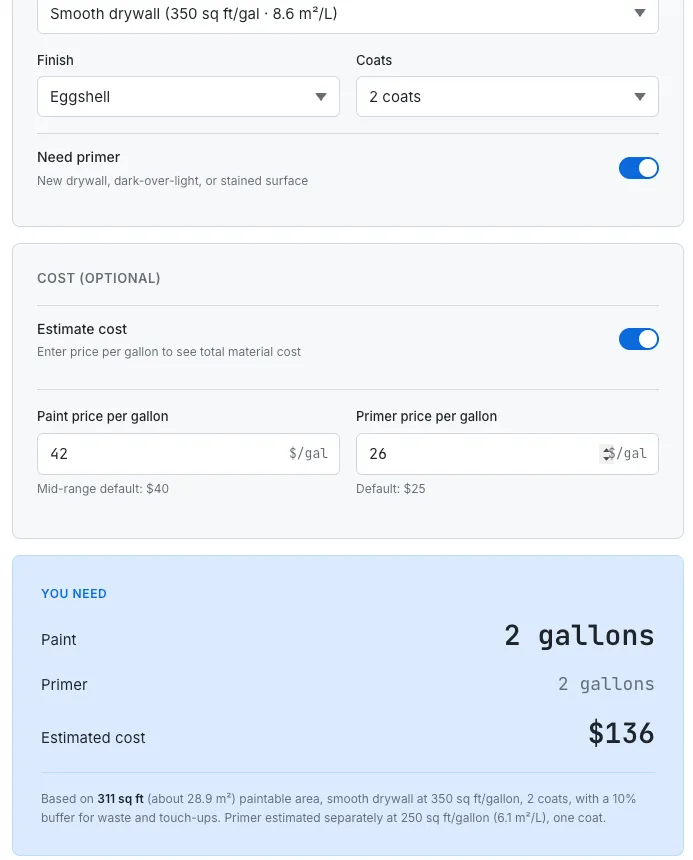
The calculator works per-room. Pick the sheen first using the table above, then run the calculator with that room's dimensions to get the right gallon estimate before the paint store trip.
FAQ
What sheen is best for an open-plan space where the kitchen meets the living room? Satin walls with semi-gloss trim throughout. Using semi-gloss only on the kitchen side and a different sheen on the living side creates a visible boundary between the two zones in raking light. Satin satisfies both the kitchen cleanability requirement and the living-area visual softness as a single sheen.
Does the brand matter when comparing sheens? Yes, more than people expect. Benjamin Moore's matte sits close to what other brands call flat. Sherwin-Williams matte sits close to what others call eggshell. The same word means different reflectance on different cans. The practical implication is to stay within one brand when matching sheens across a project, or to verify the actual gloss-unit positioning if mixing brands.
Can sheens be mixed on the same wall? Generally no. Different sheens on the same wall produce visible boundaries in raking light, and the wall reads as patchy rather than intentional. The exception is deliberate design — a vertical band of high-gloss accent on a matte wall, for example — which works but requires precise masking and acceptance that the boundary is the visual point of the design.
What about exterior sheens? Exterior paint is a different product class from interior — different binder chemistry, different VOC, different additive package. Common exterior recommendations: walls in satin or semi-gloss, trim in semi-gloss or gloss, front door in gloss or high-gloss. The chemistry comparison is in interior vs exterior paint.
Will higher sheen show more drywall imperfections? Yes, predictably. The reflective surface is where every drywall mud line, sanding ridge, and brush mark becomes visible under raking light. A wall that isn't smooth enough for the chosen sheen will show worse with higher sheen — so the practical workflow is to check the drywall first, prep it to the smoothness the sheen requires, and only then apply paint. Skimping on drywall prep before semi-gloss is a near-guaranteed bad finish.
This guide reflects the convergent recommendations of major paint manufacturers and homeowner publishers. Individual situations vary — a single bedroom can sit anywhere from matte to satin depending on lighting, traffic, and personal preference. The table is a starting point, not an absolute rule. Brand sheen names are not standardized across manufacturers; verify gloss-unit positioning when mixing brands. For health concerns about VOC content during application, consult the specific product's safety data sheet and follow ventilation guidelines.
- Sherwin-Williams — How to Choose Paint Finishes (Sheen Guide). Manufacturer reference for room-by-room sheen recommendations including kitchens, bathrooms, bedrooms, and trim.
- Sherwin-Williams — Premium Ceiling Paint. Manufacturer reference for the ultra-flat ceiling paint category with non-lapping formula and mildew resistance.
- Benjamin Moore — How to Choose a Paint Finish. Manufacturer reference for sheen characterizations across matte, eggshell, satin, semi-gloss, and high-gloss including durability positioning.
- Benjamin Moore — Waterborne Ceiling Paint (N508). Manufacturer reference for the flattest paint in the Benjamin Moore lineup.
- Benjamin Moore — Aura Bath & Spa Matte. Manufacturer reference for the bathroom-engineered matte exception with built-in mildewcide.
- Glidden — What Type of Paint for Bathroom? Manufacturer reference for semi-gloss in high-humidity bathrooms and the satin-walls-plus-semi-gloss-trim default.
- Bob Vila — Types of Paint and Paint Finishes. Homeowner reference for finish characterizations including the glossy-finish durability framing.
- Consumer Reports — Pick the Perfect Paint Sheen for Every Room. Independent reference for room-by-room sheen recommendations across home use cases.
- SudoTool — Eggshell vs Satin vs Semi-Gloss: How to Choose. Sister guide on the chemistry of the three middle sheens.
- SudoTool — Best Paint for Bathroom: What Actually Works. Sister guide on bathroom-specific paint products and prep.
- SudoTool — Interior vs Exterior Paint: The Real Difference. Sister guide on the paint chemistry foundation behind sheen choices.
- SudoTool — How Much Paint for Kitchen Cabinets: The 10x10 Math. Sister guide on cabinet-specific enamel.
- SudoTool — How Much Trim Paint Do I Need? Sister guide on the linear-foot math behind trim quantity.
- SudoTool — How Much Paint for an Accent Wall? Sister guide on accent wall quantity and the tinted primer trick.