How Much Paint for Kitchen Cabinets: The 10x10 Math
Painting kitchen cabinets uses a different math problem from painting a room. Cabinets are calculated by exposed face area — doors, drawer fronts, face frames, visible side panels — not by wall area. A standard 10x10 kitchen typically needs about one gallon of cabinet enamel plus one quart of bonding primer for a 3-coat sequence. This guide walks through the sizing table, the wood-vs-MDF-vs-laminate primer differences, the 10x10 worked example, the time and cost picture, and how to choose a cabinet-grade paint.
The honest answer to "how much paint for kitchen cabinets" is that it depends on how many doors and drawer fronts the kitchen has, what they're made of, and whether the painted finish includes the backs of doors and the visible side panels. The simplest reference is the standard 10x10 kitchen — the US cabinet industry's pricing baseline, an L-shape footprint 10 linear feet on each leg with roughly 10 to 12 cabinets in the set. That kitchen, painted with two coats of cabinet enamel over one coat of bonding primer, typically needs about a gallon of paint and a quart of primer.
This walkthrough covers six things: the size-by-size quick reference table, why cabinet painting is a 3-coat (not 2-coat) sequence, the wood-vs-MDF-vs-laminate primer differences, the worked example for a standard 10x10 kitchen, the time and cost realities, and how cabinet-grade paint differs from wall latex. The SudoTool paint coverage calculator handles the gallons math once you've measured your cabinet face area.
How Much Paint for Kitchen Cabinets at a Glance
The size-by-size reference below assumes the industry-standard approach: both sides of doors and drawer fronts are painted (one-side-only painting risks humidity-driven warping over time), and the sequence is one bonding primer coat plus two cabinet enamel topcoats. Per the same Purpose Driven Painting trade reference, "Cabinet painting almost always requires two coats of paint, sometimes even three if you're going from dark wood to white." Every estimate below assumes two coats minimum.
| Kitchen size | Cabinet count | Painted surface | Cabinet enamel | Bonding primer |
|---|---|---|---|---|
| Small (galley, studio) | 8-10 | ~60-100 sq ft | 1 quart - 1 gallon | 1 quart |
| Standard 10x10 | 10-12 | ~100-150 sq ft | 1 - 1.5 gallon | 1 quart - 1 gallon |
| Large (U-shape, with island) | 16-20+ | ~200-300 sq ft | 2 - 2.5 gallon | 1 - 2 quart |
The gallon estimates align with Purpose Driven Painting's kitchen-size trade benchmarks: a small kitchen (8-10 cabinets) at "1 quart to 1 gallon of paint", a medium kitchen (10-20 cabinets) at "1–1.5 gallons", and a large kitchen (20+ cabinets) at "2–2.5 gallons". The same source's general primer recommendation: "Typically, 1 quart to 1 gallon of primer is enough for the average kitchen."
The single biggest variable behind these ranges is whether the project paints both sides of every door and drawer front. Industry standard is yes — one-side painting creates an asymmetric moisture barrier and warping can show up after a humid summer or winter. If the project paints only the visible front faces, the paint quantity drops by roughly half from each row.
The Cabinet Painting Sequence: Why 3 Coats Total
Wall painting is typically a 2-coat job (covered in our coats of paint guide). Cabinet painting is almost always a 3-coat sequence: one bonding primer coat plus two cabinet enamel topcoats. The primer is what most homeowners are tempted to skip and what most professional painters refuse to.
Purpose Driven Painting frames the primer requirement directly: "If your cabinets are dark, glossy, or heavily stained, you'll need a coat of primer before painting. A high-bonding primer ensures your paint adheres properly." Almost every kitchen cabinet falls into at least one of those categories: dark (oak, cherry, walnut, painted dark colors), glossy (factory-finished cabinets in any wood or laminate), or stained (accumulated kitchen grease around the stove and sink). One match is enough to require primer. Most kitchens match two or three.
The two topcoat coats follow the same logic that applies to all painting — "Cabinet painting almost always requires two coats of paint, sometimes even three if you're going from dark wood to white" (Purpose Driven Painting). Cabinet enamel is thicker, more leveling, and longer-curing than wall latex, but a single coat still doesn't produce the uniform film, color saturation, and final dry film thickness the manufacturer designed the product to reach. Two coats is the manufacturer-intended baseline; a third coat is the corrective layer for dramatic color changes (dark wood to white, for example, which echoes the math in our painting over dark walls guide).
Cabinet enamel also differs from wall paint in coverage. Wall latex typically reaches 350-400 sq ft per gallon at the manufacturer's headline figure (the math behind that number is in our paint coverage per gallon guide). Cabinet enamel, formulated thicker and with more self-leveling resin content, often produces a slightly lower practical coverage — roughly 300-350 sq ft per gallon on a properly sanded cabinet surface — even though manufacturer specs are similar to wall latex. The gallons-needed calculation accounts for the difference automatically when realistic per-surface coverage is used rather than the headline number.
Wood vs MDF vs Laminate: Different Prep, Different Primer
Cabinet material affects the primer choice and prep intensity but not the paint quantity. A 10x10 kitchen needs about one gallon of cabinet enamel regardless of whether the cabinets are solid oak, factory MDF doors, or laminate. The difference shows up in which primer goes underneath and how aggressively the surface is prepped.
Solid wood (oak, maple, cherry, walnut). Wood is naturally porous and accepts primer easily, but specific species cause specific problems. Oak is the most common challenge: its open grain pattern and tannin content can cause tannin bleed-through — yellow or pink stains that surface through the topcoat days or weeks after painting. The standard solution is an oil-based stain-blocking primer (Zinsser Cover Stain, KILZ Original) rather than a generic acrylic primer. Maple, cherry, and walnut are less prone to tannin bleed but still benefit from a high-bonding primer that locks the topcoat to the wood. Prep includes a TSP wash to remove grease, 220-grit light sanding for adhesion, and wood-filler patching of any dings or scratches.
MDF (medium-density fiberboard). Factory MDF cabinet doors arrive very smooth — only a light 220-grit scuff is needed for adhesion. The trap is at the cut edges: hinge mortises, handle holes, and any field-cut joints expose raw MDF fiber, which is extremely absorbent. Unsealed edges swell with moisture, causing paint cracking later. The fix is extra primer attention along edges — sometimes a second primer coat just on the cuts, or a shellac-based primer like Zinsser BIN, which seals MDF more thoroughly than waterborne primers (waterborne primers can swell raw MDF body slightly during the wet phase). Body work otherwise mirrors wood: one primer coat, two topcoats.
Laminate (Thermofoil, melamine). Laminate is the hardest substrate to paint and the most common point of cabinet-painting failure. Bob Vila's laminate-cabinet reference states the requirement directly: "Primer is essential when painting laminate cabinets. If you fail to prime them, the paint will almost certainly begin peeling off." The mechanism is different from wood or MDF — laminate is not porous at all, so the failure mode is adhesion rather than absorption. As the same reference notes, "Laminate is not nearly as porous as its wood equivalents."
The standard prep for laminate is more aggressive than for wood: "Thoroughly scuff the surfaces of the cabinet with 120-grit sandpaper" (Bob Vila). The coarser grit gives the bonding primer mechanical teeth to grip a substrate that has no natural texture. The primer choice itself must be a true bonding primer — Bob Vila recommends "a bonding primer that's tenacious enough to stick to laminate, like Zinsser Interior Primer." Other workable options in the same category include Zinsser Bullseye 1-2-3, INSL-X Stix, and KILZ Adhesion. Standard acrylic wall primers are not sufficient. Once that primer cures, the topcoat sequence is the same two coats.
Across all three materials, the paint quantity is roughly the same — about one gallon of cabinet enamel for a 10x10 kitchen. The primer type swaps based on the substrate.
The 10x10 Kitchen Worked Example
Walking through the math end-to-end: a 10 linear ft by 10 linear ft L-shape kitchen, the US cabinet industry's standard pricing reference. The set typically includes 10 to 12 cabinets across uppers and lowers, with one or two tall cabinets included depending on layout.
The first step is total exposed painting surface. Cabinet enamel goes on doors, drawer fronts, face frames (the visible front rails and stiles of frame-style cabinets), and any exposed side panels. Industry painter estimates for typical component sizes:
| Component | Count (typical 10x10) | Each (sq ft) | Subtotal (sq ft) |
|---|---|---|---|
| Cabinet doors | 8-12 | 1.5-2.0 | 12-24 |
| Drawer fronts | 4-8 | 1.0-1.5 | 4-12 |
| Face frames (rails + stiles) | — | — | 10-15 |
| Visible side panels (end caps) | 2-4 | 3.0-5.0 | 6-20 |
| Crown molding + toe kicks (optional) | — | — | 5-10 |
| Subtotal (one side) | — | — | ~37-81 |
| Both sides (industry standard) | — | — | ~74-162 |
For arithmetic, take 100-150 sq ft as the representative range for a 10x10 kitchen painted on both door and drawer sides. The general gallon math from Purpose Driven Painting: "A single quart of paint typically covers 100–125 square feet, while a gallon covers 350–400 square feet."
Cabinet enamel calculation (two coats, 350 sq ft/gal effective coverage):
- Low end: 100 sq ft × 2 coats = 200 sq ft painted ÷ 350 sq ft/gal = 0.57 gallon → about 2 quarts
- High end: 150 sq ft × 2 coats = 300 sq ft painted ÷ 350 sq ft/gal = 0.86 gallon
- Plus 10% industry buffer: high end becomes 0.94 gallon
- Practical purchase: 1 gallon for a typical 10x10
Bonding primer calculation (one coat, slightly lower 300 sq ft/gal effective coverage due to thicker primer):
- 100-150 sq ft × 1 coat ÷ 300 sq ft/gal = 0.33-0.50 gallon
- Practical purchase: 1 quart for a typical 10x10
The end result — about a gallon of cabinet enamel plus a quart of bonding primer — matches Purpose Driven Painting's medium-kitchen benchmark of "1–1.5 gallons" of paint plus "Typically, 1 quart to 1 gallon of primer is enough for the average kitchen." The 1-quart primer estimate is on the low end of their range and works for most 10x10 projects; larger kitchens or more absorbent substrates (raw MDF with exposed edges, oak with tannin sealing) may push the primer to a half-gallon or full gallon.
Wall painting math differs sharply. Painting 100 sq ft of wall with one coat consumes about 0.29 gallons. Cabinet painting consumes more per square foot because of the double-side coverage (doors and drawer fronts get painted on both sides), the three-coat sequence (primer + two topcoats versus two topcoats), and the thicker self-leveling enamel formulation. The same 100 sq ft of cabinet face area effectively becomes 200 sq ft painted area at two coats plus 100 sq ft of primer — a 3x multiplier compared to a single coat of wall paint.
Time, Cost, and Common Mistakes
The total cost for a DIY 10x10 kitchen cabinet repaint, materials only:
- Cabinet enamel (1 gallon): $35-80 per Bob Vila's painter-trade estimate "expect to pay $35 and $80 per gallon of paint and another $100 or so in supplies"
- Bonding primer (1 quart): $15-25
- Brushes, foam rollers, drop cloths, painter's tape, sandpaper, TSP: $80-120
- Optional new hardware (knobs and pulls): $50-200
- DIY materials total: $180-$425
Professional cabinet refinishing typically runs $1,500-$4,500 for a comparable 10x10 kitchen depending on regional labor rates, prep complexity, and finish specification. The DIY savings are mostly the labor cost — materials are a small fraction of either figure.
Time budget for a DIY project:
- Day 1-2: Remove doors and hardware, clean, sand, fill, patch repairs, spot-prime
- Day 2-3: Full primer coat, dry, light scuff sand
- Day 3-4: Topcoat #1, dry, light scuff sand if needed
- Day 4-5: Topcoat #2, initial cure
- Day 5-6: Reinstall doors and hardware (allow 48-72 hours of cure before reinstalling)
- Total active work: 3-5 days
Cabinet enamel's full cure time runs from one week to a full month depending on the product line (waterborne alkyds and urethane-modified enamels both cure slowly compared to wall latex). During the cure window, doors should be handled gently and the painted surfaces should not be wiped clean — full cure produces the scratch-resistant film cabinets need to survive daily kitchen use.
Four common failure patterns:
Skipping primer entirely. The most common mistake and the most expensive to fix. Bob Vila's warning for laminate cabinets — "If you fail to prime them, the paint will almost certainly begin peeling off" — applies in different degrees to wood and MDF too. The fix after the fact requires stripping the failed paint, cleaning, sanding, and starting over with primer; net cost is significantly higher than buying the primer the first time.
Painting in place. Doors and drawer fronts must come off the cabinet boxes before painting. Painting them while still attached causes drip marks at the bottom edges, paint accumulation around hinges, and an asymmetric finish where the back of the door (still attached, hard to reach) gets a different number of coats than the front.
Leaving hardware on. Trying to mask around hinges and knobs invariably produces tape-edge bleed and paint accumulation behind the hardware. Remove every hinge, knob, and pull. Bag and label each set so the right hinges go back on the right doors at the end.
Reinstalling before cure. Cabinet enamel reaches touch-dry within an hour or two but only reaches full cure (the hard scratch-resistant film state) over 7-30 days. Reinstalling at 24 hours risks soft-block — the painted door surface temporarily sticks to the cabinet box face frame — and lifting paint at hinge locations. Wait at least 48-72 hours for reinstall, and handle the doors gently until full cure.
Choosing a Cabinet-Grade Paint
Wall latex on cabinets fails within months — chipping at corners, marking from fingernails, scuffs around knobs and pulls. Cabinet refinishing needs a furniture-grade enamel: thicker, more self-leveling, with a harder final film. Three product categories dominate the cabinet paint market.
Waterborne alkyd (Benjamin Moore Advance). The waterborne alkyd category combines oil paint's hard final film with acrylic's easy soap-and-water cleanup. Benjamin Moore's Advance line is the dominant example. Per the official product description, Advance is a "100% alkyd formula water-dispersible alkyd developed with proprietary new resins that keep VOCs low even after tinting", providing "the application and performance of traditional oil paint in a waterborne formula that cleans up with soap and water." The trade-off is a longer recoat window — usually overnight rather than the four-hour latex window from the Glidden drying-time reference — and a longer full cure.
Urethane-modified acrylic (Sherwin-Williams Emerald Urethane Trim Enamel). The same product class with a slightly different chemistry: acrylic resin modified with urethane for cabinet-grade hardness. Sherwin-Williams's Emerald Urethane Trim Enamel is marketed to "Give cabinets, doors and trim a smooth, luxurious finish", with the durability sell aimed directly at kitchen use cases: "Durable finish is great for windows, doors and trim." and "Perfect for areas that are cleaned frequently." The product also markets that it "goes on in fewer coats" than typical trim enamels. INSL-X Cabinet Coat (popular in the DIY market) sits in the same category at a lower price point.
Sheen choice. Cabinet paint typically ships in semi-gloss or satin only — the cleanability requirement rules out flat and eggshell. Purpose Driven Painting's general guidance for cabinet finishes is "semi-gloss or satin finish". The trade-off between the two is the same one covered in our eggshell vs satin vs semi-gloss guide: semi-gloss is the most cleanable and durable but shows every dent and brush mark; satin hides surface imperfections better but is slightly less cleanable. For DIY projects where the surface prep may not be perfect, satin is the safer choice. For projects with thorough sanding and filler work — or projects done with a sprayer rather than brush and roller — semi-gloss is appropriate.
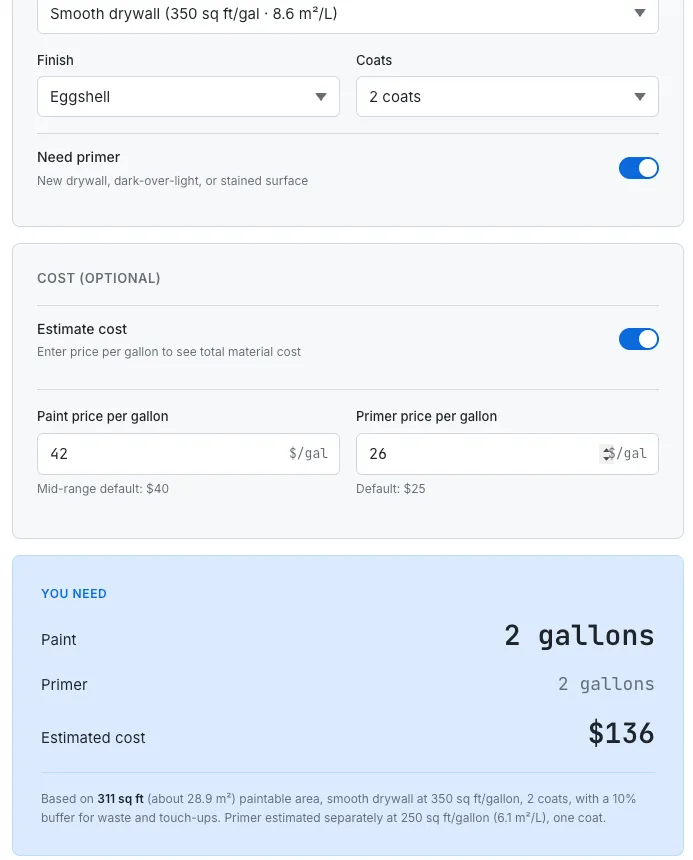
For cabinets, the calculator inputs are the same — surface area, surface type, and coat count — but the surface area is the cabinet face area (doors + drawer fronts + face frames + visible side panels) rather than wall area, and the coat count reflects the bonding primer plus two cabinet enamel topcoats sequence.
The kitchen cabinet repaint is the home-improvement project where small DIY savings buy a major visual upgrade — assuming the prep is honest and the primer is right for the substrate. The paint quantity is small (about a gallon for a standard 10x10) but the time investment is real (several days of active work plus a long cure window). The math in this guide and the calculator both handle the gallons piece; the rest is patience and prep discipline.
This is a general home-improvement guide based on industry consensus and major manufacturer documentation. Cabinet paint coverage and primer recommendations vary by product line and substrate condition; always check your specific paint can label and product data sheet. Cabinet refinishing failure (peeling, chipping) is most often a prep or primer issue rather than a paint-quality issue — the prep section is not optional. For cabinets in homes built before 1978, the painted finish may contain lead; test before sanding and consult a licensed contractor for safe removal. Specialized substrates (metal cabinets, glass-fronted cabinets, water-damaged or structurally compromised cabinetry) fall outside the scope of standard cabinet refinishing guidance.
- Bob Vila — Painting Laminate Cabinets: How to Get Pro Results. Verbatim source for the laminate primer requirement, the bonding-primer specifics, the 120-grit scuff prep, the porosity contrast with wood, and the painter-trade cost estimate.
- Purpose Driven Painting — How Much Paint Do You Need For Cabinets? Painter-trade reference for the quart-and-gallon coverage rates, the kitchen-size paint quantity estimates, the two-coat baseline for cabinet painting, the bonding-primer-for-difficult-substrates guidance, and the semi-gloss-or-satin sheen recommendation.
- Benjamin Moore — Advance Interior Paint. Manufacturer source for the waterborne alkyd category description and the oil-paint-performance-with-waterborne-cleanup framing.
- Sherwin-Williams — Emerald Urethane Trim Enamel. Manufacturer source for the cabinet/doors/trim use case, the durability framing for frequently-cleaned areas, and the fewer-coats claim.
- Glidden — How Long Does Paint Take to Dry and Cure? Manufacturer guidance for the four-hour latex recoat baseline. Cabinet enamels typically specify longer recoat windows than wall latex.
- SudoTool — How Many Coats of Paint Do You Really Need? Sister blog covering the general coat-decision matrix and the dry-film-thickness math behind two-coat painting.
- SudoTool — Paint Coverage per Gallon: The Real Number. Sister blog explaining the 350-400 sq ft per gallon manufacturer figure and the practical-coverage adjustments.
- SudoTool — Eggshell vs Satin vs Semi-Gloss: How to Choose. Sister blog on the sheen trade-off — semi-gloss is the most cabinet-appropriate sheen for cleanability.
- SudoTool — How to Paint Over Dark Walls Without a 5-Coat Marathon. Sister blog covering the tinted-primer approach for dark-to-light transitions; applicable when painting dark-stained cabinets a light color.