Best Paint for Bathroom: What Actually Works
Bathroom paint is a separate product category from regular interior wall paint, and using the wrong one shows up fast — chalky mildew patches in 6 months, peeling around the shower trim in 9, bubbling above the door in 12. The fix isn't a fancier brand; it's a formula that does three specific things at once. This guide covers what those three things are, the five products that do them best across the price range, the sheen choice that matters more than most people realize, and the prep steps that decide whether the paint lasts five years or five months.
This guide walks through (1) the three things bathroom paint must do that regular paint doesn't, (2) the top five product picks from premium to budget, (3) the satin-versus-semi-gloss decision for walls versus trim versus ceiling, (4) what to look for on the label if you're shopping, (5) the five most common mistakes that ruin bathroom paint jobs, and (6) the prep sequence for a humid bathroom. Once the right paint is picked, the SudoTool paint coverage calculator handles the gallon math (most bathrooms fit in 1-2 gallons).
What Makes Bathroom Paint Different from Regular Paint
Three differences separate bathroom-rated paint from regular interior latex. Skip any one and the paint job fails inside a year.
Mildewcide additives. A bathroom wall sits at near-100% humidity for an hour or two after every shower, with shaded corners and the strip behind the toilet staying damp far longer than the rest of the room. Regular interior paint has little or no mildewcide, so within months a black or grey spotting appears in those high-humidity spots. Bathroom-rated paint includes a mildewcide that suppresses fungal growth on the dried paint film — Zinsser's Perma-White line, for example, is marketed with a five-year mold and mildew warranty against film-surface growth. Important boundary: mildewcide only protects the paint film itself, not mildew growing behind the wall (inside drywall, between studs, around plumbing). That's a ventilation or drainage problem, not a paint problem.
Moisture-resistant resin. Standard interior paint binders flex slightly with humidity changes — the film absorbs a small amount of moisture, swells, then contracts as it dries, producing micro-cracking over hundreds of cycles. Bathroom paint uses a denser acrylic resin that resists moisture penetration into the film itself, which keeps peeling, bubbling, and blistering from starting. Benjamin Moore's Aura Bath & Spa, Sherwin-Williams Duration Home, and Behr Marquee all sit in this category — the binder chemistry is what separates them from their respective general-purpose lines.
Scrubbable sheen. Bathroom walls accumulate soap film, water spots, and dust faster than other rooms, and they get wiped or scrubbed more often. Matte and eggshell finishes lift color when scrubbed; satin and semi-gloss have a denser, harder surface film that survives routine cleaning. There's a useful side effect too — reflective surfaces show mildew spots earlier, when they're still removable with a wipe, instead of letting them settle in unnoticed against a matte background.
All three of these have to work together. A paint with mildewcide but no moisture-resistant binder peels even though it doesn't grow mildew. Moisture-resistant binder without mildewcide grows visible mildew within the first year. Either of those without a scrubbable sheen looks fine for six months and ruined after the first deep clean.
Top 5 Bathroom Paint Picks
Prices vary by region, dealer, and Sherwin-Williams's frequent 30-40% sale cycles, so treat the ranges below as approximate. The bigger decision is which tier you need, not which exact dollar figure shows up at your local store.
| Pick | Tier | Price (gal) | Why it wins | Trade-off |
|---|---|---|---|---|
| Benjamin Moore Aura Bath & Spa | Premium | ~$80-90 | Mildew-resistant formulation built in; Color Lock technology for color stability under humidity; 100% acrylic, zero VOC; two-coat coverage | Matte sheen only (no satin or semi-gloss variants); premium-decorator-store distribution (not at Home Depot) |
| Sherwin-Williams Duration Home | Mid-premium | ~$70-85 | Antimicrobial agents in the formula; moisture-resistant resin; widely available at Sherwin-Williams stores; multiple sheens including satin and semi-gloss | SW dealer required; the brand's similar Cashmere line is a low-traffic paint and not recommended for bathrooms despite the smooth finish |
| Zinsser Perma-White | Budget mildew-proof | ~$25-35 | 5-year mold and mildew warranty on the dried film (Rust-Oleum / Zinsser); self-priming; semi-gloss and satin available; 30-minute dry, 2-hour recoat | Tintable but skews to lighter colors; limited deep-saturation palette |
| Behr Marquee | Mid-tier | ~$50-60 | Antimicrobial mildew protection; one-coat coverage rating; matte, satin, and semi-gloss available; sold at every Home Depot | Mildew resistance is solid but less robust than Aura or Duration in heavy-humidity bathrooms |
| Behr Premium Plus Kitchen & Bath | Budget | ~$30 | Entry-level with bathroom-specific moisture and mildew resistance; Home Depot availability; lowest price point with bathroom-appropriate formulation | No specific mildew warranty; less robust than Zinsser Perma-White in chronic moisture problem rooms |
Which pick fits which situation:
- Aura Bath & Spa — best result regardless of price; matte aesthetic preferred; not on a budget.
- Duration Home — premium performance with sheen options; have a Sherwin-Williams nearby; comfortable buying during one of the brand's regular sale cycles.
- Zinsser Perma-White — bathroom has a history of mildew problems; want the strongest warranty on mildew specifically; budget matters but mildew protection matters more.
- Behr Marquee — want big-box availability with mid-tier performance; one-coat coverage saves time.
- Behr Premium Plus Kitchen & Bath — budget is the constraint; bathroom is well-ventilated and not historically problematic; willing to repaint sooner if it underperforms.
Satin vs Semi-Gloss: Sheen by Bathroom Type
The default sheen combination across the painting industry is satin walls plus semi-gloss trim, with semi-gloss walls reserved for high-humidity bathrooms. Glidden's bathroom paint guidance leans semi-gloss for any bathroom with persistent moisture; Sherwin-Williams positions satin as the durable mid-sheen and semi-gloss as the moisture-resistant pick. Both are scrubbable; the difference is in light reflection, imperfection visibility, and how much the wall reads as "shiny" to a guest.
| Bathroom type | Walls | Trim | Ceiling |
|---|---|---|---|
| Well-ventilated bathroom (window + fan) | Satin | Semi-gloss | Mildew-resistant flat or matte (bathroom-labeled) |
| Poorly-ventilated bathroom (fan only, or fan that's underused) | Semi-gloss | Semi-gloss | Mildew-resistant flat or matte |
| Master bathroom (large shower, daily heavy use) | Semi-gloss | Semi-gloss | Mildew-resistant flat or matte |
| Guest or powder bathroom (occasional use) | Satin | Semi-gloss | Mildew-resistant flat or matte |
Matte is almost never the right call. The one exception is Benjamin Moore's Aura Bath & Spa Matte, which is engineered specifically for bathroom moisture and washability despite the matte label — the formulation, not the sheen name, is doing the work. A generic brand's matte interior paint on a bathroom wall fails the same way regular interior paint does. For a deeper sheen comparison at the room scale, see our eggshell vs satin vs semi-gloss guide.
High-gloss is for trim only. A full wall of high-gloss reads as fluorescent under bathroom vanity lights and amplifies every drywall imperfection. The right place for high-gloss is the door, the doorframe, and the window casing — small areas where the durability matters and the reflectivity reads as intentional.
What to Look For on the Label
Five things to verify before buying. The first three are non-negotiable for a bathroom; the last two are quality-of-life.
1. "Mildew-resistant" or "antimicrobial" labeling. If neither phrase appears on the can, the paint is general-purpose interior and will grow mildew in a bathroom. Every product in the Top 5 above carries this labeling.
2. "Moisture-resistant" or "Kitchen & Bath" designation. This is the binder claim — the resin is designed to survive humidity cycling. Many manufacturers package mildew resistance and moisture resistance under a unified "Kitchen & Bath" product line (Behr Premium Plus Kitchen & Bath, for example).
3. Sheen: satin or semi-gloss (or matte if the matte is bathroom-engineered like Aura). Skip eggshell and standard matte — they aren't scrubbable enough to handle bathroom cleaning. For more on the underlying paint chemistry that drives sheen and resin choices, see our interior vs exterior paint difference guide.
4. VOC: under 50 g/L, or "zero VOC." A bathroom is small and enclosed; volatile organic compounds linger longer than in larger rooms. Most modern bathroom-rated paint comes in well under the EPA federal cap (250 g/L for flat, 380 g/L non-flat per 40 CFR Part 59), and the premium picks (Aura, Marquee Matte) are zero-VOC formulations.
5. Stated warranty. Zinsser Perma-White's 5-year mold-and-mildew warranty is the most specific in the consumer market. Other brands generally offer durability warranties without isolating mildew as a separate guarantee — Aura and Duration carry strong product reputations, but the warranty language doesn't isolate mildew the way Zinsser's does.
Five Common Mistakes That Ruin Bathroom Paint Jobs
1. Using regular interior paint to save money. The most expensive mistake disguised as a savings. The five-to-ten-dollar-per-gallon premium for bathroom-rated paint pays for itself in the first year because it doesn't fail; regular paint in a bathroom typically shows chalking and mildew at the six-month mark and starts visible peeling around twelve months. Repainting then costs the original premium plus the labor of stripping the failed paint.
2. Painting over existing mildew. The most damaging mistake. Mildew under a new paint film keeps growing — the colony stays alive, feeds off whatever organic matter is in the substrate, and slowly pushes the new film loose from underneath. The fix is to remove the mildew first. Bob Vila's bathroom-paint guidance specifies a three-parts-water-to-one-part-bleach solution, scrubbed onto the affected area and allowed to dry fully (typically 24 hours with the fan running) before any priming or painting. If the mildew has penetrated into the drywall paper itself, drywall replacement may be needed — paint won't fix structural mildew damage.
3. Painting in high-humidity conditions. Latex paint dries by water evaporation; in a bathroom where humidity sits at 70%+, the water in the paint can't evaporate into the air efficiently. The film stays soft for far longer than the label suggests, cures unevenly, and the finished sheen ends up patchy. The fix is environmental: paint when the bathroom has been dry for 24 hours, run the fan during application and for the recoat window, and leave the door open to a less-humid room across the house.
4. Showering before the paint has cured. Latex paint feels dry to the touch in about an hour and is recoat-ready in four, but full cure to washing-and-scrubbing hardness takes two to four weeks. The critical window is the first 48-72 hours — showering during that period exposes still-soft film to direct steam, which causes blistering and uneven sheen that doesn't self-correct. Wait three days minimum before the first shower; gentle cleaning and heavy scrubbing should wait two to four weeks.
5. Skipping primer when the situation requires it. Primer isn't always needed, but bathrooms have five common situations where it is: new drywall (absorbs paint unevenly), bare wood or MDF trim (raises grain and absorbs unevenly), a dramatic color change (especially dark to light), a previously glossy surface (the new paint won't bond), and any area where mildew was just cleaned (a sealing primer locks down any residual spores). Kilz Kitchen & Bath Primer is a common reference for the moisture-resistant primer category. For the broader primer decision tree, see primer 101: when you actually need it.
Prepping a Humid Bathroom Before You Paint
A five-step sequence that decides whether the paint job lasts five years or five months.
Step 1 — Remove existing mildew. Mix one part household bleach to three parts water in a spray bottle. Apply to the affected wall area, let it sit for 10 minutes, scrub with a soft-bristle brush, and rinse with clean water. Run the fan and open the window for 24 hours of full drying before doing anything else. Wear gloves and ventilate the room — bleach fumes in a small bathroom are unpleasant and not great for lungs.
Step 2 — Clean and patch the surface. Wipe walls with a mild detergent solution to remove soap film and dust that the mildew step missed. Fill any cracks or nail holes with spackling compound, let it dry per the manufacturer's instruction (typically a few hours), then sand smooth with fine-grit sandpaper. Vacuum the dust off the walls and floor — sanding dust on a wet primer coat is a finish-killer.
Step 3 — Prime if needed. Apply Kilz Kitchen & Bath Primer (or a comparable moisture-resistant primer) if any of the five situations in mistake #5 above apply. One coat is enough for most cases; two for new drywall or heavy stain coverage. Recoat window for water-based primer is one to two hours; oil-based requires 24 hours.
Step 4 — Paint two coats. The manufacturer recommendations across Aura, Duration, Marquee, Perma-White, and Premium Plus Kitchen & Bath converge on two coats for proper film thickness. Latex recoats in four hours under normal conditions; wait the full window even if the surface feels dry. Run the fan throughout the application and the recoat wait.
Step 5 — Cure before showering. 48-72 hours minimum before the first shower. Two to four weeks before any heavy cleaning or scrubbing. The film is fully hardened to its rated scrub resistance only after the full cure window — early aggressive cleaning lifts the finish back off.
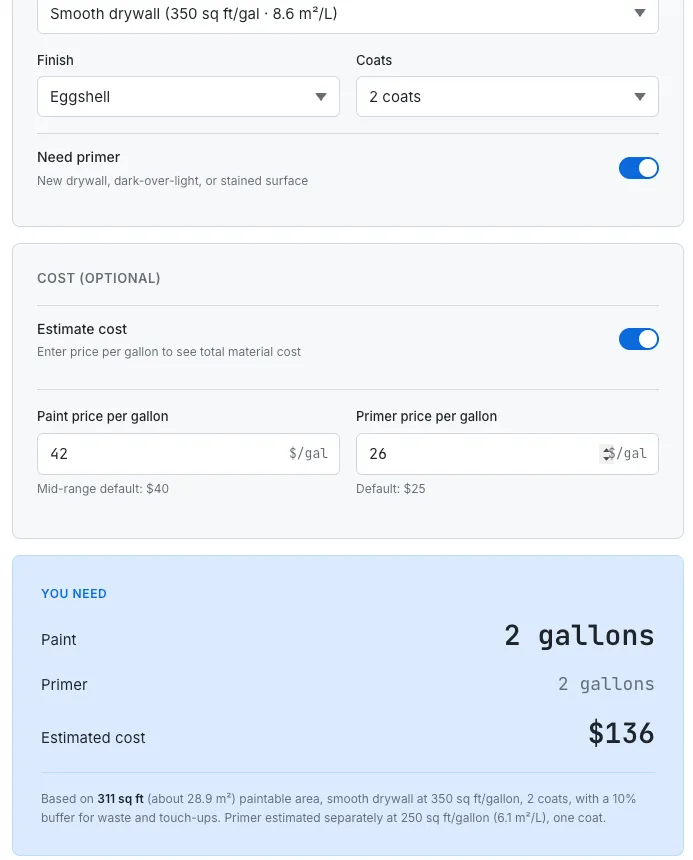
For a standard 5×8 ft bathroom with 8-foot ceilings, the calculator returns roughly 1 gallon for two coats of wall paint. Subtract door (20 sq ft) and window (15 sq ft) for the most accurate result.
The Practical Bottom Line
Bathroom paint is one of the few home-improvement categories where the budget pick (Zinsser Perma-White) holds up against the premium pick (Aura Bath & Spa) on the specific dimension that matters most — mildew resistance. The premium pick wins on aesthetics, color stability, and matte-finish elegance; the budget pick wins on the explicit five-year warranty. Both fail the same way if the prep is wrong: applied over existing mildew, in high humidity, or used in a bathroom that exhausts steam directly into the wall cavity through inadequate ventilation. The paint is half the answer; the prep and ventilation are the other half.
Frequently Asked Questions
What is the best paint for a bathroom?
The premium pick is Benjamin Moore Aura Bath & Spa (~$80-90 per gallon, matte only, mildew-resistant formulation built in). The budget mildew-proof champion is Zinsser Perma-White (~$25-35 per gallon, with a 5-year mold and mildew warranty). In between sit Sherwin-Williams Duration Home (~$70-85), Behr Marquee (~$50-60), and Behr Premium Plus Kitchen & Bath (~$30). All five carry the three essentials: mildewcide, moisture-resistant resin, and a scrubbable finish.
Should bathroom walls be satin or semi-gloss?
The industry default is satin walls plus semi-gloss trim for bathrooms with adequate ventilation. Switch to semi-gloss walls when ventilation is poor or the bathroom runs constantly humid — a master bathroom with daily heavy shower use, for example. Both sheens are scrubbable; the difference is light reflection and how visible surface imperfections become.
Can you use regular interior paint in a bathroom?
It typically fails within a year. Regular interior paint has little or no mildewcide, so black or grey spotting appears in high-humidity spots within months, chalking shows around the six-month mark, and visible peeling starts around twelve months. Bathroom-rated paint costs only a few dollars more per gallon and avoids stripping and repainting a failed job.
How long after painting a bathroom can you shower?
Wait 48-72 hours minimum before the first shower. Latex paint feels dry in about an hour and recoats in four, but the critical early-cure window is the first 48-72 hours — direct steam during that period causes blistering and uneven sheen that doesn't self-correct. Full cure to scrubbing hardness takes two to four weeks, so heavy cleaning should wait that long.
Can you paint over mildew in a bathroom?
No — mildew under a new paint film keeps growing and slowly pushes the film loose from underneath. Remove it first: scrub with a one-part-bleach-to-three-parts-water solution, let it sit 10 minutes, rinse, and allow 24 hours of drying with the fan running. If mildew has penetrated the drywall paper itself, drywall replacement may be needed; paint won't fix structural mildew damage.
This guide summarizes manufacturer documentation (Benjamin Moore, Sherwin-Williams, Rust-Oleum / Zinsser, Behr) and homeowner-focused publishers as published. Prices vary by region, dealer, and current promotions; check current local pricing before purchase. Mildew warranty terms vary — read the specific product literature for exclusions and required conditions. Structural mildew problems (recurring growth, drywall damage, persistent moisture from plumbing or roofing leaks) need ventilation, drainage, or plumbing remediation before any repaint; paint alone will not solve a moisture-source problem.
- Benjamin Moore — Aura Bath & Spa Interior Paint — Matte. Manufacturer reference for the mildew-resistant coating, Color Lock technology, 100% acrylic latex, zero VOC, and two-coat recommendation.
- Sherwin-Williams — Duration Home Interior Acrylic Latex. Manufacturer reference for the antimicrobial agents and moisture-resistant resin in the bathroom-appropriate Sherwin-Williams product line.
- Rust-Oleum / Zinsser — Perma-White Mold & Mildew-Proof Interior Paint. Manufacturer reference for the 5-year mildew warranty, self-priming formulation, and 30-minute touch-dry / 2-hour recoat specs.
- Behr — Marquee Interior Paint Collection. Manufacturer reference for the antimicrobial mildew protection and one-coat coverage claim across the Marquee sheens.
- Bob Vila — How to Choose The Best Paint for Bathrooms. Homeowner reference for the 3-to-1 water-to-bleach mildew-cleaning solution and Kilz Kitchen & Bath Primer recommendation.
- Glidden — What Type of Paint for Bathroom? Manufacturer reference for the semi-gloss recommendation in high-humidity bathrooms and the satin-walls-plus-semi-gloss-trim default combination.
- Sherwin-Williams — How to Choose Paint Finishes (Sheen Guide). Reference for the sheen taxonomy and durability characteristics across matte, eggshell, satin, semi-gloss, and high-gloss.
- US EPA — Architectural Coatings VOC Standards (40 CFR Part 59). Federal VOC limits for interior architectural coatings (250 g/L flat, 380 g/L non-flat).
- SudoTool — Interior vs Exterior Paint: The Real Difference. Sister guide on the binder chemistry and additive differences that bathroom paint shares with the exterior category.
- SudoTool — Eggshell vs Satin vs Semi-Gloss: How to Choose. Sister guide on the sheen trade-off at the room scale.
- SudoTool — Primer 101: When You Actually Need It. Sister guide on the primer decision tree, including bathroom-specific situations.