Interior vs Exterior Paint: The Real Difference
Set a can of interior paint next to a can of exterior paint and they look identical — same white plastic lid, same acrylic-latex smell when you pop it, same milky texture under the stir stick. The only visible difference is the word on the label. The chemistry inside, though, is not the same product. Interior and exterior paint share an acrylic-latex foundation, then diverge on three things that matter: the binder that holds pigment to the wall, the additives that determine how the dried film behaves, and the VOC content the formula is allowed to carry. Use one in place of the other and the failure mode is predictable.
This guide walks through (1) the binder chemistry that drives the difference, (2) the additives exterior paint carries that interior doesn't, (3) the VOC trade-off and what EPA and California regulations require, (4) what happens when interior paint is used outside, (5) what happens when exterior paint is used inside, (6) interior/exterior hybrid paint and where the compromise lies, (7) edge cases that don't fit cleanly indoor-or-outdoor, and (8) a side-by-side comparison table. The SudoTool paint coverage calculator handles gallon math once the paint type has been chosen.
The Core Difference Between Interior and Exterior Paint: Binder Chemistry
A paint film has four ingredients — pigment for color, binder for adhesion, solvent (water for latex) to move it onto the wall, and additives for specialized performance. The interior-versus-exterior choice is driven by the binder, the resin that locks pigment to the substrate after the water evaporates.
Exterior paint uses a flexible binder. A wood-sided house is never still. Siding expands when the sun warms it and contracts at night, swells when it absorbs rain and shrinks when it dries, moves a few millimeters between July and January because of thermal cycling. An exterior paint film has to move with the substrate — a rigid film snaps and flakes off the moment the wood does anything but sit perfectly still. Acrylic resins dominate exterior formulations because acrylic stays flexible across temperature swings and resists ultraviolet breakdown. Sherwin-Williams, Benjamin Moore, and Behr all build their exterior product lines around acrylic-latex chemistry for exactly this reason.
Interior paint uses a harder binder. Drywall barely moves — interior temperature and humidity stay within a narrow band, and there's no UV or rain. What an interior surface gets instead is contact: kitchen grease, bathroom soap film, kid fingerprints, dog tails, vacuum bumpers, the household sponge dragged across the wall once a quarter. An interior paint film has to survive scrubbing. That requires a harder resin — vinyl-acrylic and styrene-acrylic blends sit alongside pure acrylic in interior formulas, raising film hardness so that wiping doesn't peel color away.
The trade-off is unavoidable. A binder optimized for outdoor flexibility scuffs more easily under indoor cleaning. A binder optimized for scrub resistance shatters when wood siding expands. No single resin chemistry is best at both — which is also why interior/exterior hybrid paints are a compromise (more on that below), not a winning formulation that supersedes both categories.
Additives Exterior Paint Has That Interior Doesn't
After binder, the next biggest difference is the additive package.
Mildewcide. Exterior surfaces stay damp for hours after rain, and shaded north-facing walls in humid climates grow visible black mildew within months of being painted with the wrong product. Exterior paint contains a mildewcide additive that suppresses fungal growth on the dried film. Sherwin-Williams sells M-1 as a paint-additive concentrate for the same purpose, registered by the EPA to inhibit mildew, mold, and algae on the surface coating. One important boundary: the mildewcide protects the paint film itself, not the substrate behind it. Mildew growing from inside the wall (a ventilation, vapor-barrier, or drainage problem) keeps going regardless of the topcoat.
UV-resistant pigments. Sunlight bleaches paint color. Organic pigments — the chemistry that makes saturated reds, deep blues, and bright yellows possible — degrade in UV within one to two years on a south-facing wall. Exterior paint relies more heavily on inorganic pigments (iron oxides for reds and browns, titanium dioxide for whites, chromium oxide for greens) that hold their color much longer outdoors. Interior paint can use the cheaper, brighter organic pigments because there's no UV exposure to break them down.
Weather-resistance additives. Surfactants and water-repellent additives in exterior paint slow water absorption, which keeps the film from blistering during rain and from being damaged by wet-dry-wet-dry cycling. These additives have no purpose indoors and would slightly degrade scrub resistance if added to interior paint.
Interior paint trades these additives for a different set: scrub-resistance modifiers that let a microfiber cloth wipe the wall without lifting color, low-odor formulations for occupied spaces, and stain-blocking additives that resist coffee splashes and crayon marks. The two additive packages are not interchangeable. A few are even mutually exclusive — some mildewcide compounds are mild indoor allergens, and the wet-edge surfactants in interior paint break down faster under outdoor UV.
The VOC Trade-Off
Volatile organic compounds (VOCs) are the chemicals that evaporate as paint dries — they're what gives fresh paint its smell, and they're regulated for good reason. The US Environmental Protection Agency's Volatile Organic Compounds page lists short-term effects including headaches and irritation of the eyes, nose, and throat, with longer exposure linked to damage to the liver, kidneys, and central nervous system.
Interior paint has to be low-VOC because people breathe the air it dries into. Under EPA's National Volatile Organic Compound Emission Standards for Architectural Coatings (40 CFR Part 59 Subpart D), federal limits are 250 g/L for interior flat paint and 380 g/L for interior non-flat coatings (eggshell, satin, semi-gloss, gloss). California's South Coast Air Quality Management District Rule 1113 is the strictest US standard, capping flat interior coatings at 50 g/L — a fifth of the federal limit. Most modern interior paint sold in the United States runs well below the federal cap, with "low-VOC" labels at roughly 50 g/L or less and "zero-VOC" labels typically under 5 g/L (not literally zero — a marketing threshold, not a chemical absolute).
Exterior paint is allowed higher VOC content because outdoor curing dilutes the off-gas. The film dries in moving air with no enclosed space to accumulate fumes. The looser VOC budget lets exterior formulations carry the heavier additive load — mildewcide, UV stabilizers, weather-resistant surfactants — that gives outdoor durability. Net effect: exterior paint usually has higher VOC content than interior paint of comparable price and finish.
This is the first reason exterior paint can't move indoors without consequences. The chemistry that's safe under open sky off-gasses into a closed bedroom for weeks or years, well past the surface-dry stage.
What Happens If You Use Interior Paint Outside
Short answer: visible damage in 3-6 months, paint failure by month 12. The timeline is reproducible across painting-contractor reports and manufacturer warranty data.
Months 1-3: chalking begins. Run a finger across the painted siding and a fine powder comes off — that's the binder breaking down under UV before the pigment particles have anywhere to anchor. Chalking on a white wall is hard to spot until the finger test. On a darker color, the surface starts looking slightly hazy or matte where it used to be glossy.
Months 3-6: color fades visibly. Direct south- and west-facing walls fade fastest. Whites go yellow or gray, reds go pink, dark greens go olive. The first mildew patches appear on shaded sides, especially north-facing walls in humid climates, because the interior formula has no mildewcide. Painting-contractor accounts converge on roughly the 3-6 month window for the first visible failures.
Months 6-12: peeling and cracking start. The rigid interior binder can't follow siding expansion, so the film tears at expansion seams and where boards meet trim. Water gets behind the lifted edges and pushes more film off as it freezes and thaws. Bubbles form where moisture is trapped between the substrate and the film.
Month 12 onward: the paint sheds. Repainting requires scraping or stripping the failed coating, repairing whatever substrate damage the trapped water caused, and starting from primer. The cost premium of having used interior paint as a shortcut almost always exceeds the original savings — paint plus labor times two, plus the substrate repair the first failure caused.
Almost no exceptions. Fully covered porch ceilings or interior garage walls that never see UV or rain can last longer with interior paint, but the moment a fascia or siding board sees a single day of summer sun the failure clock starts.
What Happens If You Use Exterior Paint Inside
Short answer: the air quality problem is the real one. The appearance problem is secondary.
VOC off-gassing. Exterior paint carries the higher VOC load that outdoor curing tolerates. Brought indoors, the same formula releases its VOCs into the room's enclosed air. The EPA Indoor Air Quality reference describes VOC concentrations indoors as consistently higher than outdoors — sometimes by an order of magnitude — and the architectural-coating share of those VOCs persists well past the surface-dry stage. Symptoms range from immediate (headaches, nausea, dizziness, eye and throat irritation) to chronic (potential central nervous system, kidney, and liver effects under prolonged exposure). The mildewcide and UV stabilizers add their own allergen and irritation potential in enclosed spaces. Ventilation reduces but does not eliminate the exposure window — the off-gas continues for weeks at minimum and years for the heaviest VOC fractions.
Drying and cure problems. Latex paint cures from the outside in: the surface skin dries first while solvent is still trapped beneath. Outdoor air movement and direct sunlight speed both halves of the process. Move the same formula indoors and the surface skins as expected but the underlying film stays soft for far longer than the label says. Painting-contractor data points to typical latex full cure at 14 days under ideal conditions and up to 30 days in cool, humid, or poorly ventilated spaces. Exterior paint cures even slower indoors than interior paint does, and the visible result is usually patchy sheen and uneven color where parts of the film cured at different rates.
Surface performance. The flexible exterior binder scuffs more easily under indoor contact. Furniture rubbing against the wall leaves marks. Cleaning attempts can lift color along with dirt because the film never developed the scrub resistance that interior chemistry would have built in.
Remediation if it has already happened. Open the windows immediately and run a fan for several days to bleed the worst of the VOCs. The long-term fix is a coat of interior primer (which acts as a partial VOC barrier) plus two coats of interior paint over the top. This is the same procedure manufacturers recommend for sealing existing exterior paint that has to remain indoors.
The "Interior/Exterior" Hybrid Paint Compromise
Several major manufacturers sell a dual-labeled "interior/exterior" product. Olympic Elite Advanced Stain-Blocking Paint + Primer in One is positioned for either environment. EVOLVE Paint & Primer covers the same category. CIONIA All-in-One markets to furniture and cabinet refinishing. Glidden Porch and Floor handles porch decks specifically. These products do exist, and they do work — but they are a compromise, not a category that supersedes dedicated interior and exterior paint.
What the compromise looks like. Hybrid formulations carry less mildewcide and weaker weather additives than a dedicated exterior paint. They also carry more weather-leaning chemistry and higher VOC than a dedicated low-VOC interior paint. The result is a film that works in both environments but excels in neither. Mildew resistance is moderate, not strong. Scrubbability is moderate, not strong. VOC content is middling, not low. For a small project — a piece of furniture, an accent piece of cabinetry, a single shelf — the convenience of one can for two uses can outweigh the loss of category-specific performance. For a full house exterior or a bedroom that will be lived in for years, it doesn't.
When hybrid makes sense: small DIY projects without long-term durability demands, partially-protected outdoor zones (porch ceilings under a deep overhang, garage interior walls), or matched-color touch-up work where carrying two separate cans is impractical.
When hybrid doesn't make sense: full siding, full interior of living spaces (where the VOC budget matters), or anything that needs to last more than five years.
Read the label carefully on any product that claims dual use — many "interior/exterior" labels are limited to specific substrates (porch floors, masonry, metal trim) rather than general-purpose siding or wall paint. The dedicated product is almost always the better long-term choice.
Edge Cases That Confuse People
Not every surface fits the clean indoor-or-outdoor binary. The cases below are where the most common substitution mistakes happen.
Front doors. The exterior face of a front door takes exterior paint — UV, rain, and thermal cycling are all in play. The interior face takes interior paint if the door is painted a different color on the inside, or exterior paint applied to both faces if the door is the same color throughout. The painting convention for split-color doors is that the hinge edge matches the exterior color (visible when the door is open from outside) and the latch edge matches the interior color (visible from inside), which keeps both views looking intentional.
Trim and molding. Interior trim takes interior trim enamel — typically Sherwin-Williams Emerald Urethane, Benjamin Moore Advance, or equivalent — in satin or semi-gloss for cleanability. Exterior trim and fascia take exterior paint, usually in semi-gloss. Using interior trim paint on exterior trim has the same UV and weather problems as using interior wall paint on siding. See our trim paint quantity guide for the linear-foot math that turns trim into a quart-not-gallon project.
Garages. A garage looks like interior space but acts like both. The interior walls and ceiling take interior paint — preferably a low-VOC, moisture-resistant formula, because garage ventilation is poor and the space accumulates car exhaust and chemical vapors that compound with paint VOCs. The exterior walls (the side facing the outside of the house) take exterior paint. The garage floor is a different category — epoxy floor coatings designed for concrete substrate, not architectural latex of either type.
Sunrooms. Glass-walled rooms with strong direct sunlight are physically indoor (enclosed, ventilated like the rest of the house) but optically outdoor (UV exposure on the walls). The right choice is high-quality interior paint with UV-resistant pigments — some manufacturers sell "sunroom" or "high-traffic" interior lines specifically for this. Exterior paint is the wrong answer because the VOC profile is too high for enclosed living space.
Porch ceilings. Under a deep porch roof, a ceiling sees minimal direct rain and UV but is still outdoor air — bugs, humidity swings, occasional rain blown sideways. Use exterior paint or a porch-specific product like Glidden Porch and Floor. Interior paint on a porch ceiling shows mildew within a year because the interior formula has no fungicidal additives.
Basements. Basements are interior space. Use interior paint. The wrinkle is humidity — most basements run wetter than the rest of the house, so mildew-resistant interior paint (Zinsser Perma-White and similar) is a sensible choice for the walls and ceiling.
Quick Comparison Table
| Property | Interior paint | Exterior paint |
|---|---|---|
| Binder | Harder (scrub resistance) | Flexible (thermal movement) |
| Key additives | Scrubbable surfactants, low-VOC carriers, stain-blockers | Mildewcide, UV-resistant pigments, weather sealants |
| VOC (US EPA federal) | Flat ≤250 g/L, non-flat ≤380 g/L | Typically higher; outdoor curing accommodates |
| California SCAQMD | Flat ≤50 g/L (strictest in US) | Higher limit than interior |
| Drying time (latex) | Recoat ~4 hours, full cure ~14-30 days | Recoat 4-8 hours (outdoor conditions), full cure ~14-30 days |
| Finish options | Matte, eggshell, satin, semi-gloss, gloss, faux | Mainly flat, satin, semi-gloss, gloss |
| Used in wrong environment | Outside: chalk + fade 3-6 months, fail by month 12 | Inside: VOCs off-gas weeks to years, uneven cure |
| Price reference (Behr lines) | $30-$70/gal (Premium Plus to Dynasty) | $44-$80/gal (Premium Plus to Dynasty) |
The pricing premium for exterior paint reflects the additive cost — mildewcide, UV stabilizers, and inorganic pigments are all more expensive than the interior equivalents — not a margin difference. Paying $5-$10 extra per gallon for the right product is much cheaper than repainting after a 12-month failure.
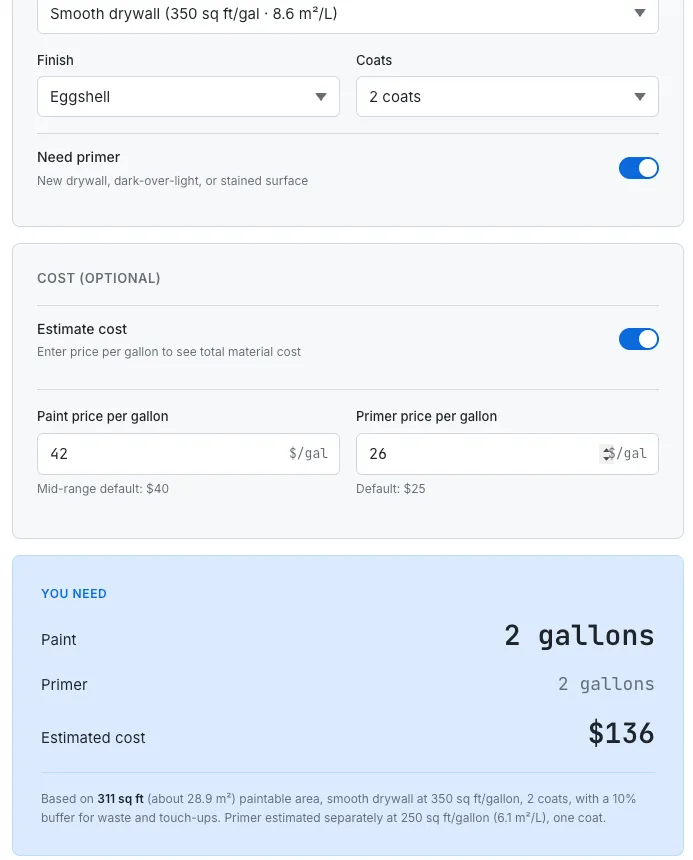
After choosing interior or exterior paint for the project, the calculator handles the quantity math separately. The coverage rates the calculator uses (350 sq ft per gallon for smooth surfaces, down to 175 for stucco) are the same for both paint types — the type choice is upstream.
The Practical Takeaway
Pick paint by the environment the surface lives in, not by what's already in the garage. Interior surfaces — including interior trim, basements, sunrooms, and garage interior walls — take interior paint with its harder binder and lower VOC. Exterior surfaces — siding, fascia, exterior doors, exterior trim, porch ceilings — take exterior paint with its flexible binder, mildewcide, and UV-resistant pigments. The hybrid interior/exterior label exists and serves small projects, but it is a compromise rather than a winner over either dedicated category. The cost penalty for buying the right product is small relative to the cost of redoing a job that failed within a year because the wrong chemistry was applied to the wrong environment.
Frequently Asked Questions
What is the difference between interior and exterior paint?
Both share an acrylic-latex foundation but diverge on three things. Interior paint uses a harder binder, lower VOC content, and additives tuned for scrubbing and stain resistance. Exterior paint uses a flexible binder that moves with thermal expansion, plus mildewcide and UV-resistant pigments that resist weather, and higher VOC content tolerated by outdoor curing.
Can I use interior paint outside?
No. Chalking begins in months 1-3, color fades and the first mildew appears at 3-6 months, and peeling and cracking start by months 6-12 as siding expansion shatters the rigid interior binder. By month 12 the paint sheds, and repainting plus substrate repair almost always costs more than using the right exterior paint would have.
Can I use exterior paint indoors?
It is a bad idea, mostly for air quality. Exterior paint carries a higher VOC load that off-gasses into enclosed air for weeks to years even after the surface dries, with effects from headaches and nausea to central nervous system risk on long exposure. It also cures unevenly indoors because latex dries outside-in and lacks the airflow and sunlight the formula expects.
Do interior/exterior hybrid paints work?
They work but they compromise. Hybrids carry less mildewcide and weaker weather additives than dedicated exterior paint, and more weather-leaning chemistry and higher VOC than dedicated low-VOC interior paint. They suit small projects and partially-protected zones like a deep-overhang porch ceiling, but not full siding or living spaces lived in for years.
What paint should I use on a front door or trim?
The exterior face of a front door takes exterior paint; the interior face takes interior paint if painted a different color. For split-color doors, the hinge edge matches the exterior color and the latch edge matches the interior. Interior trim takes interior trim enamel in satin or semi-gloss, while exterior trim and fascia take exterior paint.
Why does exterior paint cost more than interior paint?
The premium reflects the additive cost — mildewcide, UV stabilizers, and inorganic pigments all cost more than the interior equivalents — not a margin difference. With Behr's lines, Premium Plus runs $30-$40 per gallon interior versus $44-$48 exterior, and the Dynasty line runs $60-$70 interior versus $75-$80 exterior.
This guide summarizes manufacturer documentation (Sherwin-Williams, Benjamin Moore, Behr) and US EPA architectural-coating regulations as published. Specific VOC limits, additive packages, and product lines change over time; check current product data sheets and regional regulations before purchase. Health information about VOC exposure is summarized from EPA Indoor Air Quality and toxicology references — for medical questions about VOC exposure or paint-related symptoms, consult a physician or poison control center rather than relying on a homeowner-level guide.
- US EPA — Architectural Coatings: National VOC Emission Standards. Federal regulation establishing the 250 g/L flat and 380 g/L non-flat VOC limits for interior architectural coatings (40 CFR Part 59 Subpart D).
- US EPA — Volatile Organic Compounds' Impact on Indoor Air Quality. EPA reference for VOC health effects including headaches, irritation of eyes/nose/throat, and longer-term central nervous system, kidney, and liver risks.
- South Coast Air Quality Management District — Rule 1113. Architectural Coatings. California regulation establishing the strictest US VOC cap of 50 g/L for interior flat coatings.
- Sherwin-Williams — M-1 Advanced Mildew Treatment. Manufacturer product page documenting mildewcide function on dry paint film, compatible with interior and exterior latex, oil, and solvent-based coatings.
- Bob Vila — Solved! Can You Use Exterior Paint Inside? Homeowner reference for the chemical-composition risk, drying problems indoors, and VOC continued off-gassing after the paint dries.
- Bob Vila — Types of Paint and Paint Finishes. Reference for binder chemistry differences and acrylic flexibility under outdoor expansion/contraction.
- SudoTool — How Many Coats of Paint Do You Really Need? Sister guide on coat count, the upstream decision after paint type is chosen.
- SudoTool — Primer 101: When You Actually Need It. Sister guide on primer's role as a VOC barrier when remediating exterior paint applied indoors.
- SudoTool — How Much Trim Paint Do I Need? Sister guide on interior trim enamel as a separate product category from wall paint.
- SudoTool — Paint Coverage per Gallon: The Real Number. Sister guide on the 350-400 sq ft/gal coverage rate that applies once paint type is selected.