How Much Trim Paint Do I Need? The Linear-Foot Math
Trim is the painting category most homeowners over-buy on. Walls get measured in square feet directly; an accent wall is just length times height. Trim is different — baseboard, door casing, window casing, plus optional crown molding and chair rail — and it gets measured in linear feet first, then converted to square feet by multiplying by the trim width. Skip that conversion and the paint store's default gallon recommendation lands you with three-quarters of a can drying out for a project that genuinely needed one quart.
This guide walks through (1) why trim paint is a separate product category from wall paint, (2) the linear-foot to square-foot conversion formula, (3) standard trim widths to plug into the formula, (4) a worked example for a typical 12x12 bedroom, (5) the quart-vs-gallon threshold for trim projects, and (6) three common trim paint mistakes. The SudoTool paint coverage calculator handles the gallon math once trim linear feet have been converted to square feet.
Trim Paint Is a Different Product Category
Regular wall paint on trim fails within months — fingerprints don't wipe off, the painted edge chips at the corners, and the finish scuffs along the baseboard where shoes and vacuums hit it. Trim, doors, and cabinets all share the same high-traffic, hand-touch, cleaning-solvent reality, and the paint chemistry has to match. The category is trim-specific enamel, not wall latex.
| Product | Base | Sheens | Manufacturer framing |
|---|---|---|---|
| Sherwin-Williams Emerald Urethane Trim Enamel | Waterbased urethane-modified alkyd | Satin, Semi-Gloss, Gloss | "Interior/exterior waterbased urethane modified alkyd with the look and feel of an alkyd/oil finish." |
| Benjamin Moore Advance | Waterborne alkyd | Satin, Semi-Gloss, High Gloss | "the application and performance of traditional oil paint in a waterborne formula that cleans up with soap and water" |
| INSL-X Cabinet Coat | Acrylic enamel | Semi-Gloss | DIY-market alternative at a lower price point |
The product framing comes directly from manufacturer marketing. Sherwin-Williams positions Emerald Urethane Trim Enamel to "Give cabinets, doors and trim a smooth, luxurious finish" and notes the product is "Perfect for areas that are cleaned frequently." Benjamin Moore's Advance is sold as "100% alkyd formula water-dispersible alkyd developed with proprietary new resins that keep VOCs low even after tinting", delivering oil-paint-grade performance with water cleanup. Both are the same product class — cabinet-and-trim enamel — and both work well on trim where regular wall latex won't.
Sheen is almost always semi-gloss or satin. Bob Vila's framing for why glossy finishes belong on trim: glossy paints "form a durable finish that repels dirt and grime better than flat paint, and they're easier to wipe clean, too." Flat and eggshell on trim is rare for exactly that reason — cleanability matters more than the slight extra hide power. For the sheen trade-off at the wall scale (where the math is different), see our eggshell vs satin vs semi-gloss guide.
Trim coats follow the same one-or-two-coats rule as wall paint. Bob Vila: "Apply one to two coats for a durable finish, making sure you wait the proper amount of time before applying the next coat." Two coats is the practical default for any color change or fresh-trim installation. For the recoat timing math (latex 4 hours, alkyd overnight, primers 30-60 minutes), see how long to wait between coats of paint.
How to Measure Trim: Linear Feet Converted to Square Feet
Wall painting is straightforward — length times height equals square feet. Trim is one extra step because trim has a length but barely any "width" relative to a wall. The conversion is a three-step formula:
- Add up linear feet across every section of trim (each baseboard run, each door casing, each window casing).
- Multiply by trim width in inches divided by 12 to convert to square feet per coat.
- Multiply by 2 for the standard two-coat application total.
Baseboard-only example:
- 100 linear ft of 3.5-inch baseboard
- 100 × 3.5 / 12 = 29 sq ft per coat
- 2 coats = 58 sq ft total application
Baseboard + door casing example:
- 100 ft baseboard at 3.5 inches → 29 sq ft per coat
- 30 ft door casing at 2.25 inches → 30 × 2.25 / 12 = 5.6 sq ft per coat
- Total: ~35 sq ft per coat × 2 coats = 70 sq ft
Sherwin-Williams's coverage rates are the same for trim as for walls (paint chemistry, not application target, drives coverage). The two-coat assumption is baked into Benjamin Moore's official calculator: "These calculations assume 2 coats of paint and do not include the ceiling." The same applies to trim — single-coat application is the exception, two-coat is the rule.
Industry buffer: add 10% to the calculated square footage for cuts, drips, and the inevitable second-coat re-trim that comes out heavier than the first. Add 15% if the trim is porous or freshly installed (more first-coat absorption).
Standard Trim Width Reference
The biggest error in trim quantity estimates is using the wrong width. A baseboard that's actually 5 inches wide instead of the assumed 3.5 inches needs 43% more paint. Measure if possible, or use the reference below for the common defaults.
| Trim type | Width range | Most common | Thickness |
|---|---|---|---|
| Baseboard | 3-5 inches | 3.5" | 3/4" |
| Door casing | 2 1/4 – 3 1/2 inches | 2 1/4" | 1/2" |
| Window casing | 2 1/4 – 3 1/2 inches | 2 1/4 – 2 1/2" | 1/2" |
| Crown molding | 1 1/2 – 8 inches | 4 1/2" | 1/2 – 3/4" |
| Chair rail | 2 – 3 1/2 inches | 2 1/4" | 3/4" |
The width figures align with VIP Classic Moulding's industry reference. Baseboards: "The average baseboard is no less than ¾ inch in thickness, ranging anywhere from 3-5 inches wide." Door casing: "The most commonly used door trim casing size is 2 ¼ inches in width and ½ thick", with custom widths going up to 3 1/2 inches. Chair rail, by the same source, sits at 2 1/4 inches wide and 3/4 inches thick. Crown molding has the widest range — anywhere from 1 1/2 to 8 inches, with 4 1/2 inches being most common.
If you don't know your trim width: default to 3.5 inches. It's the most common baseboard size, slightly above casing average, and the safest over-estimate for paint quantity (better to have leftover than to run out).
Crown molding caveat: the 5x range (1.5 to 8 inches) means crown alone can easily double your trim paint requirement. Measure before estimating. A 6-inch crown around a single 12x12 room adds 48 ft × 6 / 12 = 24 sq ft per coat — enough to push a single-room project from quart to two-quart territory.
Worked Example: 12x12 Bedroom Trim
Walk through the math end-to-end for a representative bedroom: 12 ft × 12 ft, standard 8-foot ceilings, one interior door, one standard window.
Step 1 — Baseboard:
- Wall perimeter: 12 + 12 + 12 + 12 = 48 linear ft
- Subtract door opening (3 ft): 48 − 3 = 45 linear ft of baseboard
- At 3.5 inches wide: 45 × 3.5 / 12 = 13.1 sq ft per coat
Step 2 — Door + window casing:
- Door casing (3 sides of one door): roughly 2 × 7 ft (sides) + 1 × 3 ft (top) = 17 linear ft
- Window casing (4 sides of one window): roughly 2 × 5 ft + 2 × 3 ft = 16 linear ft
- Total casing: ~33 linear ft at 2.25 inches → 33 × 2.25 / 12 = 6.2 sq ft per coat
Step 3 — Total:
- 13.1 + 6.2 = ~19 sq ft per coat
- Two coats: 19 × 2 = 38 sq ft of total paint application
- With 10% buffer: 38 × 1.10 = 42 sq ft
Result: Sherwin-Williams's quart spec is 100 sq ft (one coat), so 1 quart of trim paint covers the room's full trim for two coats with about 58 sq ft of spare capacity. Enough leftover for touch-ups on the cure-window damage that always happens, plus the next room if it's painted the same color.
Variations:
- Add a 4.5-inch crown molding to the same room (48 ft of crown): +18 sq ft per coat × 2 = +36 sq ft → total 78 sq ft. Still inside 1 quart (100 sq ft), but tighter.
- Wider 5-inch baseboard instead of 3.5": baseboard area goes from 13.1 to 18.75 sq ft per coat → total ~25 sq ft per coat × 2 = 50 sq ft. Still 1 quart.
- Two doors and two windows in the same room: casing roughly doubles to ~66 ft → 12.4 sq ft per coat. Total ~26 per coat × 2 = 52 sq ft. Still 1 quart.
Almost every single-room trim project fits in 1 quart. The category for cabinet-grade trim enamels (Sherwin-Williams Emerald Urethane, Benjamin Moore Advance) is the same product family used for kitchen cabinet refinishing — see how much paint for kitchen cabinets for the cabinet-specific math that uses these same paints.
Quart vs Gallon Threshold for Trim Projects
The quart-to-gallon line for trim is much further out than for walls because trim surface area per linear foot is low. The breakpoints:
| Project scope | Two-coat sq ft | Recommended purchase |
|---|---|---|
| Single room, baseboard only (12x12 bedroom) | ~25-30 sq ft | 1 quart (large surplus) |
| Single room, baseboard + casing | ~40-50 sq ft | 1 quart |
| Single room + crown molding | ~70-90 sq ft | 1 quart (tight) |
| 2-3 rooms, same color, baseboard + casing | ~100-150 sq ft | 2 quarts or 1 gallon |
| Full house (5-7 rooms, baseboard + casing) | ~250-350 sq ft | 1 gallon |
| Full house + crown molding throughout | ~400-500 sq ft | 1 gallon + 1 quart |
The rule of thumb: single room = 1 quart, full house = 1 gallon. The exception is wide trim (5-inch baseboards, 4-6-inch crown) which can push a multi-room project into the 2-quart range, and the paint store's default gallon suggestion, which is driven by inventory turnover rather than by the underlying math.
Practical purchase note: paint stores stock standard colors (off-whites, pure white) in quart sizes consistently, but custom-tinted trim colors are sometimes gallon-only. If the desired color isn't available as a quart, the options are (a) check another store, (b) substitute a standard near-equivalent, or (c) buy the gallon and store the leftover (sealed trim enamel is stable for 1+ year and useful for touch-ups during the cure window).
Three Common Trim Paint Mistakes
1. Using wall paint on trim. The most expensive mistake to fix. Regular interior latex on trim chips at the corners, scuffs along the baseboard top edge, and fingerprints don't wipe off — failures show up within months and the remediation requires stripping and redoing with proper enamel. Trim always gets a trim-specific enamel: Sherwin-Williams Emerald Urethane, Benjamin Moore Advance, INSL-X Cabinet Coat, or equivalent. Same color is fine; the paint product itself has to be different.
2. Applying only one coat. Bob Vila's guidance is the practical standard: apply one to two coats for a durable finish. One coat is acceptable only for same-color, properly-prepped, light-touch repaints; in every other case, two coats is the default. A single coat leaves the enamel film too thin to reach its cabinet-grade scrub resistance, so the trim looks fine for a few months and starts failing where hands and shoes touch it.
3. Matching trim sheen to wall sheen. The whole architectural function of trim is to define the edge between wall and floor (or wall and door, or wall and ceiling). When trim and wall share the same sheen, the trim visually disappears in raked light — the eye loses the edge that frames the room's geometry. The standard combination is one sheen step up: walls in flat or eggshell, trim in satin; walls in eggshell, trim in semi-gloss. The contrast is intentional design, not optional. Bob Vila on the trim-versus-flat distinction: glossy paints form a more durable, more wipe-cleanable finish than flat paints, and the visual contrast happens as a side effect.
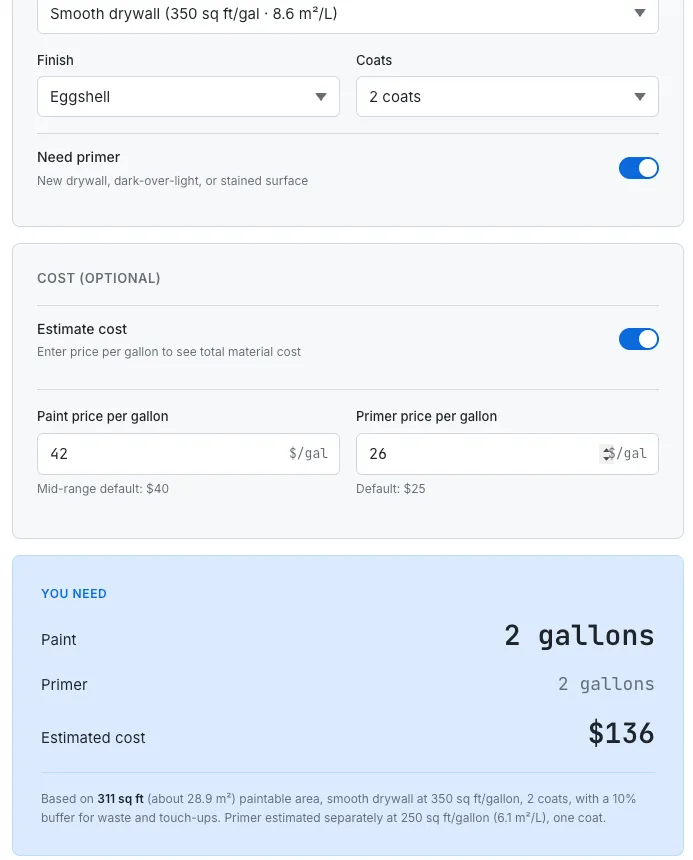
For trim projects, the calculator math runs after the linear-foot to square-foot conversion. 100 linear ft of 3.5-inch baseboard = 29 sq ft per coat; plug that into the calculator with 2 coats to confirm whether a quart or a gallon is the right purchase.
The honest summary on trim paint is that the gallon default is almost always too much for a single-room job, and almost always right for full-house work. Linear-foot measurement plus the width-divided-by-12 conversion produces the actual square footage the trim covers — and most homeowners discover their bedroom project genuinely needed one quart of a trim-specific enamel rather than the gallon the paint store recommended by default.
This guide reflects manufacturer documentation (Sherwin-Williams, Benjamin Moore) and industry trim sizing references. Actual paint quantities vary by trim width, application method, and prep condition — old or porous trim absorbs more paint than freshly primed surfaces. Coverage rates from manufacturer calculators are best-case estimates calibrated to smooth, properly primed surfaces. For commercial millwork or large historical restoration projects, consult a licensed contractor and use the project-specific product data sheets rather than the homeowner-level references in this guide.
- Sherwin-Williams — Paint Calculator. Manufacturer reference for the 350-400 sq ft per gallon and 100 sq ft per quart coverage rates that apply to trim paint as well as wall paint.
- Sherwin-Williams — Emerald Urethane Trim Enamel. Manufacturer reference for the trim-specific waterbased urethane-modified alkyd category and the "cabinets, doors and trim" use case framing.
- Benjamin Moore — Advance Interior Paint. Manufacturer reference for the waterborne alkyd product class — the same product family Sherwin-Williams's Emerald Urethane competes in.
- Benjamin Moore — Paint Calculator. Manufacturer reference for the two-coat baseline assumption that drives the doubled-square-footage math for trim.
- Bob Vila — Painting Window Trim. Reference for trim coat count (one to two), trim paint type recommendations (high-quality latex gloss for interior wood), and the glossy-finish durability framing for trim cleanability.
- VIP Classic Moulding — All About Standard Wood Trim Sizes. Industry reference for standard baseboard, casing, crown molding, and chair rail width and thickness dimensions.
- SudoTool — How Much Paint for Kitchen Cabinets: The 10x10 Math. Sister guide using the same trim-and-cabinet enamel product class for cabinet refinishing.
- SudoTool — Eggshell vs Satin vs Semi-Gloss: How to Choose. Sister guide on the sheen trade-off; trim almost always lands in satin or semi-gloss for cleanability.
- SudoTool — How Long to Wait Between Coats of Paint. Sister guide on recoat timing for the two-coat trim application.
- SudoTool — How Many Coats of Paint Do You Really Need? Sister guide on the topcoat-count math behind the two-coat trim default.