How Long to Wait Between Coats of Paint
The most common painting mistake is mistaking "touch-dry" for "recoat-ready." Touch a wall an hour after the first coat, find it dry to the fingertip, and apply the second coat — the next morning brings drag marks, lifted brush strokes, or uneven sheen. Paint moves through three different time states, not one, and manufacturer recoat times exist precisely because the surface looking dry isn't the same as the film being strong enough to take another pass.
How long between coats of paint comes down to two variables: the paint type and the room conditions. Glidden, Sherwin-Williams, Benjamin Moore, and Bob Vila all converge on the same headline numbers — latex paint recoats in four hours, oil-based paint recoats in twenty-four, primer recoats in roughly an hour. What changes the actual elapsed time in a real room is the humidity, the temperature, and whether the air is moving. This guide covers the three time states most people confuse, the manufacturer recoat specs for each paint type, the conditions that stretch those specs, and what specifically goes wrong if you recoat too soon.
The honest framing: manufacturer recoat times are minimums at ideal conditions. The paint can label is the definitive spec for the specific product you're using — Glidden's own guidance says "labels on all paint cans specify the dry and recoat times for that particular paint." When in doubt, the label wins.
The Three Time States: Touch-Dry, Recoat-Ready, and Full Cure
Paint moves through three distinct states, and conflating them is the source of most between-coats failures. The same wall is in a different state at one hour, at four hours, and at four weeks — recoating safely needs the middle state, not the first.
Touch-dry. The surface no longer transfers paint to a fingertip. The volatile carrier — water for latex, mineral spirits for oil/alkyd — has evaporated from the top layer. The film underneath is still wet and still curing. Sherwin-Williams puts the latex timing at "Latex paint dries to the touch in one hour and cleans up with water." Glidden uses identical phrasing for latex being "typically being dry to the touch in about one hour." The trap is treating touch-dry as a recoat signal.
Recoat-ready. The first coat has cured internally enough to withstand the shear force of a second coat — brush pressure, roller drag, sprayer pressure. For latex, recoat-ready arrives roughly 3 to 4 hours after touch-dry. Glidden's recoat number is "you can safely recoat in four hours". Sherwin-Williams's interior application guidance allows "three to four hours of drying time at recommended drying temperatures before dark" for both latex and alkyd house paints during exterior work.
Full cure. The paint film reaches its final hardness — scrub-resistant, scratch-resistant, ready for cleaning solvents. This takes weeks, not hours. Bob Vila puts the latex range as "For latex paint, cure time is typically between 2 and 4 weeks" with the same article noting oil-based paint "it should be fully cured within 7 days." Recoat-ready and full cure are different goals — the second coat can land at recoat-ready; the room shouldn't be scrubbed until full cure.
The mechanism behind the gap is the chemistry. Latex paint dries by water evaporation followed by acrylic polymer coalescence — the resin particles fuse into a continuous film over time. Oil/alkyd paint dries by oxidative cure: oxygen from the air reacts with the oil molecules to form a cross-linked polymer network. Both processes continue long after the surface feels dry. Recoating before the first coat has reached recoat-ready stage interrupts the chemistry mid-process.
Latex (Water-Based) Paint Recoat Times
Most interior wall paint sold today is latex — acrylic or vinyl-acrylic — because it dries faster, has lower VOCs, and cleans up with water. The 4-hour recoat number is the industry-standard reference, but it's calibrated to a 77°F / 50% RH ideal condition that most rooms don't actually meet.
| Source | Touch-dry | Recoat-ready | Notes |
|---|---|---|---|
| Glidden (latex, general) | 1 hour | 4 hours | Verbatim manufacturer spec |
| Sherwin-Williams (latex, general) | 1 hour | 3-4 hours | Per interior application FAQ; "before dark" framing for exterior work |
| Benjamin Moore Regal Select Eggshell | 1 hour | 1-2 hours | Official product spec; high-quality acrylic with fast coalescence |
| Bob Vila (latex, general) | ~1 hour | 4 hours minimum | Industry-painter consensus |
The Benjamin Moore Regal Select Eggshell official spec is the outlier on the fast end. The product page lists "1 Hour" dry and "1-2 Hours" recoat at an application range of "50-90" °F. Premium-tier acrylic formulations cure faster because the polymer particles coalesce more readily. Within the same Benjamin Moore lineup, Advance (a waterborne alkyd designed for cabinets, doors, and trim) requires 14 to 16 hours between coats — same brand, same waterborne base, very different chemistry. Paint formulation drives the spec by an order of magnitude.
The practical rule: treat the 4-hour latex recoat as the safe default, the paint can label as the definitive spec for the specific product, and any high-humidity or low-temperature condition as a multiplier — easily 1.5x to 2x longer than the label number.
Oil-Based and Alkyd Paint Recoat Times
Oil-based paint — including alkyd trim enamel and some cabinet enamels — cures by a fundamentally slower mechanism. The result is recoat times measured in hours-to-overnight rather than the latex's hours.
| Source | Touch-dry | Recoat-ready | Notes |
|---|---|---|---|
| Glidden (oil-based) | 6-8 hours | 24 hours | Verbatim manufacturer spec |
| Sherwin-Williams (alkyd) | Overnight | (Overnight, per FAQ) | Per interior application FAQ |
| Bob Vila (oil-based) | 6-8 hours | 24 hours | Industry-painter consensus |
Glidden's official numbers for oil-based: "can be dry to the touch in 6–8 hours", "typically ready to recoat in 24 hours". Sherwin-Williams condenses the same idea into a single sentence: "Alkyd paint dries to touch overnight and cleans up with solvent." Compare that to the same source's latex line — "Latex paint dries to the touch in one hour and cleans up with water." — and the practical difference is roughly 8x.
The chemistry explains the gap. Latex dries by directional water evaporation (top to bottom). Oil-based dries by oxidative polymerization — oxygen reacts with oil molecules at every exposed surface simultaneously, building a cross-linked polymer network. There's no shortcut to that reaction completing; ventilation helps but only at the margin. Recoating an alkyd trim job at 6 hours puts the second coat over a first coat that's roughly half-polymerized — the two coats then mix, the surface wrinkles, and the topcoat may lift along brush strokes when the underlying chemistry finally tries to finish.
If the project is alkyd trim, plan a day per coat. Two-coat work over a week, rather than two-coat work over a weekend.
Primer Recoat Times
Primer recoats faster than most topcoat paints because primer is formulated with lower solids content — less polymer means a thinner film that cures faster. For oil-based primers, the recoat time is dramatically shorter than oil-based topcoat paint, even though both use the same base.
| Primer type | Touch-dry | Recoat-ready (primer-to-topcoat) |
|---|---|---|
| Latex (water-based) primer | 30 minutes | 30-60 minutes |
| KILZ Original (oil-based primer) | 30 minutes | 1 hour |
| Zinsser B-I-N (shellac-based) | ~25 minutes | ~45 minutes |
| Oil-based primer (general) | 30-60 minutes | 1-3 hours |
KILZ Original is the canonical example of how oil-base primer differs from oil-base topcoat. The product spec is "Touch in 30 minutes. Paint in 1 hour." at 77°F (25°C) and 50% RH — twenty-four times faster recoat than Glidden oil-based paint despite the identical oil base. The thinner primer film cures faster, and primer doesn't need the cosmetic uniformity of a finish coat (the topcoat hides it), so manufacturers can specify a tight recoat window without compromising appearance.
The primer recoat number applies to both "primer over primer" and "primer to first topcoat." For the substrate-specific primer choices — when latex primer fits, when shellac is mandatory, why MDF needs solvent-based — see our primer 101 guide.
Temperature, Humidity, and Ventilation — How Conditions Extend the Timer
Every manufacturer recoat number is calibrated to a 77°F / 50% RH ideal condition. Real rooms rarely hit that. The three biggest variables, in order of impact:
Humidity. Bob Vila explains the mechanism directly: "The more humid a room (i.e., the more moisture in the air), the longer it takes paint to dry since a paint's water content won't evaporate as easily in high humidity." Glidden adds the surface-side description: "High humidity levels cause moisture to settle on the painted surface, preventing the paint from drying properly and potentially leading to a tacky or uneven finish."
The practical effect is roughly proportional: at 70% relative humidity, a latex recoat that would be ready in 4 hours at 50% RH often needs 8 to 12 hours. At 80% RH or higher — common during summer days or in unconditioned basements — recoat times can stretch overnight.
Temperature. Cold rooms slow the polymer coalescence (latex) or the oxidation reaction (oil). The latex application range from Bob Vila is 50°F to 85°F; oil-based stretches to 40°F to 90°F. Below the floor, paint can fail to form a film at all — water freezes before evaporating, oil doesn't react fast enough to cure.
The opposite problem matters too. Sherwin-Williams warns that "Extremely high temperatures (over 100° F) could cause a paint film to dry before it has had a chance to properly adhere to the surface. This can cause it to peel in the future." A surface that flash-dries skips the adhesion phase — the film sets before the binder has bonded to the substrate, and the paint releases as a thin layer months later.
Ventilation. Bob Vila on the third variable: "The fresh air of a well-ventilated space encourages the water molecules to evaporate and the paint to cure." Glidden's practical recommendation: "close the windows and turn on the air conditioning or run a fan." Air-conditioning dehumidifies; fans move boundary-layer moist air away from the surface. Both shorten the recoat time toward the label spec.
The simple field rule: in air-conditioned conditions at 70°F, expect roughly the label recoat number. Add 50% in humid summer rooms; double in poorly ventilated basements or unconditioned garages.
What Goes Wrong if You Recoat Too Soon
The penalty for recoating before the first coat is recoat-ready is a long list of cosmetic and structural failures. Glidden's clinical version: if paint is applied too thickly or recoated before the first coat fully dries, "the dry time will be considerably longer and the paint may dry gloppy and uneven", and the result can be "a discolored or streaky finish that could undermine the aesthetic appeal."
Bob Vila's deeper warning targets the structural failures: "Failing to wait the recommended recoat time can weaken the bond between the paint and the surface, leading paint to possibly blister, crack, or peel down the line."
The seven failure modes in practice:
- Drag and brush-mark lift — second-coat brush pressure pulls up the uncured first coat, leaving visible brush lines after the finish dries.
- Uneven sheen — partial wet zones in the first coat absorb the second coat differently, producing visible gloss/matte differences.
- Splotchy or streaky finish — Glidden's "discolored or streaky finish" wording. Patches of the first coat dry while others don't; the second coat lands on a mixed-wetness surface.
- Gloppy or uneven texture — the two coats blend into one thicker film with uneven thickness.
- Blistering — trapped volatiles below the film form bubbles as they try to escape later.
- Cracking — uneven polymerization between coats produces mud-crack patterns once full cure approaches.
- Peeling — Bob Vila's strongest warning. Adhesion to the substrate weakens; the paint releases in sheets months later.
Failure modes 5 through 7 (blistering, cracking, peeling) usually don't show up immediately. They appear weeks or months after the job — by which point the original work has been long forgotten. That's why they're the hardest to attribute to recoat timing and the easiest to repeat on the next project.
The prevention rule is simple: treat the manufacturer's recoat time as a minimum, add 50% in non-ideal conditions, and check the paint can label as the authoritative spec for the specific product.
Full Cure: When You Can Actually Live in the Room
Recoat-ready isn't the same as ready for normal use. Once the second coat is on, the painted surface still needs weeks to reach final hardness — scrub-resistant, scratch-resistant, ready for cleaning solvents.
Bob Vila's latex cure window: "For latex paint, cure time is typically between 2 and 4 weeks". In humid climates the window stretches to the full 4 weeks; in arid climates it tightens toward 2. Oil-based paint, despite slower recoat times, actually reaches full cure faster — Bob Vila puts oil-based at "it should be fully cured within 7 days." The oxidative cure produces a cross-linked polymer network more rapidly than latex's polymer coalescence reaches final hardness.
Practical guidance during the cure window:
- Days 1-2: Furniture can return to the room but shouldn't press hard against painted surfaces — pad furniture legs and door bumpers.
- Week 1: Light contact is fine — fingertips, gentle touch. No washing, no cleaning solvents.
- Weeks 2-4: Avoid scrubbing, wet cleaning, or any chemical solvent contact. Dust with a dry cloth only.
- After full cure: Normal cleaning resumes — water-and-detergent wiping is safe for most interior latex, and the higher the sheen, the more scrub-tolerant the final film.
Cabinet enamels are a separate case. The combination of high-traffic kitchen use and the harder waterborne-alkyd or urethane-modified-acrylic chemistries means cabinet paint typically requires 7 to 30 days of cure before doors should be wiped clean — see how much paint for kitchen cabinets for the full cure-window guidance specific to cabinets.
The math behind the elapsed project time is straightforward. The total topcoat count drives the wall-clock duration more than the between-coat wait — see how many coats of paint do you really need for the decision matrix. Two coats of latex with the recommended 4-hour recoat is a one-day project. Two coats of oil with the 24-hour recoat is a three-day project. Either way, full cure is the same: weeks before scrubbing.
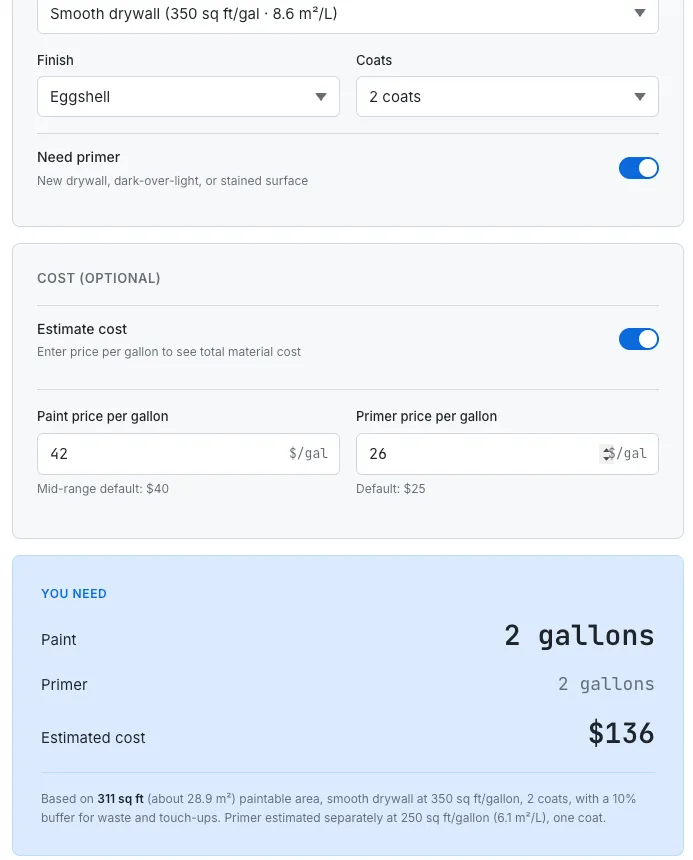
The calculator's coat count drives both gallons needed and project duration — at 4-hour latex recoat times, two coats fit in a day; at 24-hour oil-based recoat times, two coats stretch across three.
The honest summary on between-coats timing is that the paint can label wins. Manufacturer recoat numbers exist because the chemistry actually requires them, the numbers are minimums calibrated to ideal conditions, and patience is cheaper than repainting peeling work six months later.
This guide synthesizes manufacturer documentation (Glidden, Sherwin-Williams, Benjamin Moore, KILZ) and major industry sources. Specific paint products vary in recoat and cure times by formulation; always read the paint can label as the definitive spec for the product you're using, especially for high-performance, low-VOC, or specialty formulations. For commercial coatings, food-contact surfaces, or industrial substrates, consult a licensed contractor. Recoating outside the manufacturer's window may void product warranty coverage.
- Glidden — How Long Does Paint Take to Dry and Cure? Manufacturer reference for the latex 1-hour touch / 4-hour recoat numbers, oil-based 6-8 hour touch / 24-hour recoat numbers, premature recoat consequences, humidity warning, and ventilation guidance.
- Bob Vila — How Long Does It Take Paint to Dry? Industry-painter reference for the humidity-evaporation mechanism, the ventilation cure framing, the blister/crack/peel failure warning, and the latex 2-to-4-week / oil-based 7-day full cure windows.
- Benjamin Moore — Regal Select Eggshell — Product specifications. Official manufacturer specs for dry time, recoat time, and application temperature range.
- Sherwin-Williams — Interior Product Application FAQs. Manufacturer reference for latex vs alkyd touch-dry timing, the 3-4 hour exterior drying window, and the over-100°F flash-dry adhesion warning.
- KILZ — KILZ Original Oil-Based Primer. Manufacturer source for the 30-minute touch / 1-hour recoat spec at 77°F and 50% RH — the canonical fast-recoat oil-based primer reference.
- SudoTool — Primer 101: When You Actually Need It (and When You Don't). Sister guide on primer types and when each is required.
- SudoTool — How Many Coats of Paint Do You Really Need? Sister guide on the topcoat count decision — the main driver of total project duration once recoat times are factored in.
- SudoTool — How Much Paint for Kitchen Cabinets: The 10x10 Math. Sister guide with the cabinet enamel cure-window guidance (7-30 days) for cabinet repaints.
- SudoTool — Paint Coverage per Gallon: The Real Number. Sister guide on the gallons-per-coat math that complements the time-per-coat math.