Primer 101: When You Actually Need It (and When You Don't)
Skip primer to save a step and a contractor will spot it within thirty days — a dark color showing through the topcoat, latex peeling off oil-based paint, or a ceiling water stain bleeding back through fresh paint. Prime every wall, though, and you waste time and money on rooms that didn't need it. This Primer 101 guide separates the two cases: when primer is genuinely required, when it's safe to skip, and how to pick the right primer type for the surface in front of you.
Most paint failures on a repaint job trace back to primer — either skipped when it shouldn't have been, or applied with the wrong type for the substrate. The good news is that primer logic is straightforward once you separate the four jobs primer does, the eight situations where it's mandatory, and the small number of cases where modern self-priming paint genuinely covers the gap. The bad news is that the marketing label "paint and primer in one" promises a lot more than the chemistry actually delivers on raw substrates and glossy surfaces.
This guide walks through (1) the four mechanisms primer actually performs, (2) the eight situations where skipping primer causes paint failure, (3) the narrower set of cases where modern self-priming paint is enough, (4) the five primer types and how to pick between them, (5) a surface-by-surface cheat sheet, (6) when "paint and primer in one" genuinely works, and (7) the five most common primer mistakes. The SudoTool paint coverage calculator handles the gallons math once you've decided what primer (if any) the project needs.
What Primer Actually Does (and Why "Just Paint" Isn't Always Enough)
Primer isn't a cheaper first coat of paint — it's a chemically different product engineered for four specific jobs. Understanding which job applies to your project is the difference between buying a single can of the right primer and either skipping a step that matters or wasting money on a step that doesn't.
Adhesion. Sherwin-Williams defines primer as "specially formulated to make sure the top coat of paint adheres to the surface below", with the underlying mechanism being "aggressive filling and binding with underlying surfaces." On porous substrates this matters because raw paint absorbs unevenly; on glossy or non-porous substrates it matters because regular paint has nothing to grip. Benjamin Moore frames the second case directly: "Bonding primers increase adhesion over an existing glossy finish or a non-porous substrate like paneling."
Sealing. Porous surfaces — new drywall, bare wood, masonry, fresh skim coat — absorb paint at different rates across the surface, producing the splotchy "patchy" look that won't fully even out across two topcoats. Stained surfaces have a separate sealing problem: the stain itself can bleed back through new paint. Benjamin Moore on stain blocking: "Stain-blocking primers suppress stains from smoke, tannins or water. Without a primer, those stains can come through even after painting."
Uniformity. New drywall is the most common case. The sheetrock surface and the mudded joints (the taped seams between sheets) absorb paint at very different rates — without primer the joints show through as a sheen difference even after two topcoats. Benjamin Moore is unambiguous: "Primer fills and evens out porous surfaces like new drywall. New drywall should always be primed, because it's very porous and therefore can absorb moisture, odors, oils or other stains."
Hiding and sheen. Dark-to-light color changes ordinarily take three or four topcoats to fully cover. A tinted primer — pigmented in a shade close to the new topcoat — knocks one of those coats off the schedule. Benjamin Moore: "Primer (tinted or white) obscures or hides a dark existing color when painting over with a light color or vice versa." For the full math of how tinted primer cuts the topcoat count, see our painting over dark walls guide.
Eight Times You Should Never Skip Primer
Bob Vila's 8 Times You Should Never Skip Paint Primer compiles the situations where primer is mandatory. Each maps to one of the four mechanisms above, and any one match is enough to require primer for the project.
1. Latex paint over oil-based paint. Latex won't grip an oil-based surface chemically. Bob Vila's rule: "Latex paint, which is water-based, won't adhere well to a wall that's already been covered in oil-based paint, unless you prime first." Bonding primer creates the intermediate layer that both paints can hold onto. To test whether existing paint is oil or latex, rub a small spot with a cotton ball soaked in denatured alcohol — latex transfers onto the cotton, oil-based doesn't.
2. New drywall. The sheetrock surface and the mudded joints absorb paint at very different rates. Without primer, those joints show through as visible sheen differences. New drywall takes a single coat of PVA drywall primer or a standard latex primer — the goal is just to equalize the absorption rate before the topcoats land.
3. Bare wood. Wood grain absorbs paint unevenly, and some species push the problem further. Cedar, redwood, and oak contain natural tannins that bleed through latex paint as brown or yellow stains in the days after painting. KILZ recommends its oil-based Original primer for "bare wood especially redwood varieties that bleed tannin". For non-tannin woods, a standard latex primer works.
4. Dark-to-light color transitions. A tinted primer pigmented close to the new topcoat reduces topcoat count from three or four down to two. The mechanism is hiding power: a primer formulated with high-opacity pigment buries the existing dark color so the topcoats don't have to. Sherwin-Williams sells a four-shade gray-scale "Color Prime" system that pre-matches primer to topcoat for this exact case.
5. Wallpaper, or removed-wallpaper walls. Bob Vila on painting over wallpaper: "You can paint over wallpaper. But you shouldn't attempt it without priming first." Wallpaper inks and patterns bleed through paint; on removed-wallpaper walls, residual adhesive and drywall damage need an oil or alkyd primer to seal cleanly.
6. Glossy or non-porous surfaces. Laminate, Formica, tile, PVC, glass, and glossy painted surfaces all share the same problem — regular paint slides off. Only bonding primers grip these substrates. KILZ Adhesion describes itself as "specifically formulated to bond to a variety of 'tough-to-paint' surfaces", with the technical claim that it "provides a sound anchor for topcoats while reducing or potentially eliminating the need for sanding dense, glossy surfaces." For kitchen cabinet projects specifically, the substrate-by-substrate primer table is in our kitchen cabinet paint guide.
7. Masonry, brick, concrete, and fresh skim coat. Masonry is two to three times more absorbent than drywall, and its high pH chemically breaks down standard latex binders. Alkali-resistant masonry primer handles both problems in one coat.
8. Stained surfaces — water marks, smoke, nicotine, knots, grease. Stain-blocking primer (oil-based or shellac-based) is mandatory; standard latex primer fails on anything beyond the lightest marks. KILZ's own product comparison is direct: "Oil-based primers are better at blocking or sealing stains, especially water-soluble stains." Shellac primers (Zinsser BIN class) handle the worst cases — fire smoke, pet odors, persistent nicotine — that even oil-based primers struggle with.
When It's Actually Safe to Skip Primer
The good news: an ordinary repaint on an ordinary wall doesn't need primer. Benjamin Moore concedes the point directly: "Most previously painted, undamaged and untainted walls do not require priming, especially when using a high-quality interior paint."
Consumer Reports' paint testing reaches a similar conclusion through head-to-head product comparisons: "Self-priming paints have improved over the years to the point where you no longer need to prime." The important caveat in the same Consumer Reports guidance is the boundary condition — the recommendation applies when walls are smooth, already painted, and the new color is similar to or darker than the existing one. Outside that window, the eight situations above still apply.
So the safe-to-skip conditions, taken together:
- The wall has been painted before
- The existing paint is intact (no peeling, no chipping, no chalking)
- The wall is clean and free of stains, smoke, or grease
- The new color is similar to the existing color, or darker
- You're using a quality self-priming paint, not a contractor-grade flat
If all five hold, a two-coat repaint without separate primer produces an excellent result. If any single one fails — especially the bare-substrate, glossy-surface, or stain conditions — the primer step goes back on the schedule.
The Five Primer Types and How to Pick
Primer choice maps to substrate and problem, not to brand preference. The five categories below cover essentially every residential painting project.
| Type | Base | Best for | Weakness | Representative products |
|---|---|---|---|---|
| Water-based latex | Water | Standard walls, drywall, light stains, color change | Doesn't block heavy stains or seal tannin-rich wood | KILZ 2 All-Purpose, Zinsser Bulls Eye 1-2-3 |
| Oil-based | Mineral spirits | Bare wood, tannin-bleed species, heavy water and smoke stains, latex-over-oil transition | Strong odor; needs ventilation; slow cleanup with mineral spirits | KILZ Original, Zinsser Cover Stain |
| Shellac-based | Alcohol | Toughest odors (fire, pet, nicotine), heavy knots, persistent stains; fast dry | Strong alcohol odor; alcohol-based cleanup; highest cost per gallon | Zinsser B-I-N |
| Bonding (adhesion) | Modified acrylic | Laminate, Formica, tile, PVC, glass, glossy painted surfaces; minimal sanding needed | Overkill on ordinary surfaces | KILZ Adhesion, INSL-X Stix, Zinsser Bulls Eye 1-2-3 (also adhesion-rated) |
| Tinted primer | (Any base, pigmented) | Dark-to-light or light-to-dark transitions; reduces topcoat count | Requires color matching to topcoat | Sherwin-Williams Color Prime System (gray-scale) |
KILZ's three-step selection framework reduces to the same logic: identify the surface type first, then the problem (stains, odors, gloss), then any special constraints. The brand also distinguishes oil-based versus water-based by use case directly — KILZ Original is its recommendation for "priming over a previous oil-based paint and/or priming on fresh wood", while the water-based Restoration line is preferred when "priming indoors where ventilation may be poor" or where local VOC regulations limit oil-based product availability.
Surface-by-Surface Primer Cheat Sheet
The same five categories, mapped to the substrates a typical homeowner encounters:
| Surface | Primer needed? | Recommended type | Key note |
|---|---|---|---|
| New drywall | Yes | PVA drywall or standard latex | Equalizes joint vs sheetrock absorption |
| Bare wood (general) | Yes | Oil-based or latex | Evens out grain absorption |
| Bare wood (cedar, redwood, oak) | Yes — oil or shellac | Oil-based or shellac | Blocks tannin bleed-through |
| MDF | Yes — solvent only | Oil-based (KILZ Original, Zinsser Cover Stain) | Bob Vila: "Prime the MDF with a solvent-based primer, such as Zinsser or KILZ. Avoid water-based primer, as it may cause the wood fibers to swell." |
| Laminate, Formica, tile, PVC | Yes | Bonding primer (KILZ Adhesion) | Sanding usually unnecessary with bonding primer |
| Metal (interior, dry) | Sometimes | Standard or rust-inhibiting | Required if exposed to moisture, per Sherwin-Williams: "highly recommended if the metal will be exposed to moisture" |
| Masonry, concrete, brick | Yes | Alkali-resistant masonry primer | High pH breaks down standard latex binder |
| Glossy or semi-gloss painted surface | Yes — bonding or deglosser | Bonding primer, or deglosser + standard primer | Skipping causes topcoat peeling |
| Matte/eggshell painted, clean, similar color | Usually no | (Skip) | Self-priming paint sufficient |
| Walls with wallpaper or removed-wallpaper | Yes | Alkyd or oil-based | Seals residual adhesive and drywall damage |
| Stained surfaces (water, smoke, grease) | Yes | Oil-based or shellac | Heavier the stain, the stronger the primer base |
For kitchen cabinets specifically — where laminate, oak, and MDF all show up regularly in the same project — the substrate-by-substrate primer table sits in our kitchen cabinet paint guide.
"Paint and Primer in One": When It Actually Works
The marketing label suggests a single product that does both jobs. The reality is that paint-and-primer-in-one is not a chemical hybrid — it's a paint with higher solids content and stronger hiding power, marketed as a primer replacement. That distinction matters because the situations where it works are narrower than the marketing suggests.
It works when:
- The surface is already painted and intact
- The new color is similar to the existing color, or darker
- The wall is smooth, clean, and free of stains
- The product is a quality self-priming paint (premium tier from a major brand)
It fails when:
- The substrate is bare — drywall, wood, masonry — because high-hide paint still absorbs unevenly into a porous surface
- The surface is glossy or non-porous, because hiding power doesn't fix an adhesion problem
- The existing paint is oil-based and the new paint is latex, because the chemistry mismatch is the bond failure
- The transition is dark-to-light, because hide power alone usually still needs three or four topcoats without a tinted primer base
- Stains, knots, tannin, or odors are in play — paint binder can't seal bleed-through that requires the heavier resins in oil or shellac primer
Consumer Reports' guidance reads the same way once the caveat is preserved: self-priming paints have eliminated the primer step for ordinary repaint work, but the eight-situation list at the top of this guide still applies. When a paint store recommends a self-priming product, the right question is "which of those eight situations does my wall fall into?" — not "is this paint good enough to skip primer in general?"
Five Common Primer Mistakes
1. Skipping primer on bare wood. Self-priming paint over raw wood produces uneven absorption and, on cedar / redwood / oak, tannin bleed-through that surfaces days or weeks later. Any oil-based or latex primer (depending on species) takes one extra hour and prevents the failure entirely.
2. Water-based primer on MDF. The water content swells the fiber and produces a raised-grain texture that no amount of sanding fixes neatly. Bob Vila's rule is direct: "Avoid water-based primer, as it may cause the wood fibers to swell." MDF gets oil-based primer (KILZ Original, Zinsser Cover Stain) or a shellac primer, never water-based.
3. Standard primer on glossy paint. Standard primers grip porous surfaces; glossy paint isn't porous. The result is a topcoat that releases in sheets within months. Bonding primer (KILZ Adhesion, Zinsser Bulls Eye 1-2-3) is the only correct answer, or alternatively a deglosser plus sanding plus standard primer for a more labor-intensive equivalent.
4. Latex primer on heavy stains. Light marks (felt marker, light water spotting) usually clear with a water-based primer like KILZ 2. Heavy stains — multi-year smoke, nicotine, fire damage, persistent water rings — require oil-based or shellac primer. KILZ states the comparison directly in its own product literature: "Oil-based primers are better at blocking or sealing stains, especially water-soluble stains."
5. Skipping primer to save time. A primer coat takes 30 minutes to an hour to recoat depending on the primer (KILZ Original lists 30 minutes touch dry and 1 hour to recoat at 77°F and 50% relative humidity). Skipping that coat to save an hour typically adds one or two extra topcoats to compensate for poor coverage or color hide — net cost is several hours of finish-coat work plus the gallons consumed. The math behind topcoat count is in our coats of paint guide.
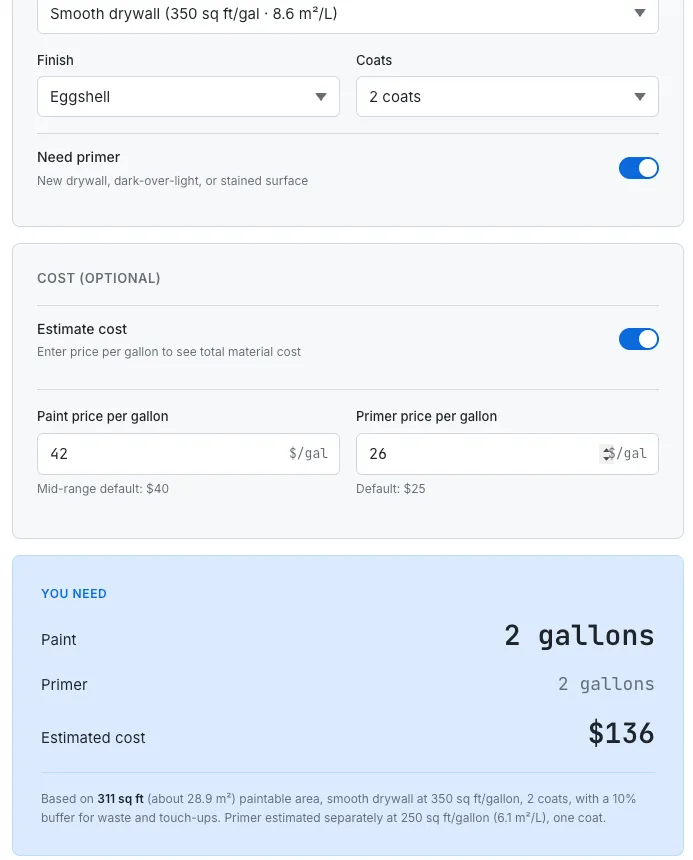
The calculator's primer toggle is a separate input — primer coverage rate and finish-coat coverage rate are calculated independently, with the standard 10% industry buffer applied to each.
The honest summary on primer is that it's neither a universal requirement nor an optional luxury — it's a step that's mandatory in roughly eight specific situations, optional in the cases that surround them, and unnecessary on the ordinary repaint that covers most weekend projects. Knowing which of those three applies to your room is the entire skill. Once that's settled, the gallons math is straightforward.
Frequently Asked Questions
When do I actually need primer before painting?
Prime when any one of five conditions is true: the surface is bare or porous (new drywall, raw wood, masonry), it is glossy or non-porous (laminate, tile, Formica, PVC), the existing paint is oil-based and you are going over with latex, you are transitioning dark to light and want fewer topcoats, or stains, knots, or odors need to be blocked.
Can I skip primer when repainting a wall?
Often yes. Benjamin Moore states most previously painted, undamaged and untainted walls do not require priming, especially with a high-quality interior paint. It is safe to skip when the wall is already painted, the paint is intact, the surface is clean and unstained, the new color is similar or darker, and you use a quality self-priming paint.
Do I need primer on new drywall?
Yes. The sheetrock surface and the mudded joints absorb paint at very different rates, so without primer the joints show through as sheen differences even after two topcoats. New drywall takes a single coat of PVA drywall primer or a standard latex primer to equalize the absorption rate before the topcoats land.
What primer do I use on glossy or laminate surfaces?
A bonding primer is the only type that grips non-porous surfaces like laminate, Formica, tile, PVC, glass, and glossy paint. KILZ Adhesion describes itself as specifically formulated to bond to tough-to-paint surfaces and reduces or potentially eliminates the need for sanding dense, glossy surfaces. Standard primers grip porous surfaces, so they peel off gloss.
Why can't I use water-based primer on MDF?
The water content swells the fiber and produces a raised-grain texture that sanding does not fix neatly. Bob Vila's rule is to prime MDF with a solvent-based primer such as Zinsser or KILZ and avoid water-based primer, as it may cause the wood fibers to swell. MDF takes oil-based or shellac primer, never water-based.
Does paint and primer in one really work?
It works in a narrow window. Paint-and-primer-in-one is a high-solids paint with stronger hiding power, not a chemical hybrid. It works on an already-painted, intact, clean wall when the new color is similar or darker. It fails on bare, glossy, or oil-based surfaces, on dark-to-light transitions, and where stains, knots, or odors need sealing.
This is a general home-improvement guide based on manufacturer documentation (Sherwin-Williams, Benjamin Moore, KILZ) and major industry sources. Specific primer products vary in coverage and stain-blocking strength; always read the product label and technical data sheet for the primer you're using. For homes built before 1978, painted surfaces may contain lead — test before sanding or stripping and consult a licensed contractor for safe removal. Commercial coatings, industrial substrates, and specialized situations (lead, asbestos, structural damage, mold) fall outside the scope of this homeowner guide.
- Sherwin-Williams — Why Use Primer? Manufacturer reference for the adhesion mechanism, bare-wood priming rationale, metal-with-moisture rule, and bold-color tinted-primer logic.
- Benjamin Moore — FAQ: Primer. Manufacturer reference for the five-reason primer framework (adhesion, hide, seal, sheen, uniformity), the new-drywall mandatory primer rule, the stain-blocking primer description, and the "previously painted walls do not require priming" boundary statement.
- Bob Vila — 8 Times You Should Never Skip Paint Primer. Verbatim source for the eight-situation list, the latex-over-oil adhesion failure, and the wallpaper-painting requirement.
- Bob Vila — How to Paint MDF. Verbatim source for the MDF solvent-based-primer-only rule and the water-based fiber-swell warning.
- KILZ — KILZ Adhesion Primer. Manufacturer source for the bonding-primer surface list (Kynar, PVC, vinyl, Formica, glass, tile, glazed brick, fiberglass, metals, chalky paints, glossy finishes) and the "tough-to-paint surfaces" framing.
- KILZ — Restoration vs. Original: What's the Difference? Manufacturer source for the oil-vs-water-based primer trade-off, redwood tannin priming guidance, and the indoor-ventilation case for switching to water-based.
- Consumer Reports — Okay to Skip Primer When You Paint. Independent paint-testing source on self-priming paint performance for ordinary repaint work — with caveats for smooth, previously-painted walls and similar-or-darker color changes.
- SudoTool — How to Paint Over Dark Walls Without a 5-Coat Marathon. Sister guide covering tinted primer math for dark-to-light transitions.
- SudoTool — How Much Paint for Kitchen Cabinets: The 10x10 Math. Sister guide with substrate-by-substrate primer table for wood, MDF, and laminate cabinets.
- SudoTool — How Many Coats of Paint Do You Really Need? Sister guide on the topcoat-count math; primer reduces but doesn't eliminate the topcoat sequence.