How Much Paint for an Accent Wall? Quart vs Gallon
Walk into a paint store with "I'm doing an accent wall" and you'll get pointed at a gallon by default. The math says otherwise — a typical 8 by 10 foot accent wall is 80 square feet, two coats take roughly 160, and that's well under what a gallon delivers but a touch above what a single quart covers. The result is that a lot of accent wall projects end with three-quarters of a gallon drying out in the garage. This guide walks through the quart-vs-gallon threshold, the actual math for a standard accent wall, when a separate primer step is mandatory (it usually is for bold or dark colors), and how to pick the right paint quantity instead of defaulting to whatever's on the shelf.
The honest answer to "how much paint for an accent wall" depends on three things: the wall area, whether you need a tinted primer for the color change, and the practical can sizes the paint store actually sells. Most paint stores stock quarts and gallons but not anything in between, which forces the decision into a binary that doesn't always match the underlying math. The math is straightforward once Sherwin-Williams's published coverage rates are plugged in — the only complication is that most accent walls are dramatic colors, which usually need a primer too.
This guide covers (1) the quart vs gallon threshold for accent walls, (2) how to measure a single wall, (3) the worked example for a standard 8 by 10 ft accent wall, (4) when bold or dark colors push you into needing primer as well, (5) the five decision factors that move the quart/gallon line, and (6) three common accent wall paint mistakes. The SudoTool paint coverage calculator handles the same math automatically once you've entered the wall dimensions.
The Quart vs Gallon Threshold for Accent Walls
Three coverage rates from Sherwin-Williams's paint calculator FAQ set the baseline for every accent wall calculation:
- Paint: "A gallon of paint typically covers about 350-400 square feet"
- Quart: "A quart of paint covers 100 square feet"
- Primer: "A gallon of primer covers about 200-300 square feet"
Those are one-coat numbers. Paint projects are typically two coats — Benjamin Moore's calculator notes that "These calculations assume 2 coats of paint and do not include the ceiling." So the practical coverage per quart for a finished, two-coat accent wall is half of 100, or 50 square feet.
The breakpoints, with two-coat math built in:
| Wall size | Area (sq ft) | Two-coat area | Recommended purchase |
|---|---|---|---|
| 7×8 ft (small) | 56 | 112 sq ft | 1 quart (light coverage acceptable) or 2 quarts safer |
| 8×8 ft | 64 | 128 sq ft | 1-2 quarts |
| 8×10 ft (standard) | 80 | 160 sq ft | 2 quarts or 1 gallon |
| 9×10 ft | 90 | 180 sq ft | 2 quarts or 1 gallon |
| 10×10 ft | 100 | 200 sq ft | 1 gallon |
| 10×12 ft (large) | 120 | 240 sq ft | 1 gallon |
| Vault / double-height (12×16 ft) | 192 | 384 sq ft | 1 gallon + 1 quart |
The rule of thumb: two-coat area under 100 sq ft → 1 quart suffices; 100-200 sq ft → 2 quarts or 1 gallon; above 200 sq ft → 1 gallon. The standard 8×10 ft accent wall lands right at the threshold where the paint store's default gallon recommendation starts to make sense as a margin call rather than a math one.
Sherwin-Williams's own calculation method is the simple formula: "measure the length and width of your project and multiply those numbers together to get your square footage." The complication is what to subtract for doors and windows, which the next section covers.
How to Measure an Accent Wall
For a single wall with no openings, the area is just length times height. Most accent walls are plain — homeowners pick the bare wall opposite a window or behind a headboard precisely because the surface is uninterrupted. But some accent walls do include a door or window:
- Standard interior door: about 21 sq ft (3 ft × 7 ft) — the Sherwin-Williams calculator's default subtraction.
- Standard window: about 15 sq ft (3 ft × 5 ft) — also the calculator default.
- Outlets and switches: too small to bother subtracting.
- Trim and baseboards: only subtract if you're painting them a different color; otherwise count them in.
Worked example with subtractions: a 12 ft × 9 ft wall is 108 sq ft. Subtract one door (108 − 21 = 87 sq ft) and one window (87 − 15 = 72 sq ft). The painted accent wall is 72 sq ft, which at two coats is 144 sq ft — well within 2 quarts of paint, comfortably inside 1 gallon.
Benjamin Moore's own calculator includes the rough-estimate caveat directly: "These calculations are not intended to give more than a rough estimate. Precise paint needs will vary according to many factors, including application method." A roller transfers nearly all the paint to the wall; an HVLP sprayer can lose 30-50% to overspray. For more on where the 350-400 sq ft per gallon number actually comes from and how application method changes the practical figure, see paint coverage per gallon.
The Worked Example — Standard 8x10 ft Accent Wall
The 8 ft tall × 10 ft wide accent wall is the modal case — a typical bedroom feature wall behind the headboard, or a living room TV wall, or a dining accent. Walk through the math end-to-end:
- Wall area = 10 ft × 8 ft = 80 sq ft
- Subtractions = usually none (accent walls are typically plain)
- Two coats = 80 sq ft × 2 = 160 sq ft of total paint application
- Industry buffer (10%) = 160 × 1.10 = 176 sq ft
Can a single quart do it? Sherwin-Williams's quart rating is 100 sq ft. 176 sq ft of two-coat application is 1.76 quarts — just under two quarts. A single quart of paint, stretched thin, can sometimes cover an 8x10 wall in two coats if the underlying wall is the same color or lighter and the topcoat has good hide power. More often, the second coat starves of paint and the finish goes patchy on the second pass.
Practical decision:
- Option A: Buy 2 quarts (if available in the desired color and finish).
- Option B: Buy 1 gallon (margin of safety, plus leftover for touch-ups).
- Option C: Buy 1 quart and a second quart at the start of the second coat (works if the paint store stocks the color in quarts).
Most paint stores stock standard colors in both quart and gallon sizes, but specialty or custom-tinted colors are often gallon-only. For a custom dark or bold accent color, Option B (1 gallon) is usually the only available choice.
If primer is also needed (most accent walls — see the next section): add about 2 quarts of tinted primer or 1 quart of primer if the existing wall is a similar tone. Total project paint: roughly half a gallon of finish + half a gallon of primer for an 8x10 accent wall with a noticeable color change.
Bold or Dark Colors — When You Also Need Primer
Most accent walls are dramatic colors — navy, charcoal, dark green, wine, black, emerald, deep burgundy. Bob Vila frames the use case directly: "An accent wall provides a visual focal point in any room and is a great way to add color and personality to a home." On black specifically: "Black paint on an accent wall gives off an illusion of depth because it contrasts so sharply with lighter elements in the room."
Sherwin-Williams's accent wall guidance treats the color jump from base wall as the central design choice — "Choose a color a few shades darker than the other walls in the room" — and even with a moderate shift, a tinted primer often makes the difference between a clean two-coat finish and a patchy three-or-four-coat marathon. The full tinted-primer math is in our painting over dark walls guide.
The added paint quantity when primer is in scope:
- Tinted primer: 80 sq ft ÷ 200 sq ft/gal = 0.4 gallons, or about 1.6 quarts. Practical purchase: 2 quarts (or half a gallon).
- Finish (two coats over the primer): 160 sq ft ÷ 350 sq ft/gal = 0.46 gallons, or about 1.8 quarts. Practical purchase: 2 quarts (or half a gallon).
- Combined: roughly 2 quarts of primer + 2 quarts of finish for a typical 8x10 accent wall with a significant color change.
For substrate-specific primer choices (water-based, oil-based, shellac, bonding), see our primer 101 guide. For pigment-heavy colors that may still need a third finish coat even with tinted primer — saturated reds, hunter green, sapphire blue — the topcoat-count math is in how many coats of paint do you really need.
The shortcut for dark accent walls: budget for 1 quart of tinted primer + 1 gallon of finish paint. The gallon gives a safety margin against the heavier coverage demands of dark colors, and the leftover is useful for touch-ups during the cure window.
Five Decision Factors for Quart vs Gallon
Beyond pure wall area, five variables shift the quart-vs-gallon line:
1. Wall area after subtraction. Two-coat area under 100 sq ft favors a quart; over 200 sq ft requires a gallon. The threshold around 100-200 sq ft is where the trade-off matters most.
2. Color jump. Light-to-light or same-tone repaints in two coats stay in the quart range. Light-to-dark transitions need tinted primer (adding 1-2 quarts to the project). Bold saturated colors (reds, hunter green) may need a third topcoat, pushing total paint up by another 50%.
3. Finish / sheen. Flat and matte finishes have higher hide power thanks to light scatter, which sometimes lets a thinner two-coat application work. Eggshell, satin, and semi-gloss show every imperfection, which means prep matters more than paint quantity — but the gallons-needed math is the same. Sheen does not change topcoat count; see eggshell vs satin vs semi-gloss.
4. Surface texture. Smooth drywall hits the 350-400 sq ft per gallon range. Orange peel knocks coverage down to about 300 sq ft per gallon. Knockdown and heavier textures drop further, to 225-275 sq ft per gallon. For a typical drywall accent wall, this doesn't usually change the quart-vs-gallon decision; for textured plaster accents, expect to add a quart of margin.
5. Application method. Brush-and-roller transfers nearly all of the paint to the wall. HVLP and airless sprayers lose 30-50% to overspray, which on an indoor accent wall is impractical anyway because of the masking required. Accent walls are almost always brush-and-roller projects, so this factor rarely matters.
The fastest mental shortcut: a plain 8x10 accent wall with a moderate color change = 1 gallon of paint (or 2 quarts) + 1 quart of primer if the color jump is significant. Adjust up for larger walls or pigment-heavy colors, down for very small or same-tone projects.
Three Common Accent Wall Paint Mistakes
1. Buying a full gallon for a small accent wall. The default paint store recommendation is a gallon because gallons are higher-margin and faster-turning inventory. For a small bathroom accent (5x7 ft = 35 sq ft × 2 coats = 70 sq ft), a single quart is genuinely sufficient and three-quarters of a gallon will sit unused. Quarts work — most major brands carry their full color line in quart sizes for sample-and-accent projects. The exception is custom-tinted colors, which are often gallon-only.
2. Skipping primer on a dark accent. The most common dark-accent failure is going straight to two coats of finish over a light base wall. The result is base color bleed-through, a third or fourth topcoat, and a messy finish along edges. A single quart of tinted primer (gray or color-matched) under two coats of finish is consistently cheaper in total paint used than three to four uncoordinated topcoats, plus the result is cleaner.
3. Mismatching sheen between accent and adjacent walls. A high-gloss accent next to eggshell or satin walls creates a visible reflection difference where the walls meet, especially in natural side-light. Sherwin-Williams's accent wall guidance specifically calls out the color-but-not-sheen pattern: choose a color a few shades darker than the other walls in the room, while typically keeping the sheen consistent with adjacent walls. The exception is intentional contrast — a deliberately high-gloss black or jewel-tone accent designed as a reflective focal point — but the contrast should be a design choice, not an accident.
Sherwin-Williams's accent wall how-to also flags two prep points worth following: taping carefully along trim, baseboards, ceilings, and where the accent wall meets the other walls, and sealing the tape edges with a putty knife or credit card to prevent paint bleed under the tape line. The wall-meeting-other-walls tape line is what separates a clean accent edge from a messy one.
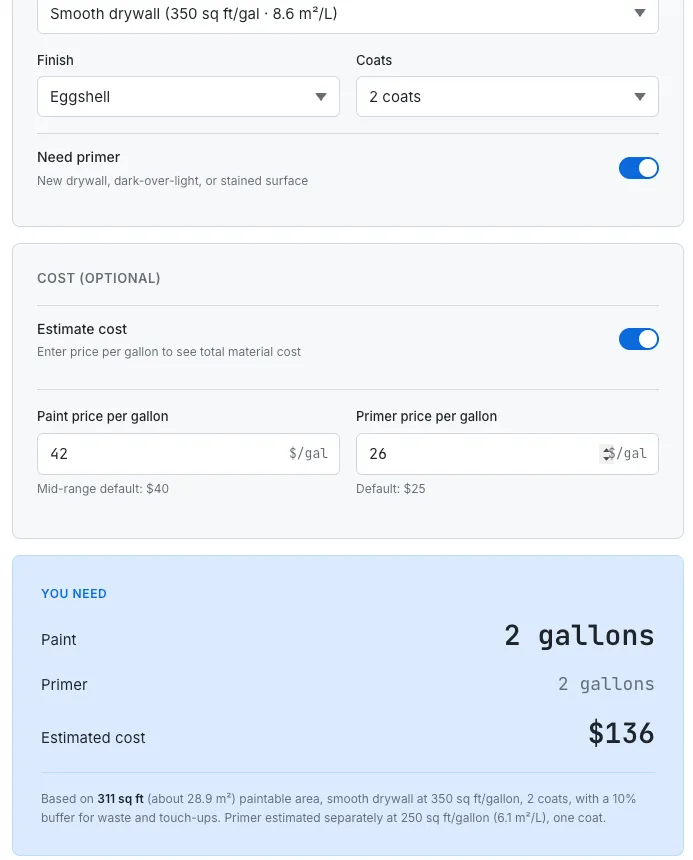
For accent walls, the calculator handles the same single-wall math: dimensions in, gallon or quart estimates out, with primer separated when a tinted primer is needed for a dark color change.
The honest summary on accent walls is that the gallon default is usually too much and the bare quart is usually too little — most projects fit either two quarts or one gallon, with another half-gallon of tinted primer when the color shift is dramatic. The math is simple once the wall is measured; the rest is whether the paint store stocks the color in the right size.
Frequently Asked Questions
How much paint do I need for an accent wall?
Most accent walls under 8x10 ft fit within 1 quart for two coats if the color change is modest. A standard 8x10 ft wall is 80 sq ft, which is 160 sq ft for two coats — just over what a quart delivers — so the practical purchase is 2 quarts or 1 gallon. Add about 2 quarts of tinted primer if the new color is much darker than the existing wall.
Is a quart of paint enough for an accent wall?
A quart covers 100 sq ft per Sherwin-Williams, which is one coat. Walls under 50 sq ft, like a small bathroom or half-wall, genuinely need only 1 quart for two coats. A standard 8x10 ft wall needs about 160 sq ft of two-coat coverage, so a single quart usually falls short and the second coat goes patchy.
Do I need primer for a dark accent wall?
Usually yes. Going from a light base wall to a dark accent finish needs a tinted primer to keep the topcoat count at two instead of a patchy three-or-four-coat marathon. For an 80 sq ft wall, budget about 2 quarts of tinted primer plus 2 quarts of finish, or 1 quart of primer plus 1 gallon of finish for a safety margin.
How do I measure an accent wall for paint?
For a plain wall, multiply length by height. Subtract about 21 sq ft for a standard door and about 15 sq ft for a standard window — the Sherwin-Williams calculator defaults. Skip outlets and switches, and only subtract trim and baseboards if you are painting them a different color. A 12x9 ft wall with one door and one window comes to 72 sq ft.
Should I buy a quart or a gallon for an accent wall?
Use the two-coat area: under 100 sq ft favors 1 quart, 100-200 sq ft means 2 quarts or 1 gallon, and above 200 sq ft needs a gallon. The standard 8x10 ft wall lands at the threshold where the gallon is a margin call. Custom-tinted colors are often gallon-only, which can make the gallon the only choice.
Should the accent wall match the sheen of the other walls?
Usually yes. Sherwin-Williams's guidance is to choose a color a few shades darker than the other walls while keeping the sheen consistent. A high-gloss accent next to eggshell or satin walls creates a visible reflection difference in side-light. Intentional high-gloss contrast can work, but it should be a deliberate design choice, not an accident.
This guide reflects manufacturer paint calculator documentation (Sherwin-Williams, Benjamin Moore) and major home-improvement reference sources. Actual paint quantities vary by wall texture, application method, color depth, and surface preparation. Coverage rates from manufacturer calculators are best-case estimates calibrated to smooth drywall and ideal application — practical coverage on textured surfaces or with sprayer application can be 20-50% lower. When in doubt, buy slightly more paint than the calculator estimates; leftover paint stores for 1+ year for touch-ups, while running out mid-coat usually means redoing the wall.
- Sherwin-Williams — Paint Calculator FAQ. Manufacturer reference for the coverage rates: 350-400 sq ft per gallon of paint, 200-300 sq ft per gallon of primer, 100 sq ft per quart of paint, and the basic length-times-width measurement method.
- Sherwin-Williams — Learn to Paint Accent Walls. Brand reference for accent wall placement (opposite the main entrance), color choice guidance (a few shades darker than the other walls), and prep/taping technique.
- Benjamin Moore — Paint Calculator. Manufacturer reference for the two-coat assumption baked into calculator output and the rough-estimate caveat for application method variance.
- Bob Vila — The 16 Best Accent Wall Colors. Reference for the accent wall use case (visual focal point), sizing flexibility (small sections can be accent walls), and dark color guidance (black-on-accent depth contrast).
- SudoTool — How to Paint Over Dark Walls Without a 5-Coat Marathon. Sister guide on tinted primer for dark color transitions.
- SudoTool — Primer 101: When You Actually Need It (and When You Don't). Sister guide on primer types and substrate-by-substrate recommendations.
- SudoTool — How Many Coats of Paint Do You Really Need? Sister guide on the topcoat count math for pigment-heavy colors.
- SudoTool — Paint Coverage per Gallon: The Real Number. Sister guide explaining where the 350-400 sq ft per gallon figure comes from and how application method changes practical coverage.
- SudoTool — Eggshell vs Satin vs Semi-Gloss: How to Choose. Sister guide on the sheen trade-off for accent walls vs adjacent walls.