Is It Cheaper to Install Vinyl Plank Flooring Yourself?
The material costs the same whether you lay it or a pro does — so the real decision is whether to pay for labor or spend a weekend. Here is the honest math.
If you've priced out a new floor, you've seen the gap: buy the vinyl plank yourself and it's one number; have a pro install it and it's nearly double. Almost all of that difference is labor — which is exactly why so many people ask whether it's cheaper to install vinyl plank flooring yourself. For click-lock luxury vinyl, the answer is usually yes, and often by a lot. But "cheaper" comes with one real condition, and it's worth understanding before you rent a tapping block.
What you save by installing vinyl plank flooring yourself
Here's the key idea that cuts through every cost guide: the flooring itself costs the same whether you install it or hire someone. A pro doesn't get you cheaper planks. So when you do it yourself, what you're really saving is the labor line — and on a floor, labor is a big line.
Professional labor for vinyl plank runs about $1.50 to $3 per square foot for a straightforward click-lock install, climbing to the $3 to $10 per square foot range once you add subfloor prep, tricky layouts, or a higher-cost area (Today's Homeowner; This Old House). Put that against a typical mid-range luxury-vinyl job and the two paths look like this:
| 1,000 sq ft, click-lock LVP | DIY | Professional |
|---|---|---|
| Materials (LVP + underlayment, ~10% waste) | $3,500–5,000 | $3,500–5,000 |
| Labor | $0 (your time) | $2,000–4,000 |
| Tools | $50–150 | included |
| Total | ~$3,500–5,000 | ~$5,500–9,000 |
Because the materials cancel out, the whole comparison comes down to that labor line.
Those savings scale with the size of the job. On a small 200-square-foot room, This Old House puts the DIY savings at roughly $600 to $2,000 versus hiring out; stretch to a whole floor and it grows into the low thousands. The bigger the area — and the higher the labor rate where you live — the more the DIY route is worth.
What DIY actually costs (materials, underlayment, tools)
The DIY column above isn't free — it's just materials plus a little equipment. Here's what goes into it:
- The planks. Standard vinyl plank runs about $2 to $5 per square foot; luxury vinyl (LVP) is $4 to $10, and rigid-core waterproof lines reach $10 to $14 (Today's Homeowner).
- Underlayment. Budget about $0.50 per square foot — but many modern LVP lines have a pad already attached, in which case you skip this entirely. Our guide on whether you need underlayment for vinyl plank covers when it's required.
- Waste. Buy about 10% more than your room's square footage to cover cuts and mistakes — more for diagonal or herringbone layouts. (Waste factor by pattern breaks this down.)
- Tools. Cheap. Vinyl planks cut with inexpensive tools — a utility knife, a tapping block, spacers, a handsaw or jigsaw for notches — so a first-timer can get set up for roughly $50 to $150, and some of it rents.
- Old-floor removal. If you're tearing out carpet or tile, a pro charges $1 to $4 per square foot to haul it away — another line you can cut by doing it yourself.
To size the material half of your budget, measure the room and let a calculator turn it into a box count and a dollar figure — then you can layer labor on top to compare against a quote.
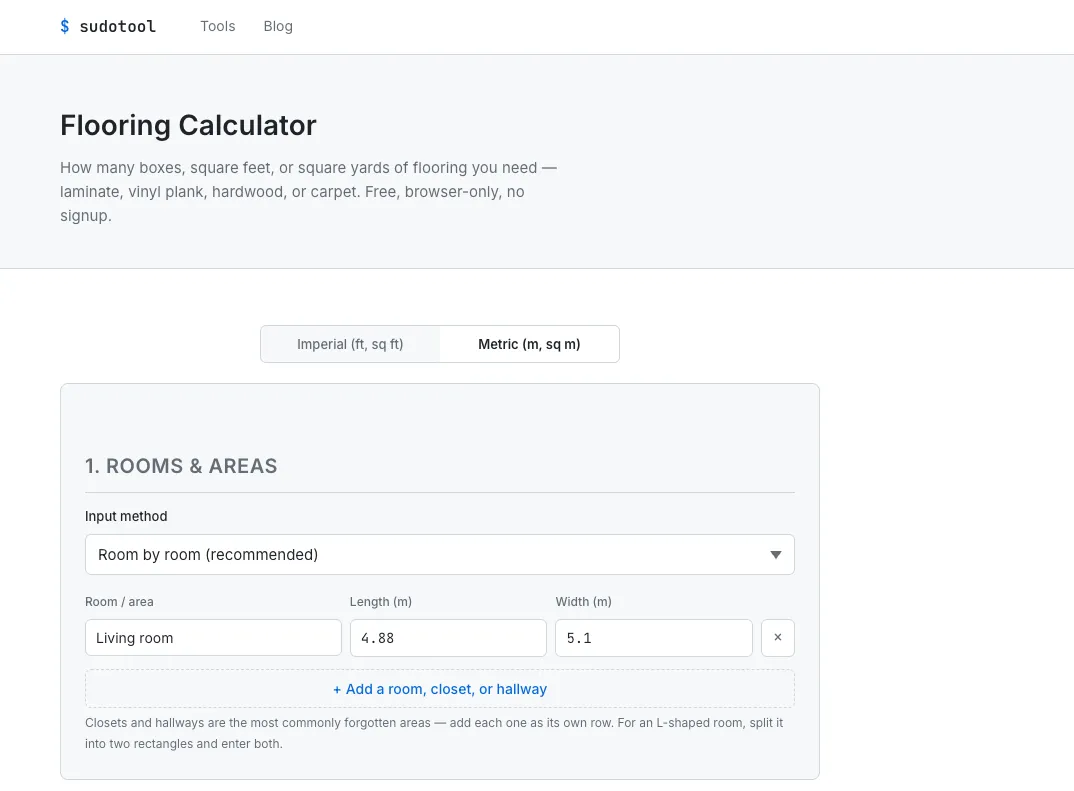
The flooring calculator turns your room size into square footage, a box count, and an estimated materials cost — the number you compare a pro's quote against.
What a professional charges — and what the money buys
Paying for installation isn't just paying someone to snap planks together. That $2 to $4 per square foot (and up) buys a few things worth naming:
- Subfloor prep. A good installer flattens dips and humps, sets or removes fasteners, and makes sure the base is sound — the step that most often goes wrong on a DIY job.
- Speed. A pro crew usually finishes a floor in one to two days; a first-time DIYer will take longer.
- Haul-away. Tear-out and disposal of the old floor is often included.
- A labor warranty. If a seam lifts or a plank fails, that's the installer's problem to fix — not yours.
For a large area on a deadline, a subfloor that needs real leveling, or a glue-down or herringbone install, those are exactly the things that make the labor worth paying for.
Is vinyl plank flooring actually easy to install yourself?
For the most common type — click-lock luxury vinyl — it genuinely is one of the more approachable DIY floors. As Today's Homeowner describes it, "click-lock planks are designed for easy installation, similar to assembling a jigsaw puzzle" — no glue, no nails, just planks that snap together. The important qualifier comes in the same breath: "as long as the subfloor is even and in good condition, the process should be straightforward."
That line draws the boundary. Click-lock (floating) vinyl is beginner-friendly; glue-down and loose-lay ask for more skill, and glue-down in particular is usually a job for pros. On time: a professional install takes one to two days, and doing it yourself "will likely take longer" (This Old House) — realistically about a day for a single room and a weekend or more for a whole floor.
The hidden costs that can erase your savings
Here's where the "cheaper" promise gets its asterisk. The savings above assume the floor goes down right. The most expensive DIY mistakes almost all trace back to the subfloor and the layout:
- Skipping subfloor leveling. This is the big one. Lay planks over dips and humps and, as FixThisBuildThat warns, you can "wind up with floors that have gaps between the boards or click when you walk on them" (FixThisBuildThat). A floor that clicks or separates often has to come back up.
- Proud nails and screws. Fasteners that aren't set below the surface "transfer through to the flooring itself," telegraphing bumps you'll feel and see.
- Bad layout planning. Not measuring the first row can leave you finishing with a sliver of a plank — with four-foot planks, you don't want to end a row with less than an eight-inch piece. It looks bad and wastes material.
- Not mixing the planks. Pulling boards straight from one box in order can create obvious repeating patterns; spread planks from several boxes as you go.
- Forgetting the expansion gap or acclimation. Vinyl expands and contracts, so it needs a small perimeter gap and, on many products, time to acclimate to the room first — skip either and planks can peak or gap later. See our guides on expansion gaps and acclimating vinyl plank.
None of these are hard to avoid — but any one of them can mean pulling up the floor and buying material twice, which is how a DIY job quietly becomes more expensive than hiring out. The savings are real; they're just conditional on doing the boring prep well.
DIY or hire a pro? A quick decision guide
Put it together and the call is usually clear:
- Do it yourself if: you're using click-lock LVP, your subfloor is already flat and sound, the rooms are simple rectangles, and you have a weekend and some patience. This is the sweet spot where the savings are real and the risk is low.
- Hire a pro if: the subfloor needs leveling, you're doing glue-down or a herringbone pattern, there are stairs, you're covering a large area on a deadline, or you want a labor warranty — especially for a rental or a home you're about to sell.
Whichever way you lean, start with the materials number. Measure up, price the planks, and compare the all-in DIY cost against a couple of real quotes — our guides on what it costs to floor a 12×12 room and how many boxes of flooring you need make that estimate quick.
Frequently Asked Questions
Is it cheaper to install vinyl plank flooring yourself?
Usually, yes. The material costs the same whether you or a pro lays it, so installing it yourself mainly skips the labor — roughly $1.50 to $10 per square foot, or about $2,000 to $4,000 on a 1,000-square-foot floor. The savings hold as long as your subfloor is flat and you work carefully.
How much does it cost to install vinyl plank flooring yourself?
For materials only, budget about $2 to $5 per square foot for standard vinyl plank and $4 to $10 for luxury vinyl, plus around $0.50 for underlayment if your planks don't already have a pad attached. Basic tools run $50 to $150. On 1,000 square feet, that is roughly $3,500 to $5,000.
How much do you save installing vinyl plank yourself versus a pro?
You save the labor, which varies with the job — from about $1.50 per square foot for a simple click-lock install to $10 for a complex one. On a small 200-square-foot room that is roughly $600 to $2,000; on 1,000 square feet, a typical mid-range job saves about $2,000 to $4,000. Bigger areas and higher local labor rates save more.
Is vinyl plank flooring hard to install for a beginner?
Click-lock vinyl plank is one of the easiest floors to install yourself — the planks snap together like a jigsaw puzzle, with no glue or nails. The main requirement is a flat, sound subfloor. Glue-down vinyl is harder and is usually best left to professionals.
How long does it take to install vinyl plank flooring yourself?
A professional typically finishes in one to two days, and doing it yourself will usually take longer. Plan on roughly a day for a single room and a weekend or more for a whole floor, plus time to let the planks acclimate to the room beforehand if the manufacturer requires it.
When should you hire a pro for vinyl plank flooring?
Hire a pro when the subfloor needs leveling, when you are installing glue-down or a herringbone pattern, when there are stairs, or when you are on a deadline over a large area. A professional also stands behind the labor, which matters for a rental or a home you are about to sell.
Bottom line
Installing vinyl plank flooring yourself is usually the cheaper route, and often meaningfully so — because the planks cost the same either way, DIY mostly buys back the labor, on the order of $2,000 to $4,000 on a 1,000-square-foot floor. Click-lock luxury vinyl makes that realistic for a first-timer. Just remember what the savings are riding on: a flat, sound subfloor and the patience to plan the layout, leave the expansion gap, and not rush. Get those right and the money stays in your pocket. If the subfloor is a mess or the job is big and time-sensitive, paying a pro for the labor — and the warranty behind it — is money well spent. Price your materials first, then decide.
- This Old House, How Much Does Vinyl Plank Flooring Installation Cost?
- Today's Homeowner, How Much Does Vinyl Plank Flooring Cost?
- FixThisBuildThat, 10 Beginner Mistakes Installing Vinyl Plank Flooring
Costs vary widely by region, installer, material grade, and the condition of your subfloor. The figures here are typical ranges from the sources listed — get local quotes for your specific project before budgeting.