Flooring Waste Factor by Pattern: How Much Extra Flooring to Buy
You measured the room perfectly, ordered exactly that many square feet — and still ran short. That gap is the flooring waste factor, the extra you buy to cover cuts, defects, and repairs. The catch is that "just add 10%" only fits a straight floor. A herringbone layout can need twice the cushion, and buying short means hunting for a matching production lot that may no longer exist.
Once you know your room's square footage, the next decision is how much to add on top before you order. That cushion is the waste factor, and the right number isn't a single figure — it's driven mostly by how the planks are laid. Get it right and you finish with a spare box or two; get it wrong and the project stalls at the worst moment.
This guide covers (1) what a waste factor actually pays for and why 5% is a floor, not a target, (2) the percentages by installation pattern, (3) why herringbone and chevron waste the most, (4) the modifiers — plank size, room shape, your own experience — that move the number, and (5) how to apply it to your order.
What a Flooring Waste Factor Is (and Why 5% Isn't Enough)
A waste factor is the percentage you add to your measured area to decide how much to buy. It pays for four things: the boards trimmed off at every wall, the pieces you set aside for defects or off-color grain, the occasional miscut, and a few planks kept back for a future repair — ideally from the same production lot, since shade and grain shift from one run to the next.
You'll see 5% quoted as the standard flooring waste factor. Treat it as a floor, not a target. A 5% allowance is really only enough to cover milling defects and the boards you cull for color or knots — the sorting that happens before a single plank is cut. It doesn't account for the wood lost at every wall, the mistakes, or the leftovers you want on hand later. Once those enter the picture, a plain straight install lands closer to 10%, which is why most retailer and manufacturer guides quote 10% as the working number for a simple rectangular room. The pattern is what moves it from there.
Waste Factor by Pattern: The Numbers
Layout is the single biggest lever on waste, because it decides how much of each board ends up as an unusable offcut. Here's the working range by pattern:
| Layout | Waste to add | Why |
|---|---|---|
| Straight, parallel to the wall | 5–10% | Offcuts carry into the next row; 5% covers defects only, ~10% once cuts and multiple rooms are counted |
| Diagonal (45°) | ~15% | Angled cuts at both ends of every row leave triangular offcuts |
| Herringbone or chevron | 15–20% | Every board is angle-cut; the small offcuts rarely fit elsewhere |
| Carpet | ~10–20% | Fixed roll widths force seams and large offcuts |
For a straight floor, offcuts are efficient: the piece you cut off the end of one row often starts the next, so little is truly wasted. Industry guides and manufacturers like Swiss Krono land on about 10% for a standard install. A diagonal run at 45 degrees jumps to roughly 15%, because the angled cut happens at both ends of nearly every row and those triangular cut-offs can't be reused. Carpet is a different animal: it's sold off fixed-width rolls, so your room rarely divides evenly into the roll and you lose strips to seams — overage often lands near 20%, though it depends heavily on roll width versus room dimensions.
One material note: laminate can run a touch leaner — some guides drop it to around 8% — because it chips and breaks less than solid hardwood during handling and cutting.
Read these as planning ranges, not guarantees — the right pick within a range comes down to your room and your nerves. When you're unsure, lean to the high end. The cost of a little surplus is one box you might return or stash in a closet; the cost of coming up short is a second order, a possible color mismatch, and a stalled install. Those two risks aren't the same size.
Herringbone and Chevron: Why They Waste the Most
If you're searching for the herringbone flooring waste number specifically, plan on 15–20%, with chevron toward the higher end of that band. The reason is built into the pattern. In a herringbone floor, each plank meets the next at a right angle, so the boards are cut short and square again and again; in a chevron floor, the ends are cut at an angle (often 45°) to form a continuous V. Either way, almost every board produces a small, oddly shaped offcut, and unlike a straight layout, those scraps seldom fit anywhere else in the pattern.
Room size nudges the figure too. The Australian flooring supplier Havwoods, for example, advises a 15% allowance for herringbone and chevron in spaces under 100 m², easing to 12% for larger areas — a bigger floor absorbs the fixed offcut loss more efficiently, the same way it does for straight plank (10% under 100 m², 7% above). It's the same principle behind the waste on tile patterns; our guide on herringbone tile waste walks through the angled-cut math for tile, which behaves much the same way.
Skill matters more here than in any other layout. A seasoned installer plans the cuts so offcuts get reused where the pattern allows, keeping waste near the low end of the range; a first-timer working out the angles in real time will burn through more. Dry-laying a few rows before committing — setting the boards out loose to check the fit and the cut list — is the simplest way to keep a herringbone or chevron job from running over.
What Else Pushes the Percentage Up
Pattern sets the baseline; these factors move it:
- Plank size. Wide or long boards — roughly 7 inches and wider — tend to need 12–15%, because matching grain and pattern across bigger planks wastes more than narrow strip flooring, where small offcuts slot in easily.
- Room shape. Closets, doorways, angled walls, and bump-outs all add cuts. A floor broken into several small areas wastes more than one clean rectangle of the same total size.
- Who's installing. Professionals typically run 7–10% on a straight job; first-time DIY installers are better served by 12–15% to absorb miscuts and measurement errors. Your first cut is rarely your cleanest.
- Direction changes. Running flooring continuously from room to room, or turning it through a hallway, adds transition cuts that a single closed room never sees.
Stack a couple of these — a wide-plank herringbone in a choppy floor plan, installed by a first-timer — and the realistic number climbs to the very top of the range. When several push the same direction, round up rather than splitting the difference.
The same factors run in reverse. One large, simple rectangle with few doorways, narrow strip planks, a straight layout, and an experienced installer can sit comfortably at the bottom — even the 7% that a big straight floor allows. The single most effective way to hold waste down, whatever the pattern, is to measure carefully and order once, instead of guessing low and patching later with a second batch.
How to Apply the Waste Factor to Your Order
The math is one line: order quantity = measured area × (1 + waste %). Take a 200-square-foot room. A straight layout at 10% needs 200 × 1.10 = 220 sq ft; the same room on a 45° diagonal at 15% needs 200 × 1.15 = 230 sq ft; in herringbone at 20% it's 200 × 1.20 = 240 sq ft. Same floor, three different orders — entirely because of the pattern.
Two finishing steps. First, convert that padded area into whole boxes: divide by the coverage printed on the box and round up, since stores sell full boxes only. If that 240-square-foot herringbone order comes in boxes covering 22 square feet each, that's 240 ÷ 22 = 10.9 — so you buy 11 boxes. Second, buy the entire order at once. The waste factor is also your insurance for the future: order everything together, from the same production lot, so the spare planks you keep actually match the floor years from now. (Need to nail the measured area first? Our guide on how to measure a room for flooring covers that step.)
It's worth being blunt about why the extra matters. Flooring is made in batches, and color and grain drift between production runs. Come up even one box short and the replacement may be a different lot — or the product line may be discontinued altogether — leaving a visible band where new material meets old. The few dollars of surplus built into a proper waste factor is cheap insurance against that; a mismatched repair isn't something you can sand or paint away.
If you'd rather not run the percentages by hand, the calculator does it for you — enter each room, choose the material and layout, and it applies the matching waste factor and returns whole boxes:
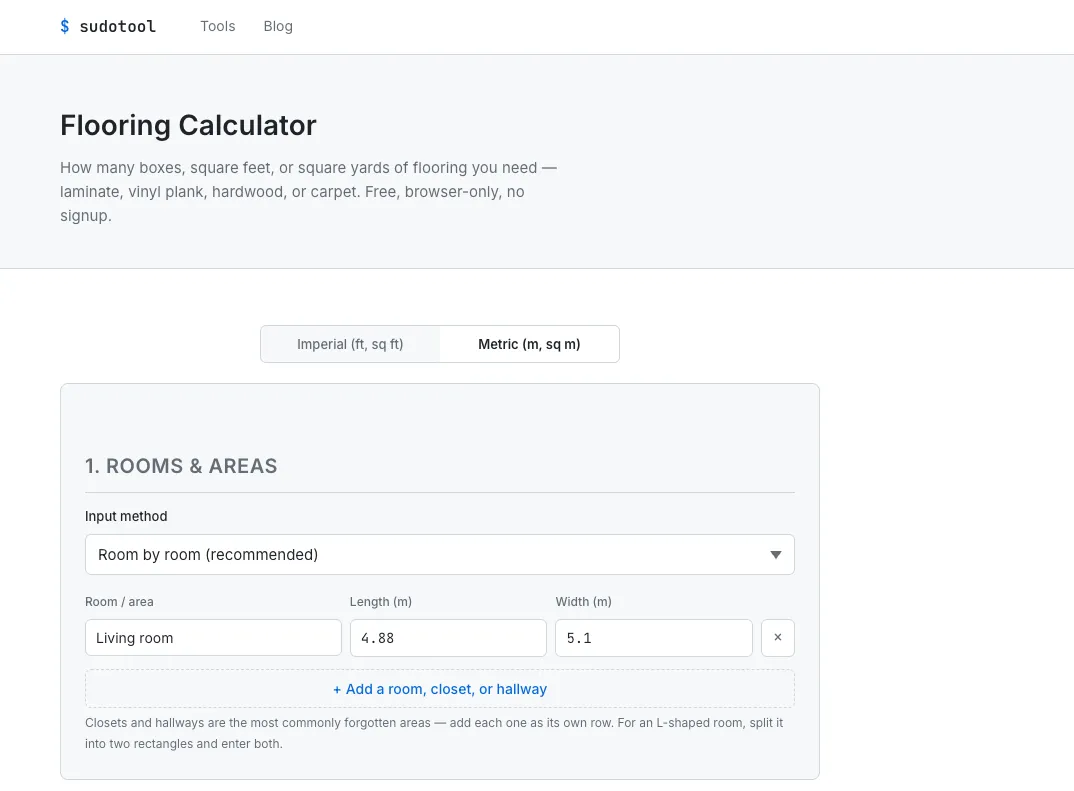
Enter each room, then let the layout choice set the waste factor — no manual percentages.
Frequently Asked Questions
How much extra flooring should I buy?
It depends on the layout. Add about 5 to 10 percent for a standard straight install, around 15 percent for a 45-degree diagonal, and 15 to 20 percent for herringbone or chevron. Carpet runs near 20 percent. Wide planks, choppy rooms, and first-time installers push those numbers higher.
How much waste does herringbone flooring have?
Plan for about 15 to 20 percent. Every board in a herringbone or chevron floor is cut at an angle, and the small, oddly shaped offcuts rarely fit anywhere else, so more material ends up as scrap than in a straight layout where offcuts start the next row.
Is 10 percent enough waste for flooring?
For a simple, straight install in a roughly rectangular room, 10 percent is usually enough. For a diagonal or herringbone layout, wide planks, or a room broken up by closets and angles, step up to 15 to 20 percent instead.
Why is 5 percent the bare minimum, not the target?
A 5 percent allowance typically covers only milling defects and the boards you cull for color or knots — not the cut-ends at the walls or installer mistakes. Once you account for those, a straight install realistically needs closer to 10 percent.
How do I add a waste factor to my order?
Multiply your measured square footage by 1 plus the waste percentage, then round up to whole boxes. For 200 square feet at 15 percent, that is 200 x 1.15 = 230 square feet. Divide by the coverage on the box to get the number of boxes.
Does plank size change the waste factor?
Yes. Wide or long planks — roughly 7 inches and wider — tend to need 12 to 15 percent because matching grain and pattern across bigger boards wastes more. Narrow strip flooring uses less, since small offcuts are easier to place.
These percentages are planning ranges drawn from manufacturer and retailer guidance, not guarantees. Actual waste varies with your specific product, plank dimensions, room layout, and installer. Confirm the figures against your flooring's packaging and have your retailer or installer verify the final order quantity before you buy.
- CalcForHomes — Waste Factor Guide. Reference for the per-pattern percentages (straight 10%, diagonal 15%, herringbone/chevron 20%), wide-plank 12–15%, DIY vs pro figures, the laminate 8% note, and the order = area × (1 + waste %) formula.
- Havwoods — Everything You Need to Know About Wastage. Reference for the area-tiered allowances: standard plank 10% / 7% and herringbone & chevron 15% / 12% above and below 100 m².
- Swiss Krono USA — How to Measure for Laminate Flooring. Manufacturer reference for the 10% standard waste guidance.
- Carpet One — Calculate Square Footage. Retailer reference for the "at least 5–10%" general overage and the ~20% carpet allowance.
- Independent Hardwood Floor — How Much Extra Flooring Should You Buy? Reference for the 5–10% (simple) vs 10–15% (complex) framing and keeping matching material for future repairs.