How to Measure a Room for Flooring (Step by Step)
The most expensive flooring mistake isn't picking the wrong plank — it's ordering the wrong amount. Run short and you may not be able to match the same production lot, leaving a visible shift across the floor; over-order and the surplus is money sitting in the garage. Both trace back to the same first step. This guide walks through how to measure a room for flooring, from square footage to boxes.
"How much flooring do I need?" is really two questions: how big is the floor, and how much extra should you buy on top of it. Get the measurement right and the rest is arithmetic. The good news is that flooring math is almost entirely length times width — the part people get wrong is what they forget to measure, not the multiplication.
This guide covers (1) the basic length-by-width method and how to measure accurately, (2) breaking odd-shaped rooms into rectangles, (3) the closets, hallways, and nooks that get left out — and the built-ins you should subtract, (4) how much waste factor to add, and (5) turning your square footage into the boxes or square yards you actually buy.
How to Measure a Room for Flooring in Square Feet
Start with the core formula: multiply the room's length by its width, in feet, and you have the area in square feet. A room that's 12 feet by 12 feet is 144 square feet (12 × 12 = 144). That single calculation handles any simple rectangular room. (Working in metric? Multiply length by width in meters to get square meters — the method is identical; just keep your room measurements and the flooring's coverage in the same unit.)
Two habits keep the number honest. First, rooms are rarely perfectly square — walls bow, corners drift off 90 degrees, and the two ends of a wall can differ by an inch or more. Measure each wall at more than one point and use the larger figure, then round each measurement up to the nearest inch rather than down. You're sizing a material order, so erring high is the safe direction. Second, clear the floor first; measuring around furniture is how a closet alcove or a chimney recess quietly disappears from the total.
A tape measure is fine for most rooms, but a laser distance meter is faster and easier to use solo in a large space — point it at the far wall and read the length without a helper holding the other end. Either way, write each room's length and width down as you go; you'll need the individual numbers again when you split the space into sections.
Break Odd-Shaped Rooms into Rectangles
Few real rooms are a clean box. The trick for any irregular space — an L-shaped living-dining room, a bedroom with a closet bump-out, a bay window — is to divide it into separate rectangles, calculate each one on its own, and add the areas together.
Picture an L-shaped room as two rectangles: the main body (say 12 × 15 = 180 sq ft) plus the leg of the L (say 6 × 8 = 48 sq ft), for 228 square feet total. Draw a quick floor sketch, mark each rectangle with its own length and width, and you've turned an intimidating shape into two easy multiplications. The same method scales to a kitchen with an alcove or a hallway that doglegs — more rectangles, same addition. (Measuring for tile works exactly the same way; our guide on calculating tile for a room uses the identical area-then-waste approach.)
A couple of shapes call for judgment. For a curved or angled wall, don't try to calculate the curve — draw the smallest rectangle that fully contains the space, use that area, and let the waste factor absorb the offcut. And mind the threshold areas: the few inches of flooring that run into a doorway opening belong to whichever room you're flooring, so fold them into that room's rectangle rather than treating them as a separate space.
Don't Forget Closets, Hallways, and Nooks
This is where most under-orders happen, and it's the heart of the question "do you include closets when measuring for flooring?" The answer is yes — anywhere the new floor will run, you measure. Walk-in closets are always part of the total. Reach-in closets are optional but worth including for a finished, continuous look if you're flooring them. Treat each closet as its own little rectangle, and measure it at floor level rather than at shelf height: closet walls aren't always plumb, so the floor dimensions can differ from what you'd read higher up.
Hallways, entries, and landings count too, since they're usually the same flooring run. The flip side is knowing what to leave out. You subtract the footprint of large permanent built-ins — a kitchen island, fixed cabinetry, a staircase — because no flooring goes there. But you don't bother subtracting small gaps like a doorway opening into a room that won't be floored, floor vents, or the space under removable appliances such as a refrigerator or range (the floor typically runs under those anyway). Chasing every little cut-out just risks coming up short; that's what the waste factor is for.
| Area | Include in your total? |
|---|---|
| Main room, wall to wall | Yes — measure to the walls |
| Walk-in closets | Yes — always, if floored |
| Reach-in closets | Yes if you're flooring them (recommended) |
| Hallways, entries, landings | Yes — same flooring run |
| Under removable appliances (fridge, range) | Yes — floor usually runs underneath |
| Doorway openings to non-floored rooms | No — subtract if the floor stops there |
| Kitchen islands, fixed cabinets, staircases | No — subtract their footprint |
A calculator that lets you enter rooms one at a time makes this hard to get wrong — each closet and hallway becomes its own line, and an L-shaped room is just two entries:
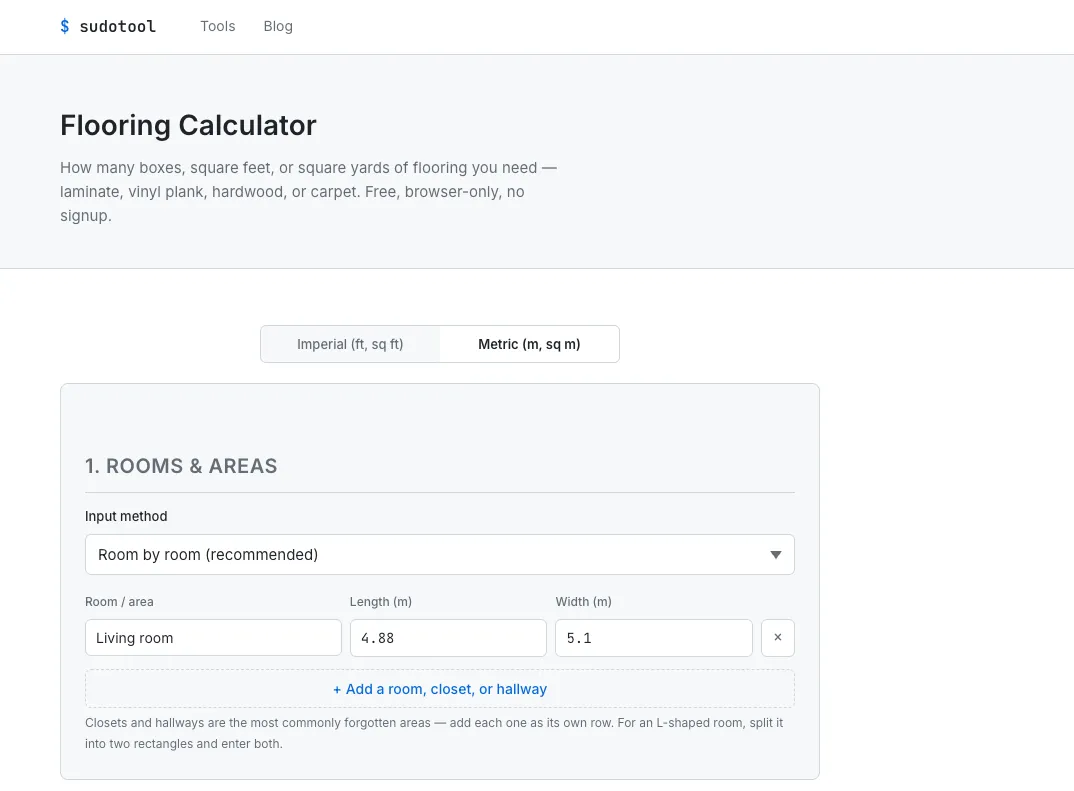
Add each room, closet, and hallway as its own row — and split an L-shaped room into two rectangles.
Add a Waste Factor
Your measured square footage is the floor; it's not how much you buy. Every install loses material to cuts at the walls, the occasional damaged board, and trimming around obstacles — and you want a few extra planks set aside for future repairs, ideally from the same lot. So you add a waste factor on top of the measured area.
How much depends mostly on the layout. A standard straight installation runs about 5–10% extra. Diagonal and herringbone patterns waste more at every cut, so they typically need around 15%, climbing toward 20% in small or cut-heavy rooms. Carpet sits near 20% on its own, for a reason specific to how it's sold (covered in the next section). Manufacturer guidance lands in the same range — laminate maker Swiss Krono, for instance, advises adding 10% for a standard install and 20% for a tile-style pattern.
| Installation | Waste to add |
|---|---|
| Standard straight plank or tile | 5–10% |
| Diagonal or herringbone pattern | ~15% (up to 20% in complex rooms) |
| Carpet | ~20% (roll widths create seams and offcuts) |
These are starting points, not precise figures — the exact percentage shifts with plank size, room shape, and how many doorways and angles you're cutting around. For a fuller breakdown by layout, see our guide on flooring waste factor by pattern.
Convert Square Footage into Boxes (or Square Yards)
The last step is turning your total — measured area plus waste — into the unit the store actually sells.
Hard flooring (laminate, vinyl plank, engineered or solid hardwood) is sold by the box. Each box covers a set number of square feet, printed on the label, and that coverage varies by product — commonly in the 20–24 square-foot range, though some run higher or lower. Because it varies, always read the box rather than assuming. To find the count, divide your total square footage by the per-box coverage and round up to the next whole box. A 180-square-foot order in boxes that cover 25 square feet each is 180 ÷ 25 = 7.2, which rounds up to 8 boxes.
Carpet is the exception: it's usually priced by the square yard. Since one square yard equals nine square feet, divide your square footage by 9 — 120 square feet becomes about 13.3 square yards. Carpet also comes on wide rolls, typically 12 feet (some makers offer 13.5- or 15-foot widths). Your room's width rarely divides evenly into a roll, so there are seams and offcuts to plan around, which is why carpet's waste factor sits higher than hard flooring's.
One more thing the box won't tell you: for a single run longer than about 40 feet or wider than 25 feet, hard flooring generally needs an expansion transition partway across, per manufacturer installation specs. That doesn't change your area math, but it can change your shopping list by a transition strip or two.
Whatever the count comes to, buy the whole order at once. Flooring is produced in batches, and the shade and grain can shift slightly from one run to the next — the batch or dye-lot number is printed on the box. Ordering everything together, with the waste factor already built in, is the only reliable way to keep the floor consistent and to still have a matching plank or two on hand for repairs years later. This is the real cost of measuring short: not just a second trip, but a second lot that may not match.
Your Room-Measuring Checklist
Pulling it together, here's the whole sequence:
- Clear the floor so nothing hides a nook.
- Divide the space into rectangles — one per room, closet, hallway, and bump-out.
- Measure each rectangle's length and width, checking the walls at multiple points and rounding up to the nearest inch.
- Multiply and add every rectangle to get total square feet; subtract large built-ins like islands and staircases.
- Add your waste factor — 5–10% straight, ~15% for patterns, ~20% for carpet.
- Convert to boxes (total ÷ box coverage, rounded up) or square yards for carpet (total ÷ 9).
That's a reliable hand calculation. If you'd rather not juggle the rectangles, waste percentages, and box coverage yourself, enter each room and let the tool do every step:
Frequently Asked Questions
Do you include closets when measuring for flooring?
Yes. Include every closet you are flooring as part of the total — walk-in closets always, and reach-in closets too if the new floor runs into them. Measure each closet as its own rectangle at floor level, since closet walls are not always plumb, then add it to the room.
How much extra flooring should I buy?
Add roughly 5 to 10 percent for a standard straight layout, around 15 percent for diagonal or herringbone patterns (up to 20 percent in cut-heavy rooms), and about 20 percent for carpet because roll widths create seams and offcuts. The extra covers cuts, mistakes, and future repairs.
How many boxes of flooring do I need?
Divide your total square footage, waste factor included, by the coverage printed on the box, then round up to the next whole box. Box coverage varies by product — commonly 20 to 24 square feet — so always check the label rather than assuming a number.
How do I measure an L-shaped room for flooring?
Split the L into two rectangles, measure the length and width of each, multiply to get each area, then add them together for the total. Any odd shape — alcoves, bays, bump-outs — breaks down into rectangles the same way.
Do you subtract kitchen islands or cabinets when measuring?
Subtract the footprint of large permanent built-ins — kitchen islands, fixed cabinets, and staircases — since no flooring goes there. Do not bother subtracting small gaps like doorway openings, vents, or the space under removable appliances; the waste factor absorbs them.
What is the difference between square feet and square yards?
One square yard equals nine square feet. Hard flooring is sold by the square foot or by the box, but carpet is usually priced by the square yard, so divide your square footage by 9 to convert it before you shop for carpet.
This guide summarizes general measuring methods and manufacturer and retailer guidance as published. Waste percentages and box coverage are starting points that vary by product, layout, and room — confirm the figures on your specific flooring's packaging, and have your retailer or installer verify the final order quantity before you buy.
- Swiss Krono USA — How to Measure for Laminate Flooring in 3 Steps. Manufacturer reference for the length × width formula, the 144 sq ft example, the 10% standard / 20% tile-pattern waste guidance, and the 40-foot / 25-foot transition rule.
- Carpet One — Calculate Square Footage. Retailer reference for splitting irregular rooms into rectangles, the square-feet-divided-by-9 carpet conversion, the 5–10% general and ~20% carpet overage, and rounding up measurements.
- D&G Flooring — How to Measure for Flooring. Reference for including walk-in and reach-in closets, measuring at floor level, and taking length and width readings at multiple points.
- Arko Flooring — How to Measure the Square Footage of a Room. Reference for measuring at several points along each wall and subtracting doorway openings to non-floored rooms.
- Flooring America — Carpet Width. Reference for standard carpet roll widths (12 ft, with 13.5 ft and 15 ft options) and how wider rolls reduce seams.
- BuildDirect — How to Measure Your Space for Laminate Floors. Reference for the boxes-needed calculation (total ÷ box coverage, rounded up).
- Coohom — How Much Laminate Flooring Is in a Box. Reference for typical per-box coverage and the advice to check the box label.
- Flooring Explorer — Rooms Measuring Guide. Reference for subtracting large built-ins such as kitchen islands, cabinets, and staircases from the floor area.