Do You Need Underlayment for Vinyl Plank Flooring?
Vinyl plank is sold as a floor you can almost throw down and walk on. Underlayment is the step where that promise gets complicated — and getting it wrong can void the warranty.
Whether you need underlayment for vinyl plank flooring depends on three things, and almost every confused answer online comes from mixing them up: the type of plank, whether you are floating or gluing it down, and what is under the floor. Sort those out and the decision is usually obvious — and in a surprising number of cases the right answer is to add nothing at all, because adding the wrong layer can do more harm than skipping it.
This guide covers the one question that decides most cases — does the plank already have a pad — then when bare floating planks do need underlayment, why glue-down planks never do, what changes over concrete versus wood versus an existing floor, and finally the three layers people constantly confuse: cushion underlayment, a vapor barrier, and an acoustic pad. Before you buy anything, it helps to measure the room so you know how much of each layer you would actually need.
Attached Underlayment: The Rule That Settles Most Cases
Most modern luxury vinyl plank — especially rigid-core SPC and WPC — ships with a pad already bonded to the back of each plank. It is usually a thin layer of cork or IXPE foam, and it goes by names like "attached underlayment," "pad-attached," or "with attached backing" on the box and spec sheet. If yours has it, that pad is doing the job a separate underlayment would otherwise do.
The rule that follows is the single most important thing to get right: if your planks have an attached pad, do not add a second pad on top of it. Stacking a second cushion under planks that already have one creates too much give. That extra flex stresses the click-lock joints over time, and the planks can gap or separate at the seams. Because of this, many flooring manufacturers prohibit a second underlayment in their installation instructions, and doing it anyway can void the warranty.
"Many," though, is not "all" — and this is where blanket internet advice goes wrong. Some manufacturers do allow one thin underlayment over an attached pad within a strict cap. COREtec's installation guide, for instance, permits a second underlayment under its attached-pad products in residential use as long as that underlayment is no thicker than 3 mm. The practical takeaway is not "never" but "check first": your product's own installation guide is the authority, because it is the document the warranty hangs on. When you are not sure whether a plank has a pad, flip one over — an attached pad is a visible foam or cork layer on the back — or look for "attached underlayment" on the spec sheet.
The one near-universal exception works in the other direction. Over concrete, if the attached pad does not include a moisture barrier, a thin 6-mil polyethylene sheet is still fine to add — because it is a vapor barrier, not cushion, so it does not add the soft, unstable height that causes the locking problems. More on that in the subfloor section.
| Plank type | Already has a pad? | Add underlayment? |
|---|---|---|
| Rigid-core (SPC/WPC) with attached pad | Yes — cork or IXPE backing | No. A second pad can stress the locking joints and void the warranty. Many brands prohibit it; some allow one thin pad (around 3 mm). Only a thin 6-mil vapor barrier on concrete. |
| Floating plank, no attached pad | No | Usually yes — 1 to 1.5 mm foam or cork, with a moisture barrier over concrete. |
| Glue-down (full-spread adhesive) | Not applicable | No. The adhesive bonds to the subfloor; underlayment prevents that bond. |
When Bare Floating Planks Do Need Underlayment
If your planks float (click together rather than glue down) and have no pad on the back, you normally do lay a separate underlayment. It earns its place by doing four small jobs at once:
- Comfort underfoot. A pad takes the hard, hollow feeling out of a floating floor and softens each step.
- Quieter footsteps. It absorbs some of the click and echo a bare floating floor makes — and over a finished room below, this matters a lot (see the acoustic section).
- Minor smoothing. A thin pad masks the tiniest dips in the subfloor — but only the tiniest. It is not a leveling product.
- A little warmth. It adds a small amount of thermal insulation between the floor and a cold slab.
The thickness norm for vinyl plank underlayment is thin: most products call for roughly 1 to 1.5 mm, and the manufacturer's stated maximum is a hard limit, not a suggestion. Thicker is not better here — too much cushion brings back the same locking-joint problems as a doubled-up pad. Within that range, a denser 1 mm pad tends to favor sound absorption, while a 1.5 mm pad leans toward comfort and resilience. Whatever you choose, never exceed the maximum thickness your plank's installation guide allows.
Cost is modest and depends mostly on the material. Basic polyethylene foam runs roughly $0.10–$0.20 per square foot; foam with a built-in vapor barrier about $0.15–$0.40; cork and rubber climb higher, into the $0.60–$2.00 range. A separate 6-mil poly sheet for moisture is the cheapest layer of all, around $0.05–$0.15 per square foot. Treat these as ballpark figures — they move with region, brand, and where you buy.
Glue-Down Vinyl Plank: No Underlayment, Ever
There is one plank type where the answer is a flat no. Glue-down vinyl plank is set in a full-spread adhesive that bonds each plank directly to the subfloor, and an underlayment in between would stop that bond from forming. Lay a pad under glue-down planks and you have not cushioned the floor — you have prevented the installation from working. So for glue-down, the question is not which underlayment but how well the subfloor is prepared.
That prep is the real work. The subfloor has to be clean, flat, and structurally sound, and on concrete it has to be dry — adhesive failure from a damp slab is a common way glue-down jobs go wrong. Concrete should be cured and moisture-tested before any adhesive goes down; manufacturers spell out the limits, with COREtec, for example, citing a calcium chloride test (ASTM F1869) capped at 8 lbs per 1,000 sq ft over 24 hours and an in-situ relative humidity test (ASTM F2170) capped at 90%. Use only the adhesive the manufacturer specifies, too — using the wrong one is another path to a voided warranty.
This is why the floating-versus-glue-down question is worth answering first: it decides half the underlayment question on its own. Floating planks may want a pad; glue-down planks never do.
Does the Subfloor Change the Answer? Concrete vs. Wood vs. Existing Floor
Once you know the plank type, the subfloor decides the rest — mostly by deciding whether moisture is in play.
Concrete slab. The concern here is not cushion, it is moisture. Concrete wicks ground moisture upward, so under bare floating planks most manufacturers require a 6-mil polyethylene vapor barrier, or an underlayment with a moisture barrier built in. This applies to every kind of slab — slab-on-grade, basement, and suspended. One point that trips people up: a vinyl plank being "waterproof" does not make it a moisture barrier. Waterproof means water on top of the floor will not ruin it; it says nothing about vapor rising from below, which can still promote mold and mildew under the planks. If your planks already have an attached pad, you skip the cushion but may still add the thin vapor barrier when the pad lacks one.
Plywood or OSB (wood subfloor). A wood subfloor in a conditioned space does not pump moisture the way a slab does, so a vapor barrier is generally unnecessary. For bare floating planks, a thin foam underlayment is optional — a comfort and sound choice rather than a requirement. The thing to watch is height: every layer you add raises the floor and changes how it meets doorways and transitions.
Over an existing floor. Laying vinyl plank over an existing hard floor — old vinyl, laminate, or tile — usually means no additional underlayment, because the existing floor effectively acts as the underlayment. The catch is that any unevenness telegraphs through: tile grout lines and worn spots have to be addressed first, and the surface still has to meet the flatness standard below. If you are weighing whether your existing surface is even a candidate, the same logic that governs tiling over existing tile applies — the old surface has to be sound, clean, and flat before anything goes on top.
Underlayment vs. Vapor Barrier vs. Acoustic Pad
Most underlayment confusion comes from treating three different products as one. They are not — each does a separate job, and you sometimes need none, one, or two of them at once:
- Cushion underlayment — foam, cork, or rubber, roughly 1 to 1.5 mm. Adds comfort, dampens basic sound, and masks the smallest dips.
- Vapor barrier — a thin plastic sheet (6-mil poly) whose only job is to block moisture rising from concrete. It provides no cushion.
- Acoustic underlayment — a pad rated specifically to raise the floor's sound numbers for a room above living space.
That last one matters most in a condo or an upstairs room, where sound is often a code or association requirement rather than a preference. Two ratings come up: IIC (Impact Insulation Class), which measures footstep and impact noise, and STC (Sound Transmission Class), which measures airborne noise like voices. Building codes set a floor-ceiling minimum between dwelling units of IIC 50 and STC 50 in the lab, with a field-tested equivalent around 45 (the standards behind them are ASTM E492 for impact and ASTM E90 for airborne sound). Many condo associations and luxury developments go well past code, commonly writing in STC and IIC requirements in the mid-50s to low-60s.
Here is why the underlayment is what gets you there: a bare concrete slab on its own tests only around IIC 25–30, nowhere near the code minimum, and adding a rated acoustic underlayment is what brings the assembly into the compliant range. There is a catch for attached-pad planks, though — since you generally cannot add a second pad, the way to hit a condo's sound spec is to choose planks whose attached pad is already acoustic-rated, rather than planning to lay an acoustic layer underneath. Whatever your building requires, find out the exact IIC and STC numbers before you buy, because the floor system has to be specified to meet them.
One more distinction lives in this section: leveling is not underlayment's job. The industry flatness standard for vinyl plank, echoed in manufacturer guides like COREtec's, is no more than 3/16 inch of deviation over 10 feet (or 1/8 inch over 6 feet). A thin underlayment can mask dips under about 1/16 inch and nothing more. Anything beyond that has to be corrected with a self-leveling compound in the low spots, or by grinding down the high ones — a soft pad stretched over a wavy floor only causes more plank movement and wear.
How to Decide: A Four-Question Checklist
Put it together and the whole decision comes down to four questions, answered in order:
- Does the plank have a pad attached to the back? If yes, add nothing extra — only a thin 6-mil vapor barrier if you are over concrete and the pad lacks one. If no, go to the next question.
- Floating or glue-down? If glue-down, no underlayment at all — put your effort into subfloor prep and moisture testing. If floating, go on.
- What is underneath? Over concrete, use an underlayment with a moisture barrier (or a separate 6-mil sheet). Over wood, a thin comfort pad is optional. Over a sound existing floor, you usually need nothing.
- Is it above living space or in a condo? If so, use an acoustic-rated underlayment, or planks with an acoustic attached pad — and confirm your building's required IIC and STC numbers first.
Whatever the answers, the spec sheet and installation guide for your specific plank are the final word, because they are what the warranty depends on. Once the underlayment question is settled, the rest is arithmetic — your underlayment covers the same square footage as the floor, so size both at once:
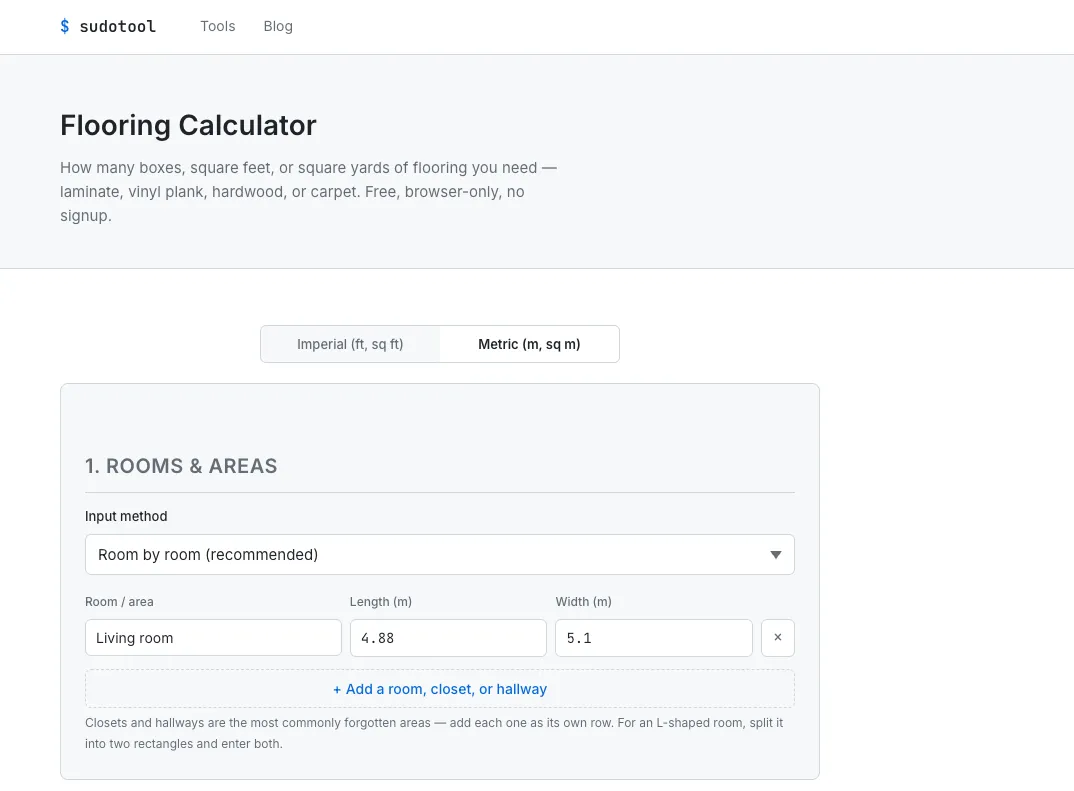
The flooring calculator gives you the floor's square footage — the same area your underlayment or vapor barrier needs to cover.
Frequently Asked Questions
Do you need underlayment for vinyl plank flooring?
It depends. If the planks already have a pad attached to the back, you usually add nothing — just a thin vapor barrier over concrete. Bare floating planks normally get a 1 to 1.5 mm foam or cork underlayment. Glue-down planks never get underlayment, because the adhesive must bond to the subfloor.
Can you put underlayment under vinyl plank that already has an attached pad?
Usually not. Many manufacturers prohibit it, because a second pad adds too much cushion and can stress the click-lock joints until planks separate, which voids the warranty. Some brands do allow one thin underlayment, capped around 3 mm. Always check your product's installation guide before adding anything.
Do you need underlayment for vinyl plank on concrete?
The concern on concrete is moisture, not cushion. Most manufacturers require a 6-mil polyethylene vapor barrier, or an underlayment with a built-in moisture barrier, under bare floating planks on a slab. If your planks have an attached pad, you typically add only the vapor barrier, not more cushion.
Do glue-down vinyl planks need underlayment?
No. Glue-down planks bond directly to the subfloor with full-spread adhesive, and underlayment would stop that bond from forming. Instead of a pad, focus on subfloor prep: clean it, get it flat, and on concrete test it for moisture before spreading any adhesive.
Does underlayment fix an uneven subfloor?
Only very slightly. A thin underlayment masks dips under about 1/16 inch, but the industry flatness standard for vinyl plank is 3/16 inch over 10 feet (or 1/8 inch over 6 feet). Anything beyond that has to be fixed with a self-leveling compound or by grinding high spots, not bridged with a pad.
What underlayment do I need for vinyl plank in a condo or upstairs room?
You need a sound-rated acoustic underlayment, or planks with an acoustic attached pad. Building codes set a floor-ceiling minimum of IIC 50 and STC 50 in the lab, and many condo associations require more. Check your association's required rating first, since the underlayment is what gets the assembly there.
This is general guidance for budgeting and planning, not installation instructions for a specific product. Underlayment rules, thickness limits, moisture requirements, and warranty terms vary by manufacturer — your plank's own installation guide is the authority, and it is what the warranty depends on. When in doubt, follow it over anything you read here.
- COREtec / Georgia Carpet — COREtec PRO Series Installation Guide. A second underlayment is allowed under attached-pad products in residential use, capped at 3 mm; subfloor flat to 3/16" in 10' or 1/8" in 6'; concrete moisture limits ASTM F1869 (8 lbs) and ASTM F2170 (90% RH); waterproof but not a moisture barrier.
- Burch Brothers Flooring — Does Luxury Vinyl Plank Need Underlayment?. Adding a pad under attached-pad planks stresses the locking joints and can void the warranty; some manufacturers prohibit it; concrete typically needs a 6-mil polyethylene vapor barrier.
- FlooringClarity — Do You Need Underlayment for Vinyl Plank Flooring?. Attached-pad planks usually need nothing added; concrete needs a moisture barrier; vapor barrier and cushion underlayment are distinct layers.
- FlooringClarity — How Flat Does a Floor Need to Be for Vinyl Plank?. Industry flatness standard of 3/16" over 10 feet (1/8" over 6 feet); underlayment masks only sub-1/16" dips and is not a substitute for leveling.
- D and G Flooring — Vinyl Plank Flooring Underlayment. Thickness norm of 1–1.5 mm; doubling pads creates an unstable surface; 6-mil poly required on all slabs; underlayment cost ranges by material.
- Commercial Acoustics — IIC and STC Ratings Guide for Condo Flooring. IBC §1207 sets IIC 50 / STC 50 (lab); bare slab tests around IIC 25–30; many associations require the mid-50s to low-60s.
- UpCodes — IBC §1207 Sound Transmission. Floor-ceiling assemblies between dwelling units must reach IIC 50 and STC 50 in laboratory testing (ASTM E492 and E90), or 45 when field-tested.