Do You Need to Acclimate Vinyl Plank Flooring?
New boxes arrive and the temptation is to start clicking planks together that afternoon. Most manufacturers ask you to wait first — and a few say you don't have to at all. The right answer depends entirely on which product you bought.
Whether you need to acclimate vinyl plank flooring is one of those install-prep questions with a frustratingly conditional answer. For most products the answer is a clear yes, because vinyl is not an inert material — like wood or laminate, it expands and contracts as the temperature around it changes. LX Hausys, a luxury vinyl manufacturer, puts it plainly: "Even though vinyl flooring planks are durable, they still react to their environment, just like wood or laminate." Let the planks reach the room's temperature before you lock them down and they stay put. Skip that step and they can move after the floor is finished. But a growing number of rigid-core products now state that no acclimation is needed at all — so the honest answer is "it depends on your product," and this guide shows exactly where the line falls.
This guide covers (1) what acclimating vinyl plank actually means and why it matters, (2) how long it takes and at what temperature, (3) a table of acclimation times by manufacturer, (4) what happens if you skip it — including warranty risk, and (5) why rigid-core SPC is sometimes a genuine exception. It deliberately stays clear of the separate question of underlayment, which is a different decision entirely.
Do You Need to Acclimate Vinyl Plank? What Acclimating Actually Means
Acclimating — sometimes called acclimatizing or conditioning — means letting the planks sit inside the room where they will be installed, exposed to that room's normal temperature, long enough to reach equilibrium before the first row goes down. The boxes do the waiting; you do nothing but keep the room at living conditions.
The reason comes down to what vinyl plank is made of. Luxury vinyl plank (LVP) and luxury vinyl tile (LVT) are built around a PVC-based core in multiple layers, and that material changes dimension with temperature — it grows slightly when warm and shrinks slightly when cool. Humidity matters far less to vinyl than it does to wood or laminate, but temperature change is enough to move a plank measurably. Floor Coverings International, a flooring retailer, describes the same mechanism: vinyl contains PVC, which expands and contracts as the climate around it changes.
Here is why the timing matters. Planks rarely arrive at the temperature of the room they are going into. They may have spent days in a cold truck or a hot warehouse. If you install them while they are still cold or still warm, they will keep adjusting to the room after they are locked together — and a floor that changes size after it is installed is a floor with nowhere to put that movement. Acclimation simply gets that dimensional change over with beforehand, while the planks are still loose in their boxes and free to move.
One clarification worth making up front: acclimation is not the same question as whether you need underlayment. Underlayment is the cushioning, sound-deadening, or moisture-control layer that goes under the planks — a separate decision with its own trade-offs, covered in our guide on whether you need underlayment for vinyl plank. This article is strictly about letting the planks adjust to temperature before you install them.
How Long Do You Acclimate Vinyl Plank Flooring?
For the products that require it, 48 hours is by far the most common answer. Several major manufacturers ask you to leave the boxes in the install room for at least two full days. Shaw's guidance for its flexible vinyl plank, for example, is to let the boxes sit in the room before installing, and LX Hausys tells you to keep the planks in their boxes in the install room for at least 48 hours before you start, so they can adjust naturally to the room's climate
That said, the real range runs from 24 to 72 hours depending on the product, and some rigid lines call for none — the table in the next section lays out the specifics. The longer end applies when conditions have been extreme: LX Hausys notes that if the planks were exposed to significant cold during transit or the temperature has swung a lot, giving them 72 hours or more is the wiser choice. When in doubt, longer never hurts; the only cost is patience.
Temperature is the other half of the requirement. The most commonly cited window is 65–85°F (about 18–29°C), though several manufacturers state a slightly wider 55–85°F. The key conditions are consistent across guides:
- Keep the HVAC running. The room should be held at a normal living temperature, not a powered-down jobsite. Karndean's guidance for its LooseLay vinyl is to have the HVAC operating during the acclimation period — at least 48 hours before, throughout, and after the install — with the room held at 65–85°F.
- Avoid direct sunlight. Strong sun through a window can heat planks unevenly. Karndean recommends blocking direct sunlight with window coverings during acclimation and installation.
- Hold the temperature afterward, too. Acclimation is not just a pre-install step. Manufacturers ask you to keep the same temperature range during the install and for at least 24 hours after it is finished, so the floor settles at the conditions it will live in.
How to acclimate vinyl plank, step by step
The mechanics are simple. Carry the unopened boxes into the exact room where the floor is going — not the garage, basement, or a staging area down the hall, since those rarely match the install room's climate. Lay the boxes flat in neat stacks. Mohawk's instructions for its SolidTech vinyl are explicit that you should store and transport the product flat in neat stacks and never stand the boxes upright, because upright storage can warp the planks. Leave the boxes closed unless your manufacturer specifically tells you to open them, and make sure air can circulate around the stacks. Then keep the room's HVAC at a steady living temperature and let the clock run.
Acclimation Times and Temperatures by Manufacturer
Acclimation specs are set per product, and they vary more than you might expect — even within a single brand. The table below collects the requirements straight from manufacturer installation guides. Read it as a snapshot, not a substitute: the numbers change between product lines, so the figure that governs your install is the one printed in your own product's instructions.
| Product | Acclimation required? | Time | Temperature |
|---|---|---|---|
| Mohawk SolidTech (rigid SPC) | Yes | At least 48 hours (hold 24 hours after) | 55–85°F (13–30°C) |
| Pergo Extreme (Uniclic Multifit) | Yes | At least 48 hours | 55–85°F (13–30°C) |
| Flexible / glue-down LVP (e.g. LX Hausys) | Yes | At least 48 hours (72+ if exposed to cold) | 65–85°F (18–29°C) |
| COREtec Pro (SPC) | No (not required) | None — install in a climate-controlled room | 55–85°F (13–29°C), avg 70°F |
| Shaw Floorté (SPC) | No (not required) | None — install in a climate-controlled room | 55–85°F (13–29°C), avg 70°F |
| Pergo Extreme Ultra WetProtect | No, if product is 45–115°F (24–48h still advised) | 0–48 hours | 45–115°F (7–46°C) |
Two things stand out. First, the requirement genuinely splits — some rigid products demand 48 hours while others, equally rigid, require nothing. Second, even the "no acclimation" products still specify a temperature range for the install itself; "no acclimation" never means "install in any conditions." The deciding factor is the product, which is why the SPC exception below deserves a careful, honest read rather than a blanket rule.
What Happens If You Don't Acclimate Vinyl Plank Flooring?
Skipping acclimation on a product that requires it does not usually wreck the floor the instant you finish. The trouble shows up over the following days and weeks, as the planks reach the temperature they should have reached beforehand. The common failure modes:
- Gapping. If you install while the planks are warm and the room later cools, the planks shrink and pull slightly apart, opening visible gaps between boards.
- Buckling or peaking. The reverse case: install while the planks are cold, the room warms, and they expand. With nowhere to go, the expansion forces edges upward — the floor peaks at the seams or buckles. Swiss Krono, describing improperly acclimated floors, warns that the result can be a buckling or gap-ridden floor.
- Telegraphing and unevenness. Dimensional movement after install can show up as ridges or an uneven surface that "telegraphs" through the finished floor.
- A voided warranty. This is the one that costs real money. Many manufacturers list acclimation as a condition of their warranty, so skipping it can void coverage on exactly the failures it would have prevented. Swiss Krono states it bluntly: "skipping the proper acclimation process will void your warranty." LX Hausys makes the same point — if the manufacturer requires acclimation and you skip it, you can lose your warranty protection.
The honest summary is that a floating floor with skipped acclimation might look fine for a while, but you are carrying the risk of gaps and buckling and forfeiting your warranty to save two days. For most installs that is a poor trade. The exception is the set of products engineered not to need it in the first place — which brings us to rigid core.
The Rigid-Core SPC Exception: When "No Acclimation" Is Real
Not every vinyl plank needs 48 hours, and pretending otherwise would be wrong. Rigid-core SPC — stone polymer composite — uses a dense, stone-powder-filled core that is far more dimensionally stable than flexible vinyl or WPC (wood plastic composite). Because it barely moves with temperature, several manufacturers explicitly state that their SPC products need no pre-installation acclimation:
- COREtec Pro (SPC). Shaw's residential installation guidelines for COREtec Pro state, word for word: "Acclimation of material prior to installation is not required." The only requirement is to install in a climate-controlled room with an ambient temperature between 55–85°F (13–29°C), averaging around 70°F.
- Shaw Floorté (SPC). Shaw's Floorté installation guidelines use the identical language — acclimation of material prior to installation is not required — with the same 55–85°F climate-controlled install condition. Some Floorté products are marketed as installable the same day.
- Pergo Extreme Ultra WetProtect. Pergo's instructions allow this line to be installed without acclimation as long as the product is already between 45–115°F (7–46°C), though they still suggest 24–48 hours for best results.
The trap is over-generalizing from this. "SPC" does not automatically mean "no acclimation." The clearest counterexample sits in the same table above: Mohawk SolidTech is also a rigid SPC product, and Mohawk still requires it to be acclimated in the room for at least 48 hours. Likewise, the standard Pergo Extreme (Uniclic Multifit) — also rigid — requires the full 48 hours, even though its WetProtect sibling does not. The requirement is set product by product, not by core type. Flexible vinyl and glue-down LVT, for what it's worth, almost always do require acclimation; it is rigid lines that vary.
So the takeaway is not "rigid floors never need acclimation." It is that some manufacturers have engineered specific products to skip it, they say so explicitly in the install guide, and the only way to know whether yours is one of them is to read that guide.
Bottom Line: Follow Your Product's Install Guide
Acclimation is cheap insurance for most vinyl plank and a non-issue for a handful of rigid products — and the install guide is the only document that tells you which situation you are in. The practical checklist:
- Move the boxes into the exact room where the floor is going, not a garage or basement.
- Run the HVAC at a normal living temperature — commonly 65–85°F — starting before the boxes arrive.
- Check your product's install guide for the acclimation time. It could be 0, 24, 48, or 72 hours; do not assume.
- When the guide is unclear or conditions were extreme, default to 48 hours — longer is the safe error.
- Lay boxes flat in neat stacks, leave them closed unless told otherwise, and never store them upright.
- Hold the same temperature during the install and for at least 24 hours after, and read the warranty to confirm whether acclimation is a condition.
Closely related to acclimation is the expansion gap you leave around the perimeter — the deliberate space that gives a floating floor room to move with temperature once it is down. Our guide on the expansion gap for laminate flooring covers that companion step. And once the planks are conditioned and you are ready to order, the materials math is the simple part — enter your room and let the tool size the job with the right waste factor already applied:
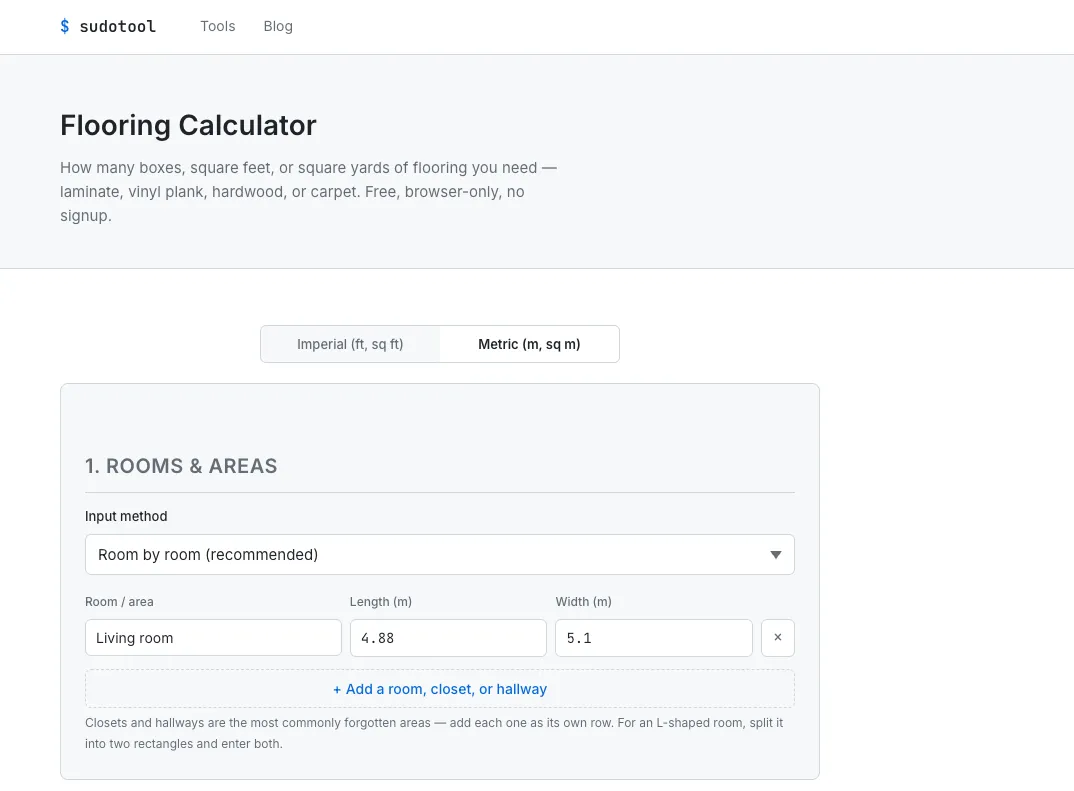
Once the planks are acclimated, the calculator turns the room into square footage and a box count.
Frequently Asked Questions
Do you need to acclimate vinyl plank flooring?
Usually yes. Most manufacturers require you to acclimate vinyl plank flooring for at least 48 hours in the actual install room, with the HVAC running at a normal living temperature of about 65 to 85°F. Some rigid-core SPC products are an exception and state acclimation is not required, so always follow your specific product's install guide.
How long does vinyl plank flooring need to acclimate?
Forty-eight hours is the most common requirement, but it ranges by product from 24 to 72 hours, and some rigid-core lines require none at all. If the planks were exposed to cold during transit or the temperature swung a lot, 72 hours or more is the safer choice. Your product's install guide has the exact figure.
What temperature should the room be when acclimating vinyl plank?
A normal living temperature, most often cited as 65 to 85°F, though some manufacturers state a wider 55 to 85°F. The HVAC should be running, and you should avoid direct sunlight on the floor during acclimation and installation. Hold the same temperature during the install and for at least 24 hours afterward.
What happens if you don't acclimate vinyl plank flooring?
As the planks adjust to room temperature after installation, they can shrink and leave gaps, or expand and buckle or peak at the edges. Surface unevenness can also telegraph through. Many manufacturers list acclimation as a warranty condition, so skipping it can void your warranty and leave you to pay for repairs.
Do rigid-core SPC vinyl planks need to acclimate?
Not always. SPC is dimensionally stable, so products like COREtec Pro and Shaw Floorté state acclimation is not required. But this is product-specific, not a rule for all SPC — Mohawk SolidTech is also rigid SPC and still requires 48 hours. Check your exact product's install guide rather than assuming.
Should you open the boxes while acclimating vinyl plank?
Lay the boxes flat in neat stacks in the install room and leave them closed unless your manufacturer says otherwise. Storing boxes upright can cause the planks to warp. The point is to let the sealed planks sit in the room's air at a stable temperature, not to expose them, so keep the stacks flat and the room conditioned.
These are general guidelines, not a substitute for your product's instructions. Acclimation times and conditions vary by product, so always follow the manufacturer's installation guide and warranty terms for your specific plank, and consult a professional installer if you are unsure.
- Shaw / COREtec Pro — Residential Installation Guidelines for SPC Products. "Acclimation of material prior to installation is not required"; install in a climate-controlled environment, ambient 55–85°F (13–29°C), average 70°F.
- Shaw — Floorté Installation Guidelines. Acclimation of material prior to installation is not required; same 55–85°F climate-controlled install condition.
- Pergo — Pergo Extreme Installation Instructions. "Pergo Extreme Luxury Vinyl Flooring must be acclimated in the room of Installation between 55-85°F (13-30°C) for a period of at least 48 hours before installation"; hold the range during install and 24 hours after.
- Pergo — Pergo Extreme Ultra WetProtect Installation Instructions (PDF). No acclimation required if the product is 45–115°F (7–46°C); 24–48 hours still advised for best results.
- LX Hausys — Why Do I Need To Acclimate When Doing Vinyl Plank Flooring?. At least 48 hours (72+ if conditions fluctuated), 65–85°F; vinyl reacts to its environment like wood or laminate; skipping can void the warranty and cause warping, gapping, or buckling.
- Mohawk — SolidTech Installation Instructions (PDF). Acclimate in the room at least 48 hours at 55–85°F (13–30°C), maintain 24 hours after; store and transport flat in neat stacks, never upright.
- Karndean — LooseLay Installation Guidelines. Run the HVAC at least 48 hours before, during, and 24 hours after installation; maintain 65–85°F; block direct sunlight during acclimation and installation.
- Swiss Krono — Acclimating: Why It's Essential to Wait 48 Hours. Wait a full 48 hours at 64–86°F; "skipping the proper acclimation process will void your warranty"; improper acclimation can cause a buckling or gap-ridden floor. (Guidance written for laminate; the same temperature-driven principle applies.)