Which Direction Should You Lay Vinyl Plank Flooring?
Get the direction wrong and a perfectly good floor can make a room feel smaller and more closed-in — yet the planks themselves are fine. Direction costs nothing to change before you start, and it moves the result more than almost any other decision.
Knowing which direction to lay vinyl plank flooring is the layout call that quietly sets the tone for the whole room. Most spaces come down to one of two rules — run the planks toward the main light, or run them parallel to the longest wall — and the rest is knowing what to do when those rules disagree, what hallways and open-plan spaces need, and whether the floor joists underneath should have any say at all.
This guide covers (1) the three rules for plank direction and which one wins when they conflict, (2) a room-by-room direction chart, (3) what to do in hallways and across an open-plan home, (4) when — and whether — floor joists actually matter for a floating floor, and (5) how diagonal and herringbone patterns change both the look and the amount you need to buy.
Three Rules for Which Direction to Lay Vinyl Plank Flooring
Nearly every recommendation you will read for which direction to lay vinyl plank flooring collapses into three rules. They usually agree; the skill is knowing the order to apply them in when they don't.
Rule 1 — Follow the main light. The most common starting point is to run planks in the same direction as the light from the largest window, so the boards run with the light rather than across it. Bob Vila's install guide puts it this way: "Second, for south-facing walls (in the northern hemisphere), it makes sense to install the planks north to south, as the sun's rays pouring through the windows can complement the texture." A flooring manufacturer's guidance lands in the same place — flooring is typically installed in the same direction as the leading source of natural light, and luxury vinyl is no exception. There is an honest counter-view: some installers run planks perpendicular to a large window or glass door instead, on the grounds that it reduces visible seams and evens out glare. Both are defensible. Running with the light is the more common default; running across it is a reasonable choice if hiding seams matters more to you than emphasizing the grain.
Rule 2 — Run parallel to the longest wall. When the light is ambiguous, the standard default is to lay planks parallel to the longest wall. The eye follows the boards from one end of the room to the other, so the space reads as longer and more open, and running along the long wall also means fewer cuts and a little less waste. It is the rule most rooms fall back on, and in a small room it does the most visible work.
Rule 3 — Follow the traffic in hallways and entries. In a corridor or a narrow room, run the planks lengthwise, down the direction people walk. That keeps a hallway from being chopped into short pieces that read like the rungs of a ladder, and it draws the eye forward into the space.
When the rules disagree, work down this order:
- Open-plan space? One unified direction across the whole area beats every other rule — more on that below.
- A hallway that connects several rooms? Set the hallway's direction first, then work outward into the rooms it feeds.
- A single enclosed room? It is light versus longest wall — and most of the time they already agree, because the biggest window usually sits on the longest wall. When they genuinely split, leading with the light reads the most natural.
| Rule | Lay the planks | What it does | When it takes priority |
|---|---|---|---|
| Main light | In line with the main window / light | Light runs with the grain; looks intentional, seams less obvious | There's a clear, dominant window (the usual first choice) |
| Longest wall | Parallel to the longest wall | Room feels longer and wider; fewer cuts and less waste | Light is ambiguous, or the room is small |
| Traffic flow | Lengthwise down halls and entries | Avoids a choppy "ladder" look; draws the eye forward | Hallways, corridors, and entryways |
| Floor joists | Perpendicular to the joists (only if relevant) | Adds rigidity, reduces bounce | Only over an older wood subfloor with noticeable give |
A Room-by-Room Direction Chart
Most real situations map cleanly onto one recommendation. Here is the quick reference:
| Situation | Recommended direction | Why |
|---|---|---|
| Room with one big window wall | Toward that window (with the light) | Light runs along the boards and emphasizes the grain; seams read less |
| Long rectangular room, light unclear | Parallel to the longest wall | Maximizes length and openness, minimizes waste |
| Narrow hallway or entry | Lengthwise, entrance inward | Adds depth so the corridor feels longer |
| Open-plan kitchen / dining / living | One direction throughout (usually parallel to the longest outside wall) | Reads as a single continuous floor |
| Adjacent rooms separated by a door | Same direction if you can; if not, switch at the doorway | Hides the change on a natural visual break |
| Over a concrete slab | Choose by looks; ignore joists | There are no joists under a slab to consider |
| Over an older wood subfloor with bounce | Perpendicular to the joists | Adds rigidity where the structure has some give |
| You want a diagonal or herringbone look | A design choice, not a rule | Stronger visual effect, but more waste — see below |
Which Way in a Hallway or Narrow Room
Hallways have the clearest answer of any space: run the planks lengthwise, from the entrance toward the far end. A corridor laid this way gains depth and reads as longer and more spacious; laid the other way, across its width, it breaks into short stubs that look like rungs. The same logic applies to any narrow room — follow the long dimension, not the short one.
The complication comes when a hallway connects several rooms at once. There, the hallway is the spine, so its direction should be decided first and the adjoining rooms made to match. Picking a pretty direction for one bedroom and then fighting the hallway is how a whole-house floor ends up looking disjointed. Settle the corridor, then work outward.
One Direction Through Open-Plan and the Whole House
In an open-plan home — where the kitchen, dining, and living areas share one uninterrupted floor — continuity beats every per-room optimization. Run the planks in a single consistent direction across the whole space so it reads as one continuous surface. Change direction partway through an open area and most people notice the seam immediately; it looks like two floors that happen to meet. When one direction can't be ideal for every zone, the usual best compromise is to run parallel to the longest outside wall, which tends to line up with the main window wall anyway.
Rooms that are fully closed off by doorways are a different case — there you can change direction if you want to, but make the switch at the doorway, where a transition strip falls on a natural break in the line of sight. A direction change stranded in the middle of an open floor looks like a mistake; one tucked under a door reads as deliberate. The same instinct extends vertically: where a floor continues up a staircase to another level, keeping the same direction from one floor to the next holds the look together.
Transition strips at those doorways and thresholds are their own small topic — what matters here is simply that the doorway is the place to put any change, not the open floor.
Do Vinyl Planks Need to Follow the Floor Joists?
This is where vinyl plank parts ways with the old hardwood rule, and it is worth being precise about. Solid hardwood is traditionally nailed down perpendicular to the floor joists, because the boards span the joists and that crosswise run stiffens the floor and prevents sagging and squeaks. That rule is real — for a fastened floor.
Vinyl plank is usually a different animal. Most luxury vinyl plank and laminate are installed as floating floors: the planks click together and rest on top of the subfloor without glue, nails, or staples, held together by the locking edges rather than fixed to the structure. Because the floor isn't fastened down, its support comes from a flat, stable subfloor — not from lining the boards up with the joists. The requirement that actually matters for a floating floor is flatness, typically within about 3/16 inch over a 10-foot span, not joist orientation. So over a flat plywood or OSB subfloor with underlayment, or over a concrete slab, you are free to choose direction by looks alone.
There is one exception worth checking before the first row goes down. On an older wood subfloor that has developed some bounce, running the planks across the joists can still help. As one installation guide frames the trade-off: "On a concrete slab, joist direction is entirely irrelevant. For most modern click-lock products, this isn't a make-or-break decision, but on an older wood subfloor with noticeable give, it's worth checking before the first row goes down." In other words: most modern installs let the look win, and the perpendicular-to-joists move is a niche fix for a springy old subfloor — not a rule that overrides your light and longest-wall decisions.
Diagonal and Herringbone: Direction as a Design Choice
Direction doesn't have to mean "which wall." Laid at 45 degrees, a diagonal floor pulls the eye toward the corners and can make an oddly shaped room feel wider; herringbone and chevron turn the planks into a pattern in their own right. Both are design statements rather than orientation rules — and both cost more material. A diagonal layout runs about 15 percent waste, and herringbone or chevron lands around 15 to 20 percent, because the angled end cuts leave offcuts that rarely fit anywhere else. If you are weighing one of these, our guide on the flooring waste factor by pattern breaks the numbers down. The practical point: the moment direction becomes a pattern, you need to buy more, so recheck the box count before you order.
Once you've settled the direction and the pattern, the materials math is the easy part — enter your room and let the tool size the order, with the right waste factor already applied:
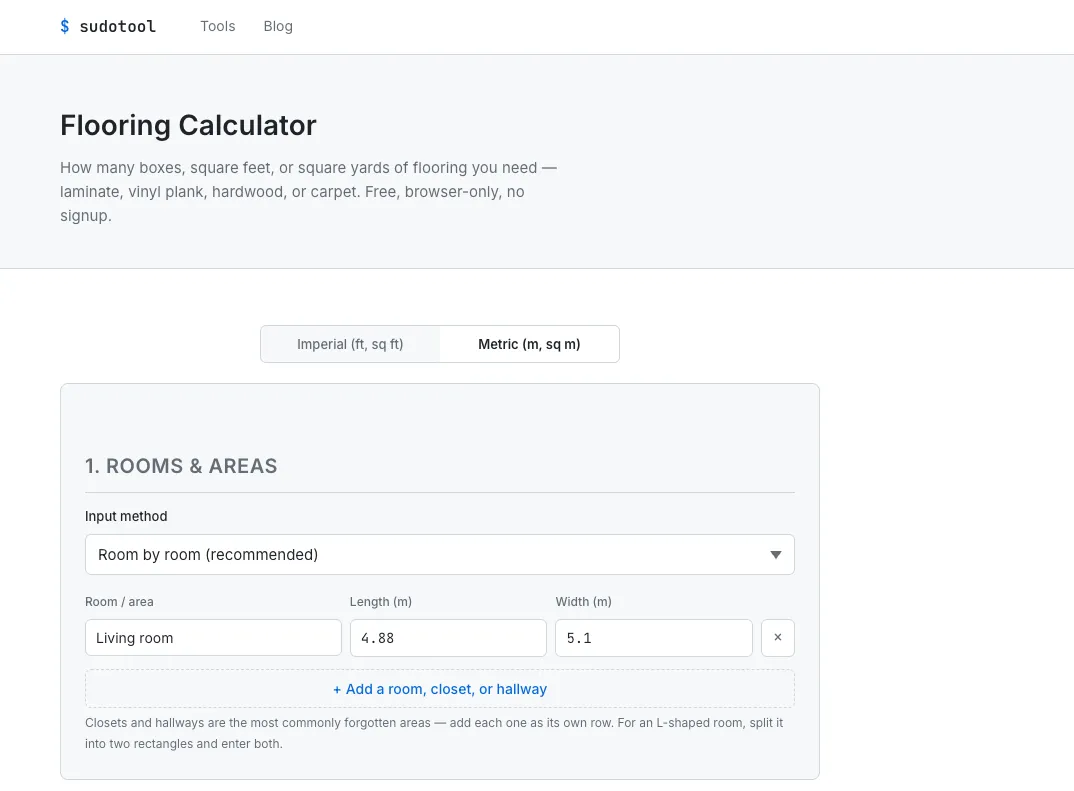
Once the direction and pattern are set, the calculator turns the room into square footage and a box count.
Frequently Asked Questions
Which direction should you lay vinyl plank flooring?
Run the planks toward the main light source — usually the largest window — or parallel to the longest wall, which is the most common default. When those two point different ways, leading with the light tends to look the most natural. Run hallways lengthwise, and keep one direction across connected open spaces.
Should vinyl plank run the same direction in every room?
In open-plan spaces that flow together, yes — one direction reads as a single continuous floor and avoids a visual break. Rooms fully separated by doorways can change direction, but make the switch at the doorway with a transition strip so the change lands on a natural break instead of mid-floor.
Does vinyl plank flooring need to follow the floor joists?
Usually not. Floating vinyl plank is not fastened to the subfloor, so it is not tied to joist direction the way nail-down hardwood is. Over flat plywood or a concrete slab, choose direction by looks. The exception is an older wood subfloor with noticeable bounce, where running perpendicular to the joists adds rigidity.
Which way should you lay vinyl plank in a hallway?
Lengthwise, running the planks down the length of the hall from the entrance inward. That adds depth and makes a narrow corridor feel longer, instead of chopping it into short pieces that look like rungs. If the hallway connects several rooms, set its direction first and let the rooms follow.
Should vinyl planks run parallel or perpendicular to a window?
The most common choice is parallel to the light from the main window, so the boards run with the light and the grain reads cleanly. Some installers go perpendicular instead to reduce visible seams and even out glare. Both are defensible — it comes down to the room and the look you want.
Does plank direction affect how much flooring you need?
A straight layout parallel to the longest wall keeps cuts and waste lowest. Diagonal layouts add about 15 percent waste and herringbone or chevron 15 to 20 percent, because the angled end cuts leave offcuts that rarely fit elsewhere. If you switch to a pattern, recheck the box count before ordering.
These are general layout guidelines, not a substitute for your product's instructions. Always follow the manufacturer's installation directions for your specific plank and subfloor, and confirm any structural concerns with a professional before you begin.
- Bob Vila — How to Install Vinyl Plank Flooring. Three direction rules: follow the plank flow through hallways and connecting rooms; for south-facing walls in the northern hemisphere, run north to south so light complements the texture; otherwise install along the longest walls.
- MSI Surfaces — The Right Way To Lay LVP. Manufacturer guidance: install in the same direction as the leading natural light; run parallel to the longest wall to make small rooms feel bigger; lay hallways and long rooms lengthwise; keep direction consistent floor to floor.
- Minimal and Modern — Which Direction to Lay Vinyl Plank Flooring: A Simple Guide. Reference for the joist nuance: running perpendicular to joists adds rigidity over an older wood subfloor with give, while joist direction is irrelevant on a concrete slab and not a make-or-break decision for most click-lock products.
- Coohom — Which Direction to Lay Vinyl Plank Flooring. Reference for laying planks perpendicular to a primary light source to reduce visible seams, running lengthwise in hallways, keeping one direction across adjoining areas, and placing transitions at doorways.