How Much Does It Cost to Floor a 12x12 Room?
Same room, same 144 square feet — and quotes that swing from a few hundred dollars to several thousand. Two things explain the gap: the material you pick, and who lays it.
The cost to floor a 12x12 room is one of those numbers that seems like it should have a single answer and doesn't. A 12-by-12 room is 144 square feet of floor — but depending on whether you lay a budget laminate yourself or have porcelain tile installed, the bill runs anywhere from about $200 to well over $4,000. The spread comes down to two levers: the material, and the labor, which is often close to half the total. This guide breaks the cost down by material so you can see where your project lands.
This guide covers what a 12x12 floor costs by material (DIY versus installed), what makes up the price beyond the flooring itself, when doing it yourself pays off, why two quotes for the same room can differ so much, and three sample budgets. To turn your square footage into an exact materials order, see how many boxes of flooring you need.
What It Costs to Floor a 12x12 Room, by Material
Here is the 144-square-foot room priced out by material — materials only (the DIY path) and the total installed by a professional. Figures are 2026 ranges from This Old House's cost guides; the wide bands reflect the gap between budget and premium product, and between a simple square room and a complicated one.
| Material | Materials only (DIY) | Installed (pro) |
|---|---|---|
| Laminate | $145–$575 | $720–$1,730 |
| Luxury vinyl plank (LVP) | $430–$1,440 | $865–$2,880 |
| Carpet | Usually pro-installed | $430–$1,585 |
| Engineered hardwood | $430–$1,440 | $865–$3,310 |
| Solid hardwood | $430–$1,440 | $720–$4,030 |
| Ceramic / porcelain tile | Usually pro-installed | $1,585–$6,915 |
The pattern is clear: laminate and vinyl plank anchor the affordable end, especially as a do-it-yourself job, while solid hardwood and tile sit at the top once professional labor is added. Tile is the outlier — even a modest ceramic can land above hardwood once installed, because the labor is the most demanding of any common floor. Per square foot, the installed ranges work out to roughly $5–$12 for laminate, $6–$20 for LVP, $3–$11 for carpet, $6–$23 for engineered and $5–$28 for solid hardwood, and $11–$48 for ceramic or porcelain tile.
Two things help when you read those bands. The low end of each row is a builder-grade product in a simple, square room with nothing wrong underneath; the high end is a premium line, a fussy layout, or both. Most real 12x12 jobs land somewhere in the middle of their row, not at either edge — so if you want a single number to start from, take the midpoint of the material you are leaning toward and treat the rest of this guide as the reasons it moves up or down.
What Goes Into the Price
The flooring itself is only part of a quote. For a 12x12 room, the line items that add up are:
- Materials — the flooring, priced per square foot and bought for about 158 square feet once you add a 10% waste factor to the 144 you measured.
- Labor — usually 30–50% of an installed quote. It is lowest for click-together floating floors, higher for glue-down and nail-down wood, and highest for tile at roughly $3–$15 per square foot.
- Underlayment or pad — a foam or cork underlayment for hard flooring, or carpet pad at about $0.75–$2 per square foot. Many vinyl planks come with the pad attached, which removes this line entirely.
- Old-floor removal — tearing out and disposing of the existing floor typically adds $1–$3.50 per square foot.
- Subfloor repair — if the subfloor is uneven or damaged, leveling or patching it can run $1.50–$7 per square foot. It is the most common surprise on an otherwise simple job.
- Trim and transitions — baseboard or quarter-round, plus the transition strips at doorways. Small per room, but easy to forget when you are budgeting.
For a straightforward 12x12 over a sound subfloor, the materials and labor dominate and the rest is minor. It is the removal and subfloor lines that quietly turn a tidy estimate into a bigger one.
The Add-Ons That Catch People Out
Those per-square-foot extras are easy to wave off until you put them on a 144-square-foot room. Here is what each one actually adds to a 12x12:
- Removing the old floor: about $144–$504. At $1–$3.50 per square foot, tear-out and disposal is the line most likely to catch you out — and the one a floating floor laid over the existing surface can erase entirely.
- Underlayment: roughly $45–$75. A foam or cork roll for a hard floor, unless your planks already have a pad attached. Carpet pad costs more, at $0.75–$2 per square foot, or about $108–$288 for the room.
- Subfloor leveling or repair: $216–$1,008 if it is needed. At $1.50–$7 per square foot, an uneven or soft subfloor is the single biggest swing on an otherwise simple job — and it stays invisible until the old floor comes up.
- Trim and transitions: roughly $50–$150. New quarter-round or baseboard plus the strips at each doorway. Minor on their own, but they belong in the budget.
Stacked together, these can add 30 percent or more on top of the flooring itself. They are also where two estimates most often part ways: one assumes a clean, bare, level subfloor, and the other prices the room you actually have.
DIY vs. Hiring a Pro
Because labor is so much of the bill, who installs the floor is the biggest single decision for the budget. Skip the installer on a 12x12 room and you typically cut 30–50% off the total — often several hundred dollars, and more on the pricier materials. On luxury vinyl plank, where installation labor runs $3–$10 per square foot, that labor alone comes to $430–$1,440 on a 144-square-foot room — the entire amount a confident do-it-yourselfer keeps.
The catch is that not every floor is equally DIY-friendly. Click-together laminate and luxury vinyl plank float over the subfloor with no glue or nails, which is why they are the usual starting point for a first-timer — and because they can often go over the existing floor, they sidestep removal costs too. Solid hardwood (nailed down) and tile (set in mortar, leveled, grouted, and left to cure) are far less forgiving; a mistake there is expensive to undo, and both are usually worth a professional. The honest trade is real: weigh the labor you would save against the tools, the time, and the cost of getting it wrong.
Why Two Quotes for the Same Room Differ
It is common to get two estimates for an identical 12x12 room that are hundreds of dollars apart. The room didn't change; the variables behind the number did:
- Material grade. Within a single category, a builder-grade product and a premium line can differ two- to fivefold per square foot. "Laminate" alone spans most of the affordable range.
- Room complexity. Closets, angles, and lots of doorways mean more cuts, more waste, and more labor hours than a clean rectangle.
- Removal and subfloor. One quote may assume the old floor is gone and the subfloor is flat; another may price in tear-out and leveling. Always check what each estimate includes.
- Region. Labor rates vary widely by metro area, so the same install can cost noticeably more in one city than another.
- Transitions and extras. Stairs, thresholds, and trim are sometimes itemized separately and sometimes folded in, which alone can move a quote.
Three 12x12 Budgets
To make the ranges concrete, here are three realistic ways a 144-square-foot room shakes out:
- Budget, DIY (~$435): click-together laminate at about $2.50 per square foot for roughly 158 square feet (~$395), plus an underlayment roll (~$40), installed yourself over a sound existing floor.
- Mid-range, professional (~$1,300): luxury vinyl plank installed at about $9 per square foot across 144 square feet — add $150–$500 if the old floor needs to come out first.
- Premium, professional (~$2,300): solid hardwood installed at about $16 per square foot, before any removal or subfloor work. Tile at a similar rate lands in the same neighborhood and climbs from there.
Treat these as checkpoints: if a quote lands near one of them, it is in normal territory; if it is far off, ask what is — or isn't — included.
Ways to Spend Less on a 12x12 Floor
If the quotes are coming in higher than you hoped, most of the savings on a 12x12 room hide in the same few places:
- Install it yourself. Labor is 30–50 percent of the bill, and a click-together laminate or vinyl plank is within reach of a careful first-timer. This is the largest single saving on the list.
- Float over the existing floor. If the old surface is sound and flat, a floating floor can go right on top — skipping the $144–$504 removal cost on a 144-square-foot room.
- Choose mid-tier, not premium. The step from budget to mid-range product is small; the step from mid-range to premium is where the price balloons. A solid mid-tier laminate or LVP looks and wears well for far less than the top of the line.
- Buy in stock, not special order. In-stock product is cheaper than a custom order and avoids delivery surcharges, and off-season or clearance pricing helps further.
- Do the prep yourself. Even when a pro installs, you can clear the room, pull the baseboards, and haul the old floor away — labor you would otherwise be paying for.
None of these change the floor you end up with. They change who does the work and how much of the price is product rather than labor.
Whichever route you pick, the materials half of the budget is the easy part to nail down — enter your room and let the tool size and price the order:
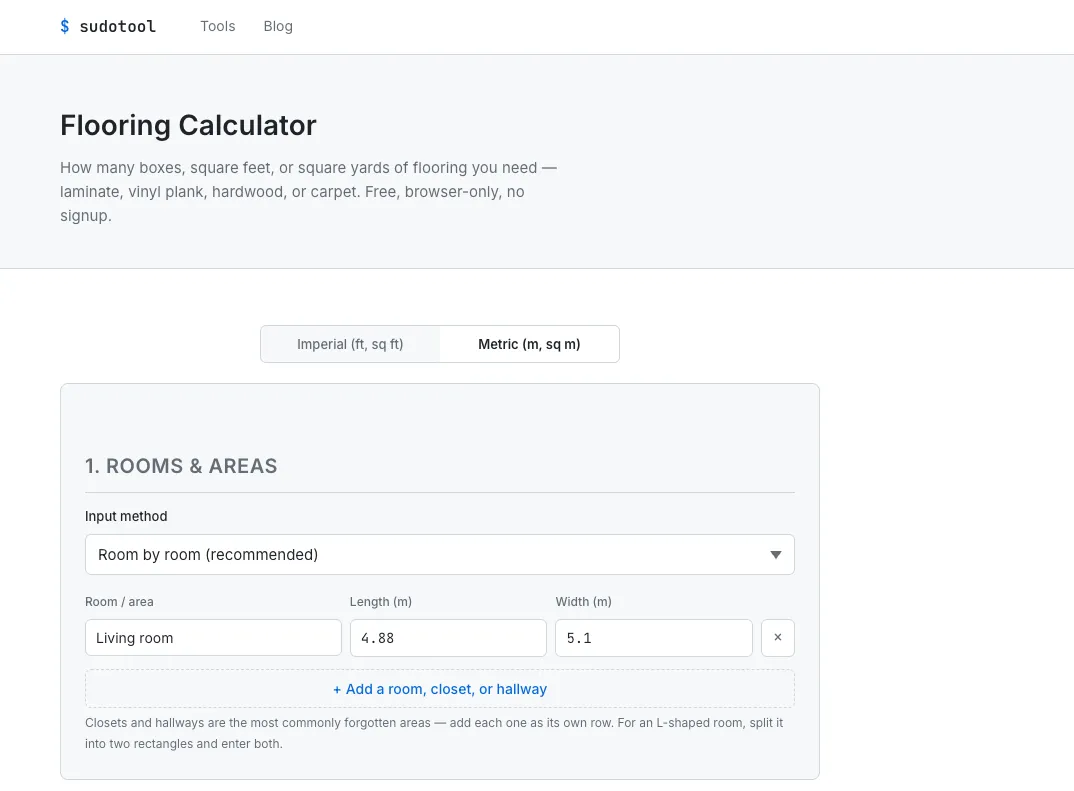
The flooring calculator turns a 12x12 room into square footage, a box count, and an estimated materials cost — the DIY half of the budget.
Frequently Asked Questions
How much does it cost to floor a 12x12 room?
A 12x12 room is 144 square feet. Expect roughly $150 to $600 in materials if you DIY a laminate floor, about $700 to $3,300 installed for most mid-range materials (laminate, luxury vinyl plank, engineered wood, or carpet), and $2,000 to $5,000 or more for solid hardwood or tile installed by a pro. Labor is often close to half the total.
How much does it cost to put laminate in a 12x12 room?
Laminate runs about $1 to $4 per square foot for materials and $5 to $12 installed, so a 144-square-foot room is roughly $145 to $575 in materials or $720 to $1,730 installed. Laminate is one of the easiest floors to install yourself, which is where most of the savings come from.
Is it cheaper to install flooring yourself?
Yes. Labor is typically 30 to 50 percent of an installed quote, so doing a 12x12 room yourself can save several hundred dollars. Click-together laminate and luxury vinyl plank are the most DIY-friendly because they float over the subfloor; solid hardwood and tile are better left to a pro.
What is the cheapest way to floor a 12x12 room?
The cheapest route is a click-together laminate or vinyl plank installed yourself over the existing floor. Floating it avoids both labor and the $1 to $3.50 per square foot cost of tearing out the old floor, which can bring a 12x12 room in for a few hundred dollars in materials.
Does the price include removing the old floor?
Usually not. Tearing out and hauling away the old floor typically adds $1 to $3.50 per square foot on top of the new flooring. Floating floors like laminate and vinyl plank can often go right over the old surface, which is one way to avoid that cost.
Why is tile so much more expensive to install?
Tile has the highest labor cost of any common floor — about $3 to $15 per square foot — because it involves mortar, leveling, cutting, and curing time. Even when the tile itself is inexpensive, that labor pushes a tiled 12x12 room well above a laminate or vinyl one.
The figures here are 2026 estimates drawn from published cost guides and are meant for budgeting, not as a quote. Real prices vary widely by material grade, region, room condition, and contractor — get itemized local estimates, and confirm exactly what each one includes (removal, subfloor prep, trim) before you commit.
- This Old House — Laminate Flooring Installation Cost. Materials $1–$4/sq ft, installed $5–$12/sq ft, ~$720–$1,728 for a 144 sq ft room, plus labor, underlayment, and subfloor figures.
- This Old House — Vinyl Plank Flooring Cost. Luxury vinyl plank materials $3–$10/sq ft, installed $6–$20/sq ft, labor $3–$10/sq ft.
- This Old House — Hardwood Flooring Cost. Solid hardwood installed $5–$28/sq ft, engineered $6–$23/sq ft, materials $3–$10 and labor $3–$8/sq ft.
- This Old House — Carpet Installation Cost. Installed $3–$11/sq ft, labor $0.50–$1/sq ft, pad $0.75–$2/sq ft.
- This Old House — Tile Floor Cost. Ceramic installed $11–$39/sq ft, porcelain $13–$48/sq ft, labor $3–$15/sq ft.