How Many Boxes of Flooring Do I Need?
Most guides end the math with one line: measure the room, then divide by the coverage on the box. That single sentence hides the three things that actually decide your order.
Figuring out how many boxes of flooring you need looks like simple division: take your square footage and divide by the coverage on the box. And it is — right up until you notice that box coverage is not a fixed number. It swings from about 18 to 35 square feet depending on what you buy, you can never purchase a partial box, and whether you keep one matching box decides if a future repair takes twenty minutes or replaces a whole floor. This guide is about that last step: converting square feet into an accurate box count without over- or under-buying.
This guide assumes you already have two numbers — your square footage and your waste percentage — and focuses on the step most people rush. Need those first two? Start with how to measure a room for flooring and the flooring waste factor by pattern. Below: how many square feet are in a box by flooring type, the box-count formula, a chart for common room sizes, the hidden cost of rounding up, and when to buy an extra box.
How Many Square Feet Are in a Box of Flooring?
There is no single answer, and that is the first thing to get right. Box coverage is set by the manufacturer and printed on every carton, and it changes with plank size, thickness, and how many pieces the box holds. Across the floor types sold at major retailers, most boxes land between roughly 18 and 24 square feet — with wide-plank engineered hardwood the main exception, reaching into the low 30s.
Here is how the typical ranges break down, with real figures pulled from current Home Depot listings:
| Flooring type | Typical coverage per box | Real examples (per box / carton) |
|---|---|---|
| Laminate | 18–22 sq ft (some 16–24) | Pergo XP ~19.6–20.2; TrafficMaster 18.7–23.9 |
| Luxury vinyl plank (LVP / SPC) | 20–24 sq ft | Lifeproof 20.1; Home Decorators Captiva 21.4; A&A Surfaces 23.8 |
| Solid hardwood | 20–24 sq ft | Bruce oak: 20 (2¼″), 22 (3¼″), 23.5 (5″) |
| Engineered hardwood | 21–35 sq ft | Lifeproof 21.7; Shaw 31.1; Century 35.1 |
| Porcelain / ceramic tile | Varies by tile size | Sold by the box; see your tile's label |
| Carpet | Not boxed | Sold by the square yard (1 sq yd = 9 sq ft) |
Two takeaways. First, the spread inside a single category is real: a narrow 2¼-inch solid oak carton covers about 20 square feet, while a 5-inch board of the same wood runs closer to 23.5 — same species, different box. Second, the gap across categories is wide enough to change your order outright. A 144-square-foot room needs eight boxes of a 20-square-foot laminate but only six of a 30-square-foot engineered hardwood. That is why the very first move is reading the coverage on your product, not assuming a round number.
The Formula: Turning Square Feet into Boxes
Once you know your box's coverage, the count is three steps:
- Start with your measured square footage. Add up every rectangle you are flooring — room, closets, hallways — and subtract large built-ins. (The full method is in our room-measuring guide.)
- Add your waste factor. A standard straight layout adds about 5 to 10 percent; diagonal and herringbone patterns need more. Home-improvement references such as Bob Vila put the general overage at 5 to 10 percent, covering cuts, the odd damaged plank, and a few spares for later. (Layout-by-layout numbers are in our waste factor guide.)
- Divide by the box coverage and round up. Whatever the division gives you, the next whole box is what you buy.
A worked example makes it concrete. A 12-by-12 bedroom is 144 square feet. Add 10 percent for a straight layout and you are buying for about 158 square feet. If your chosen plank covers 22 square feet per box, that is 158 ÷ 22 = 7.2 boxes — which becomes 8, because there is no such thing as a 0.2 box. Pick a wider engineered board at 31 square feet per box instead, and the same room is 158 ÷ 31 = 5.1, or 6 boxes. Same floor, two different shopping lists.
Why Box Coverage Varies — and How to Read the Label
The reason two products cover such different areas comes down to geometry. A box holds a set number of planks, and a box of wide, long boards simply contains more square footage than a box of narrow, short ones — even at the same price point or thickness. Thicker, more rigid planks also weigh more, so manufacturers sometimes pack fewer per box to keep it liftable. None of this is standardized across brands, which is why a number that is true for one floor tells you nothing about the next.
Every carton prints the three numbers you need: the square footage the box covers, the count of planks inside, and the batch or dye-lot number. Bob Vila's advice on this is blunt and correct — consult the packaging, because the box itself states exactly how many square feet it covers. Read it before you do any arithmetic, and read it again on every pallet you load, because stores occasionally shelve two coverage versions of the same line side by side.
The dye-lot number deserves as much attention as the coverage. Flooring is produced in batches, and shade and grain shift slightly from one run to the next. Buy the whole order at once, confirm the boxes share a batch number before you leave, and you avoid the most frustrating version of running short: a reorder that arrives a half-shade off and reveals a seam straight across the floor.
How Many Boxes for Common Room Sizes
To make the arithmetic concrete, here is how many boxes common rooms take at three coverage levels — 20, 24, and 30 square feet per box — each with a 10 percent waste factor already added and rounded up. Find the row closest to your room, then the column closest to your box's coverage.
| Room size | Area + 10% | @ 20 sq ft | @ 24 sq ft | @ 30 sq ft |
|---|---|---|---|---|
| 10 × 10 (100 sq ft) | 110 sq ft | 6 | 5 | 4 |
| 12 × 12 (144 sq ft) | 158 sq ft | 8 | 7 | 6 |
| 12 × 15 (180 sq ft) | 198 sq ft | 10 | 9 | 7 |
| 15 × 20 (300 sq ft) | 330 sq ft | 17 | 14 | 11 |
| 20 × 20 (400 sq ft) | 440 sq ft | 22 | 19 | 15 |
Read it as a sanity check, not a substitute for your own number — your real waste factor and your exact box coverage move the count. A 12-by-15 room, for instance, is 10 boxes of a 20-square-foot product but 7 of a 30-square-foot one: a three-box, real-money difference that comes entirely from coverage. When your figures sit between two columns, round toward the lower coverage so you are not the one short a box on install day.
The Hidden Cost of Rounding Up to Whole Boxes
Rounding up sounds trivial, but it is quietly its own waste factor. Because you can only buy whole boxes, the amount you actually carry home is almost always more than the percentage you planned — sometimes much more.
Take a 200-square-foot floor with a 10 percent waste factor: you are buying for 220 square feet. In boxes that cover 22 square feet, that is exactly 10 boxes, and your overage stays right at 10 percent. But in boxes that cover 24 square feet, 220 ÷ 24 = 9.17, which rounds to 10 boxes — or 240 square feet, an effective overage of 20 percent, double what you intended. Nothing went wrong; the box size alone doubled your surplus.
The pattern is worth internalizing: the larger the box coverage and the smaller the room, the bigger the rounding jump, because one box is a larger slice of a small order. It cuts the other way too — in a big room, a single rounded-up box is a rounding error. The practical lesson is not to shave your waste factor to the bone assuming that is what you will buy. The box math frequently hands you extra anyway, and that extra is exactly what you want sitting in the closet for repairs.
Should You Buy an Extra Box?
For most jobs the waste factor already leaves a few spare planks, so you may not need to add anything. But three situations make one extra unopened box — from the same dye lot — cheap insurance: a small room, where the waste percentage buys very little; a premium floor you would hate to patch with a mismatch; and any product that could be discontinued before you need a repair.
The payoff shows up years later. If a dishwasher leak or a dropped cast-iron pan ruins a few planks, a matching box turns a full-room replacement into a short swap — the same logic Family Handyman's repair guides rely on, where the easiest fix is replacing the damaged plank, assuming you saved a few. Store those spares somewhere climate-stable: wood-based and laminate planks react to humidity, so a damp basement or a baking attic can warp or embrittle them. Keep the box flat, indoors, and out of temperature swings.
And if you do over-buy, the surplus is rarely wasted money. Many retailers take back unopened boxes within a return window, so erring high and returning what you do not open is safer than coming up short and reordering a second batch that may not match. Check the return policy and keep your receipt, then buy with a little room to spare.
If you would rather not juggle coverage figures and rounding by hand, enter your rooms and let the tool size the order for you:
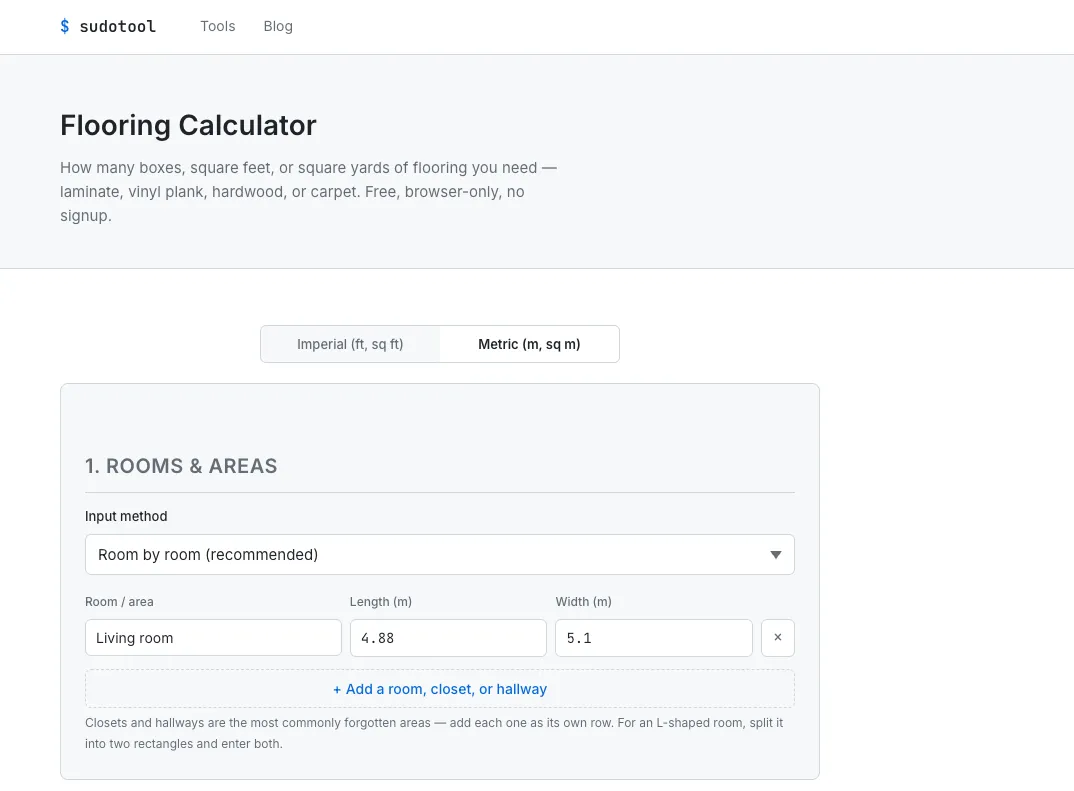
The flooring calculator turns your square footage into a box count — with the waste factor already built in, and rounded up to whole boxes.
Frequently Asked Questions
How many square feet are in a box of flooring?
Most hard-flooring boxes cover about 18 to 24 square feet, though it varies by product. Laminate and luxury vinyl plank usually run 18 to 24 square feet, solid hardwood cartons about 20 to 24, and wide-plank engineered hardwood can reach 30 to 35. The exact figure is printed on the box, so always check the label.
How do I calculate how many boxes of flooring I need?
Take your room's square footage, add a waste factor of about 5 to 10 percent for a straight layout, then divide by the coverage printed on the box and round up to the next whole box. For example, a 12-by-12 room is 144 square feet; with 10 percent waste that is about 158, and at 22 square feet per box that is 7.2, which rounds up to 8 boxes.
Do I always round up to a whole box?
Yes. Flooring is sold only in full boxes, so any fraction rounds up to the next one. That means the amount you actually buy is always a little more than your waste factor alone — and the bigger the box coverage, the bigger that rounding jump can be.
Should I buy an extra box of flooring?
For a small room, a premium product, or anything that might be discontinued, one extra unopened box from the same batch is worth it for future repairs. On larger rooms the waste factor often already leaves a spare plank or two, so a separate extra box is optional rather than essential.
Why do two boxes of the same flooring cover different areas?
Coverage depends on plank size, thickness, and how many pieces fit in a box, and those differ from one product line to the next — even within the same brand. A box of narrow 2.25-inch hardwood and a box of wide engineered planks can differ by 10 square feet or more.
Can I return unopened boxes of flooring?
Many retailers accept returns of unopened boxes within a set window, which is why buying slightly over and returning what you do not open is safer than coming up short and needing a second batch that may not match. Check the return policy and keep your receipt before you buy.
This guide summarizes general buying methods and published manufacturer and retailer figures. Box coverage and waste percentages are starting points that vary by product, layout, and room — confirm the coverage on your specific flooring's packaging, and have your retailer or installer verify the final order quantity before you buy.
- Bob Vila — How Much Flooring Do I Need? Reference for the box-count formula (total square footage ÷ per-box coverage), the 5–10% overage guidance, and reading per-box coverage off the packaging.
- The Home Depot — flooring product listings. Per-box coverage figures cited in the table, including Lifeproof LVP (20.1 sq ft/case), Bruce solid oak (20 sq ft/carton), and Shaw engineered oak (31.09 sq ft/case).
- Family Handyman — How to Replace a Flooring Plank and Basement Wood Flooring. Reference for keeping matching spare planks for repairs and for moisture-related warping when storing wood-based flooring.
- This Old House — Uses for Wood Flooring Scraps. Reference for holding back leftover material from the same lot for future patches and repairs.