The True Cost of Owning a Home Beyond the Mortgage
The payment is the number everyone shops for. It is also only about two-thirds of what the house will actually take out of your account each month.
Ask most buyers what a house costs and they will quote the mortgage payment. It is the number lenders quote, the number listing sites estimate, and the number people compare against their rent. But the true cost of owning a home includes four other line items that arrive whether or not the loan is paid off — and together they routinely add another 40% on top of the payment.
What the true cost of owning a home actually includes
Four costs sit on top of principal and interest, and they share one uncomfortable feature: they never end. Pay off the mortgage in full and the payment disappears — the property tax bill, the insurance premium, the roof, and the HOA dues keep arriving for as long as you own the place.
- Property tax — set by your county, not your lender, and reassessed periodically.
- Homeowners insurance — required by the lender, priced on the address and the structure.
- Maintenance and repairs — the only one that is invisible until it isn't.
- HOA or condo dues — zero for many homes, several hundred a month for others.
Utilities are the one people usually add to this list, and they belong in a separate bucket. Renters pay them too, so the honest way to count utilities is as a difference — the extra you pay for more square footage and for bills a landlord used to cover — not as a brand-new cost.
The only way to compare these across markets is to express them as a share of the home's value. Here is what they look like on a $400,000 home:
| Line item | Low | Mid-range | High |
|---|---|---|---|
| Property tax | $1,040 | $4,000 | $8,320 |
| Homeowners insurance | $1,000 | $1,600 | $3,000 |
| Maintenance & repairs | $2,000 | $4,000 | $6,000 |
| Total per year | $4,040 | $9,600 | $17,320 |
| Per month | $337 | $800 | $1,443 |
| As % of home value | 1.01% | 2.40% | 4.33% |
The property tax row uses real state effective rates applied to a $400,000 home: about 0.26% in the lowest-taxed state and 2.08% in the highest, per Tax Foundation data for 2022. Maintenance runs from 0.5% to 1.5% of value. HOA dues are excluded because they are all-or-nothing — add $3,600 a year to every column if the home carries $300-a-month dues.
Notice what the "mid-range" column does to a familiar piece of advice. People budget 1% of the home's value for maintenance and consider the job done. Maintenance is only about 42% of that mid-range total. The 1% rule, followed faithfully, covers well under half of what ownership costs each year.
Your mortgage payment is only about 70% of the real number
Put the two halves side by side. A $400,000 home with 20% down leaves a $320,000 loan; at an illustrative 6.5% on a 30-year fixed term, principal and interest come to about $2,023 a month. (Use our mortgage calculator for your own rate — the point here is the ratio, not the rate.)
| Low-cost | Mid-range | High-cost | |
|---|---|---|---|
| Mortgage P&I | $2,023 | $2,023 | $2,023 |
| Ownership costs | $337 | $800 | $1,443 |
| True monthly cost | $2,359 | $2,823 | $3,466 |
| Above the payment | +17% | +40% | +71% |
| P&I share of total | 86% | 72% | 58% |
The bottom row is the one worth remembering. In a low-tax state with a newer home and cheap insurance, the mortgage really is most of the cost. In a high-tax state with an older house and a hard insurance market, the payment is barely more than half of it — and the half you did not shop for is the half that keeps rising.
What the 1% maintenance rule gets right — and badly wrong
The standard advice is to budget 1% of the home's value each year for maintenance. The Census Bureau's American Housing Survey lets us check that against what owners actually spend, and the answer is not what you would guess.
Analyzing 2021 AHS data on older homes, the Census Bureau reported that "More than half of owners of older homes spent less than 1% of their home's value annually on home improvement and maintenance." The median owner of an older home spent about $1,800 a year on upkeep — and median annual spending on routine maintenance alone was around $540.
So the 1% rule overshoots what people actually spend in a typical year. It is still the right number to save, for two reasons.
Big-ticket costs are lumpy, not annual. A roof, a furnace, a water heater, a full floor replacement — each is zero in most years and then several thousand dollars in one. A median tells you about an ordinary year; it does not tell you the annualized cost of components that fail on a fifteen- or twenty-five-year cycle. The owners spending $540 are not paying less overall — many are simply between replacements. (For a sense of scale on a single item, see what it costs to put new flooring in a 12×12 room.)
Deferred maintenance does not disappear. Skipped work turns into a larger repair later, or into an inspection credit when you sell. Low spending in a given year can be a real saving or a growing liability, and the survey cannot tell them apart.
The same data explains why new buyers so often feel ambushed. The Census analysis found that "New owners spent more than longtime owners: a median of 1.5% of the home's value, compared to 0.6%." In dollars, owners who had moved in within two years spent a median of $3,900 a year on upkeep, against about $1,500 for those who had been there a decade or more — roughly 2.6 times as much. Whatever the previous owner postponed becomes yours on closing day.
Treat 1% as a sinking fund, not a forecast. In most years you will not spend it, and the surplus is exactly what pays for the year you do.
Property tax and insurance are the two that actually move
Maintenance is the cost people worry about. Tax and insurance are the ones that quietly reprice.
Property tax is decided by geography more than by the house. Tax Foundation data for 2022 put New Jersey's effective rate on owner-occupied property highest at 2.08%, followed by Illinois at 1.95% and Connecticut at 1.78%, with Hawaii lowest at 0.26%. On the same $400,000 home that is roughly $8,300 a year versus about $1,040 — an eight-fold difference driven entirely by the address. Nationally the median property tax bill was $1,815 in 2022, but that median spans everything from starter homes to mansions, which is why the rate matters more than the average bill.
Insurance has been trending in one direction. The National Association of Insurance Commissioners reported an average HO-3 homeowners premium of $1,411 in 2021, up 7.6% from the year before, and its next report found the nationwide average HO-3 premium rose a further 11.26% in 2022. Two consecutive years of high single- and double-digit increases is not the pattern of a fixed cost.
Both of these are usually collected through escrow, which produces one of the most common surprises in homeownership: your monthly payment goes up on a fixed-rate mortgage. The principal and interest portion never changes, but the escrow portion is recalculated when your tax assessment or premium changes, and the shortfall from last year is spread across next year's payments.
This is the number that decides rent versus buy
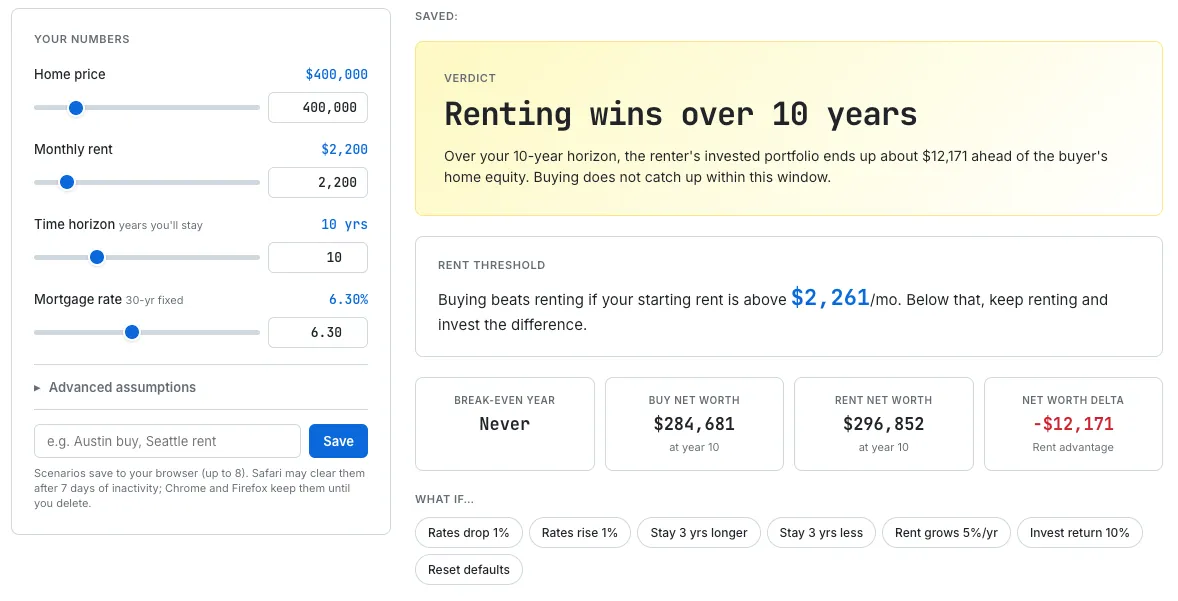
The most common mistake in a rent-versus-buy comparison is putting rent next to the mortgage payment. Rent is an all-in number. A mortgage payment is not.
Using the mid-range column, a $400,000 home is not a $2,023 housing cost. It is roughly $2,823 before a single utility bill — which means rent would have to exceed about $2,800, not $2,000, before buying wins on monthly cash flow alone. And that comparison still leaves out the opportunity cost of the down payment and the transaction costs of buying and selling, both of which our guide to whether renting is throwing money away works through in detail.
It also reframes the timing question. Because those transaction costs are front-loaded and ownership costs are continuous, the break-even horizon is usually measured in years, not months — the reasoning behind the five-year rule for buying a house.
Get your own number with five lookups
National ranges are useful for scale, but the actual figure is address-specific. Five checks will get you there:
- 1. Property tax — pull the real bill, not an estimate. County assessor sites publish the current tax for a specific parcel. Also check whether a sale triggers reassessment in that county; the previous owner's bill may not be the one you inherit.
- 2. Insurance — get a real quote before you are under contract. Premiums vary enormously by roof age, claims history, and exposure to wildfire, wind or flood. In some markets availability, not price, is the binding constraint.
- 3. Maintenance — open a separate account and fund it monthly. Start at 1% of value a year and adjust upward for an older house or original systems. A pre-purchase inspection tells you which replacements are already due.
- 4. HOA — ask for the reserve study, not just the dues. An association with thin reserves and deferred projects is a special assessment waiting to happen, and that risk is invisible in the monthly figure.
- 5. Utilities — ask the seller for twelve months of actual bills. Compare against what you pay now. The difference, not the total, is the ownership cost.
Add those five to your principal and interest and you have the number that should drive the decision — the one that tells you what the house costs, rather than what the loan costs.
Frequently Asked Questions
How much does a house cost per month besides the mortgage?
On a $400,000 home, property tax, insurance and maintenance typically add somewhere between $340 and $1,440 a month on top of principal and interest, with a mid-range figure near $800. The spread is wide mainly because state effective property tax rates run from about 0.26% to 2.08% of home value.
Is the 1% rule for home maintenance accurate?
As a prediction of this year's bill it usually overshoots. Census figures show more than half of owners of older homes spend less than 1% of home value a year on maintenance and improvements. As a savings target it still holds, because roofs, HVAC systems and other big replacements arrive all at once rather than evenly.
Do property taxes go up after you buy a house?
In many areas a sale triggers a reassessment, so your bill can be higher than the previous owner's even though nothing about the house has changed. Check the county assessor's reassessment rules and the actual current bill for that specific address before you build your budget around it.
Does a fixed-rate mortgage mean fixed housing costs?
No. The principal and interest portion is fixed for the life of the loan, but property taxes and homeowners insurance are not, and both are usually collected through escrow. Your total monthly payment can rise every year even on a 30-year fixed mortgage.
What costs do renters avoid that homeowners pay?
Homeowners pay property tax, homeowners insurance, maintenance and repairs, and any HOA dues directly. Renters cover those indirectly through rent, but they do not absorb the timing risk: a failed water heater or a jump in the insurance premium lands on the owner, not the tenant.
Bottom line
Owning a home costs roughly 1% to 4% of its value every year beyond the mortgage, and on a typical $400,000 house that is around $800 a month — about 40% on top of the payment. Property tax is set by your county and can differ eightfold between states. Insurance has risen sharply two years running. Maintenance looks cheap in most years precisely because it is expensive in a few. None of that appears in the payment a lender quotes, which is why the payment is the wrong number to compare against rent. Price the whole stack for the specific address, and the affordability question answers itself. For the loan side of the equation, see what a $400,000 mortgage really costs over 30 years.
Sources: U.S. Census Bureau — Cost of Improving and Maintaining Older Homes Higher for New Owners (2021 American Housing Survey): median upkeep spending, routine maintenance figures, and the 1.5% versus 0.6% comparison · Tax Foundation — Property Taxes by State and County: 2022 effective rates on owner-occupied housing and the national median property tax bill · Insurance Information Institute / NAIC — average HO-3 homeowners premium and NAIC — Homeowners Insurance Report for 2022. All monthly and annual totals are calculated from the rates shown and independently verified.