The History of Morse Code: How Dots and Dashes Changed the World
A portrait painter's personal tragedy, a typesetter's letter-counting trick, and the invention that made instant communication possible.
The history of Morse code begins not in a laboratory, but with a painter's grief. In February 1825, Samuel Morse was in Washington, D.C., painting a portrait of the Marquis de Lafayette. Morse was one of America's most prominent portrait painters at the time — the artist behind The Dying Hercules, exhibited at London's Royal Academy, and The House of Representatives, an enormous canvas containing over 80 portraits of congressmen, Supreme Court justices, and other notable figures.
Then a letter arrived from his father. "Your dear and deservedly loved wife is no more." His wife Lucretia, in New Haven, Connecticut, had died of a heart attack while recovering from childbirth. Washington to New Haven was a four-day journey. By the time Morse reached home, she had already been buried.
The cause of this tragedy was simple. Communication was slow. There was no way to send a message faster than a person on horseback carrying a letter. After this experience, Morse became consumed by a single obsession — finding a way to send a message to someone far away, instantly.
Ten years later, he was holding copper wire and electromagnets instead of paintbrushes. The result was the telegraph, and the language that ran on top of it was Morse code. The invention that changed the world began with one painter's personal grief.
Who Invented Morse Code?
The short answer is "Samuel Morse." The accurate answer is more complicated.
In October 1832, Morse was returning from an art study trip in Europe aboard the packet ship Sully, sailing from Le Havre, France to New York. During dinner, a Boston physician named Dr. Charles Thomas Jackson described recent discoveries in electromagnetism — including the work of Franklin, Ampère, and Faraday. An electric current could create a magnetic field, and the field disappeared when the current stopped. An idea struck Morse: what if the on-and-off pattern of an electric current could be used to transmit a coded message? He sketched an early design for an electromagnetic telegraph in his notebook during the voyage.
But Morse was a painter, not an engineer. His early prototype could send a signal no more than a short distance. Two collaborators changed everything.
First, Leonard Gale, a chemistry professor at New York University. Gale introduced Morse to a relay system invented by Joseph Henry at Princeton. A relay could amplify a weakened signal at intermediate points, allowing it to travel much farther. With Gale's help, the transmission range extended to 10 miles (16 km).
Second, and more importantly, Alfred Vail. Vail was the son of the owner of the Speedwell Iron Works in Morristown, New Jersey. He provided funding and mechanical expertise. On January 6, 1838, the first successful telegraph demonstration took place at the Speedwell Iron Works, sending a message through 2 miles (3 km) of wire.
But Vail's greatest contribution was something else entirely. Morse's original code system assigned a number to each word, requiring operators to look up words in a codebook — completely impractical. Vail scrapped this approach. He visited a newspaper typesetting shop in Morristown and counted how many pieces of each letter the typesetters kept in their type cases. More common letters had more type pieces in stock. Using this frequency data, Vail assigned the shortest code (a single dot) to the most common letter, E, and longer codes to rarer letters like Q and Z.
This frequency-based optimization significantly reduced average transmission time compared to arbitrary code assignment. And it was an idea that preceded Claude Shannon's information theory (1948) and David Huffman's optimal coding algorithm (1952) by more than 100 years. Vail had intuitively implemented the principle of data compression before the concept even existed.
The Smithsonian Institution summarizes the debate this way: Vail's contributions were "extremely significant," but "it was Morse's name that appeared on the patents." Vail left the telegraph industry in 1848, and his contributions were largely forgotten for decades.
How Does Morse Code Work?
The structure of Morse code is remarkably simple. You need only two types of signal: a short signal (dot, or "dit") and a long signal (dash, or "dah").
Every English letter, number, and punctuation mark is represented by a combination of these two signals. E is a single dot. T is a single dash. A is dot-dash. SOS is ...---.... No letter in the alphabet requires more than four symbols — keeping every character relatively short.
Timing follows a precise ratio system. The duration of one dot is the fundamental time unit, and every other element is a multiple of it:
- Dot: 1 unit
- Dash: 3 units (three times as long as a dot)
- Gap between symbols within a letter: 1 unit
- Gap between letters: 3 units
- Gap between words: 7 units
Speed is measured in words per minute (WPM), where the standard reference word is "PARIS" — which encodes to exactly 50 dot-units in Morse code. At 15 WPM, a single dot lasts 80 milliseconds.
The core principle that Morse code shares with modern encoding systems like QR codes is the same: transmitting information as efficiently as possible with minimal signals.
The First Message That Changed Everything
On May 24, 1844, Morse sat in the Supreme Court chamber of the U.S. Capitol in Washington, D.C. and tapped his telegraph key. Alfred Vail received the message at the Mount Clare railroad depot in Baltimore, 38 miles (61 km) away. The message was five words:
"What hath God wrought?"
Morse didn't choose the phrase himself. Annie Ellsworth, daughter of U.S. Patent Commissioner Henry Ellsworth, selected it from the Bible (Numbers 23:23). Morse had given her the honor of composing the first message as a gesture of gratitude — her father had supported his patent application.
The construction of the telegraph line itself is a fascinating story. Morse initially tried to lay wire underground using a specialized trench-digging plow designed by Ezra Cornell (who later founded Cornell University). Eight mules pulled the plow, cutting a trench 2 inches wide and 20 inches deep. After about 9.3 miles (15 km), the underground wire failed due to insulation problems. The team pivoted to overhead poles — 700 chestnut posts, 23 feet high, spaced 300 feet apart.
The original tape of this message is preserved at the Library of Congress.
Morse Code and the Titanic
On the night of April 14, 1912, the RMS Titanic struck an iceberg in the North Atlantic. In the forward wireless room, two Marconi Company operators were at work — Chief Wireless Operator Jack Phillips, age 25, and Junior Operator Harold Bride, age 22.
Phillips began transmitting "CQD" — the older Marconi Company distress signal (CQ meant "all stations," D meant "distress"). Bride half-jokingly suggested: "Send SOS. It's the new call, and this may be your last chance to send it." Phillips then began alternating between CQD and SOS.
The signal was picked up by the RMS Carpathia, 58 nautical miles (108 km) away. Captain Arthur Rostron immediately ordered the heating and hot water shut off, diverting all steam to the engines. The Carpathia raced through ice fields at full speed and arrived 3.5 hours later — about 1.5 hours after the Titanic had sunk. From the lifeboats, 705 people were rescued.
Jack Phillips never left the wireless room. He did not survive.
The Titanic disaster fundamentally changed wireless communication regulations. The Radio Act of 1912 made 24-hour wireless watch mandatory on all seagoing vessels. The SS Californian, a ship nearby, had not responded to the distress signals because its wireless operator had gone off duty for the night — the law ensured that would never happen again.
What Does SOS Actually Stand For?
It doesn't stand for anything.
"Save Our Souls" and "Save Our Ship" are both backronyms — phrases invented after the fact to fit the letters. SOS was adopted at the 1906 International Radiotelegraph Convention. The convention records contain no mention of any alphabetic interpretation. The signal was chosen for one reason only: the Morse code pattern ...---... (three dots, three dashes, three dots) is unmistakable and easy to transmit under stress.
In fact, SOS isn't even transmitted as three separate letters. It's sent as a single continuous pattern — no gaps between the S, O, and S. The letter breakdown is just a convenient way for humans to remember it.
SOS was officially replaced on February 1, 1999, when the Global Maritime Distress and Safety System (GMDSS) became mandatory. However, it remains recognized under international conventions as an emergency fallback signal when all other systems fail.
Is Morse Code Still Used Today?
Morse code retired from maritime communication in 1999, but it didn't die. It just changed form.
Amateur radio. Over 3 million licensed amateur radio operators are active worldwide. Morse code's CW (continuous wave) mode offers remarkable efficiency — a 5-watt CW signal can match the range of a 100-watt voice transmission. All output is concentrated into a narrow bandwidth of about 100 Hz, allowing CW signals to punch through conditions where voice is inaudible. It remains the preferred mode for low-power, long-distance communication.
Aviation. VOR (VHF Omnidirectional Range) and NDB (Non-Directional Beacon) navigation stations still transmit their three-letter identification codes in Morse code. Pilots listen for these Morse identifiers to verify they are tuned to the correct navigation aid.
Military. The U.S. Navy continues to teach Morse code to cryptologic technicians (CTR) at Naval Air Station Pensacola Corry Station. Morse code's value as a backup communication method — reliable in electronic warfare environments and when equipment fails — keeps it in active military training.
Accessibility. In May 2018, Google added Morse code input to its Gboard keyboard. The feature was developed in collaboration with Tania Finlayson, who was born with cerebral palsy. Users with motor disabilities can type using just two inputs — dot and dash — leveraging the same "maximum information from minimum signals" principle that Morse code was built on, now giving it new life in the 21st century.
The most dramatic use case. In 1966, U.S. Navy Commander Jeremiah Denton was a prisoner of war in Vietnam. When the North Vietnamese put him in front of a camera for a televised propaganda interview, Denton looked into the lens and blinked his eyes in Morse code, spelling out T-O-R-T-U-R-E. It was the first confirmation that American POWs were being tortured. Morse code can be transmitted through any medium that produces a binary signal — light, sound, tapping, blinking. This is why, 190 years after its invention, it has never been fully replaced.
Frequently Asked Questions
Who invented Morse code?
Morse code was developed by Samuel F.B. Morse and Alfred Vail in the 1830s. Morse conceived the telegraph system, while Vail designed the dot-dash alphabet by analyzing letter frequencies at a newspaper typesetting shop. The first official message was sent on May 24, 1844.
What does SOS stand for?
SOS does not stand for anything. "Save Our Souls" and "Save Our Ship" are backronyms invented after the fact. The Morse pattern ...---... was adopted at the 1906 International Radiotelegraph Convention because it is unmistakable and easy to transmit under stress.
Is Morse code still used today?
Yes. Morse code is actively used in amateur radio, aviation navigation beacons (VOR/NDB identifiers), U.S. Navy cryptologic technician training, and as an accessibility input method on Google's Gboard keyboard for users with motor disabilities.
When was the first Morse code message sent?
On May 24, 1844, Samuel Morse transmitted "What hath God wrought?" from the U.S. Capitol in Washington, D.C. to Baltimore, Maryland — a distance of about 38 miles over copper wire.
How long does it take to learn Morse code?
Memorizing the alphabet takes less than a week. Recognizing letters by ear at 5–10 WPM takes 2–4 weeks of daily practice. Reaching practical proficiency at 15–20 WPM requires 4–6 months of consistent daily practice (15–30 minutes per day).
What is the fastest Morse code transmission on record?
75.2 words per minute, achieved by Theodore Roosevelt McElroy on July 2, 1939, at the Radio Club in Asheville, North Carolina. He was copying onto a manual typewriter. This record has stood for over 85 years.
The Takeaway
Morse code is an 1830s technology. But its core principle — assigning shorter codes to more frequent information and transmitting maximum meaning with minimum signals — is the foundation of modern data compression and information theory.
190 years later, Morse code lives on in the radio waves of amateur operators, in the headphones of airline pilots, in the smartphone keyboards of users with motor disabilities, and in the blinking eyes of a prisoner of war. The form has changed. The power of dots and dashes has not.
Curious about how we built our Morse code translator — with Web Audio API sound, synchronized visual animation, and adjustable speed and tone controls? Read the dev log. The history of time zones is another 19th-century standardization story driven by the same telegraph and railroad revolution.
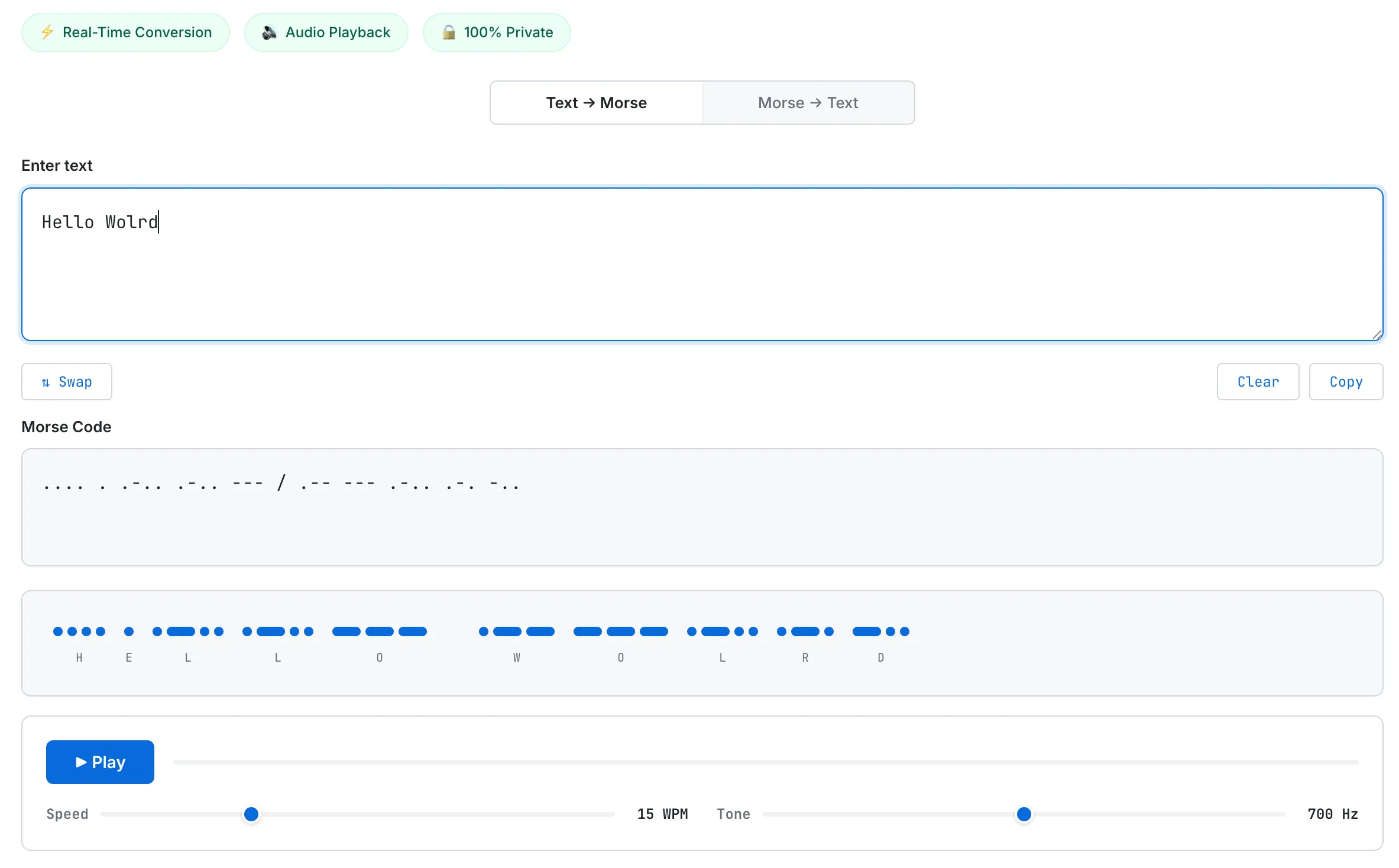
Our Morse Code Translator converts text to Morse code with visual dots and dashes and audio playback.