How Much House Can You Afford on $100K Salary in 2026? (The Honest Answer)
Lenders will say $480K. The 28/36 rule says $365K. A financial planner says $240K. Here's the math that explains the gap — and what you should actually spend.
If you make $100,000 a year and you've ever typed your salary into an online affordability calculator, you've gotten an answer somewhere between $400,000 and $500,000. That's the lender-friendly number. It's also wrong for almost everyone.
The honest 2026 answer for a $100,000 salary, after accounting for current mortgage rates, realistic taxes, insurance, and the other debts most Americans actually carry, is closer to $300,000 to $365,000. This guide walks through exactly how that range is calculated, with four side-by-side scenarios using the April 2026 rates from Freddie Mac.
The Quick Answer (Four Scenarios)
Different assumptions give very different "max home price" answers. Here are four honest scenarios, all using the April 2026 average 30-year fixed rate of 6.30% and a $100,000 gross salary ($8,333 per month):
| Scenario | Down payment | Other debts | Max home price | Monthly PITI |
|---|---|---|---|---|
| Comfortable (25% of net) | 20% | $0 | ~$240,000 | ~$1,650 |
| Conservative (28/36 rule) | 20% | $0 | ~$365,000 | ~$2,300 |
| Realistic (avg American) | 10% | $500/mo | ~$320,000 | ~$2,500 |
| FHA Stretch (lender max) | 3.5% | $300/mo | ~$480,000 | ~$3,600 |
Most online calculators show you something close to the FHA Stretch number. Most financial planners would point you toward the Comfortable number. The reality for most people sits in between — closer to the Conservative or Realistic figures. Let's walk through why.
What $100K Actually Looks Like in Your Bank Account
The first reason "lender math" feels punishing is that lenders calculate your debt-to-income ratio using gross income, not what actually arrives in your account.
For a single filer earning $100,000:
- Federal income tax + FICA: approximately $20,800 → about $79,200 take-home before state tax
- State income tax: $0 in Texas, Florida, Tennessee, Washington, etc. About $7,700 in California (effective). Most states are somewhere in between.
- Realistic take-home after a 10% 401(k) contribution: roughly $5,000 to $5,550 per month
Your lender doesn't care about any of that. They see $8,333 per month gross and apply DTI ratios to that number. The maximum monthly payment they'll approve assumes you have a magical extra $1,500 to $2,500 per month that doesn't actually exist after taxes, retirement, and life.
The 28/36 Rule (and Why Lenders Ignore It)
The traditional benchmark for housing affordability is the 28/36 rule:
- 28% front-end ratio: Your full PITI payment (principal, interest, property taxes, homeowners insurance) should not exceed 28% of gross monthly income.
- 36% back-end ratio: Your total monthly debt payments (mortgage + car loans + student loans + minimum credit card payments) should not exceed 36% of gross monthly income.
For a $100,000 salary, that's a maximum housing payment of $2,333 and a maximum total debt of $3,000.
But lenders don't enforce 28/36 anymore. Fannie Mae's automated underwriting allows up to 50% DTI with strong compensating factors. FHA loans can stretch to 56.9%. VA loans don't have a hard cap at all — they use a residual income test instead. So when an online calculator tells you "you can afford a $480K home," it's quoting the lender's max, not the financially sensible max. The gap between those two numbers is where buyers become "house poor" and miss every other financial milestone for a decade.
Mortgage Rates Right Now (April 2026)
Your monthly payment math depends entirely on the current rate. Here's the snapshot for the week of April 16, 2026, from Freddie Mac's Primary Mortgage Market Survey and Optimal Blue:
| Loan type | Rate (April 16, 2026) | Monthly P&I on $300K loan |
|---|---|---|
| 30-year fixed (conventional) | 6.30% | $1,857 |
| 15-year fixed (conventional) | 5.65% | $2,475 |
| FHA 30-year | 6.07% | $1,810 |
| VA 30-year (national avg) | ~6.24% | $1,845 |
| Jumbo 30-year | 6.43% | $1,883 |
Rates have been drifting down through April 2026 — the 30-year average dropped from 6.46% on April 2 to 6.30% by April 16, the second consecutive weekly decline. That makes today's math meaningfully better than the 7%+ rates that dominated 2024 and 2025.
The Four Scenarios in Detail
This is the meat of the post. Each scenario uses the same $100,000 salary and the same April 2026 rate of 6.30% — only the down payment, debt load, and target DTI change.
Scenario A — Conservative ($365K, the textbook 28/36 buyer)
Assumptions: 20% down, no other monthly debt, $0 HOA, 760+ credit score (no PMI).
- Maximum PITI at 28% of gross: $2,333 per month
- Working backwards from PITI: home price ≈ $365,000, loan ≈ $292,000
- Monthly P&I: $1,814 + property tax $335 + insurance $150 = $2,299 PITI
- Cash needed at closing: $73K down + ~$11K closing = ~$84K cash
This is the ceiling for a financially disciplined buyer with no other debts. The cash requirement ($84K liquid) is the practical barrier most $100K earners hit.
Scenario B — Realistic ($320K, the average American)
Assumptions: 10% down, $500/month in other debt (typical car + student loan combo), $150 HOA, 720 credit (PMI ~0.55%).
- Working backward from a 36% DTI ceiling: housing budget = $3,000 − $500 = $2,500/month
- Home price ≈ $320,000, loan ≈ $288,000
- P&I $1,783 + PMI $132 + tax $293 + insurance $150 + HOA $150 = $2,508 PITI
- Cash needed: $32K down + ~$10K closing = ~$42K cash
This is what most $100K-salary buyers actually qualify for and can afford without becoming house poor. Note that housing alone is now 30% of gross income (just over the 28% rule) but total DTI sits right at 36%. This is the edge of comfortable.
Scenario C — FHA Stretch ($480K, the lender max)
Assumptions: FHA loan with 3.5% down, $300/month student loans, lender approves 45% DTI (allowed with compensating factors), 6.07% FHA rate.
- Total housing room: 45% × $8,333 − $300 = $3,450/month
- Home price ≈ $480,000, loan ≈ $463,000
- P&I $2,807 + MIP $212 + tax $440 + insurance $150 = ~$3,609 PITI
- Cash needed: $17K down + ~$14K closing = ~$31K cash
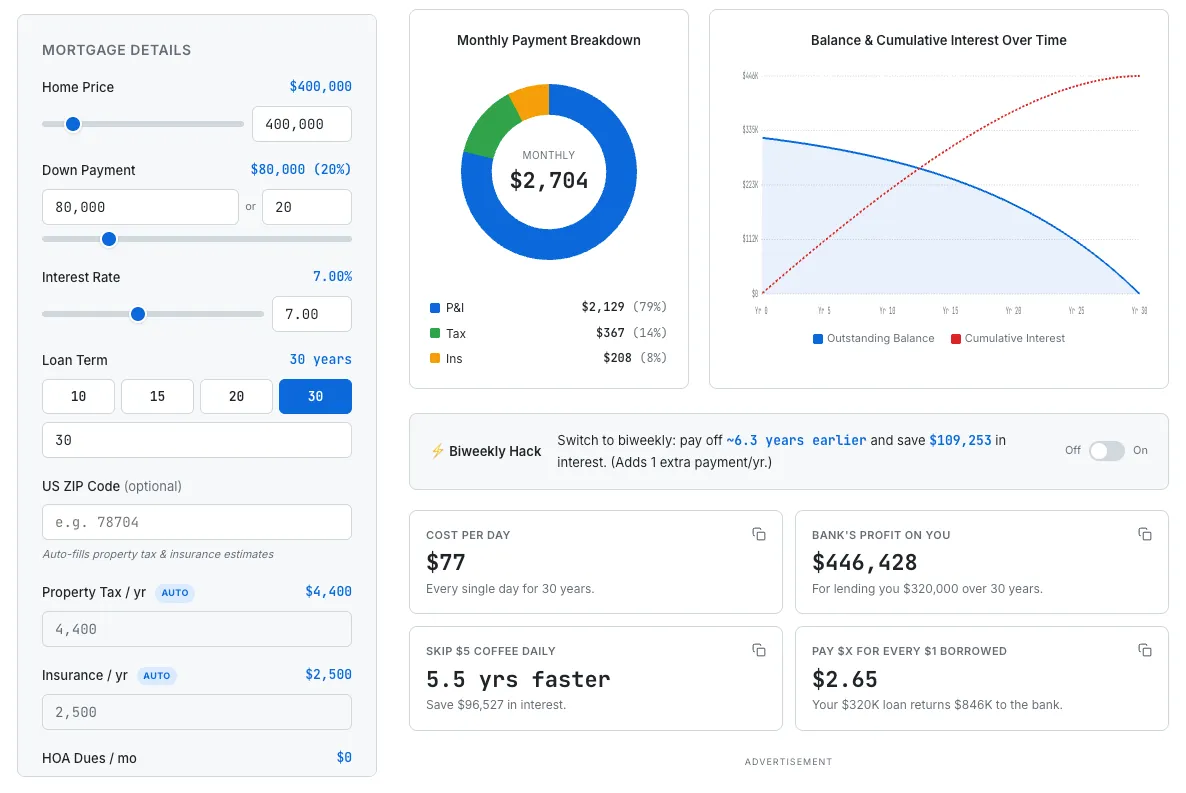
This is what online calculators often show as your "max." The cash barrier is the lowest, but the monthly cost is brutal: $3,609 of PITI is 43% of gross income and ~57% of take-home pay. Add maintenance, repairs, and one bad month, and you're refinancing or selling within five years — the exact scenario the 5-year rule for buying a house warns about, where transaction costs eat the equity you built. If you want to see exactly what these payments cost over the life of the loan, our breakdown of a $400K mortgage's real 30-year cost shows the full $446K interest tally.
Scenario D — Comfortable ($240K, the financial planner's answer)
The rule most certified financial planners actually recommend: housing should not exceed 25% of take-home pay, not 28% of gross. This protects you from being house poor.
- Take-home (after federal tax, FICA, and 10% 401(k)): ~$5,000-$5,550/month
- 25% of take-home: ~$1,300-$1,400/month for PITI
- That supports a home around $200,000-$250,000 with 20% down
Most $100K-salary buyers will refuse to limit themselves this much, especially in expensive markets. But this is the number that lets you keep saving for retirement, building emergencies funds, and surviving a job loss without panic.
The Other Monthly Debts That Crush Your Budget
This is where most affordability calculators fail you. They quietly assume you have zero other debt. Real Americans have lots:
- Average new car payment (Q4 2025): $767/month (Bankrate, citing Experian data)
- Average used car payment: $537/month
- Federal student loan payments: $200-$300/month for typical borrowers (Federal Reserve 2024); average is closer to $434 (Education Data Initiative)
- Minimum credit card payments: 2-3% of balance, often $50-$200/month
Here's the rule of thumb that hurts: every $100/month of recurring debt reduces your maximum home price by $13,000-$15,000 at current rates. Carrying a $767 car payment alone costs you $100,000-$115,000 in home buying capacity. That's the difference between a 3-bedroom house and a 1-bedroom condo.
Where Your $100K Buys (Regional Reality Check)
Using the Realistic scenario ($320K max home price) as the benchmark, here's what $100K salary actually buys in major US metros (median single-family home prices, March 2026 data):
- San Francisco: Single-family median in the city hit $2.15 million in March 2026 (up 18% YoY due to the AI boom, per Bloomberg). On $100K, you can afford about 15% of a median home. Realistically: small condo in the East Bay only.
- NYC (Manhattan): Median ~$1.2M. Brooklyn ~$880K. Effectively priced out of single-family. Studio or one-bedroom co-op in outer boroughs is the only realistic option.
- Los Angeles: Median ~$1.0M (down 5.6% YoY). $100K covers roughly 30% of median. Look at Inland Empire or condos in the city.
- Seattle: Median $550K-$700K in city, $450K-$550K in suburbs. A small home in the suburbs or a condo in the city is realistic.
- Denver: Median around $525K (down 3.2% YoY). Tight for $100K — you'll need a smaller home or a townhouse.
- Austin: Median $440K-$520K (down ~7% YoY). Workable in suburbs, tough in central Austin.
- Phoenix: Median $444K-$461K. Realistic stretch — suburbs like Goodyear and Surprise are doable.
- Atlanta: Median $388K-$485K. $100K = comfortable buyer, especially in suburbs.
- Dallas-Fort Worth: Median ~$410K. Comfortable in suburbs, tight in city.
- Chicago: Median $360K-$390K. One of the few major US metros where $100K buys a comfortable single-family home.
- Rural Mississippi: State median ~$253K. $100K salary lets you live in a $250K house with a $1,200/month payment, or buy outright in cash within four years.
The contrast is the story: the same $100K paycheck buys a six-bedroom house in Tupelo and a one-bedroom co-op in Queens. The national median home price is now $408,800 (NAR, March 2026, +1.4% YoY) — so on a $100K salary, you can afford roughly 80% of a national-median home. That's tight, and it's why "$100K salary" feels less wealthy than it sounds.
Hidden Costs Most People Forget
The PITI number isn't the full cost of homeownership. Real ownership includes:
- Closing costs: 2-5% of loan amount (Bankrate). On a $300K loan: $6,000-$15,000 due at closing.
- Moving costs: $1,000-$5,000 depending on distance and what you own.
- Furniture and immediate purchases: $5,000-$20,000 for a first house.
- Maintenance: Freddie Mac's rule of thumb is 1-3% of home value annually. On a $320K home: $3,200-$9,600 per year that calculators never show.
- Utilities: Often double what you paid in an apartment.
- Property tax escrow shortfalls: Year 2 tax bills are often higher than your initial escrow estimate, triggering a ~$100/month payment increase.
- Insurance hikes: Homeowners insurance rose 24% nationally over the past 3 years (Consumer Federation of America), with double-digit annual increases in 2023 and 2024 (S&P Global). California rates are projected to rise another 16% in 2026 (Insurify).
Pre-Approval vs. Pre-Qualification (Don't Skip This)
Before you start house hunting, get pre-approved — not just pre-qualified. The difference matters:
- Pre-qualification: Self-reported financial estimate. Lender does not pull credit or verify income. Takes 5-10 minutes online. Means almost nothing to a seller.
- Pre-approval: Lender pulls your credit, verifies income with W-2s and pay stubs, and issues a written conditional commitment. Sellers expect this. Without it, your offer goes to the bottom of the pile in any competitive market.
A pre-approval typically lasts 60-90 days. Get one when you're 30-60 days from being ready to make an offer.
How $100K Affordability Has Changed Over Time
If $100K feels like it doesn't go as far as your parents told you it would, that's because it doesn't. The home-price-to-income ratio reached a record 5.6x in 2022 per Harvard's Joint Center for Housing Studies, far above the 3-4x ratio that prevailed from the 1970s through the early 2000s. The same compound interest that makes long-term investing magical also makes long-term debt painful — your mortgage works against you the same way your 401(k) works for you.
What that means in practice: a household earning the equivalent of $100,000 in 1985 (about $35,000 in 1985 dollars) could buy a typical home priced at roughly $80,000-$110,000 — comfortably within reach. A $100,000 earner in 2026 needs to look at $400K-$500K homes to buy the same kind of house, but their salary only stretches to $300K-$365K. The shortfall isn't a personal failure. It's a structural shift in housing economics.
Smart Moves to Buy More House (Without Going House Poor)
If your goal is to maximize what you can comfortably afford, focus on these levers:
1. Pay down a credit card or two before applying
A 50-point credit score improvement can drop your interest rate by 0.25-0.50%. On a $300K loan, that's $50-$100/month — about $30K-$50K of additional home buying capacity.
2. Choose a 15-year if you can swing it (and you usually can't)
The 15-year saves enormous lifetime interest. On a $300K loan at current rates: 15-year saves about $185,000 vs. 30-year. But the monthly payment is roughly $620 higher. On $100K salary, this only works if you have very low other expenses.
3. Use biweekly payments or send extra principal
Paying half your monthly payment every two weeks creates one extra full payment per year. On a $300K loan at 6.30%, biweekly shaves roughly 5-6 years off your loan and saves ~$80,000 in interest. You can achieve the same result by adding 1/12 of your monthly P&I to each regular payment — no special biweekly arrangement needed.
4. Shop multiple lenders
Rates vary 0.25%-0.50% across lenders for the exact same borrower. Get quotes from at least three: a big bank, a credit union, and an online lender. The Consumer Financial Protection Bureau found that buyers who shop multiple lenders save an average of $300/year in interest — over 30 years, that's $9,000. Skeptical that all this matters compared to investing the down payment? Run the parallel scenario in our investment growth simulator — at the historical 7% real return on equities, $80K invested for 30 years grows to roughly $610K. Buying still wins in most scenarios, but the gap is smaller than the "American dream" narrative suggests.
Frequently Asked Questions
What house can I afford with a $100K salary?
At April 2026 mortgage rates of 6.30%, a $100,000 salary realistically supports a home in the $300,000 to $365,000 range with average debt and 10-20% down. Lenders may approve up to roughly $480,000 via FHA stretching to 45% DTI, but that path leads to being house poor.
What is the 28/36 rule?
Spend no more than 28% of gross monthly income on housing (PITI), and no more than 36% on total monthly debt. For a $100,000 salary at $8,333 gross per month, that's $2,333 max housing and $3,000 max total debt.
What's the monthly mortgage payment on a $300K home?
On a $300,000 home with 20% down at the April 2026 rate of 6.30%, principal and interest is about $1,486/month. Add property tax (~$275), insurance ($150), and HOA if applicable, and full PITI is approximately $1,910-$2,100/month.
How much down payment do I need for a $400K house?
20% conventional is $80,000 (avoids PMI). 10% with PMI is $40,000. 5% conventional first-time buyer is $20,000. FHA at 3.5% is $14,000. VA loans for eligible veterans require 0%.
Can I afford a $500K house on $100K salary?
Only with very low other debt, an FHA loan stretching to 45%+ DTI, and a willingness to spend 50%+ of take-home pay on housing. Technically possible if a lender approves, but not advisable for most buyers because it leaves no margin for emergencies.
What credit score do I need for a mortgage in 2026?
Conventional: 620+ minimum, 740+ for best rates. FHA: 580+ for 3.5% down, 500-579 needs 10% down. VA: typically 580-620 depending on lender, no official minimum.
How does $500/month in car payments affect my home buying power?
A $500 car payment reduces your maximum home price by roughly $60,000-$75,000 at current rates. Every $100/month of recurring debt cuts buying capacity by about $13,000-$15,000.
What's the difference between pre-qualification and pre-approval?
Pre-qualification is a self-reported estimate with no documents verified, takes minutes, means little to sellers. Pre-approval involves the lender pulling credit and verifying income with W-2s and pay stubs, and is a written conditional commitment. Sellers want pre-approval.
Should I get a 15-year or 30-year mortgage on a $100K salary?
On the home sizes you can afford ($300K-$365K), a 15-year mortgage saves $150K-$200K in lifetime interest, but the monthly payment is ~30% higher. Rarely affordable on $100K unless you have very low other expenses.
Do biweekly mortgage payments really save money?
Yes. Paying half your monthly amount every two weeks makes 26 half-payments per year — equivalent to 13 full payments instead of 12. On a $300K loan at 6.30%, biweekly pays off ~5-6 years early and saves ~$80,000-$90,000 in interest.
What hidden costs do new homeowners forget?
Closing costs (2-5%), moving ($1K-$5K), furniture ($5K-$20K), maintenance (Freddie Mac: 1-3% of home value annually), higher utilities, escrow shortages in year 2, insurance hikes (averaging 24% over 3 years per CFA).
Bottom Line
A $100,000 salary in 2026 honestly supports a home priced around $300,000 to $365,000 if you want to keep saving for retirement, weather a layoff, and avoid the "house poor" trap. Lenders will approve more. Online calculators will show more. Most financial planners would tell you to spend less. The right number for you depends on your other debts, your local market, and how much risk you can carry.
Don't trust a generic answer. The only number that matters is yours.