Understanding Your Earning Power: What Your Salary Really Means Per Second
You earn less than a penny per second. Here is why that number matters more than the six-figure salary on your offer letter.
What Does a Salary Calculator Per Second Reveal?
The median full-time worker in the United States earns $1,204 per week, or roughly $62,600 per year, according to the Bureau of Labor Statistics (2025). That sounds reasonable as an annual number. But break it down to the second — about $0.0084 during working hours — and you are earning less than one cent per second. A salary calculator per second does not just give you a smaller number. It gives you a fundamentally different way to think about what your time is worth.
There are two ways to calculate your per-second rate, and the choice matters:
Method 1: All hours in a year (31,536,000 seconds)
$60,000 ÷ 31,536,000 = $0.0019/sec
Method 2: Working hours only (40 hrs/week × 52 weeks × 3,600 = 7,488,000 seconds)
$60,000 ÷ 7,488,000 = $0.008/sec
Method 2 is more intuitive for most people — it answers the question "how much am I paid per second while I am working?" Method 1 is what gets used when calculating billionaire wealth growth, because investment returns do not stop on weekends. Keep this distinction in mind; it explains why comparisons between average workers and billionaires can look more dramatic than they really are.
| Annual Salary | Per Hour | Per Minute | Per Second |
|---|---|---|---|
| $30,000 | $14.42 | $0.24 | $0.004 |
| $50,000 | $24.04 | $0.40 | $0.0067 |
| $75,000 | $36.06 | $0.60 | $0.010 |
| $100,000 | $48.08 | $0.80 | $0.013 |
| $150,000 | $72.12 | $1.20 | $0.020 |
| $200,000 | $96.15 | $1.60 | $0.027 |
Even at a $100,000 salary, your per-second rate is just 1.3 cents. These numbers are small enough to be humbling, and that is exactly why they are useful.
Salary Per Second by Profession
The same second of work is valued very differently depending on what you do. Using median annual wages from the BLS Occupational Employment and Wage Statistics (May 2024):
| Profession | Median Annual | Per Hour | Per Second |
|---|---|---|---|
| Elementary Teacher | $62,340 | $29.97 | $0.0083 |
| Registered Nurse | $93,600 | $45.00 | $0.0125 |
| Software Developer | $133,080 | $64.00 | $0.018 |
| Lawyer | $151,160 | $72.67 | $0.020 |
| Surgeon | $354,760 | $170.56 | $0.047 |
A surgeon earns in one second what an elementary teacher earns in about 5.7 seconds. Over a full workday, that gap adds up to roughly $1,125. These differences reflect years of training, scope of responsibility, market demand, and the nature of the work — but seeing them on a per-second basis makes the relative value of time across professions concrete in a way that annual figures do not.
How Billionaire Wealth Growth Compares
Per-second comparisons between billionaires and average workers are all over the internet. They are striking, but they also require context.
Estimates for Jeff Bezos range from roughly $900 to $2,400 per second, depending on the time period and stock performance. Elon Musk has seen estimates as high as $7,000 to $9,700 per second during 2025, driven largely by Tesla and SpaceX valuations. These numbers come from dividing annual net-worth changes by the number of seconds in a year — they are not salaries, and they are not cash.
This distinction matters. Billionaire "earnings per second" are based on fluctuations in stock value. In a year when markets decline, these figures can go negative. A worker's salary, by contrast, is contractual and predictable. The two are fundamentally different kinds of income, and per-second comparisons between them should be understood as illustrations of scale, not direct equivalences.
That said, the scale is real. The Economic Policy Institute reports that the ratio of S&P 500 CEO compensation to typical worker compensation was 31-to-1 in 1978 and 281-to-1 in 2024. Over that period, CEO compensation grew 1,094% while typical worker compensation grew 26%. The average S&P 500 CEO earns roughly $18.9 million per year in total compensation — about $2.52 per working second, according to AFL-CIO's 2025 Executive Paywatch.
Whether you view these ratios as a market outcome or a structural imbalance depends on your perspective. The data itself is not in dispute.
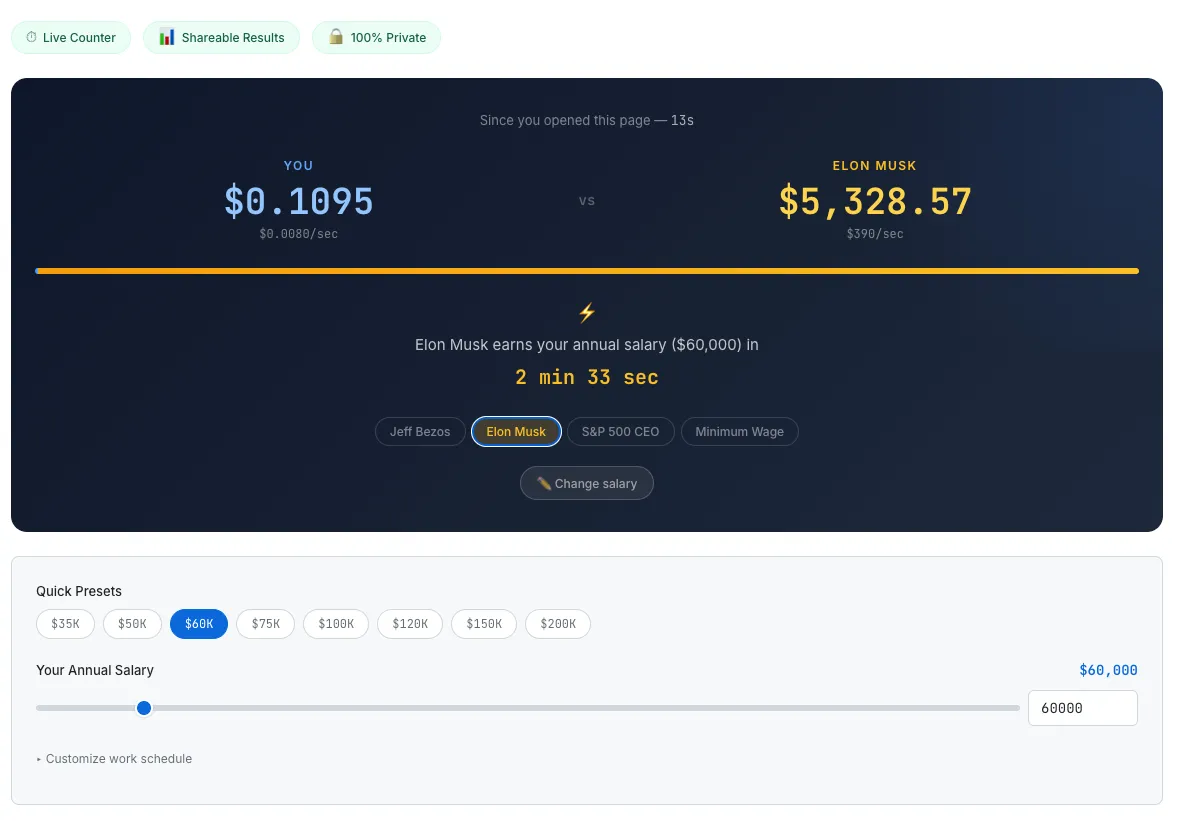
SudoTool's Salary Visualizer runs two live counters side by side — your earnings vs. a billionaire's estimated wealth growth.
Why $65,000 Feels Different Than $0.009 Per Second
The framing effect, identified by Tversky and Kahneman in their landmark 1981 paper, is one of the most robust findings in behavioral science: identical information presented differently leads to different decisions. "$2 a day" sounds more acceptable than "$730 per year." "$120 annual fee" generates fewer sign-ups than "$10 per month." The numbers are identical; the reactions are not.
Salary works the same way. "$65,000 per year" is abstract and easy to file away. "$0.009 per second" is specific, unfamiliar, and slightly uncomfortable. That discomfort is where insight lives.
A study by Sanford DeVoe (University of Toronto) and Jeffrey Pfeffer (Stanford) found something surprising: income was not correlated with happiness for salaried workers, but significantly correlated for hourly workers. When the researchers asked salaried employees to calculate their hourly wage, the connection between income and happiness strengthened. Simply reframing compensation in time-based units changed how people experienced it.
Richard Thaler, who received the 2017 Nobel Prize in Economics for his work in behavioral economics, described a related phenomenon called mental accounting: people treat identical amounts of money differently depending on how they categorize it. Knowing your per-second rate recategorizes time from an abstract resource into something with a specific, measurable dollar value. That changes how you evaluate meetings, commutes, and purchases — which is where per-second thinking becomes genuinely practical.
The Real Cost of Your Time — Meetings, Commutes, and Purchases
Once you know your per-second rate, everyday activities start revealing their price tags.
Meetings. A 30-minute meeting with three employees costs between $700 and $1,600, according to internal data from Shopify, which built a meeting cost calculator into their company calendar. The average worker spends 11.3 hours per week — about 392 hours per year — in meetings. At the median wage, that is roughly $11,760 per year of your compensation spent sitting in rooms. Shopify deleted 322,000 hours of meetings in 2023 and saw completed projects increase by 18%. Making time-cost visible changed behavior.
Commuting. The average American one-way commute is 27.2 minutes (2024 Census). At the median wage of about $30 per hour, a round-trip commute of 54 minutes costs roughly $27 per day in time value alone — about $6,750 per year. Add direct costs like gas and transit, and the total reaches approximately $13,000 per year. A remote work arrangement that eliminates even part of that commute has a concrete dollar value you can now calculate.
Purchases. A $1,200 iPhone costs about 40 hours of work at the median wage — one full work week. A $5 daily latte costs 10 minutes per day, which adds up to roughly 61 hours per year. Framing purchases in hours of labor rather than dollars forces a different kind of evaluation. "Is this worth one week of my working life?" is a harder question to dismiss than "Is this worth $1,200?"
This is not about being stingy. It is about making time-cost visible so you can make deliberate choices about what is worth it — and what is not.
How Many Workdays Does an iPhone Cost Around the World?
Your per-second rate depends not just on your job, but on where you live. The same item carries a radically different "time price" depending on geography.
According to NotebookCheck's iPhone Affordability Index (2025), the number of working days needed to buy an iPhone 17 Pro varies enormously:
| Country | Working Days for iPhone 17 Pro |
|---|---|
| Switzerland | 3 days |
| United States | 4 days |
| South Korea | ~12 days |
| Turkey | 89 days |
| Vietnam | 99 days |
| India | 160 days |
The Economist's Big Mac Index, published since 1986, uses the same principle with a cheaper item. A Big Mac costs about $5.79 in the US — roughly 11.5 minutes of work at the median wage. The same purchase in lower-wage countries takes significantly longer to earn, even when the burger itself costs less.
The OECD reports that average annual wages across member countries range from about $20,000 to $87,000 at purchasing power parity. That is roughly a 4x difference in per-second earning power between the highest-paying and lowest-paying developed economies. For workers outside the OECD, the gap can be far wider.
Why a $5,000 Raise Feels Small (But Is Not)
You negotiate a $5,000 raise. It feels good for a day, and then it fades into the background. Break it down per second and the feeling gets worse:
- Per hour: +$2.40
- Per minute: +$0.04
- Per second: +$0.00067
Less than a tenth of a cent per second. No wonder it does not feel transformative.
But stretch it across time and the picture changes completely. An extra $5,000 per year invested at a 7% average return for 40 years compounds to approximately $1,000,000. That is the standard future-value-of-annuity calculation — $5,000 deposited annually into an index fund at historical market returns.
The reason a $5,000 raise feels small is not that it is small. It is that the human brain is bad at intuiting compound growth. A fraction of a cent per second, compounded over a career, is a million dollars. That reframe matters during salary negotiations: you are not arguing over $5,000. You are arguing over a million.
Real Wages and Productivity — The Bigger Picture
Per-second thinking also illuminates broader economic trends. According to a Pew Research Center analysis, the average American's real hourly wage (adjusted for inflation) has roughly the same purchasing power today as it did in 1978.
Meanwhile, the Economic Policy Institute reports that productivity grew 74.4% from 1973 to 2013, while hourly compensation grew just 9.2% over the same period. Workers are producing significantly more output per hour, but the per-second value of their compensation has not kept pace.
This does not mean living standards have not improved at all. Technology, healthcare, and consumer goods have advanced considerably since 1978, and many of those improvements are not captured in wage data. The cost of computing power, communication, and entertainment has dropped dramatically. But for expenses that have outpaced inflation — housing, healthcare, and education in particular — the flat trajectory of real wages means those costs consume a larger share of per-second earnings than they did a generation ago.
The point is not to prescribe a policy conclusion. It is to recognize that your per-second rate exists inside a larger economic context, and understanding that context helps you make better decisions about your own career and finances.
Frequently Asked Questions
How do I calculate my salary per second?
Divide your annual salary by 7,488,000 (the number of working seconds in a year, assuming 40 hours per week for 52 weeks). For example, $60,000 ÷ 7,488,000 = $0.008 per second. To include all seconds in a year (24/7), divide by 31,536,000 instead.
How much does Jeff Bezos earn per second?
Estimates range from roughly $900 to $2,400 per second, based on annual changes in his net worth. These figures are driven almost entirely by Amazon stock performance and are not comparable to a traditional salary. In years when the stock drops, the figure can be zero or negative.
How much does Elon Musk earn per second?
During 2025, estimates ranged from $7,000 to $9,700 per second based on net-worth growth. Like Bezos, this reflects stock and asset valuations, not cash compensation. Musk's actual cash salary from Tesla has historically been $0.
How much is minimum wage per second?
The US federal minimum wage of $7.25 per hour equals about $0.002 per second — roughly one-fifth of a penny per second. This rate has been unchanged since July 2009, the longest stretch without an increase since the Fair Labor Standards Act was enacted in 1938. Many states have set higher minimums.
Should I use working hours or total hours?
For your own salary, working hours (Method 2) is more intuitive — it tells you what each second of labor is worth. Total hours (Method 1) is commonly used for billionaire wealth growth, since investments appreciate 24/7. Comparing the two directly can be misleading, so always note which method is being used.
Does this tool store my salary data?
No. SudoTool's Salary Visualizer runs entirely in your browser. No salary data or any other information is sent to any server.
Curious about how we designed the live comparison counter and why we made it the hero of the page? Read the dev log: Building a Salary Visualizer Where Comparison Is the Hero. For more on the hidden cost of meetings, see our guide: The True Cost of Meetings: Why Every Minute Has a Price Tag.