What Time Should I Go to Bed if I Wake Up at 6 AM?
The two bedtimes that line up with the end of a sleep cycle, plus a quick reference for other wake times and three scenarios where the math gets harder.
This is an informational summary of sleep cycle research and bedtime calculation methods. It is not medical advice. The cycle-aligned bedtimes described here are a research-based starting point — actual optimal bedtime varies by individual cycle length, sleep onset latency, and lifestyle. If you have ongoing sleep difficulties, please consult a licensed healthcare professional.
I had a 6:30 AM call three days a week for a stretch of months and just guessed at a bedtime each evening. Some mornings I beat the alarm; other mornings I felt like I'd been hit by a truck. Same seven hours, very different mornings. The fix turned out to be one observation: what time you should go to bed if you wake at 6 AM isn't really about hours — it's about where the last sleep cycle ends. Once that clicked, the bedtime more or less chose itself.
Short answer: for a 6 AM wake-up, the two bedtimes that align with the end of a sleep cycle are 10:15 PM (5 cycles, 7.5 hours of sleep) or 8:45 PM (6 cycles, 9 hours of sleep). Eleven forty-five PM (4 cycles, 6 hours) is a short-night option for emergencies, not a regular schedule. The math, the caveats, and a reference table for other wake times follow.
The two cycle-aligned bedtimes for a 6 AM wake-up
| Cycles | Sleep duration | Bedtime | When to use |
|---|---|---|---|
| 6 cycles | 9 hours | 8:45 PM | Recovery / catch-up nights |
| 5 cycles ★ | 7.5 hours | 10:15 PM | Recommended weekday default |
| 4 cycles | 6 hours | 11:45 PM | Short night — occasional only |
These three times are calculated so the alarm lands at the natural end of a cycle, not in the middle of one. The difference between waking from light sleep and waking from deep sleep is the difference between getting out of bed cleanly and dragging through the first hour of the morning. The 5-cycle option is the everyday recommendation; it gives you 7.5 hours of sleep, which sits inside the AASM and CDC guidance of seven or more hours per night for adults and aligns cleanly with the end of a fifth 90-minute cycle.
The math behind these bedtimes
Two numbers drive the calculation: the average length of an adult sleep cycle (~90 minutes) and the average time it takes to fall asleep — sleep onset latency, typically 10 to 20 minutes for healthy adults, with 15 minutes as a reasonable default. Working backwards from a 6:00 AM wake target:
- 5 cycles: 6:00 AM minus (5 × 90 min) minus 15 min = 6:00 AM minus 7 h 45 min = 10:15 PM
- 6 cycles: 6:00 AM minus (6 × 90 min) minus 15 min = 6:00 AM minus 9 h 15 min = 8:45 PM
- 4 cycles: 6:00 AM minus (4 × 90 min) minus 15 min = 6:00 AM minus 6 h 15 min = 11:45 PM
The 15-minute pre-sleep buffer is what most casual bedtime advice forgets. If you set bedtime at exactly 7.5 hours before your alarm, you're really sleeping 7 h 15 min, and your alarm catches you 15 minutes into the next cycle. That's the difference between a clean wake and a heavy one. How Sleep Cycles Work covers the full science of why cycles end the way they do — what happens during N1, N2, N3, and REM, and why the first cycle is usually shorter than later ones.
Why there isn't just one right bedtime
The numbers above assume average adult cycle length (90 minutes) and average sleep onset (15 minutes). Both are population averages, not biological constants.
Cycle length varies. Healthy adult cycles run anywhere from roughly 70 to 120 minutes. Yours is yours — relatively stable across nights but personal. To estimate your own average, sleep without an alarm for a week and divide your average sleep time by 5 or 6. If your cycles run 85 minutes instead of 90, the recommended 5-cycle bedtime shifts about 25 minutes later (still gives 7 hours of total sleep, just compressed). If they run 95, it shifts 25 minutes earlier.
Sleep onset varies. If you reliably fall asleep within 5 minutes of lights out, you can pull the buffer down to 5 minutes. If you take 25–30, push it up. One important caveat: consistently falling asleep in under 5 minutes is itself a marker of sleep deprivation, not unusually good sleep hygiene — the answer is more sleep, not a tighter calculator. A persistent 30+ minute onset is one diagnostic marker of insomnia and worth raising with a healthcare provider.
Once you know your two personal numbers, the calculation gets specific to you. Our Sleep Cycle Calculator exposes both as sliders so you don't have to redo the math by hand:
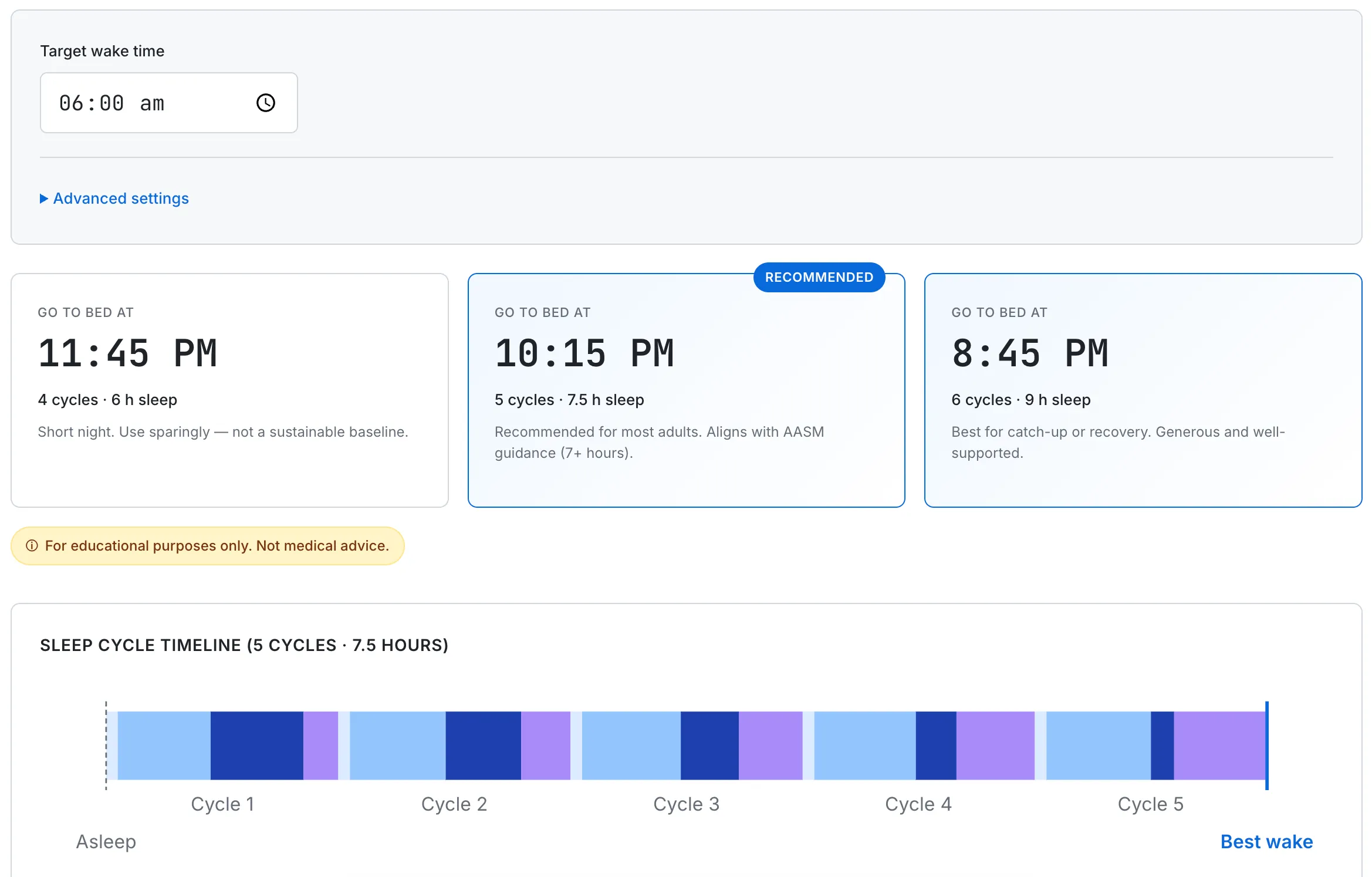
The calculator working back from a 6 AM wake target: 5 cycles at 10:15 PM is the recommended pick, with 4-cycle and 6-cycle alternatives shown alongside. Cycle length and sleep onset latency are adjustable in the advanced settings.
Quick reference: other wake times
If your wake target isn't 6 AM, the same math applies — subtract 7 h 45 min for 5 cycles or 9 h 15 min for 6 cycles. Common targets:
| Wake time | 5 cycles (7.5h) ★ | 6 cycles (9h) |
|---|---|---|
| 5:00 AM | 9:15 PM | 7:45 PM |
| 5:30 AM | 9:45 PM | 8:15 PM |
| 6:00 AM | 10:15 PM | 8:45 PM |
| 6:30 AM | 10:45 PM | 9:15 PM |
| 7:00 AM | 11:15 PM | 9:45 PM |
| 7:30 AM | 11:45 PM | 10:15 PM |
| 8:00 AM | 12:15 AM | 10:45 PM |
Three scenarios where a 6 AM wake-up gets harder
1. The night owl chronotype. When chronotype runs late, asking the body to be in bed at 8:45 PM tends to fail because the circadian system has not yet released melatonin. Circadian phase advance is described in the literature as working gradually — typically 15 minutes earlier per night across 7 to 10 nights, rather than as a one-shot shift. Bright morning light exposure between 6:00 and 6:30 AM is widely described as one of the strongest single signals for advancing the internal clock.
2. You're a shift worker. If "wake at 6 AM" only applies on some days, anchor the cycle math to your sleep start time instead and accept that the wake time will move. Aim for 5–6 full cycles after lights-out, and try to keep your sleep onset consistent within a 30-minute window most days, even if wake time varies. Total sleep matters more than wake-clock alignment when wake clock isn't fixed.
3. You're a parent of an infant or young toddler. Frequent night wakings cut cycles short, period. There's no way to get a clean 5–6 consecutive cycles if you're up at 2 AM and 4 AM. The realistic target is whatever consolidated sleep you can carve out — even 3 cycles (4.5 hours) of uninterrupted sleep plus a 30–45 minute mid-day power nap usually beats 5 fragmented cycles in cumulative restorative effect. If a partner can take alternating nights, do that — one good night every other day is better than two halves.
The wind-down hour: a practical timeline
The cycle-aligned bedtime is lights out, not "start thinking about going to bed." For a 10:15 PM target, common sleep-hygiene literature places the wind-down around 8:30 PM. Below is one example timeline based on commonly cited research-derived practices — illustrative rather than prescriptive:
| Time | Action | Why |
|---|---|---|
| 2:00 PM | Last caffeine | Caffeine has a half-life of around 5–6 hours on average (with individual range of 2–12 hours). Sleep Foundation recommends an 8-hour cutoff before bed; a 2 PM cutoff is comfortable for most people targeting a 10 PM bedtime. |
| 7:00 PM | Finish exercise | Exercise raises core body temperature and adrenaline; both need 2–3 hours to drop back to sleep-friendly levels. |
| 9:30 PM | Stop screens / dim the lights | Bright artificial light suppresses melatonin onset. Switching to dim, warm lighting helps the body register "it's getting late." |
| 10:00 PM | Book, audiobook, light stretching | Cognitive activation drops; arousal levels follow. |
| 10:10 PM | 4-7-8 breathing × 3–4 rounds | Pulls the nervous system out of any residual fight-or-flight from the day. |
| 10:15 PM | Lights out | Sleep within ~15 minutes if the rest of the wind-down landed. |
You don't need to follow it to the minute. The point is that the half-hour before lights out matters more than most people realize — if you're scrolling at 10:14 and your phone is still bright, "10:15 PM bedtime" was never really 10:15.
What if you do all this and still wake up tired?
If you've cycle-aligned your bedtime and held it consistent for a couple of weeks and you're still tired in the morning, the issue probably isn't the cycle math. There are about a dozen common alternative causes — sleep inertia, late caffeine, undiagnosed sleep apnea, social jet lag, alcohol, environment, medications, low ferritin or B12, subclinical thyroid issues. We cover the full list and a four-week self-check plan in Why Am I Tired After 8 Hours of Sleep?
This guide describes general adult sleep physiology drawn from peer-reviewed sources and is for educational use only. Individual sleep needs and cycle lengths vary with age, health, lifestyle, and sleep disorders. None of this is medical advice. If you have ongoing trouble sleeping, excessive daytime sleepiness, or suspect a sleep disorder, please consult a licensed healthcare professional.