How Sleep Cycles Work: The 90-Minute Rule Explained
What actually happens during a sleep cycle, where the 90-minute rule comes from, and how much of it you can take to the bank.
This is an informational summary of peer-reviewed sleep physiology research. It is not medical advice, diagnosis, or treatment recommendation. Individual cycle lengths and sleep needs vary. If you have ongoing trouble sleeping, please consult a licensed healthcare professional.
Modern sleep science starts with a moment of confusion at the University of Chicago. In 1953, a graduate student named Eugene Aserinsky and his adviser Nathaniel Kleitman published a finding in Science that overturned the prevailing view that the sleeping brain simply switched off. They had been watching the closed eyes of a sleeping subject move rapidly back and forth, as if the person was awake and following something. The subject wasn't awake. That observation cracked open the entire field, and within four years another student in the same lab, William Dement, had mapped what we now call sleep cycles: roughly 90-minute loops that repeat across the night.
The 90-minute number is what everyone remembers. It's also the part that's most misleading. No one's cycle is exactly 90 minutes — yours might be 75, your partner's might be 110 — and that single fact explains why the same alarm clock leaves you sharp on Monday and groggy on Wednesday. The rest of this post is about what actually happens during a cycle, what the science genuinely supports versus what gets repeated until people assume it's true, and how to apply the practical part: timing your alarm so it lands between cycles rather than in the middle of one.
How sleep cycles were discovered
REM sleep was discovered almost by accident. In the early 1950s, researchers assumed the sleeping brain was passive — a kind of nightly off-switch. Aserinsky's contribution was to spend hours watching brain-wave and eye-movement readouts from sleeping subjects, and to notice that the eye-movement pen would periodically scribble violently as if the person had woken up to look around. The person was always still asleep. He and Kleitman published the result as "Regularly Occurring Periods of Eye Motility, and Concomitant Phenomena, During Sleep" in Science in 1953.
Four years later, Kleitman and Dement published a second paper in Electroencephalography and Clinical Neurophysiology that did something different: they recorded full nights of sleep and showed that REM episodes were not random. They returned at predictable intervals — roughly every 90 to 110 minutes — interleaved with stretches of progressively deepening non-REM sleep. The cycle was the discovery. Everything we know about sleep architecture today is a refinement of that 1957 paper.
One honest footnote, from a later history paper: Aserinsky himself, looking back, described Kleitman's role in the original REM discovery as "tangential" and admitted "misgivings about giving Kleitman any authorship at all." The textbook version of the story tends to flatten these tensions; in practice, the discoveries that look inevitable in retrospect were often the work of one person's persistence pushing through the doubt of everyone around them.
What happens in a 90-minute cycle
A sleep cycle has four stages. They run in roughly the same order every cycle and together take about 90 minutes for the average adult. What changes from cycle to cycle is the proportion of time spent in each stage — but the menu is the same.
N1 — drowsy transition (about 5% of total sleep, 1 to 5 minutes per episode). The brief doorway into sleep. Muscles begin to relax, breathing slows, and a gentle sound can still wake you easily. If you've ever felt yourself "almost" fall asleep on the couch and snapped back awake, that was N1.
N2 — light sleep (about 45% of total sleep). The dominant stage of the night. Heart rate drops, body temperature falls, and the brain produces short bursts of activity called sleep spindles. Motor learning — the kind of physical skill that needs muscle memory, like playing piano or riding a bike — gets locked in during N2 spindles.
N3 — deep sleep, also called slow-wave sleep (about 10 to 20% of total sleep, roughly 40 to 110 minutes per night for someone getting 7 to 9 hours). The most physically restorative stage. Growth hormone is released, tissue is repaired, and declarative memories — facts, places, events — are consolidated. The popular "25%" figure for N3 you may have seen elsewhere comes from textbook averages; the actual range cited by the National Sleep Foundation is 10 to 20%.
REM — rapid eye movement, the dreaming stage (about 25% of total sleep, around two hours per night for adults). The brain becomes nearly as active as when you're awake, but the body is essentially paralysed except for breathing and the eye movements that give the stage its name. Dreams can technically happen in any stage, but they're less common and less intense in non-REM, which is why most of the vivid dreams you remember come from REM.
One full cycle moves through these stages in a rough pattern — N1 leading into N2, then down to N3, briefly back to N2, then into a REM episode — before starting the next cycle. The textbook diagram is clean; the actual hypnogram of any single night looks messier.
Why the first cycle is short and the last REM is long
Sleep cycles aren't identical. The first cycle of the night is usually shorter — somewhere between 70 and 100 minutes. Later cycles tend to run longer, between 90 and 120 minutes. More importantly, the proportion of stages within each cycle shifts across the night.
Deep sleep is front-loaded. The first two or three cycles of the night carry the bulk of N3. By the fourth or fifth cycle, deep sleep has largely faded out. This is one of the better-confirmed patterns in sleep research, and it's why the first half of the night feels heavier and harder to wake from than the second half.
REM is back-loaded. Your first REM episode of the night is usually only a few minutes long. By the final cycle before sunrise, REM episodes can stretch to around an hour. That's why dreams in the early morning often feel longer, more complex, and more emotionally charged than half-remembered fragments from earlier in the night — the actual REM episodes really are longer.
One practical implication: if you're going to clip your sleep, clipping the last hour costs more than the time alone suggests. Cutting an hour off a 7.5-hour night isn't a 13% reduction in everything proportionally — it's a much bigger hit to REM specifically. The body protects deep sleep first when you're sleep-deprived. REM gets sacrificed.
The honest truth about the 90-minute rule
This is the part most articles skip. The 90-minute number is a population average, not a biological constant. There are four ways the average breaks down in real people, and all four are worth knowing if you're going to use the rule for anything practical.
1. Individuals vary. Adult cycles run anywhere from roughly 70 to 120 minutes. Your average cycle length is reasonably stable but personal — closer to a fingerprint than a constant. Two people on the same alarm schedule can wake up feeling completely different because their cycles end at different times.
2. Age matters. Newborn sleep cycles are about 55 minutes long — a little over half the adult duration. They lengthen across childhood and reach the adult 85 to 90 minutes by school age. Older adults often have similar cycle lengths to younger adults but spend less time in deep sleep, which is why sleep often feels lighter and more fragmented as you age.
3. Wearable trackers can't pin it down to the minute. The most thorough recent benchmark — a 2023 multicenter Korean study (n=75, 3,890 hours of sleep, 349,114 epochs scored against polysomnography) — tested 11 consumer trackers including Apple Watch 8, Oura Ring 3, Fitbit Sense 2, and Google Pixel Watch. The honest summary: trackers are good at trends, less good at minutes. Per stage, Oura Ring 3 sensitivity ranged from 38% (wake) to 78% (deep sleep). Apple Watch 8 ranged from 41% (deep) to 66% (light). REM was usually the most reliable detection across devices because heart-rate variability spikes during REM. Deep sleep was the least reliable. The takeaway for a casual user: trust your tracker for week-over-week patterns, not for "I got exactly 47 minutes of deep sleep last night."
4. The 90-minute waking cycle is folklore. You may have read that your body cycles in 90-minute ultradian rhythms during the day, too — the basis for "take a break every 90 minutes" productivity advice. This idea (called BRAC, the Basic Rest-Activity Cycle) was a hypothesis from Kleitman's later work. It shows up clearly during sleep but has not held up cleanly during waking. Multiple time-series spectral analyses of waking activity have failed to find a 90-minute periodicity. The "90-minute work block" rule is reasonable as a general anti-fatigue guideline; it's not actually built into your biology the way nighttime cycles are.
The practical conclusion: 90 minutes is a starting point, not a guarantee. Use it as the seed of an estimate, then adjust based on how you actually feel waking at the calculated time.
Both REM and deep sleep matter
Online sleep content has a strong bias toward deep sleep as "the important stage." It's not the whole story. Each stage carries a different functional load, and selectively suppressing any one of them produces measurable effects.
Deep sleep (N3) handles physical recovery, immune function, and declarative memory consolidation. REM handles emotional processing, procedural and creative memory, and is closely linked to mood regulation. N2 — the unglamorous middle stage — hosts the sleep spindles that lock in motor learning. N1 is the bridge that gets you in.
The body self-regulates the proportion of time spent in each stage. There's no useful way to "get more REM" by trying. Above-average REM is more often a marker of sleep deprivation rebound, recent withdrawal from REM-suppressing drugs (alcohol, certain antidepressants), or a depressive episode than a sign of unusually high-quality sleep. The Sleep Foundation puts it directly: all of the sleep stages are essential. Treat them as a system, not a hierarchy.
Five common myths
1. "Everyone has 90-minute cycles." Average is around 90 minutes. Real cycles run 70 to 120. Yours is yours.
2. "More REM equals better sleep." Not unless you're rebounding from sleep deprivation. REM proportion is self-regulated, and atypically high REM is more often a clinical signal than a fitness flex.
3. "Deep sleep is the most important stage." Half-true. Deep sleep is essential for physical recovery, but emotional processing and procedural memory both run on REM, and motor skill learning runs on N2 spindles. There's no winner.
4. "You need exactly 8 hours." Eight hours is a convenient round number, not biology. The American Academy of Sleep Medicine recommends seven or more hours per night for adults; the National Sleep Foundation recommends 7 to 9 hours. Within that range, what often matters more than total time is whether your alarm catches you between cycles or in the middle of one. Five clean cycles (7.5 hours) commonly feels better than 8 hours that ends 30 minutes into a sixth cycle.
5. "You can train yourself to need less sleep." The genetic evidence says no. A small number of people carry rare mutations in genes including DEC2/BHLHE41, ADRB1, NPSR1, and GRM1 that allow function on 5 to 6 hours per night without measurable cognitive cost — these are inherited, not trainable. Studies of sleep restriction in non-carriers (Van Dongen et al., Sleep, 2003) show that two weeks of restricted sleep produced accumulating cognitive deficits that subjects did not perceive and did not habituate to. The trait is described in the literature as rare; for the majority of the population, sustained shortened sleep is described as cumulative deficit rather than adaptation.
How to use this in practice
Cycle alignment is a small adjustment with an outsized effect on how you feel waking up. The full method is simple:
1. Targeting 5 or 6 cycles. Five cycles is roughly 7.5 hours — commonly described as a standard target for a healthy work week. Six cycles is closer to 9 hours and is described in sleep medicine as appropriate during recovery from heavy exertion, illness, or a few short nights earlier in the week. Four cycles (about 6 hours) is a short night — described as acceptable occasionally but not as a long-term baseline in the cumulative-deficit literature.
2. Add 15 minutes for falling asleep. The time between lying down and actually entering N1 is called sleep onset latency. Healthy adults typically take 10 to 20 minutes. Fifteen minutes sits in the middle and is a reasonable default. If you reliably take longer, adjust upward; if you fall asleep within five minutes consistently, that's actually closer to a sign of sleep deprivation than to good sleep hygiene, and the answer is more sleep, not a tighter calculator.
3. Work backwards from your wake time. If you need to be up at 6 AM, count backwards: 15 minutes to fall asleep + five 90-minute cycles = 7 hours 45 minutes. So you should be in bed by 10:15 PM. For six cycles, that pushes bedtime to 8:45 PM. The math is small and tedious by hand. The Sleep Cycle Calculator does it instantly and shows all three options side by side:
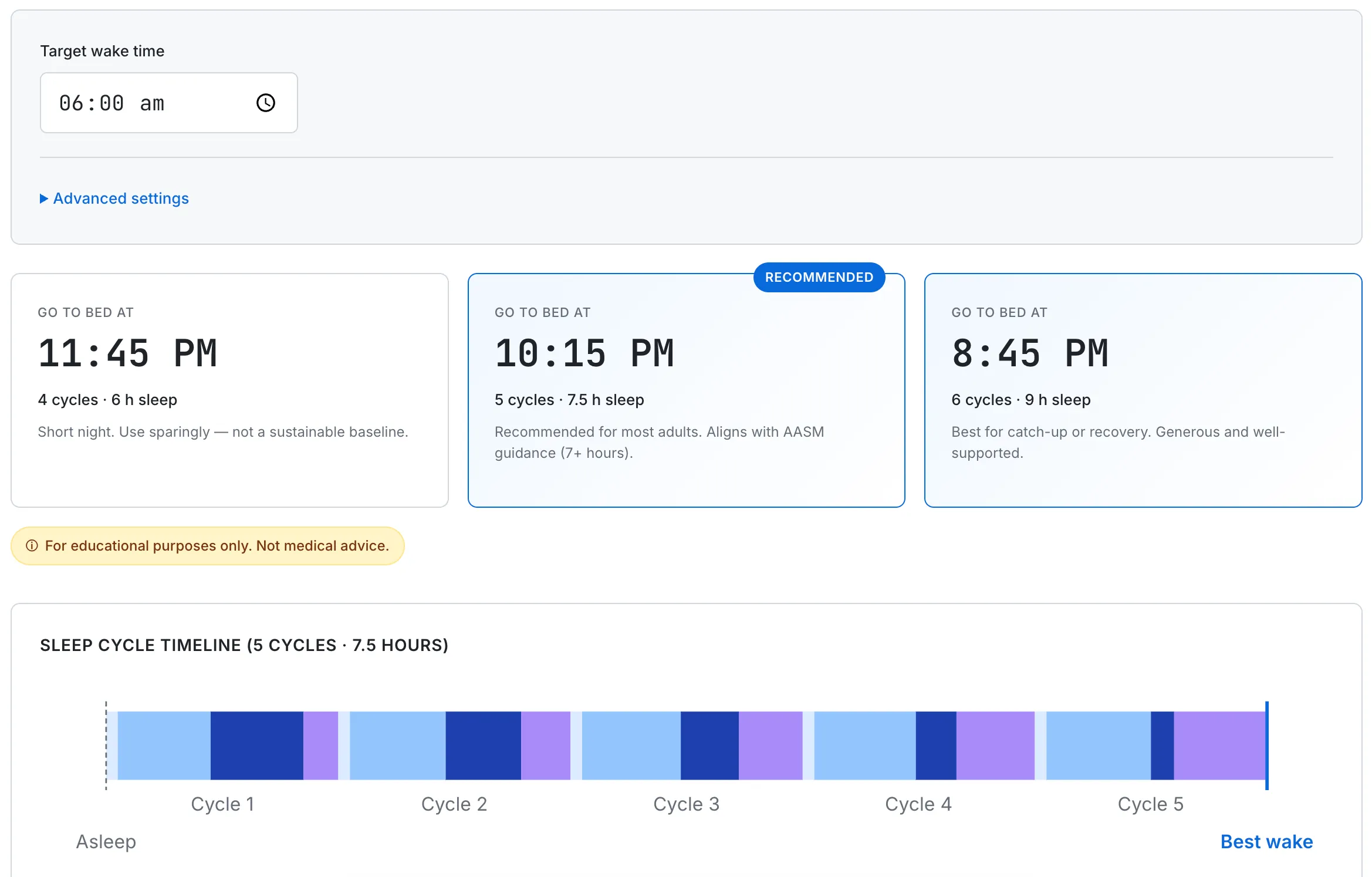
The calculator working back from a 6 AM wake target. Five cycles at 10:15 PM is the recommended pick for most adults; the bottom timeline shows deep sleep (dark blue) front-loaded and REM (purple) extending across the later cycles.
4. Calibrate over a week. The 90-minute default is an average. After a week of using a cycle-aligned bedtime, you'll start to notice whether the alarm catches you cleanly (light, easy wake) or in deep sleep (heavy, foggy wake). If most mornings feel heavy, your cycles may run shorter than 90 — try 85. If you feel like you're waking before you need to, your cycles may be longer — try 95 or 100. Most people land within a few minutes of the calculated time within a week or two.
Pair this with the basics that affect sleep onset directly: a cool, dark bedroom (around 18 to 20 °C / 65 to 68 °F), no screens for the last 30 minutes, no caffeine after early afternoon, regular exercise (timing outdoor runs to favorable weather helps consistency), and a short wind-down routine that doesn't require willpower. Cycle alignment doesn't replace sleep hygiene; it makes sleep hygiene work harder for you. If you want a structured 25-minute focus pattern to use during the day, the same cyclical idea drives the Pomodoro Technique on a shorter timescale.
This guide describes general adult sleep physiology drawn from peer-reviewed sources and is for educational use only. Individual sleep needs and cycle lengths vary with age, health, lifestyle, and sleep disorders. None of this is medical advice. If you have ongoing trouble sleeping, excessive daytime sleepiness, or suspect a sleep disorder, please consult a licensed healthcare professional.