The Minimum Payment Trap: Why Paying Only the Minimum Can Cost You Thousands
$5,000 on a credit card at today's average APR turns into 19 years of payments and $7,964 in interest — more than the original balance. Here's the math your statement doesn't quite explain, and how to escape it.
The minimum payment trap is easy to fall into: you pay what your statement asks, you never miss a due date, and somehow you're still carrying the same balance year after year. Here's the scenario most people don't run the numbers on. $5,000 balance. 22% APR. You pay only the minimum each month. This is what actually happens:
According to the Federal Reserve G.19 (released April 7, 2026), the average APR on US credit card accounts assessed interest was 21.52% in February 2026 — essentially the same 22% our example uses. The $5,000 balance isn't unusual either: Experian's State of Credit Cards data put the average US cardholder balance at $6,730 as of Q3 2024. This isn't a worst-case hypothetical. It's the typical case.
And the people stuck in it aren't rare. The CFPB's 2025 Consumer Credit Card Market Report found that 15% of general-purpose cardholders and 20% of private-label cardholders made only the minimum payment in 2024 — both the highest rates observed since at least 2015. This piece covers the minimum payment trap: why the math is so brutal, how issuers actually compute that number, what your statement legally must tell you, and four concrete moves to get out.
What the Minimum Payment Trap Actually Is
"Trap" is an emotional word for a mathematical fact. Here's the mechanics.
The typical minimum payment formula is roughly 1% of your current balance plus the month's accrued interest (more on issuer-specific formulas in the next section). At 22% APR, the monthly interest rate is about 1.833%. On a $5,000 balance:
- Month's interest: $5,000 × 1.833% = $91.67
- 1% principal portion: $5,000 × 1% = $50
- Minimum payment ≈ $91.67 + $50 = $141.67
Of that $141.67 payment, $91.67 covers interest and only $50 actually reduces your balance. Next month the balance is $4,950 and the minimum is about $139.98 — 0.35% lower. Each payment is shrinking almost as slowly as the balance.
The deeper problem: as your balance drops, the minimum drops too. You're not moving toward payoff faster over time — you're moving slower. That's the 19-year tail.
A 2019 Journal of Financial Economics paper by Benjamin Keys and Jialan Wang found that 29% of US credit card accounts regularly pay at or near the minimum. Of those, at least 9 to 20% do so not because of liquidity constraints, but because of a psychological anchoring effect — the minimum number on the statement nudges them subconsciously (NBER w22742).
How Issuers Actually Calculate Your Minimum (2026 Formula Table)
Most people don't know how their minimum is computed. The major issuers publish (or used to publish) the formula, and it's simpler than you'd expect:
| Issuer | Formula | Floor |
|---|---|---|
| Chase | max($40, 1% × balance + interest + fees) + past due | $40 |
| Capital One | max($25, 1% × balance + interest + fees) + past due | $25 |
| Citibank | max($41, 1% × (balance + interest + fees)) + past due | $41 |
| Amex (standard) | max($35, 1% × new balance + interest) + fees + 1/24 of overlimit | $35 |
| Discover | max($35, 2% × balance + fees) + past due | $35 |
| Bank of America | max($35, 1% × balance + interest + fees) + past due | $35 |
| Wells Fargo | max($25, 1% × (balance + interest + fees)) + past due | $25 |
| U.S. Bank | max($40, 1% × balance + interest + fees) + past due | $40 |
All eight follow the same pattern: a low dollar floor ($25 to $41) or "1-2% of balance plus interest plus fees," whichever is greater.
The hidden detail: this formula already includes interest. On a $5,000 balance with $91.67 in accrued interest, the $141.67 minimum you pay is "settling" the $91.67 of interest first. Only $50 reduces principal. Most newcomers to credit assume the full payment reduces what they owe. It doesn't.
Sources: Chase, Citi, American Express, Discover.
The Math at $3K, $5K, $10K, $20K
Here's what each balance level looks like at 22% APR, using the max($25, 1% × balance + interest) formula — matching our Credit Card Payoff Calculator's default output.
| Balance | Strategy | Payoff time | Total paid | Total interest |
|---|---|---|---|---|
| $3,000 | Minimum only | 14.8 years | $7,363 | $4,363 |
| Min + $100/mo | 2.2 years | $3,708 | $708 | |
| Min + $300/mo | 10 months | $3,284 | $284 | |
| Min + $500/mo | 6 months | $3,186 | $186 | |
| $5,000 | Minimum only | 18.9 years | $12,964 | $7,964 |
| Min + $100/mo | 3.3 years | $6,759 | $1,759 | |
| Min + $300/mo | 16 months | $5,730 | $730 | |
| Min + $500/mo | 10 months | $5,474 | $474 | |
| $10,000 | Minimum only | 24.6 years | $26,965 | $16,965 |
| Min + $100/mo | 5.7 years | $15,647 | $5,647 | |
| Min + $300/mo | 2.4 years | $12,582 | $2,582 | |
| Min + $500/mo | 1.6 years | $11,701 | $1,701 | |
| $20,000 | Minimum only | 30.3 years | $54,969 | $34,969 |
| Min + $100/mo | 9.0 years | $36,466 | $16,466 | |
| Min + $300/mo | 4.3 years | $28,667 | $8,667 | |
| Min + $500/mo | 2.8 years | $25,957 | $5,957 |
Three patterns jump out:
- At the minimum only, total interest almost always exceeds the original principal. $3K owes $4,363 in interest. $5K owes $7,964. $10K owes $16,965. $20K owes $34,969 — 1.75 times the original balance.
- Just $100/mo extra cuts payoff time by 3-5x. On $5K, 18.9 years becomes 3.3 years.
- $300/mo extra cuts total interest by roughly 80% or more in every case.
What Your Statement Actually Tells You
The CARD Act of 2009 — specifically the implementing regulation, Regulation Z §1026.7(b)(12) — requires issuers to put specific information on every monthly statement. Most people have never read what's actually in there.
§1026.7(b)(12)(i)(A) — the mandatory warning sentence, verbatim:
§1026.7(b)(12)(i)(B) — the minimum payment repayment estimate in months (e.g., "227 months").
§1026.7(b)(12)(i)(C) — the minimum payment total cost estimate (e.g., "$12,964").
§1026.7(b)(12)(i)(F) — the 36-month payoff alternative: the monthly payment needed to clear the balance in 3 years, the total cost at that pace, and how much you'd save vs. minimum only. This alternative is waived in three specific cases:
- When the minimum-only payoff estimate rounds to 3 years or less
- When the 36-month payment would fall below the minimum already required
- When the account mixes revolving and fixed-repayment features with a fixed feature under 36 months
§1026.7(b)(12)(i)(D) — a toll-free number connecting to an approved credit counseling agency.
In other words, the information is all there. Your statement — usually on the back page or in a dedicated disclosure section — legally has to tell you "at your current minimum, this will take X years and $Y total." Several personal finance articles claim that statements hide the true cost of minimum payments; that's not actually accurate.
So why are so many people still stuck? The problem isn't missing information; it's information being ignored. The warning exists. The numbers exist. The human brain routes around them.
Source: CFPB Regulation Z §1026.7.
Why Minimums Got So Low — A Brief History
It wasn't always like this.
1970s: The US industry standard was around 5% of balance. At a $5,000 balance, that's a $250/month minimum — enough to make meaningful dents in principal.
1980s–1990s: Competitive pressure pushed minimums down. Lower minimum = longer carried balance = more interest revenue. By 2000, a Consumer Action survey found 43% of cards using 2% minimums, and virtually none still requiring 4-5%.
January 2003 — the turning point. The Office of the Comptroller of the Currency, FDIC, Federal Reserve, and OTS jointly issued the Account Management and Loss Allowance Guidance for Credit Card Lending (OCC Bulletin 2003-1). The guidance flagged minimum payments and negative amortization — cases where the minimum didn't even cover monthly interest, so balances grew despite on-time payments — as supervisory concerns.
2003–2006: In response, Bank of America, Citi, MBNA, Chase and others converted to the modern formula — a dollar floor of $25 to $40 OR roughly 1% of balance plus interest plus fees, whichever is greater. That's the formula published in the table above.
2009 CARD Act: Added the statement disclosure requirements but did not mandate a minimum percentage. The structure has held since.
Congressional Research Service report RS22352 put one scenario into concrete numbers: on a $10,000 balance at 16% APR, a 2% minimum produces 40+ years of repayment and about $19,329 in interest, while a 4% minimum produces about 14 years and roughly $4,931 in interest. The industry cutting the minimum percentage in half nearly quadruples the interest a typical borrower pays.
The current "trap" isn't a consumer mistake. It's the residue of two decades of competitive design choices.
The Psychology — Why Smart People Still Pay Only the Minimum
Information doesn't override anchoring. The single most striking experiment on this point came from Neil Stewart at the University of Warwick, published in Psychological Science 20(1) in 2009:
Result: the group without the minimum-payment prompt paid an average of 40% of the balance, while the group with the prompt paid an average of 23%. Removing the minimum raised payments by about 70%.
— Stewart, Psychological Science 20(1): 39-41
The minimum number on the page is a psychological anchor. It subconsciously nudges people toward "that's probably what I should pay." The warning box on the same page doesn't override it. The brain reads "Minimum Payment Due: $141.67" first and lets the rest of the page blur.
Keys and Wang (2019) pushed this finding into live credit card data. Their Journal of Financial Economics paper found that 29% of accounts regularly pay at or near the minimum, and in their estimation 9 to 20% of those accounts are responding to the anchoring effect rather than to actual liquidity constraints — meaning they could pay more but don't. The CARD Act's 36-month disclosure produced roughly $62 million per year in interest savings. If all anchoring-affected consumers had responded, the savings would have been more than $2 billion per year.
The trap isn't "I didn't know." It's "I knew and still typed the minimum amount into the bill pay box." Solving it requires a different anchor.
How to Escape — Four Concrete Moves
Easiest to hardest.
1. Use the 36-month payment as your new anchor
Your statement is already required to show it (§1026.7(b)(12)(i)(F) above). Find that number. Type it into the bill pay field, not the minimum. If you can pay more, great — but never less than the 36-month target. That's the simplest lever for breaking Stewart's anchoring effect: change the anchor.
2. Set up a fixed extra payment on autopay
"I'll pay more when I have extra" doesn't work — Keys & Wang's data shows that. What works:
- Pick a fixed dollar amount you know you can hit every month without exception ($50, $100, $300).
- Set it up as automated extra payment, scheduled for the day after payday.
- Once it's running, the mental load disappears and the compounding works for you.
On a $5,000 balance at 22% APR, adding just $100/month turns 18.9 years into 3.3 years and drops total interest from $7,964 to $1,759 — $6,205 saved.
3. For bigger balances, consider a 0% balance transfer
If your credit score is 720+, you likely qualify for a balance transfer card offering 0% APR for 12-21 months. Transfer fees are typically 3-5% of the amount moved ($150-$250 on a $5,000 transfer). In exchange, you get 12-21 months of principal-only payments.
The catch: if you don't pay off the transferred balance before the promo ends, the regular APR kicks in on whatever's left. A few cards also apply retroactive (deferred) interest if you don't clear the balance by the deadline. Read the terms carefully.
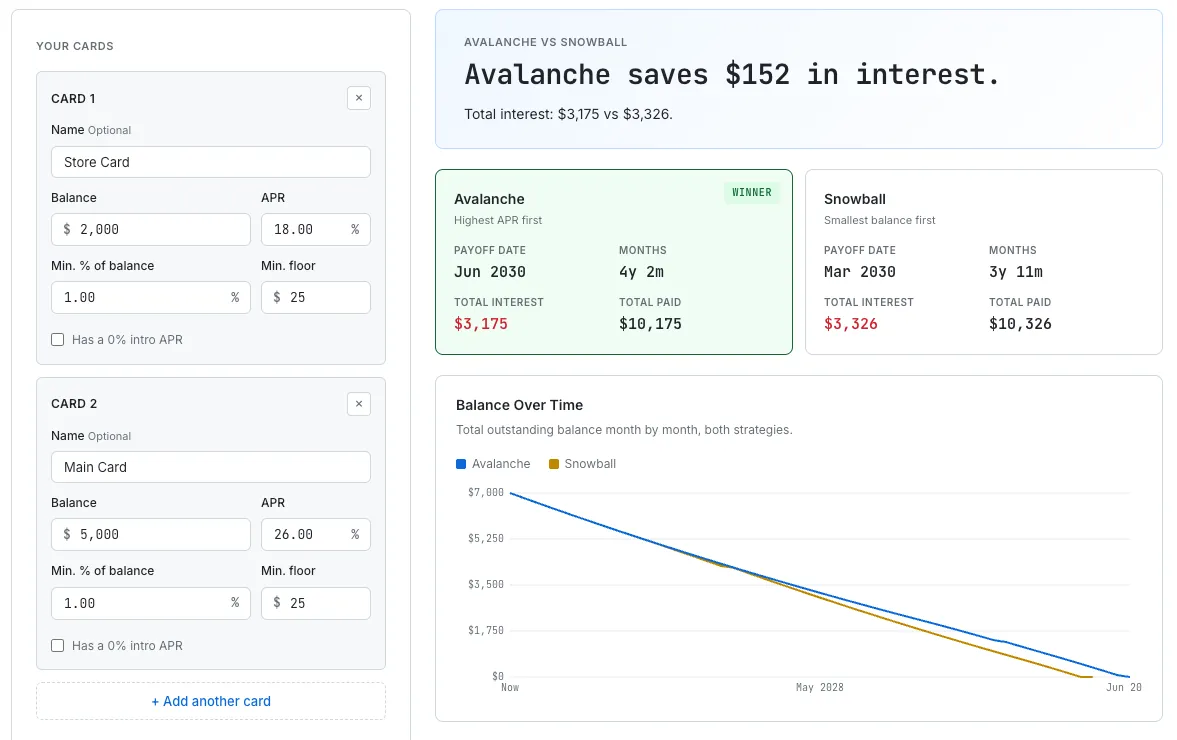
The Credit Card Payoff Calculator supports 0% promo periods per card. Check "Has a 0% intro APR" on any card row to enter the promo APR and months remaining, and the simulator switches to the post-promo APR automatically.
4. If the math has gone past you, get free help
If your balances represent multiple years of take-home pay and even the minimum is hard to make, don't try to solve it solo. Contact a National Foundation for Credit Counseling member agency. Initial sessions are free, and they can negotiate a Debt Management Plan with your creditors — often with reduced APRs, waived fees, and a single consolidated monthly payment.
What to avoid: for-profit "debt settlement" firms that advertise heavily. Their fees are high, the credit score damage is significant, and some have been sanctioned by the FTC for misleading practices. NFCC is non-profit; it's a different category.
Frequently Asked Questions
What happens if I only pay the minimum payment?
You stay in good standing on the account and avoid late fees, but interest compounds on the remaining balance. At 22% APR, a $5,000 balance paid at the minimum takes 18.9 years to clear and costs $7,964 in interest — more than the original balance. Your credit score can also drop because high utilization pulls it down even when the account is current.
Does paying only the minimum hurt my credit score?
Not directly — your account stays "in good standing" as long as you pay on time. But a near-full balance inflates your credit utilization ratio, and utilization above 30% typically drags your score. Paying only the minimum keeps utilization high for years, which quietly weighs on your credit during that entire period.
Why is the minimum payment so low?
It wasn't always this low. Until the 1990s, 5% of balance was the US industry standard. Competition during the 1990s and early 2000s pushed minimums down to about 2%, which made balances last much longer and generated more interest revenue for issuers. A 2003 joint federal regulator guidance nudged issuers toward "floor + percent" formulas, but the low percent (~1% plus interest) persisted.
How long will it take to pay off $5,000 with minimum payments only?
At 22% APR using the most common issuer formula — max($25, 1% of balance + interest) — about 18.9 years (227 months). Total paid: $12,964. Total interest: $7,964. Adding just $100 per month extra cuts payoff to 3.3 years and reduces interest to $1,759.
How long to pay off $10,000 with minimum payments only?
At 22% APR with the same formula, about 24.6 years (295 months). Total paid: $26,965. Total interest: $16,965 — that's 1.7x the original balance in interest alone. Run your actual numbers in the Credit Card Payoff Calculator.
Is it better to pay more than the minimum?
Yes, dramatically. Because the minimum formula is roughly "1% of balance + interest," most of what you pay at the minimum level goes to interest. Anything above the minimum goes to principal. On a $5,000 balance at 22% APR, adding just $100 per month cuts payoff time by 15 years and saves over $6,000 in interest.
What's the 36-month rule on my statement?
The CARD Act of 2009 requires US issuers to show on every statement the dollar amount needed to pay each month to clear the balance in 3 years. That figure is a much safer anchor than the minimum. Target the 36-month number or higher if you can — total interest drops from years of accumulation to under one year's worth.
Can my issuer raise my minimum payment?
Yes, with notice. Issuer formulas have changed before (industry-wide after the 2003 OCC guidance) and can change again. Your specific minimum also rises when new charges, fees, or interest accrue — so the minimum on last month's statement may not match this month's.
What if I genuinely can't afford the minimum?
Contact the issuer first — most have hardship programs that pause interest or reduce the minimum for 3-12 months. If that's not enough, connect with a National Foundation for Credit Counseling member agency for a free session. They can negotiate a Debt Management Plan with your creditors. Avoid for-profit "debt settlement" operations that advertise on TV — their fees and credit damage are significant.
Bottom Line
The minimum payment is designed to be the safest-looking number on your statement. It's also the most expensive one. Pay it, and a $5,000 balance costs you 19 years and $7,964 in interest. Add even $100 a month, and the same balance clears in 3.3 years with $1,759 in interest. The information has been on your statement all along; the hardest part is ignoring the anchor.