How Old Am I? The Complete Guide to Calculating Your Age
Age looks like simple subtraction until you actually try it. Leap years, cultural counting systems, and birthday edge cases turn a one-line question into surprisingly tricky math — and this guide walks through every corner of it.
"How old am I?" sounds like the easiest question in the world. You know your birthday, you know today's date, you subtract. Done. Except the first time I tried to write a function that returns an exact age in years, months, and days, I got it wrong three different ways in a single afternoon. Negative months. Off-by-one days. A leap-day edge case that nobody caught until someone born on February 29 filed a bug report.
Age is one of those things humans handle effortlessly in conversation but computers have to think about carefully. You and I know we are a year older on our birthday, not on New Year's Day. A calendar, however, only knows about days, and translating days into "27 years, 5 months, 12 days" requires borrowing across units the same way long-form subtraction does.
This guide walks through every piece of that puzzle: how age is actually computed, why leap years quietly shift things, how different cultures count age, how many days you have actually lived, and the specific mistakes that trip up everyone from developers to DMV clerks. By the end you will know when to run the math in your head and when to reach for a free age calculator instead.
How Old Am I? The Math Is Trickier Than You Think
Ask anyone "how old am I?" and they will tell you to subtract your birth year from the current year. That gets you close, not right. "28 years old" is a statement about completed years, not calendar years, and those two numbers disagree for roughly half your life — the half that falls after January 1 but before your birthday.
The precise calculation works like long subtraction with borrowing. Say someone was born on March 15, 1998, and today is April 16, 2026. Day 16 minus day 15 equals 1. Month 4 minus month 3 equals 1. Year 2026 minus 1998 equals 28. Clean case, no borrowing, and the person is 28 years, 1 month, 1 day old.
Now shift it. Someone born on March 20, 1998, today still April 16, 2026. Day 16 minus day 20 goes negative, so you borrow one month: add the days in the previous month (March has 31) to 16, giving 47. Subtract 20: that is 27 days. Now months become 4 minus 1 (borrowed) minus 3, which is 0 months. Years stay at 28. The answer is 28 years, 0 months, 27 days, and the borrowed day count is exactly where most homemade age calculators go wrong.
The gotcha deepens when the borrowed month is February. If you borrow from February in a leap year you add 29, not 28. Get this wrong and your age shifts by a day every four years — a small bug that accumulates into real inaccuracy for anyone alive long enough to collect social security.
Why Leap Years Break Simple Age Math
A tropical year — the time Earth takes to orbit the sun — is about 365.2422 days. The Gregorian calendar rounds this to 365 days and fixes the drift by adding a 29th day to February in leap years. A year is a leap year if it is divisible by 4, except centuries, which must also be divisible by 400. That is why 2000 was a leap year but 1900 was not. Over a 400-year cycle the calendar contains exactly 97 leap days.
What does this mean for age? The "years times 365" shortcut is always wrong. Over a 30-year span you will live through 7 or 8 leap days depending on your birth date, and your total age in days will be 7 or 8 days higher than 30 times 365. The gap compounds over a lifetime: by age 80 you are off by about 20 days if you ignore leap years entirely.
February 29 birthdays are their own special case. About 1 in 1,461 people are born on a leap day, or roughly 0.07 percent of the population. Most legal systems default to treating their birthday as March 1 in non-leap years, though a few jurisdictions use February 28. The distinction matters for any age-triggered right that falls on a specific day, because a 21st birthday that lands on a non-existent date has to be defined somehow.
| Year | Days | Leap? |
|---|---|---|
| 2020 | 366 | Yes |
| 2021 | 365 | No |
| 2022 | 365 | No |
| 2023 | 365 | No |
| 2024 | 366 | Yes |
| 2025 | 365 | No |
| 2026 | 365 | No |
| 2027 | 365 | No |
| 2028 | 366 | Yes |
| 2029 | 365 | No |
A decade contains either 2 or 3 leap days depending on which years it spans. That is why the question "how many days old am I?" cannot be answered without the exact dates — not just the years.
Chronological vs Biological Age: How Your Body Keeps Time
Chronological age — the number the calculator shows — is what most people mean when they ask "how old are you?" It is the count of years since your birth, and for almost every legal and social purpose, it is the one that counts. But it is not the only way to measure age, and understanding the alternatives changes how you interpret your own number.
Biological age measures how worn your body is at the cellular level. Researchers estimate it using markers like telomere length, epigenetic clocks based on DNA methylation patterns, and blood-panel composites. A 40-year-old who exercises regularly, sleeps well, and avoids heavy drinking may test several years younger; someone with chronic stress and poor sleep may test several years older. The gap can run either direction.
Functional age is about capability — how well you can climb stairs, recover from exertion, remember a shopping list, or react to sudden changes. It is the age your body acts, not the age it was built. Athletes, strength trainees, and people who stay cognitively engaged often have functional ages well below their chronological number.
Psychological age is subjective: how old you feel. Studies consistently find adults report feeling younger than their chronological age, with the gap widening as people get older. A 70-year-old who feels 55 is reporting a real thing — an internal experience of time and capacity that rarely matches the birthday count.
Our calculator sticks to chronological age because it is unambiguous and universally applicable. But the other dimensions exist, and they are worth knowing about — especially when the chronological number does not feel like it fits.
How Many Days Have You Lived? Fun Milestones to Celebrate
Days are a more honest unit than years. A year hides variation; days are always days. Counting them produces milestones that birthdays never would, and these milestones have become a small genre of their own on social media.
The 10,000 day mark is the most popular of these. It lands at about 27 years, 4 months, and 16 days old, depending on how many leap days fell inside your life. There is nothing special about it mathematically — it is just a round number in a unit humans do not usually track — but that is part of the charm. It feels like an anniversary you discover rather than one you expect.
One billion seconds arrives at roughly 31 years, 8 months. 1,304 weeks is roughly 25 years, a quarter century measured in the unit calendar software tends to store. 1 million minutes is about 1 year, 11 months — a common toddler milestone. None of these numbers are traditional, and that is exactly why they feel personal when you hit them.
Milestones like these show up in financial planning too. Our compound interest simulator will show you what a single investment does over 10,000 days of compounding. People who think about life in days tend to think in days about other things, including focus and productivity. If that is you, a Pomodoro focus timer is the natural companion for turning those days into hours of deep work.
Age Calculators for Official Purposes (ID, retirement, school cutoffs)
For a lot of questions about your life, "I am 27 or so" is fine. For others, it is not. Exact age down to the day matters for legal eligibility, retirement benefits, insurance, school enrollment, and every form of ID verification. These are not approximate calculations — being a day off is the difference between allowed and not allowed.
In the United States the drinking age is 21, enforced as of the calendar day you turn 21. The voting age is 18, also a hard cutoff. Full Social Security retirement age for anyone born in 1960 or later is 67 years and zero months; earlier birth years have sliding scales, with benefits reduced if you claim before that date. Most states allow a learner's permit at 15 or 16 and a full license at 16 or 17, also down to the day.
| Milestone (US) | Age | How exact? |
|---|---|---|
| Start school (kindergarten) | Usually 5 by Sep 1 | Day precise (varies by state) |
| Learner's permit | 15 or 16 | Day precise |
| Driver's license | 16 or 17 | Day precise |
| Vote | 18 | Day precise |
| Rent a car (no surcharge) | 25 | Day precise |
| Drink alcohol | 21 | Day precise |
| Social Security (full) | 67 (born 1960+) | Month precise |
| Medicare | 65 | Month of birthday |
School enrollment cutoffs are the sneakiest of these. Most US states use a September 1 kindergarten cutoff, but some use August, December, or "must be 5 at time of registration." A child born on August 31 is enrolled; a child born on September 2 waits a year.
Using Our Free Age Calculator: Step-by-Step
Our free age calculator is a small tool I built to answer every version of "how old am I?" in a single view: exact age, total days, weeks, hours, seconds, zodiac sign, generation, and a countdown to your next birthday. It runs entirely in your browser, which means your date of birth never touches a server.
Here is the step-by-step: (1) enter your date of birth using the picker or by typing. (2) Results render instantly — no submit button. (3) Scroll through the eight output panels: age in years, months, and days, followed by total days lived, total weeks, total hours, and total seconds. (4) The zodiac sign and generation cohort are computed from your birth date using standard Western astrology dates and Pew Research generation boundaries. (5) If your 10,000-day milestone is coming up within the next 90 days, you will see a small alert. (6) A download button exports a shareable summary image.
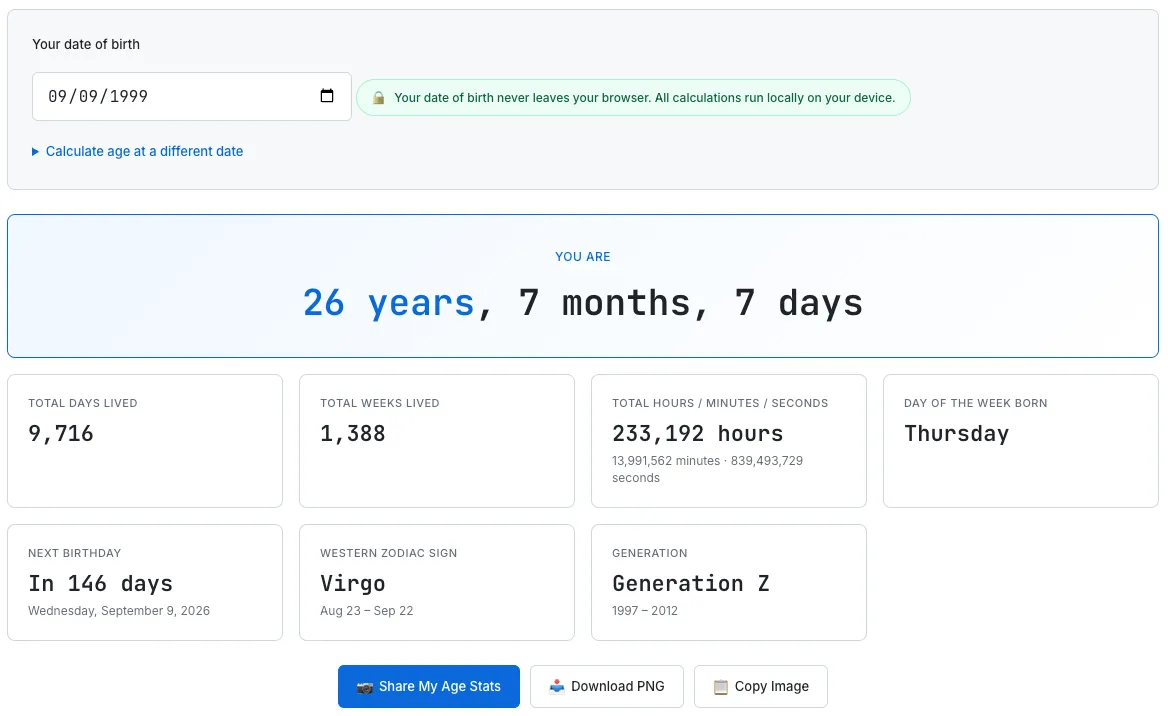
A sample run of SudoTool's Age Calculator — eight stats appear instantly when you enter a date of birth, including exact age, total days lived, zodiac, generation, the day of the week you were born, and a countdown to your next birthday. The buttons at the bottom export the result as a shareable image.
Privacy is the part I want to underline. Dates of birth are among the most sensitive personal data points in existence — they are a required field for most forms of identity theft. Our calculator has no backend. The date you type is processed in JavaScript inside your browser tab and never sent anywhere. Close the tab and the data is gone.
Common Age Calculation Mistakes (and how to avoid them)
Most age calculation bugs are not exotic. They are the same handful of mistakes repeated everywhere from spreadsheet macros to government forms. Watching out for these five will save you from almost every real-world error.
Years times 365. The first approximation everyone reaches for, and always wrong. Over 30 years you miss 7 or 8 days depending on your birthday. For anything beyond a casual estimate, compute total days directly or use an age calculator that handles leap years for you.
The birthday-day itself. A common confusion: are you 25 on your 25th birthday or the day after? The legal answer everywhere I know of is yes — the birthday is inclusive. You are 25 starting the moment your birthday begins. Some legal contexts use midnight; a few use the hour of birth. For practical purposes, the full calendar day counts.
"Will be" versus "am" near an unfallen birthday. If your birthday this year has not happened yet, you are still the age you were at the start of the year. A child born in November is still 9 in October even though they turn 10 in a month. Age calculators must compare today's date to the birth date, not just the years.
Using "age at next birthday" instead of "age now". Some insurance forms, legal documents, and government systems ask for "age at next birthday" rather than current age. A 29-year-old whose birthday is three weeks away should fill in 30, not 29. Read the label carefully and check which number the form wants before submitting — the difference can shift premiums, eligibility, or cutoffs by a full tier.
Timezone edge cases near midnight. If a date of birth is stored with a timestamp, minutes can bump it to the previous or next calendar day depending on the local timezone. The fix is to store and compare birth dates as calendar dates only, with no attached time. For coordinating dates across regions, our world clock for meeting times handles the clock side, and our guide on how time zones work covers why midnight differs by location.
Frequently Asked Questions
How do I calculate my exact age in days?
Count the number of calendar days between your date of birth and today. The calculation must account for leap years, so simple multiplication like years times 365 will always be wrong by several days over a lifetime. The accurate approach is to convert both dates to a day count (for example, the number of days since a fixed reference date) and subtract. Most age calculators do exactly this under the hood, and the result is usually displayed alongside your years, months, and days.
Can I use this to calculate a baby's age in weeks or months?
Yes. The tool shows total weeks lived alongside years, months, and days. Parents commonly use weeks for the first 3 months of a child's life, months up to age 2, then years afterwards — the calculator gives you all three views at once, which is useful for pediatric appointments and developmental milestone tracking.
How many days old will I be on my next birthday?
On any given birthday you will be a multiple of roughly 365.25 days old. The exact number depends on how many leap years fell inside your life. A person turning 30 has lived through either 7 or 8 leap days depending on their birth date, which is why the total day count for a 30th birthday is usually 10,957 or 10,958 days. An age calculator will show you the precise number for your specific date of birth.
What's the significance of being 10,000 days old?
The 10,000-day milestone falls at roughly 27 years, 4 months, and 16 days. It is not a traditional anniversary, but it has become a popular milestone on social media because the round number is memorable and the timing lands at a reflective point in early adulthood. Some people celebrate it as a personal equivalent of a birthday, and running the math with an age calculator is the easiest way to find the exact date.
Can I calculate someone else's age without knowing their exact birth time?
Yes. Age is almost always calculated from the calendar date of birth alone, not the hour or minute. Birth time only matters for astrology charts or for the rare legal edge case where two people born on the same day need to be ordered by seniority. For every practical use (school enrollment, drinking age, retirement eligibility, insurance), the date is enough.
Start Calculating Your Age the Accurate Way
Age is one of those topics that looks trivial from a distance and turns into a small rabbit hole the moment you look closely. Leap years, cultural systems, legal cutoffs, and milestone math all live inside the same question, and getting a precise answer means accounting for each of them. Run your birthday through the free age calculator once and you will have every number you might ever need, down to the day.