How Much Car Can You Afford on a $60K Salary? (The Honest 2026 Answer)
Lenders will approve $40K+ loans. Financial planners say $20K. Here's what a $60K earner can actually afford in 2026 — with the hidden costs that break most budgets.
In Q4 2025, one in five new-car buyers in the United States committed to a monthly payment of $1,000 or more — an all-time record, according to Edmunds. Even more striking: buyers earning under $100,000 per year have dropped from 50% of new-car sales in 2020 to just 37% in 2025, while buyers earning over $200,000 have grown from 18% to 29% (Cox Automotive Car Buyer Journey Study).
If your salary is $60,000 — already slightly below the median full-time worker income of $62,608 (BLS Q4 2025) — you're quietly being priced out of the new-car market. And yet the dealer still tells you a $45,000 sedan is "comfortably affordable at $700 a month."
This post walks through why that math is wrong, and what a $60K salary actually buys in 2026 — with four financial-planning rules, state-by-state take-home numbers, four real scenarios, and the hidden costs most calculators skip.
Why "Bank-Approved" Doesn't Mean "Affordable" on a $60K Salary
Lenders approve auto loans up to roughly 15–20% of your gross monthly income as a payment-to-income (PTI) ratio — on a $60K salary ($5,000 gross monthly), that's a $750–$1,000 monthly payment. Your credit DTI (debt-to-income ratio) allows even more when other debts are low. But those numbers represent the maximum the lender will extend, not what you can safely absorb.
A 22-year-old Reddit user who financed a $15,000 used car at $450/month put it plainly:
— r/personalfinance user, later describing the purchase as "the worst financial decision of my life"
The reply that resonated most on the thread was even sharper: "Just because you have money to pay for something doesn't mean you can afford it."
Here's the hard evidence that banks are not protecting buyers: the 60+ day delinquency rate on subprime auto loans hit 6.65% in October 2025 — the highest in Fitch Ratings' data going back to 1994 (Bloomberg, Nov 2025). And Cox Automotive's loan-approval rate climbed to roughly 74% in December 2025 despite rising defaults. Lenders are approving right up to the line where you fail. That line is theirs to protect, not yours.
Your Real Take-Home on $60K Depends on Your State
Most affordability advice assumes $60K gross = $5,000/month. Reality is more complicated. After federal tax, FICA, state tax, 401(k), and health insurance, monthly take-home on a $60K salary varies dramatically:
| Scenario | Annual take-home | Monthly take-home |
|---|---|---|
| Single, Texas/Florida (no state income tax) | ~$50,200 | ~$4,180 |
| Single, California | ~$43,700 | ~$3,640 |
| Single, New York | ~$47,000 | ~$3,920 |
| Married filing jointly, single earner | ~$52,000 | ~$4,330 |
After typical deductions — 5% 401(k) contribution ($250/month), health insurance premiums ($150–$250/month) — actual spendable monthly income falls into the $3,200–$3,900 range. That's the number every affordability rule should be measured against, not the gross $5,000.
Four Affordability Rules Applied to a $60K Salary
Each financial-planning rule produces a different ceiling. Here's what each says for someone earning $60K gross / ~$4,000/month take-home.
| Rule | Principle | Max vehicle price | Max monthly payment |
|---|---|---|---|
| Dave Ramsey 50% | Total vehicle value ≤ 50% annual income; pay cash | $30,000 (cash) | $0 |
| Money Guy 20/3/8 | 20% down, 3-year term, payment ≤ 8% gross monthly | $16,000–$22,000 | $400 |
| 20/4/10 (strict) | 20% down, 4-year term, all-in transport ≤ 10% gross monthly | $10,000–$15,000 | $100–$200 after other costs |
| NerdWallet 10% | Payment ≤ 10% of take-home | $20,000–$25,000 | ~$400 |
| Lender DTI max (not a rule) | Up to 45–50% total DTI | $40,000+ | $750–$1,000 |
Sources: Ramsey Solutions, The Money Guy Show, Chase 20/4/10 explainer, NerdWallet.
The honest middle ground — roughly where Money Guy's $400/month meets NerdWallet's $400/month — puts the right vehicle budget for a $60K earner at $18,000–$22,000 total, with a 48–60 month loan and a payment in the $300–$425 range. Anything beyond that requires cutting savings, emergency fund, or housing quality.
The Hidden Half: What You Actually Spend on a Car Each Month
Most affordability math fails because it stops at the loan payment. Actual monthly ownership of a $30,000 vehicle involves four more line items:
| Cost | National average monthly | 5-year total |
|---|---|---|
| Full-coverage insurance | $208 | $12,480 |
| Fuel (12,000 mi/yr, 27.2 MPG, $3.70/gal) | $136 | $8,160 |
| Maintenance, repairs, tires | $92 | $5,520 |
| Registration & fees | $17 | $1,020 |
| Non-payment total | $453 | $27,180 |
Sources: Bankrate insurance data April 2026, AAA Your Driving Costs 2025, EIA gasoline forecasts. Fuel assumes EPA 2024 combined average of 27.2 MPG.
So a "$400 car payment" is really $853/month — about 21% of a $60K earner's take-home, already twice the 10% recommended ceiling. Insurance alone swings by more than 4× between states: Wyoming averages $1,148/year, while Louisiana hits $4,481/year. Your own state is the data point that matters — a national average is just a starting point.
Four Real Scenarios: What $60K Actually Affords
Abstract rules only go so far. Here are four real profiles of $60K earners — all composites of common situations — with the concrete math.
Sarah — 28, single, renter in Austin, Texas
- Monthly take-home: $3,700 (TX no state income tax)
- Rent (1-bedroom): $1,650 + utilities/food/phone/health: $830 = $2,480 fixed
- Remaining discretionary: $1,220/month
- TX full-coverage insurance: $275/month (well above national average)
- Fuel + maintenance + registration: $225/month
Mark — 35, married (spouse at home), 2 kids, homeowner in suburban Ohio
- Monthly take-home: $3,850 (low OH state tax + MFJ standard deduction advantages)
- Mortgage PITI $1,350 + utilities/food/health: $1,370 = $2,720 fixed
- Remaining discretionary: $1,130/month
- OH insurance cheap: $155/month; fuel (family SUV) $175; maintenance $100 = $430
Priya — 26, single, San Francisco tech support role
- Monthly take-home: $3,250
- Shared rent $1,900 + utilities/food/transit pass/phone: $696 = $2,596 fixed
- Remaining discretionary: $654/month
James — 42, divorced with shared custody, Phoenix condo owner
- Monthly take-home: $3,600
- Mortgage $1,450 + student loan $325 + credit card min $150 + child support $400 + living costs $620 = $2,945 fixed
- Remaining discretionary: $655/month
- Existing debts push DTI to 38.5% before any car payment
Four different situations, one recurring pattern: the right answer is almost never the amount a lender will approve. Debts, location, insurance costs, and real take-home pay narrow the math dramatically.
The Real Answer for a $60K Earner
- Total vehicle price: $18,000–$22,000
- Loan term: 48–60 months (never 72+)
- Monthly payment: $300–$425
- All-in monthly transport cost (payment + insurance + fuel + maintenance): under $650
- Prefer a 3–5 year-old used vehicle to skip the 20% first-year depreciation hit
Push beyond this envelope — say, a $35,000 vehicle on a 72-month loan — and you're cutting one of four things: retirement contributions, emergency fund savings, housing quality, or family spending. You can tell yourself that's "affordable," but a Reddit commenter summed up the trap better:
— r/MiddleClassFinance commenter, 2026
Calculate Your Exact Number in 30 Seconds
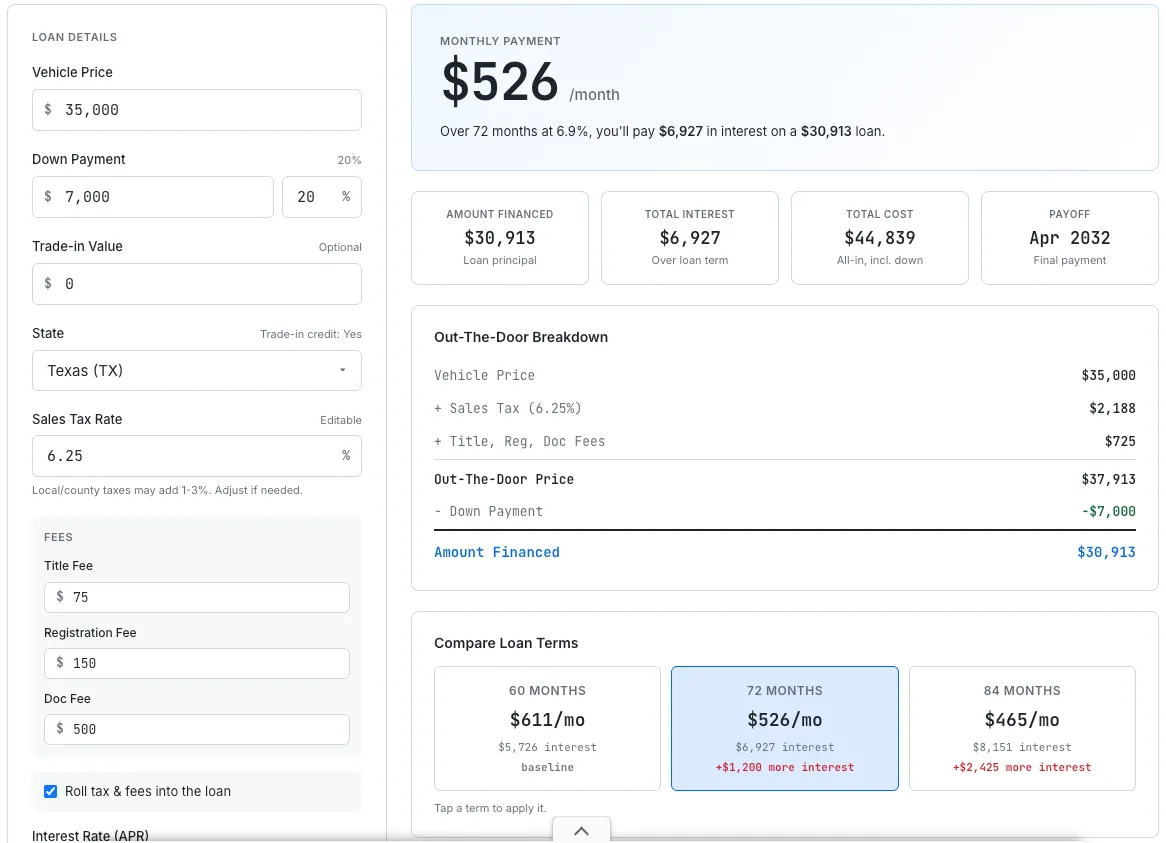
General rules are a starting point. The honest answer for you depends on your state's sales tax and trade-in rules, your credit tier's real APR, your down payment, your existing debts, and your monthly income. The free Auto Loan Calculator below plugs all of those in and shows a side-by-side comparison of 60, 72, and 84-month options — plus an affordability verdict based on the 20/4/10 rule once you enter monthly income.
For how that credit-tier rate turns into a monthly payment and total interest, see how your interest rate changes your car payment; for whether a lower rate is worth chasing, see how much 1% APR really costs.
Frequently Asked Questions
Can I afford a $40,000 car on a $60,000 salary?
Technically, most lenders will approve the loan. But the combined monthly cost — roughly $700 payment, $200 insurance, $150 fuel — eats 26%+ of a $60K earner's take-home pay, well above the 10-15% that financial planners recommend. A $20,000–$25,000 vehicle is the honest ceiling for most $60K earners.
Is the 20/4/10 rule too strict in 2026?
The rule was originally designed to be strict. What's changed is that the actual market has drifted so far from it: the average new-car payment in Q4 2025 was $767/month, and subprime auto-loan delinquencies hit a 32-year high in late 2025. The rule isn't outdated — the market is overextended.
Should I pay cash or finance a car on a $60K salary?
Most $60K earners land in the middle: put $15,000–$20,000 cash down and finance the rest over 48–60 months. Full cash usually means draining your emergency fund, which creates a worse risk than a moderate loan. The goal is a meaningful down payment (20%+) that shortens the underwater window.
New car or used car — what's better on a $60K income?
For most $60K earners, a 3-to-5-year-old used vehicle delivers the best total cost of ownership. A new car loses about 20% of its value in year one alone; a used car already has that depreciation priced in. Used auto rates run higher (around 11% vs. 6.5% new), but the lower purchase price more than offsets the rate gap.
Does this calculator store my income or loan data?
No. Every calculation runs 100% in your browser. Your salary, credit tier, state, and loan details are never sent to any server or stored in any database. When you share a scenario via URL, only the numbers you entered travel in the link — nothing else.
Bottom Line
A $60K salary in 2026 honestly affords a $20,000-ish used vehicle financed at $300–$425/month over 48–60 months. Lenders will offer you double that. Dealers will quote monthly payments without mentioning insurance or fuel. The gap between "approved" and "affordable" is where most over-extended buyers end up — and it's why subprime delinquencies are hitting 32-year highs.
The rules haven't changed. The market has stretched past them. If your calculator says "yes" to a $40K car on $60K, run the numbers including insurance, fuel, maintenance, and registration against your real take-home. The answer usually drops by 30–40%.