The Real Total Cost of a $30K Car Loan Over 5 Years (I Ran the Numbers)
$9,277 in interest. Four years underwater. $64K all-in when you add insurance, fuel, and opportunity cost. Here's the full breakdown most calculators hide.
Finance a $30,000 car at 8% APR for 84 months and you pay $9,277 in total interest — 30.9% of the principal — over 7 years. During the first 4 of those years, the car is worth less than the loan balance. In Q4 2025, 29.3% of trade-ins were underwater, with $7,214 of negative equity rolled into the next loan on average — an all-time record (Edmunds Q4 2025 Insights Report). Americans collectively owe $1.67 trillion on auto loans as of Q4 2025 (NY Fed Household Debt Report, Feb 2026).
A $30K car loan sounds small next to a $400K mortgage. This post shows why — when you include depreciation, insurance, fuel, and the opportunity cost of financing — it's anything but.
The Three Loan Terms — What Each $30K Option Really Costs
April 2026 rates from Bankrate's weekly auto loan survey. Each scenario is a new-car loan for $30,000.
| Scenario | Monthly payment | Total interest | Total paid | Interest as % of principal |
|---|---|---|---|---|
| 60 months / 7.0% APR | $594 | $5,642 | $35,642 | 18.8% |
| 72 months / 7.5% APR | $519 | $7,347 | $37,347 | 24.5% |
| 84 months / 8.0% APR | $468 | $9,277 | $39,277 | 30.9% |
Choosing 84 months over 60 months cuts the monthly payment by $126 — but costs you $3,635 more in total interest. Two reasons this gap is bigger than most buyers expect:
- Longer terms carry higher rates. Lenders charge a premium (0.5–1.0 percentage points) for the extra duration risk.
- Interest compounds over more months. Even if rates were identical, 84 months means 24 more payments of interest on a slowly-shrinking balance.
Per Edmunds, 20.8% of new-car loans in Q4 2025 were 84 months or longer — an all-time high. The market is choosing the monthly-payment-looks-smaller option, and paying thousands extra in interest for the privilege.
Depreciation — A $30K Car Is Worth $12,000 in 5 Years
According to iSeeCars' 2026 5-year depreciation study, the average new vehicle loses 41.8% of its value over 5 years. On a $30,000 starting price:
| Year | Estimated value | % of original | Year-over-year loss |
|---|---|---|---|
| 0 (new) | $30,000 | 100% | — |
| 1 | $24,000 | 80% | -20% |
| 2 | $21,000 | 70% | -10% |
| 3 | $18,000 | 60% | -10% |
| 4 | $15,000 | 50% | -10% |
| 5 | $12,000 | 40% | -10% |
The segment variation is significant:
- Electric vehicles: -57.2% in 5 years. The worst depreciators — including several Tesla and Nissan models.
- Luxury vehicles: 50-60%. Most of the top 25 worst-depreciating models are luxury badges.
- Mainstream sedans/SUVs: 40-45%. The category most $30K buyers land in.
- Pickup trucks: -34.2%. Best mass-market retention (Toyota Tacoma, Tundra).
- Hybrids: -35.4%. Second-best retention overall.
Source: iSeeCars 2026 5-Year Depreciation Study.
The Underwater Trap — How Long You Owe More Than the Car Is Worth
Overlay the depreciation curve on each loan amortization schedule (zero down payment, average-depreciation vehicle):
| Scenario | Max underwater (month 12) | Break-even month | Underwater duration |
|---|---|---|---|
| 60 months / 7% | ~$807 | month 16 | ~1.3 years |
| 72 months / 7.5% | ~$1,886 | month 28 | ~2.3 years |
| 84 months / 8% | ~$2,669 | month 48 | ~4.0 years |
An 84-month loan keeps you underwater for more than half the loan's lifetime. During that 4-year window, if anything goes wrong — a totaled vehicle, a job loss forcing a sale, a decision to trade up — you either pay the gap in cash or roll it into the next loan. Per Edmunds, drivers who rolled negative equity into their next loan carried an average payment of $916/month, compared to $772 industry-wide. A Reddit commenter captured the mechanism in a single line:
— r/DaveRamsey commenter, 2026
The Hidden Half — Owning a $30K Car Costs $25,000 More
So far, everything has been about the loan. Actually owning the car is a separate stack of bills. AAA's 2025 "Your Driving Costs" study puts average total new-vehicle ownership at $11,577/year ($964.78/month) for 15,000 annual miles.
Scaled to 12,000 miles/year with national-average rates:
| Category | Annual cost | 5-year total |
|---|---|---|
| Full-coverage insurance | $2,496 | $12,480 |
| Fuel (27.2 MPG EPA 2024 avg, $3.70/gal) | $1,632 | $8,160 |
| Maintenance, repairs, tires | $792 | $3,960 |
| Registration and fees | $189 | $945 |
| Non-loan ownership | $5,109 | $25,545 |
Sources: Bankrate April 2026 insurance averages, AAA Your Driving Costs 2025, EPA 2024 combined fuel economy.
Now combine the 84-month loan and the ownership stack:
Every 10,000 miles of driving costs about $8,700 in cash outflow for roughly $1,600 of retained residual value. That's the real shape of "owning" a financed new car.
Opportunity Cost — What You Could Have Had Instead
Here's a fairer comparison than "payment vs. payment." Put $15,000 cash into a reliable used car instead of financing a new $30K, and invest the $594/month payment difference at 7% annual return (below the historical S&P 500 average of 10.1% nominal / 7.4% real):
| Option A: Finance new $30K at 7% / 60 months | Option B: Buy used $15K cash + invest $594/mo at 7% | |
|---|---|---|
| Initial cash out | $0 | $15,000 |
| 60 months of loan payments | $35,642 | $0 |
| Investment principal contributed | $0 | $35,640 |
| Portfolio value at year 5 (7% compound) | — | $42,529 |
| Car value at year 5 | $12,000 (40% residual) | $7,500 (older used) |
| Net 5-year wealth position | −$23,642 | +$35,029 |
Difference after 5 years: $58,671. Both buyers drove cars the entire time. One is $58K richer.
Three honest caveats: (1) Option B only works if you actually invest the monthly difference rather than spending it. (2) 7% assumes long-term average market returns, not guaranteed. (3) The $15K used vehicle has to stay on the road. Even cutting the advantage in half — halving the invested amount, lowering returns to 5% — the gap remains in the $25K-$30K range over 5 years.
For the math on how compound returns work over longer horizons, see Compound Interest Explained.
To see how the interest rate alone drives that cost, see how your interest rate changes your car payment — and whether chasing a lower rate is worth it in how much 1% APR really costs.
Hidden Multipliers — How a $30K Car Becomes a $47K Total
Dealers sell $30K cars, but contracts rarely land at $30K. Every fee, tax, and add-on financed into the loan collects interest for the life of the term.
| Line item | Typical cost | Notes |
|---|---|---|
| Vehicle sticker price | $30,000 | — |
| Sales tax (6% average state) | +$1,800 | Rolled into loan in most states |
| Title & registration | +$225 | Varies by state |
| Doc fee | +$500 | Florida and Alabama can exceed $1,000; California caps at $85 |
| Dealer GAP insurance | +$600 | Your auto insurer sells the same for ~$20-100/yr |
| Extended warranty | +$3,000 | Dealer upsell; often duplicates manufacturer warranty |
| Financed total | $36,125 | — |
| 84-month interest at 8% APR | +$11,175 | Now includes tax, fees, and add-ons |
| Lifetime cost of the "$30K car" | ~$47,300 | 57% markup over sticker |
Source: fees and caps from CarEdge State of Dealer Fees 2026. A Reddit commenter described the upsell mechanism precisely:
— r/DaveRamsey commenter
Rule of thumb: never finance add-ons. GAP insurance is cheaper from your auto insurer. Extended warranties are usually redundant for the first 3 years (manufacturer warranty covers it anyway) and their claims process is restrictive. Pay for them outside the loan or decline altogether.
$400K Mortgage vs. $30K Car Loan — The Real Comparison
On absolute dollars, a $400K mortgage clearly costs more than a $30K auto loan. But the more interesting comparison is interest relative to retained asset value:
| Loan | Term | Rate | Total interest | Interest / principal |
|---|---|---|---|---|
| $400K mortgage | 30 years | 7.0% | $558,036 | 139.5% |
| $30K car loan (60 mo) | 5 years | 7.0% | $5,642 | 18.8% |
| $30K car loan (84 mo) | 7 years | 8.0% | $9,277 | 30.9% |
The mortgage looks vicious on percentage terms. But consider what the money buys:
- $400K mortgage: 30 years of interest, but the house typically appreciates 2–4× over that window. Net: paying interest on an asset that grows.
- $30K 84-month car loan: $9,277 in interest on a car worth $12,000 at payoff. The interest alone is 77% of the car's remaining value. Net: paying interest on an asset that shrinks.
For the full 30-year mortgage breakdown, see I Ran the Numbers on a $400K Mortgage. The math is painful — but it ends with a standing house. Car loans don't.
Practical Guide — How to Avoid the $47K Trap
None of this means car ownership is always wrong. But the structural defaults of modern auto financing — long terms, rolled fees, dealer GAP, extended warranties, negative equity carryover — work against the buyer. Seven specific moves push the math back toward sane:
- Negotiate out-the-door price first, not monthly payment. If the salesperson asks "what monthly payment works for you?" redirect to "what's the OTD price?"
- Secure external pre-approval from a bank or credit union before stepping into a dealership. Dealer financing frequently includes a rate markup (the "reserve") that your bank won't charge.
- Cap loan term at 60 months. 72 and 84 are almost always net losses mathematically. If the 60-month payment is too high, lower the vehicle price — not the term.
- Put at least 20% down to shorten the underwater window by 6–10 months.
- Buy GAP and extended warranty (if at all) outside the loan. Never finance an add-on — the interest doubles the effective price.
- Refuse to roll negative equity from a trade-in into the new loan. That single move is the cleanest way to prevent the debt spiral.
- Run your own numbers for your state, credit tier, and down payment — not just the average.
Frequently Asked Questions
How much interest do you pay on a $30,000 car loan for 5 years?
At the April 2026 average 60-month rate of 7.0% APR, a $30,000 loan costs about $594/month and $5,642 in total interest ($35,642 total paid). Stretching to 72 months at 7.5% drops the payment to about $519/month but raises total interest to $7,347. An 84-month 8% APR loan costs $9,277 in interest — 30.9% of the principal.
How much more expensive is a 72-month auto loan compared to 60 months?
On a $30,000 loan, choosing 72 months (7.5% APR) over 60 months (7.0% APR) adds about $1,705 in total interest. The monthly payment drops by about $75, but you stay underwater — owing more than the car is worth — for roughly 2.3 years instead of 1.3 years.
When is it worth refinancing an auto loan?
Refinancing makes sense when your remaining interest savings comfortably exceed the $200–$500 in typical refi fees. For most $30,000 loans, that's during the first 30–40% of the term if rates have dropped 1%+. On an 84-month loan, refinancing stops being worthwhile past roughly month 60 because the remaining balance is too small to generate meaningful savings.
How do I get a $30K car payment under $400/month?
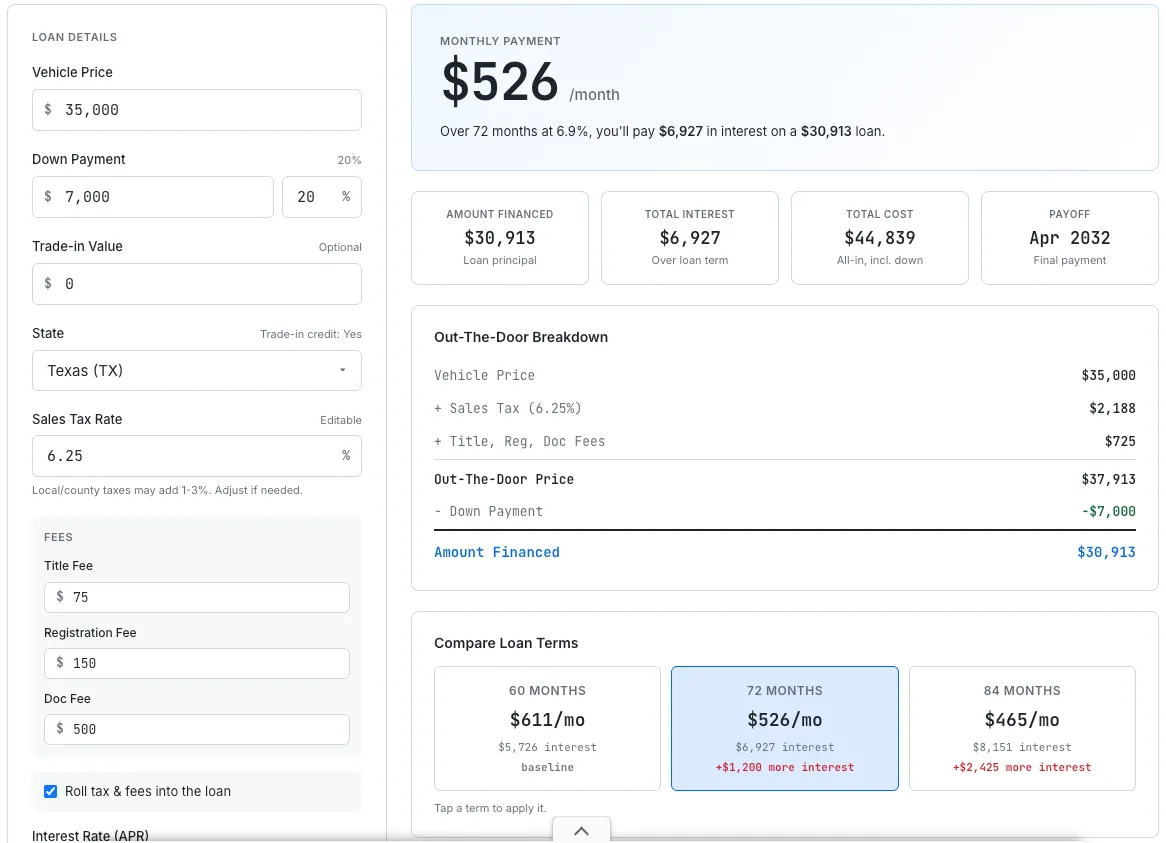
Two options: (1) 84-month loan at 8% = about $468/month ($9,277 total interest), or (2) reduce the vehicle price to $25,000 with a 60-month term = about $495/month ($4,702 total interest). Option 2 saves over $4,500 in interest for just $27 more per month. Lower price beats longer term in almost every scenario.
Does this calculator handle trade-in negative equity?
Yes. When your trade-in's remaining loan balance exceeds its value, the calculator automatically detects it and adds the shortfall to your new loan principal with a warning. It also applies the correct 2026 sales tax and trade-in credit rules for all 50 US states plus DC — including the 7 states that don't allow a trade-in sales tax credit.
Bottom Line
A $30K car loan isn't small. On an 84-month 8% APR loan, you pay $9,277 in interest — 30.9% of the principal — while the car loses 60% of its value. Add sales tax, fees, GAP, and an extended warranty financed into the loan, and the "$30K car" becomes a $47,000 lifetime cost. Add insurance, fuel, and maintenance, and the 5-year total cash outlay hits ~$64,900.
The defaults in modern auto financing — longer terms, financed fees, rolled negative equity — all favor the dealer and the lender. The math isn't subtle. Shortening the loan term, capping the vehicle price, and keeping add-ons out of the financing does most of the work.