Understanding Unit Conversion: The Complete Guide to Metric and Imperial Systems
Why two measurement systems exist, how they differ, and how to convert between them — with real-world disaster stories, mental math tricks, and a complete reference chart.
In 1999, NASA's Mars Climate Orbiter was destroyed as it entered the Martian atmosphere. The cause was simple: Lockheed Martin's ground software produced thrust data in pound-force seconds, while NASA's navigation system expected newton-seconds. A factor-of-4.45 mismatch. The total mission cost — $327.6 million — was lost because of a unit conversion error. Guinness World Records lists it as the most expensive metric-imperial conversion error in history.
Unit conversion is not a dull math exercise from school. In the real world, it costs money, endangers patients, and destroys spacecraft. This guide covers why the metric and imperial systems exist, how they differ, and how to convert between them quickly and accurately.
A Brief History of Measurement
Humanity's first measuring tools were body parts. The ancient Egyptian cubit was the distance from the elbow to the tip of the middle finger. The foot was, literally, the length of a foot. The problem was that everyone's arms and feet were different sizes.
Medieval Europe made things worse. In 1324, England's King Edward II formally defined one inch as three barleycorns laid end to end. Since actual barleycorns vary significantly in size, this was inherently imprecise. Remarkably, British and American shoe sizes are still based on barleycorn increments today.
By 1789, pre-revolutionary France had approximately 800 different units of measurement in use. Since the same unit name could mean different quantities in different towns, local definitions numbered an estimated 250,000 across the country, according to National Geographic. Commerce was chaos.
In 1790, the French National Assembly tasked the French Academy of Sciences with creating a universal measurement standard. Astronomers Jean-Baptiste Delambre and Pierre Mechain spent six years (1792–1798) surveying the meridian arc from Dunkirk to Barcelona. The result: one meter, defined as one ten-millionth of the distance from the North Pole to the Equator. In 1795, the metric system was legally adopted in France.
Curiously, Napoleon reportedly dismissed the metric system as "tormenting the people with trivia." In 1812, he revoked it and introduced a hybrid system. France did not fully re-impose the metric system until 1840, after his empire collapsed.
The metric system then spread globally. In 1875, 17 nations — including the United States — signed the Treaty of the Metre, establishing the International Bureau of Weights and Measures (BIPM). In 1960, the 11th General Conference on Weights and Measures formalized the modern International System of Units (SI). The most recent milestone came in 2019, when the kilogram — previously defined by a physical platinum-iridium cylinder stored in a Paris vault — was redefined using the Planck constant (6.62607015 × 10⁻³⁴ J·s). A fundamental constant of the universe, not a human artifact.
Metric vs Imperial — Key Differences
The fundamental difference is design philosophy.
The metric system is decimal. Every unit connects to the next by powers of 10. One kilometer = 1,000 meters. One meter = 100 centimeters. One centimeter = 10 millimeters. If you know the prefixes, you never need to memorize conversion factors — kilo always means 1,000, centi always means 1/100, milli always means 1/1,000.
The imperial system is built on historical relationships. One foot = 12 inches. One yard = 3 feet. One mile = 5,280 feet. There is no consistent pattern. Weight is the same — 1 pound = 16 ounces, 1 stone = 14 pounds, 1 ton = 2,000 pounds (US) or 2,240 pounds (UK). Each relationship must be memorized individually.
The metric advantage is clear: conversions are just decimal point shifts. The imperial system's one practical strength is that certain fractions work out neatly — 1/3 of a foot is exactly 4 inches, while 1/3 of a meter is 33.333... centimeters. But this minor convenience doesn't justify the system's overall inconsistency.
Who Uses What — And Why It's Complicated
About 95% of the world's population lives in countries where the metric system is the official standard. Only three countries have not mandated full everyday metric conversion: the United States, Myanmar, and Liberia. Myanmar announced its intention to adopt metric in 2013, and Liberia followed in 2018. As NIST points out, all countries — including the US — have recognized and adopted the SI system; the distinction is about mandatory daily use versus voluntary adoption.
But "official adoption" doesn't always mean "everyday use."
The United Kingdom formally committed to metrication in 1965 and completed its official partial transition in 1995. Yet road signs still show miles and yards. Beer is sold in pints. People state their weight in stones and pounds. Meanwhile, petrol stations sell fuel in liters, groceries are weighed in grams and kilograms, and science and medicine use metric exclusively. According to YouGov polling, the British public freely mixes both systems in daily life — one of the most complex measurement cultures in the world.
The United States appears to reject metric entirely, but that's not quite true. Scientific research is conducted exclusively in metric. The military uses metric extensively for NATO interoperability. Drug prescriptions are in milligrams and milliliters. Wine and spirits have been sold in metric-only containers since around 1980. Electrical units — watts, volts, amperes — are metric worldwide, the US included. Under the Mendenhall Order of 1893, all US customary units have been defined in terms of SI — 1 inch is exactly 2.54 centimeters, by definition.
There are cultural curiosities elsewhere too. In Japan, real estate listings commonly use the traditional unit tsubo (approximately 3.3 m²), even though metric has been official since 1966. The Japanese unit momme remains the industry standard worldwide for weighing pearls and silk.
When Getting Units Wrong Really Matters
Unit conversion mistakes are not just inconvenient. They are genuinely dangerous.
NASA Mars Climate Orbiter (1999). Lockheed Martin's ground software output thrust data in pound-force seconds, but NASA's navigation system expected newton-seconds. This 4.45× discrepancy accumulated over months of flight, sending the spacecraft approximately 100 km too close to Mars. It entered the atmosphere and was destroyed. The total mission cost — spacecraft development, launch, and operations — was $327.6 million.
Air Canada Flight 143, the "Gimli Glider" (1983). This Boeing 767 was Air Canada's first metric-configured aircraft, introduced during Canada's metric transition. The fuel quantity gauges were inoperative, so ground crew measured fuel manually using a dipstick. They converted the reading using a factor of 1.77 pounds per liter instead of the correct 0.80 kilograms per liter. The result: the aircraft carried roughly 10,100 kg of fuel instead of the required 22,300 kg — less than half. At 41,000 feet, both engines flamed out. Captain Robert Pearson, an experienced glider pilot, deadstick-landed the 767 at a decommissioned RCAF base in Gimli, Manitoba. All 69 people on board survived; 10 sustained minor injuries.
Medication errors. Between 2002 and 2012, an average of 63,358 out-of-hospital medication errors per year in the United States were related to measurement confusion, with an 84% increase in errors caused by "confused units of measure" over that period, according to a study reported by Modern Healthcare. Confusing pounds with kilograms when entering a patient's weight can result in medication doses calculated for a person more than twice their actual size. The American Academy of Pediatrics now recommends that all liquid medicine prescriptions use milliliters only — never teaspoons or tablespoons.
Cooking. Follow a British recipe using American measuring cups, and every ingredient will be about 20% short. A US cup is 236 mL, but a UK cup is 284 mL. A US pint is 473 mL; a UK pint is 568 mL. Same word, different quantity.
Common Conversions You'll Actually Use
Below are the most frequently searched conversion factors. All values are from NIST. Those marked "exact" are defined values, not approximations.
Length: 1 inch = 2.54 cm (exact) · 1 foot = 0.3048 m (exact) · 1 yard = 0.9144 m (exact) · 1 mile = 1.609344 km (exact)
Weight: 1 ounce = 28.3495 g · 1 pound = 0.45359237 kg (exact, by the 1959 international agreement between the US, UK, Canada, Australia, New Zealand, and South Africa) · 1 stone = 6.35029 kg
Volume: 1 US fluid ounce = 29.5735 mL · 1 US cup = 236.588 mL · 1 US pint = 473.176 mL · 1 US gallon = 3.78541 L (exact) · 1 UK pint = 568.261 mL
Temperature: °F = (°C × 1.8) + 32 · Key reference points: 0°C = 32°F (freezing), 20°C = 68°F (room temperature), 37°C = 98.6°F (body temperature), 100°C = 212°F (boiling water)
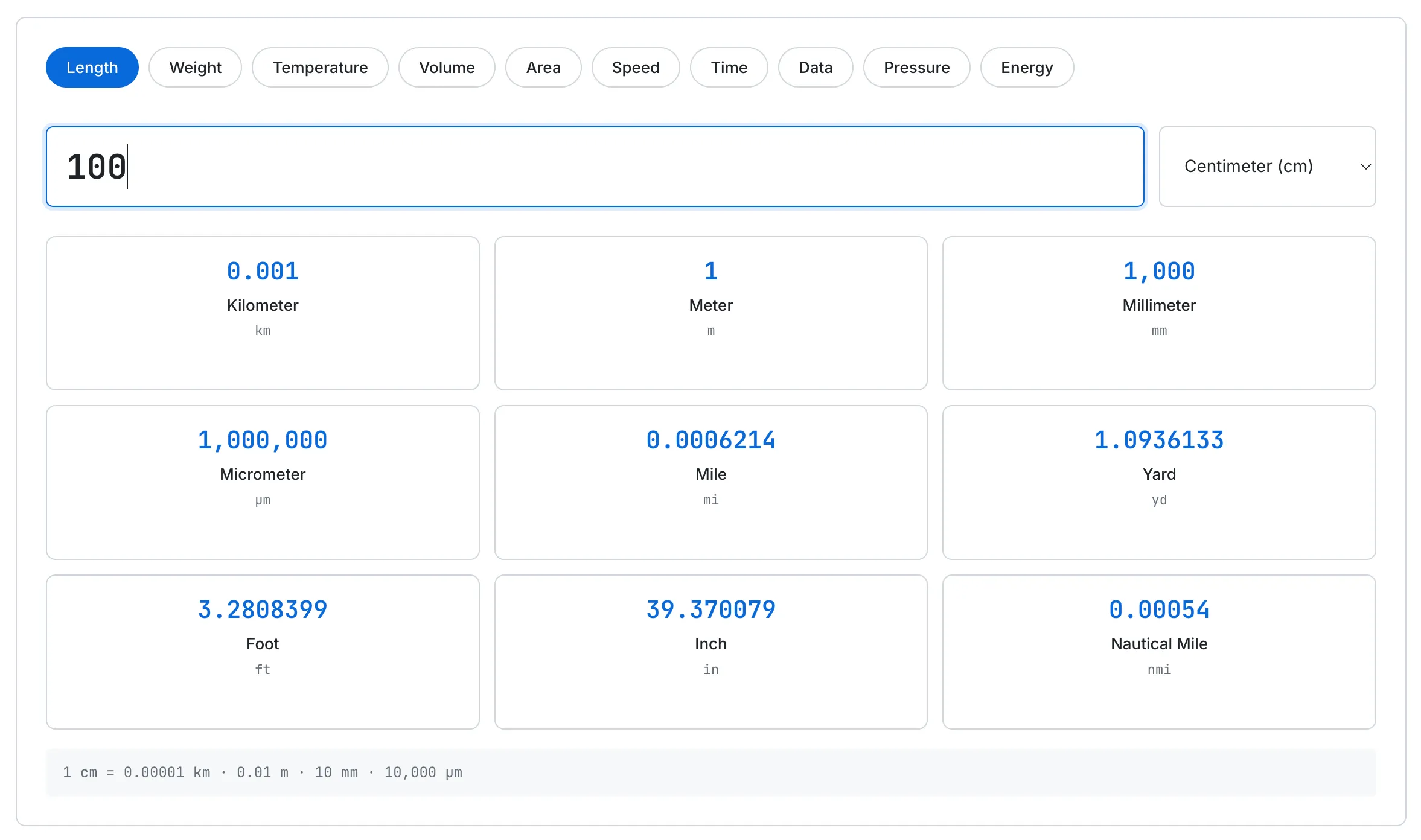
Rather than looking up conversions one at a time, SudoTool's Unit Converter shows every result at once.
Mental Math Tricks for Quick Conversions
You don't always need a calculator. These tricks get you close enough for everyday situations.
Kilometers to miles: the Fibonacci trick. The ratio of consecutive Fibonacci numbers (1, 1, 2, 3, 5, 8, 13, 21, 34, 55, 89, 144...) approaches approximately 1.618 — within about 0.5% of the actual miles-to-kilometers factor (1.609344). So for any Fibonacci number of kilometers, the previous Fibonacci number is approximately the equivalent in miles. 8 km ≈ 5 miles. 13 km ≈ 8 miles. 21 km ≈ 13 miles. For non-Fibonacci numbers, decompose into Fibonacci sums: 100 km = 89 + 8 + 3 → 55 + 5 + 2 = 62 miles (actual: 62.1 miles).
Kilograms to pounds: "double it and add 10%." Multiply the kg value by 2, then add 10% of the result. Mathematically, that's 2x + 0.2x = 2.2x — and the actual conversion factor is 2.20462. The error is about 0.2%. Example: 70 kg → 140 + 14 = 154 lbs (actual: 154.32 lbs).
Celsius to Fahrenheit: "double it and add 30." This works well in the everyday temperature range of 5–20°C, where the error stays within 0–2°F. It becomes less accurate above 25°C.
0°C → 30°F (actual 32°F, error 2°F) · 10°C → 50°F (actual 50°F, error 0°F) · 20°C → 70°F (actual 68°F, error 2°F) · 30°C → 90°F (actual 86°F, error 4°F)
Temperature intuition guide. If you're not used to Celsius, remember this: "At 0 it's freezing, at 10 it's not, at 20 it's warm, and at 30 it's hot."
Understanding Metric Prefixes
The real power of the metric system lies in its prefix system. A single base unit — meter, gram, or liter — combined with a prefix expresses any magnitude.
Common prefixes: tera (T, 10¹², one trillion) · giga (G, 10⁹, one billion) · mega (M, 10⁶, one million) · kilo (k, 10³, one thousand) · hecto (h, 10², one hundred) · deca (da, 10¹, ten) · base unit · deci (d, 10⁻¹, one tenth) · centi (c, 10⁻², one hundredth) · milli (m, 10⁻³, one thousandth) · micro (μ, 10⁻⁶, one millionth) · nano (n, 10⁻⁹, one billionth)
A popular English-language mnemonic for the everyday prefixes: "King Henry Died By Drinking Chocolate Milk" — Kilo, Hecto, Deca, Base, Deci, Centi, Milli.
Frequently Asked Questions
What is the difference between the metric and imperial system?
The metric system is a decimal-based measurement system using meters, grams, and liters, where units scale by powers of 10. The imperial system uses feet, pounds, and gallons with inconsistent conversion factors — 12 inches in a foot, 3 feet in a yard, 5,280 feet in a mile. Over 190 countries officially use the metric system.
Why does the United States still use the imperial system?
The US inherited British measurement units before independence. By the time the metric system gained global popularity, American industry, infrastructure, and manufacturing were built around imperial units. The Metric Conversion Act of 1975 made metric the "preferred system" for trade and commerce but kept adoption voluntary. In 1982, President Reagan defunded the US Metric Board that was coordinating the transition. No mandatory conversion legislation has advanced since.
How many countries use the metric system?
Over 190 countries officially use the metric system. Only three — the United States, Liberia, and Myanmar — have not mandated full everyday conversion. However, even these countries use metric in scientific, military, and medical contexts. The UK and Canada officially use metric but retain imperial units for certain everyday purposes like road signs and beer.
Is the metric system more accurate than imperial?
Neither system is inherently more accurate — both can achieve the same precision with proper tools. However, the metric system's decimal base makes conversions far less error-prone. Converting within metric only requires moving a decimal point. Imperial conversions require memorizing irregular ratios, which increases the chance of mistakes — as the NASA Mars Climate Orbiter incident proved at a cost of $327.6 million.
What happened when NASA mixed up metric and imperial units?
In 1999, Lockheed Martin's software output thrust data in pound-force seconds (imperial), but NASA's navigation system expected newton-seconds (metric). The 4.45× mismatch accumulated over months, sending the Mars Climate Orbiter approximately 100 km too close to Mars, where it burned up in the atmosphere. The total mission cost was $327.6 million.
How do you quickly convert Celsius to Fahrenheit?
For a quick estimate, double the Celsius temperature and add 30. Example: 25°C → (25 × 2) + 30 = 80°F (actual: 77°F). This is accurate within 2–3°F in the 5–20°C range. For the exact value, use the formula: °F = (°C × 1.8) + 32. Key landmarks: 0°C = 32°F (freezing), 37°C = 98.6°F (body temperature), 100°C = 212°F (boiling).
Does the United Kingdom use metric or imperial?
Both. The UK officially adopted metric in 1995 but uses a hybrid system in daily life. Road signs show miles. Beer is sold in pints. Body weight is often stated in stones and pounds. Yet science, medicine, food labeling, and commerce all use metric. Fuel is sold in liters, but fuel economy is measured in miles per gallon — a uniquely British contradiction.
How many kilometers are in a mile?
One mile equals exactly 1.609344 kilometers. To convert miles to kilometers, multiply by 1.609. To convert kilometers to miles, multiply by 0.621. A quick mental shortcut: miles are about 60% longer than kilometers. So 10 miles ≈ 16 km, and 100 km ≈ 62 miles.
Making Unit Conversion Easy
Measurement systems are not just number schemes. They are legacies of history, culture, and politics. The metric system was born from the French Revolution's pursuit of rational order. The imperial system traces back to medieval barleycorns and a king's foot. Over 200 years later, both still coexist — and still cause confusion.
But different systems don't have to mean difficult conversions. A few key conversion factors and a couple of mental math tricks handle most everyday situations. And when you need precise values, there's a tool that shows every conversion at once — no repeated searches required.
For a look at how we designed the converter and why it works differently from other tools, read Why I Built a Unit Converter When Google Already Has One. And if you're interested in a related challenge — converting between currencies rather than units — check out our guide to Understanding Exchange Rates.