Is a Credit Card Annual Fee Worth It? The Break-Even Math
An annual fee is not a verdict on the card. It is one side of a subtraction problem, and the other side is how much you actually spend.
Card issuers describe an annual fee as the price of the perks. That framing quietly skips the only question that matters: whether the card gives you back more than it takes. Is a credit card annual fee worth it? The answer comes down to a single number — the amount you have to put through the card each year before the rewards catch up to the fee. That number is easy to calculate, and it is often much larger than people expect.
Is a credit card annual fee worth it? Start with one number
The whole decision collapses into one formula:
Break-even spend = annual fee ÷ (fee card's earn rate − no-fee card's earn rate)
The trap is in the denominator. Most people compare the annual fee to the card's total rewards, which makes almost any card look like a winner. But you were never choosing between this card and nothing — you were choosing between this card and the no-fee card you would otherwise carry. What matters is the difference in earn rates, not the headline rate.
A card advertising 3% back sounds like it earns three times as much as a plain card. If your realistic alternative is a no-fee 2% card, the actual edge is one percentage point, and every dollar of the fee has to be recovered one cent at a time.
| Annual fee | +0.5 pt edge | +1 pt edge | +1.5 pt edge | +2 pt edge |
|---|---|---|---|---|
| $95 | $19,000 | $9,500 | $6,333 | $4,750 |
| $127 (U.S. average) | $25,400 | $12,700 | $8,467 | $6,350 |
| $250 | $50,000 | $25,000 | $16,667 | $12,500 |
| $550 | $110,000 | $55,000 | $36,667 | $27,500 |
| $795 | $159,000 | $79,500 | $53,000 | $39,750 |
Read a row and then look honestly at your own spending. A $550 fee with a one-point edge needs $55,000 a year routed through that single card before it breaks even. That is not a rewards strategy for most households; that is a small business's expense budget.
Why the "+2 points" column is mostly fantasy
The right-hand columns of that table are the flattering ones, and they are also the least realistic. In its December 2025 report to Congress, the Consumer Financial Protection Bureau measured what rewards cards actually pay out across the market: rewards earned as a share of purchase volume "has remained steady with a slight increase from 1.4 percent to its most recent level of 1.6 percent." Across the whole market, cardholders earned $47.5 billion in rewards in 2024 — on an average earn rate of about 1.6 cents per dollar.
Now hold that against the fact that no-fee 2% cash back cards are widely available. A fee card that beats a good free card by two full points on everything you buy is close to nonexistent. What premium cards actually offer is a large edge in narrow categories — travel booked through a portal, restaurants, groceries, a specific airline.
That changes how you should run the calculation. A card paying 5x on flights is worth exactly nothing extra if you fly once a year. If you spend $2,000 annually on flights, a 3-point edge in that category is worth $60 — not the several hundred dollars implied by the marketing.
So do the arithmetic category by category. Pull your last twelve months of statements, find your real spending in each category the card rewards, multiply each by the edge over your no-fee baseline, and add it up. Using advertised rates against your total spending will overstate the benefit almost every time.
Statement credits cut the fee, not the math
Premium cards increasingly bundle statement credits — travel credits, food delivery credits, streaming or rideshare credits. These are not rewards, and treating them as rewards will scramble your calculation. Handle them as a discount on the fee:
Effective fee = annual fee − credits you would have spent anyway
Everything hinges on that last phrase. A credit only saves you money if it reimburses spending you were going to do regardless. Manufacturing a purchase to "use up" a credit is spending, not saving — and issuers design credits knowing that a meaningful share go partly unused.
| Credits you'd genuinely use | Effective annual fee | Break-even spend at +1 pt |
|---|---|---|
| $0 | $550 | $55,000 |
| $100 | $450 | $45,000 |
| $300 | $250 | $25,000 |
| $500 | $50 | $5,000 |
The table shows why two people can hold the identical card and reach opposite conclusions, both correctly. A frequent traveler who uses every credit faces a $50 effective fee. Someone who books one trip a year faces something close to the sticker price. The card did not change — the usage did.
Year one is a trap — judge the card on year two
Welcome bonuses distort everything. A sign-up bonus can be worth several years of annual fees collected in a single lump, which means almost any fee card clears its break-even in year one. That tells you nothing about whether you should still be paying for it in year three.
The fix is simple: run the break-even calculation with the bonus removed. If the card still comes out ahead on your ordinary spending, it is genuinely worth keeping. If it only worked because of the bonus, it was a one-year product and should be treated as one.
This matters more than it used to, because the fees themselves are climbing. The CFPB found that the average annual fee "has increased by 21 percent since 2022, from $105 to $127," driven by premium cards, while only about 16 percent of accounts carry a fee at all. Total annual fees charged hit $8.7 billion in 2024, the highest level in the Bureau's data. Fewer people are paying annual fees, and the ones who do are paying more — so a card that penciled out three years ago may not survive its next fee increase.
If you carry a balance, the fee isn't your problem
Everything above assumes you pay in full every month. Roughly half of cardholders do not. The CFPB reports that "the revolve rate on general purpose cards hovered between 49 and 50 percent in 2023 and 2024," and its Making Ends Meet survey found 49 percent of consumers with credit cards revolved a balance in 2024.
For those cardholders the rewards math stops being relevant, because interest is an order of magnitude larger. Average APR on general purpose cards reached 25.2 percent in 2024, the highest in the Bureau's series, and new accounts opened that year averaged 27.5 percent.
Put numbers on it. Carrying a $2,000 balance at 25.2% costs about $504 a year in interest. To offset that with rewards at the market-average 1.6% earn rate, you would need to run $31,500 a year through the card. Meanwhile, a household spending $2,000 a month on the card earns roughly $384 in rewards for the year — less than the interest on a balance a quarter of that size.
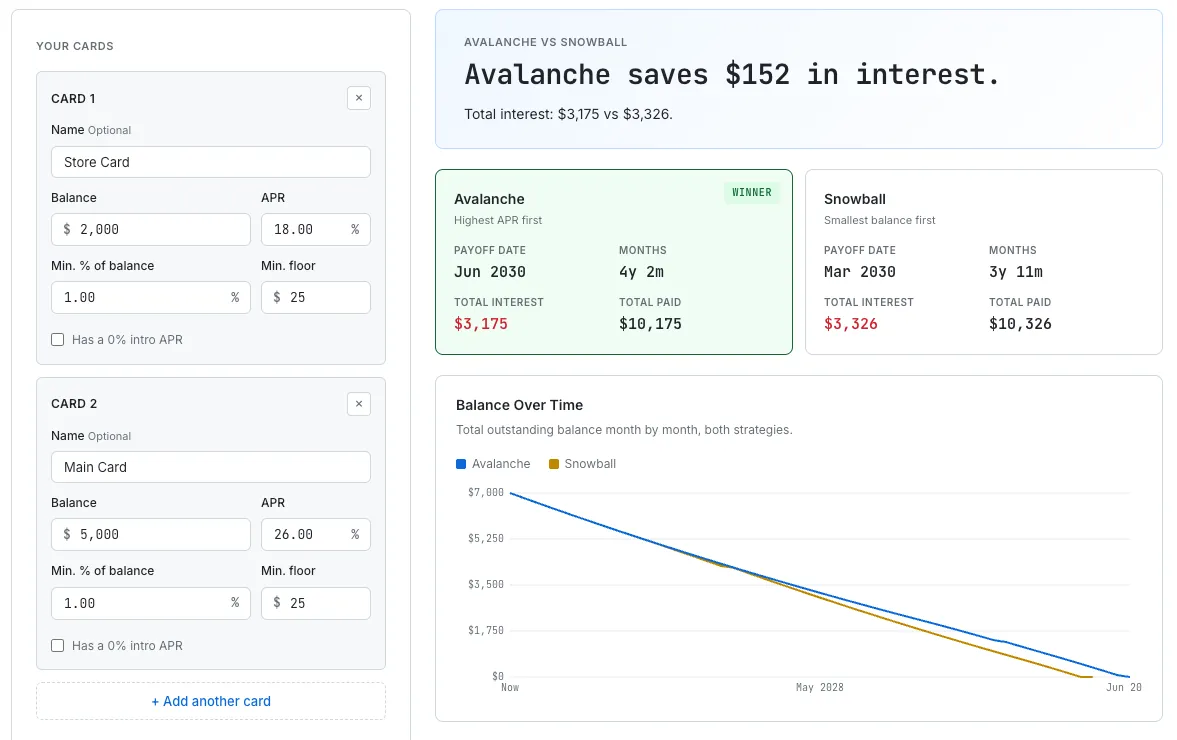
That is the honest hierarchy. A half-point difference in earn rate is a rounding error next to a 25% interest rate, and an annual fee on top of a revolving balance guarantees you start every year underwater. If that describes your situation, the rewards question can wait — how minimum payments stretch a balance for years and whether a balance transfer fee is worth paying are the far more valuable calculations.
Run your own number in five steps
Fifteen minutes with your statements settles the question for any card you hold:
- 1. Pull your real annual spending, by category. Most issuers publish a year-end summary that breaks it out for you. Use last year's actual numbers, not what you think you spend.
- 2. Calculate your no-fee baseline. Work out what a solid free card would have paid on that same spending. This is the number the fee card has to beat.
- 3. Calculate the fee card's earnings on your mix. Apply each category rate to your real spending in that category — not the advertised headline rate to your total.
- 4. Subtract only the credits you would have used anyway. That gives you the effective fee.
- 5. Compare, with the welcome bonus removed. If step 3 minus step 2 beats the effective fee, keep the card. If not, it is costing you money to hold.
If the answer is "not worth it," cancelling is not automatically the best move. Closing an account removes its age and its credit limit from your profile, which can nudge your utilization ratio the wrong way — see what actually moves a credit score for how much that matters. Ask the issuer about a product change to a no-fee card on the same account first; it usually preserves the account history while ending the fee.
Frequently Asked Questions
How much do you need to spend to justify a $95 annual fee?
Divide the fee by how much more the card earns per dollar than a no-fee card. If it earns one percentage point more, a $95 fee needs about $9,500 of annual spending on that card to break even. If it earns two points more, about $4,750. Compare against the no-fee card you would otherwise carry, not against zero.
Is a credit card annual fee worth it if you pay your balance in full?
That is the only case where the break-even math is meaningful. If you never carry a balance you pay no interest, so the comparison is purely rewards and credits against the fee. If you do carry a balance, interest at current average rates dwarfs any rewards difference and the fee becomes the smaller problem.
Do statement credits count as rewards?
Treat them as a discount on the fee rather than as rewards, and count only the ones you would have spent money on anyway. A $300 travel credit turns a $550 fee into an effective $250 fee if you genuinely travel. If you spend money you would not otherwise spend just to use a credit, it is not a saving.
Should you cancel a card with an annual fee you do not use?
Before cancelling, ask the issuer whether you can switch to a no-fee card on the same account. A product change usually keeps the account's age and credit limit, both of which closing would remove from your credit profile. If no downgrade is offered, weigh the fee against the effect on your utilization and account history.
Does a sign-up bonus make an annual fee worth it?
Usually for the first year only. A welcome bonus can cover several years of fees at once, which makes almost any card look like a good deal in year one. Run the break-even calculation again with the bonus removed to see whether the card still earns its keep in year two and beyond.
Bottom line
An annual fee is worth paying when the card beats your free alternative by more than the fee costs — and that comparison is arithmetic, not a matter of opinion about the perks. Divide the fee by the earn-rate edge, check the answer against what you genuinely spend, treat credits as a discount rather than a bonus, and re-run the whole thing without the welcome offer before year two arrives. If a balance is rolling over each month, none of it applies yet: clear the interest first, because at 25% APR no rewards program is going to out-earn it.
Sources: Consumer Financial Protection Bureau — The Consumer Credit Card Market: Report to Congress (December 2025): average annual fee $105 to $127 since 2022, $8.7 billion in total annual fees in 2024, 16% of accounts charging a fee, rewards earn rate of 1.6% of purchase volume, $47.5 billion in rewards earned in 2024, average APR of 25.2% on general purpose cards, and a 49–50% revolve rate · CFPB — Making Ends Meet in 2024: 49% of consumers with credit cards revolved a balance in 2024. All break-even figures in this article are calculated from the formula shown and independently verified.